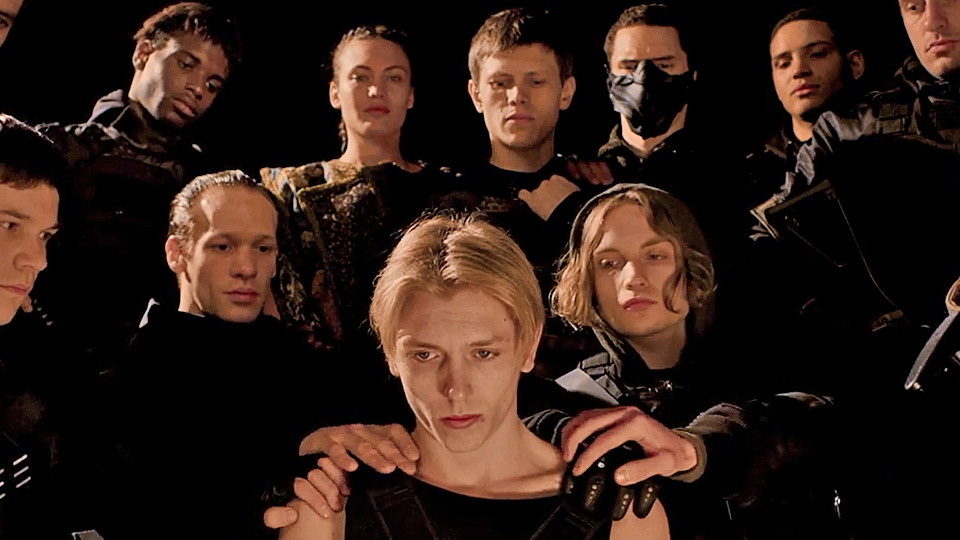
Shudder’s latest premiere, the French film Jessica
Forever, offers a scifi antidote to war films. This is a quietly absorbing genre
piece concerned with the lives left to those who know nothing more than
fighting for survival, those who must endure not only what battle has done to
them, but what battle has encouraged them to do.
In an unnamed future, Jessica (Aomi Muyock, Love),
collects and rehabilitates “orphans” — feral young men with nothing and no one.
Left entirely on their own, they wreak bloody havoc on society and are hunted
by government-controlled drones.
We open on one such young man, Kevin (Eddy Suiveng). He’s thrown himself through a pane of glass in what looks to be a recently abandoned home. As a heavily armed tactical unit descends on the premises, only to softly embrace the combatant, writers/directors Caroline Poggi and Jonathan Vinel introduce the visual and tonal fluidity the film will emphasize throughout its running time.
The dystopian cinematic landscape is highly populated, but Jessica
Forever manages to carve out a unique space.
Muyock’s enigmatic central figure, so quietly effecting,
provides the film its compelling center of gravity. Around her orbits a loose family
of young men, and as Poggi and Vinel weave in and out of their day-to-day, we’re
tuned into the filmmakers’ primary interest.
Unlike so very many movies out there, it is not the glamour
or danger of war that attracts these filmmakers. Instead, Jessica Forever
focuses on the mental and emotional wreckage these young men carry around with
them as they cling to each other and their varying ideas of family, home and
normalcy.
Everything about the design of this low budget scifi poem is
astonishing. Working with cinematographer Marine Atlan, who shot the pair’s short
After School Knife Fight, Poggi and Vinel create and sustain a hypnotic
mood.
An absurd beauty to some of the shots helps the filmmakers offset its deliberate pacing. The entire crew, sound design in particular, pulls their weight as well, and the cumulative effect moves this lightly plotted ensemble piece in daring directions.
It’s Christmas, and regardless of a profound, almost
insurmountable family tragedy, one irredeemably oblivious father (Richard
Armitage) decides his kids (Jaeden Martell and Lia McHugh) should get to know
the woman (Riley Keough) he left their mother for. A week in an isolated mountain
cabin during a blizzard should do it.
Dad stays just long enough to make things really
uncomfortable, then heads back to town for a few days to work. Surely everybody
will be caroling and toasting marshmallows by the time he returns.
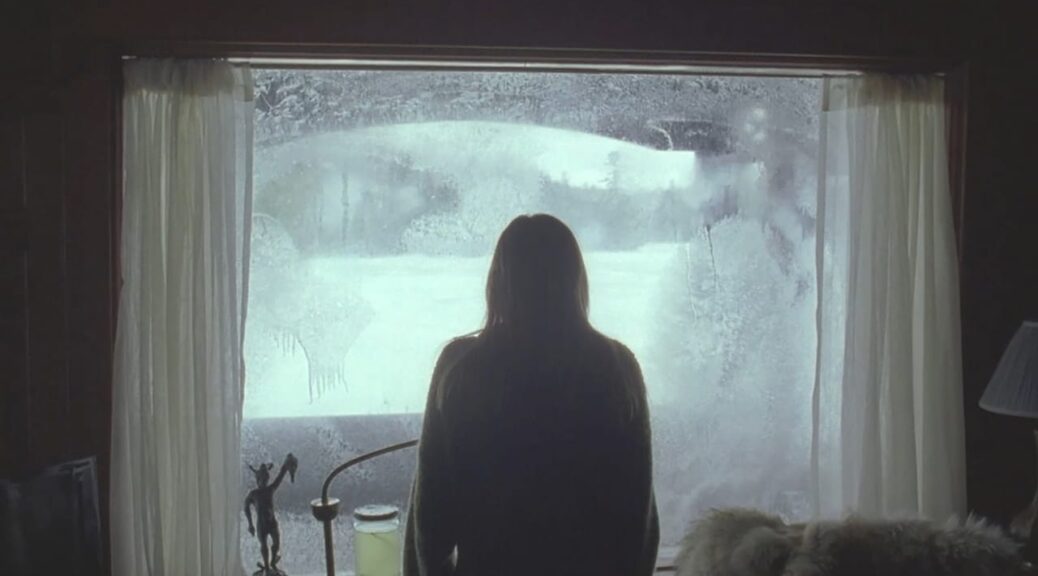
Though everything about The Lodge brings to mind A24 horror—for a number of reasons, Hereditary in particular—the film is actually a Hammer effort. No longer the corset-and-bloodletting studio, Hammer’s millennial output has been sparse but often quite good.
Choosing to back filmmakers Severin Fiala and Veronika Franz making their follow up to the supremely creepy Goodnight Mommy should be a solid risk to take. Here the pair does not shy away from the body of “white death” horror that came before The Lodge, with eerie and sometimes humorous nods to The Thing and The Shining, among others, haunting the piece.
The film also brings to mind A24’s It Comes at Night, another quiet film that saw Riley Keough trapped in an isolated abode with unsettling family dynamics. Keough is riding an impressive run of performances and her work here is slippery and wonderful. As the unwanted new member in the family, she’s sympathetic but also brittle.
Jaeden Martell, a kid who has yet to deliver a less than impressive turn, is the human heartbeat at the center of the mystery in the cabin. His tenderness gives the film a quiet, pleading tragedy. Whether he’s comforting his grieving little sister or begging Grace (Keough) to come in from the snow, his performance aches and you ache with him.
A healthy ability to suspend disbelief will aid in the experience The Lodge has to offer, but there’s no denying the mounting dread the filmmakers create, and the three central performances are uniquely effective. Thanks to the actors’ commitment and the filmmakers’ skill in atmospheric horror, the movie grips you, makes you cold and uncomfortable, and ends with a memorable slap.
It’s a beautiful day in the living room, what with all these excellent movie choices! Well, not every single one is a winner, but that’s what we’re here for. We’ll help you get it sorted.
I can see where you might believe that these are films in which bad dates occur. While that might be a fine, future podcast and list, the fact is that today we explore the worst horror movies to watch while you are on a date.
While horror movies can sometimes make for excellent date night choices, these, we predict, will turn the date sour. They are also highly likely to douse any romantic sparks. (And if they don’t, your date is a sociopath. Be warned.)
5. Audition (1999)
The prolific director Takashi Miike made more than 70 movies in his first 20 or so years in film. Among the best is Audition, a phenomenally creepy May/December romance gone very, very wrong.
Audition tells the story of a widower convinced by his TV producer friend to hold mock television auditions as a way of finding a suitable new mate. He is repaid for his deception.
Nearly unwatchable and yet too compelling to turn away from, Audition is a remarkable piece of genre filmmaking. The slow moving picture builds anticipation, then dread, then full-on horror.
By the time Audition hits its ghastly conclusion, Miike and his exquisitely terrifying antagonist (Eihi
4. Irreversible (2002)
French filmmaker/provocateur Gaspar Noe does not play well with his audience. Every film, no matter how brilliantly put together or gloriously filmed, is a feat in masochism to watch. Later efforts, like Enter the Void and Climax, spread the misery out for its full running time, but for Irreversible, he gave it to us in two horrifying scenes.
Filmed in reverse chronological order and featuring those two famously brutal sequences, Noe succeeds in both punishing his viewers and reminding them of life’s simple beauty. While the head bashing is tough viewing, the film centers on a rape scene that is all but impossible to watch.
Noe’s general MO is to punish you through sheer duration. The scenes last so long you feel like you cannot endure another minute, and this scene certainly does that. Not shot even momentarily for titillation, and boasting a devastatingly excellent performance from Monica Bellucci, it justifies its own horrific presence. There are other films with necessary and difficult rape scenes – Straw Dogs, I Spit on Your Grave, The Last House on the Left, Henry: Portrait of a Serial Killer – but none is harder to stomach than this.
There’s no denying the intelligence of the script, the aptitude of the director, or the absolute brilliance of Monica Bellucci in an incredibly demanding role.
3. Teeth (2007)
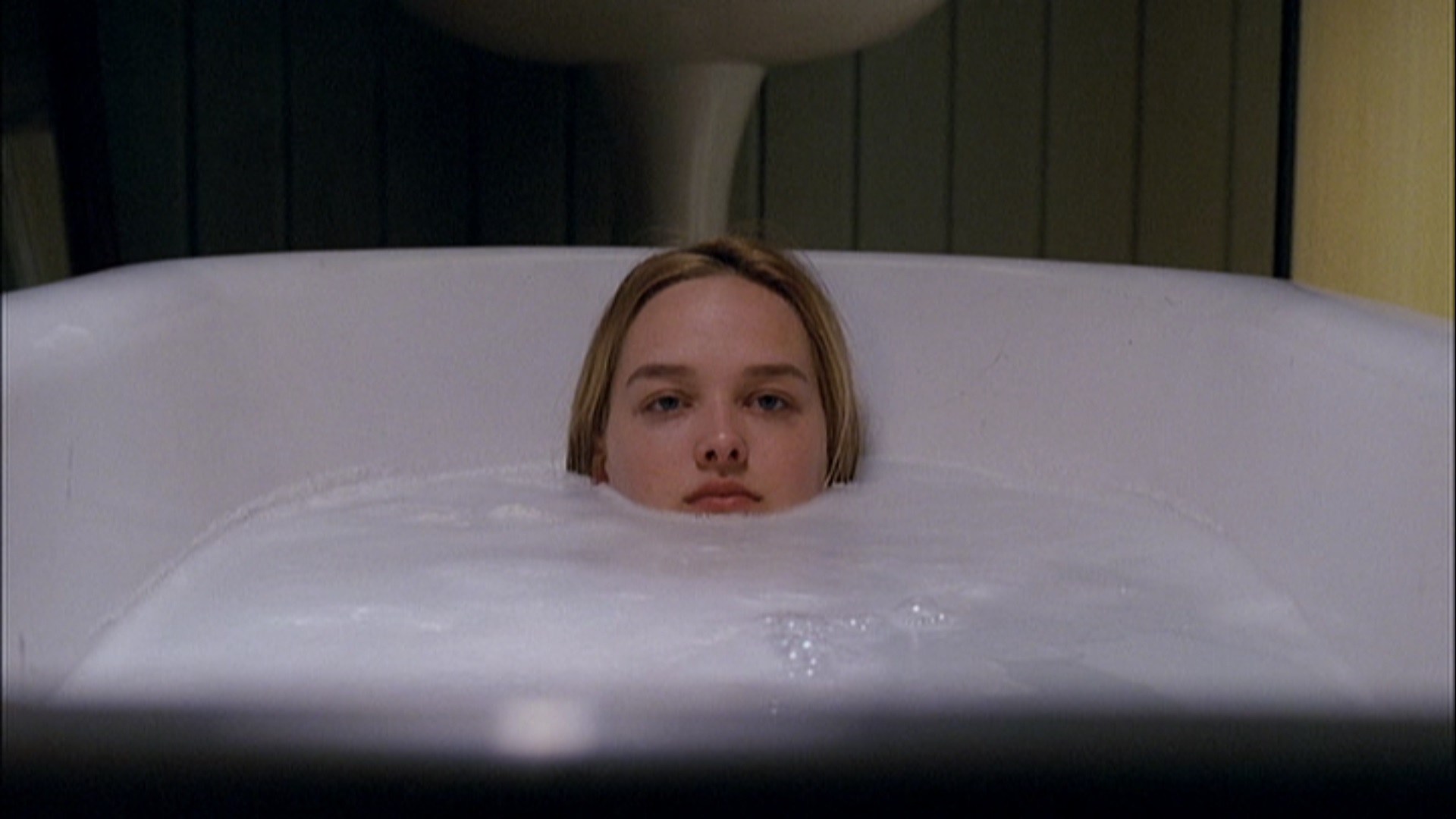
Of all the films built on the hysteria of impending womanhood, few are as specific as Teeth, a film in which a pubescent discovers a sharp set where teeth ought not be. This is a dark comedy and social satire that is uncomfortable to watch no matter your gender, although I imagine it may be a bit rougher on men.
Treading on the dread of coming-of-age and turning male-oriented horror clichés on ear, Teeth uses the metaphor implicit in vagina dentata—a myth originated to bespeak the fear of castration—to craft a parable about the dangers as well as the power of sexual awakening.
Written and directed by artist (and Ohioan!) Roy Lichtenstein’s son Mitchell, Teeth boasts an irreverent if symbol-heavy script with a strong and believable lead performance (Jess Weixler).
Weixler’s evolution from naïveté to shock to guilt to empowerment never ceases to captivate.
https://www.youtube.com/watch?v=J-qd-k0Vg7s
2. Antichrist (2009)
Lars von Trier’s foray into horror follows a couple down a deep and dark rabbit hole of grief. Von Trier’s films have often fixated on punishing viewers and female protagonists alike, but in this film the nameless woman (played fearlessly by Charlotte Gainsbourg) wields most of the punishment – whether upon her mate (Willem Dafoe) or herself.
Consumed by grief, a mother allows her husband—also grieving—to become her psychotherapist as they retreat to their isolated cabin deep in the woods where they will try to overcome the horror of losing their only child.
They won’t succeed.
Like dental scenes, gynecological horror draws a particular reaction. Whether it’s the abuse scene at the beginning of Proxy, nearly any scene in the brilliant French film Inside, or the final feast in Trouble Every Day, scenes of this ilk can be tough to watch. But to watch as Gainsbourg – who’s already inflicted some serious pain on Dafoe’s character – takes the scissors to herself is next to impossible.
https://www.youtube.com/watch?v=w4U5rdi9w-U
1. A Serbian Film (2010)
This is not a movie we would recommend to basically anyone. That’s not to say it’s a bad film – it’s well directed, acted, and written. It’s just that the co-writer/director Srdjan Spasojevic is trying to articulate the soul-deadening effects of surviving the depravity of war.
The title is no coincidence – the film is meant to reflect the reality of a nation so recently involved in among the most horrific, unimaginable acts of war. It’s as if Spasojevic is saying, after all that, what could still shock us?
Milos (Srdjan Todorovic) was a porn star before the war. He’s lured back for one lucrative “acting” effort, but there’s a reason it pays so well.
The entire film is an assault, but there is one scene in this one that catapults it to the top of this list, and you probably already know what that is. Milos (Srdjan Todorovic) finally realizes the depths of his new director’s evil when he sees his latest effort: newborn porn. There is no unseeing this.
Tis the season, and as Valentine’s-aimed romantic dramedies
go, the blandly titled The Photograph could be worse.
Issa Rae (Insecure) leads the cross-generational love story as Mae, NYC museum curator trying to process her grief and an incredibly long letter, both hers now because of her estranged mother Christina’s recent death.
Christina (a solid Chanté Adams), mainly unveiled via flashback,
broke from her own difficult mother as well as the love of her life back in
Louisiana years ago to follow a career as a photographer in New York.
As Mae learns some painfully obvious truths by way of
Christina’s letter, writer/director Stella Meghie (Everything,
Everything) weaves two romances together across time to look at the
wages of a woman’s ambition and the ways we relive our parents’ mistakes.
There’s plenty to like here, and Meghie’s film certainly
looks like a dreamy romance waiting to happen. Scenes are beautifully lit,
gorgeously filmed and romantically scored. You can’t fault the casting, either.
LaKeith Stanfield (Sorry to Bother You) has an easy chemistry with Rae as the journalist interested in Christina’s life, and Meghie surrounds her leads with vibrant supporting characters. Lil Rel Howery, Courtney B. Vance and an underused Kelvin Harrison Jr. all round out the ensemble, adding much needed life.
Rob Morgan (Mudbound, Last Black Man in San Francisco, Just Mercy), wonderful as always, steals his few scenes with a restrained, mournful presence that enriches an insubstantial story. There’s a ragged weariness to his character, one that’s all the more poignant when offset by the buoyancy of Y’lan Noel’s turn as the younger version of the same character.
Meghie has assembled a fine cast, she just doesn’t give them
enough to do. Neither love story gets enough room to grow and Mae’s arc feels
forced and rushed. Because Christina is gone before the cameras role, Meghie
handles Mae’s conflict with her mother exclusively through clunky dialog, and the
usually reliable Rae has trouble conveying any convincing inner turmoil.
For a low stakes romance, The Photograph is a very pretty picture.
Some good stuff to watch at home this week. There’s one racing biopic that’s so much better than it has any right to be, and also two super weird flicks.
Birds of Prey (and the Fantabulous Emancipation of One Harley Quinn)
by Hope Madden and George Wolf
First on the Harley Quinn playlist: Breaking Up Is Hard to Do
Harley (Margot Robbie, positively electric) tells us she and the Joker are done, and she didn’t take it well. What’s worse, Harley’s new relationship status means anyone in Gotham who’d like her dead (and there’s plenty) doesn’t have to worry about payback from “Mr. J.”
Shuffle: It’s a Man’s Man’s Man’s Man’s World
At the top, there’s Roman Sionis aka Black Mask (Ewan McGregor, hamming it up to glorious effect) who likes the faces peeled off of his enemies. He wants a priceless diamond that’s been lifted by teenage pickpocket Cassandra Cain (Ella Jay Basco), and Harley, forced to bargain for her life, promises to get it.
But Gotham has no shortage of talented women fed up with being kept down, and Harley tends to attract them. The vocally gifted Black Canary (June Smollett-Bell), the deadly mysterious Huntress (Mary Elizabeth Winstead, scene-stealingly deadpan) and the conveniently suspended Detective Montoya (Rosie Perez, nice to see you) all find themselves on the wrong end of a sizable bounty, and things get messy.
Shuffle: Sisters Are Doin’ It For Themselves
The badass girl power isn’t limited to the cast. Director Cathy Yan (Dead Pigs) serves up an irresistible cocktail of Scott Pilgrim visual flair and Tarantino continuity clash. Yan seems to relish the freedom of an R-rating (see “face-peeling” above), crafting memorable set pieces bursting with slick fight choreography, cartoonishly satisfying violence and wonderfully stylish pandemonium.
Shuffle: Respect
As Hope’s dad told the many Madden girls growing up: eyes, nose, throat, groin, knees are all equally vulnerable no matter the size of the attacker. Yan appears to be the sister we didn’t know about, but she certainly knows how to hurt a guy.
Writer Christina Hodson has become the go-to for ridiculous franchises that need more than we dare hope (she’s the one who wrote the only Transformers movie that didn’t suck). She teams well with Yan and her badasses, offering backstories and traumas that toe the line between superhero/supervillain legend and shit women deal with every day.
If you saw the stale trailer, noted the deadly release date, remembered the limp Suicide Squad and feared the worse, we hear ya. And maybe Birds of Prey benefits slightly from low expectations. But there’s no denying the raucous, foul mouthed, glitter-bomb fun.
It fills us with glee to look back on a year brimming with so many great movies. Original movies, even! Jojo Rabbit—that was unique. The Farewell, Marriage Story, Knives Out, The Lighthouse, Parasite, The Souvenir, Uncut Gems, Us, Portrait of a Lady on Fire, The Last Black Man in San Francisco—it’s a long list, and not all of the entries made it as far as an Oscar nomination (unfortunate!). But they did make for a fascinating year.
We have only a handful of complaints about this year’s batch of nominees, but we really want to point out how impressed we are with the animation nominees: two excellent blockbusters (Toy Story 4 and How To Train Your Dragon: The Hidden World) plus three outstanding and entirely underseen animated gems (Missing Link, I Lost My Body, Klaus). Whenever the Academy leads people to find great films they might have missed, they’re doing their job.
On the whole we expect the 2020 awards to be somewhat predictable. Luckily, on the whole, we also think the awards will go where they should.
Our picks for Oscar, 2020:
Best Adapted Screenplay
Steven Zaillian, The Irishman
Taika Waititi, Jojo Rabbit
Todd Phillips, Joker
Greta Gerwig, Little Women
Anthony McCarten, The Two Popes
We begin with the one category that feels undecided. While we are semi-confident in our picks, we also think Jojo Rabbit could hop away with gold.
Should Win: Greta Gerwig, Little Women
Will Win: Greta Gerwig, Little Women
Best Original Screenplay
Rian Johnson, Knives Out
Noah Baumbach, Marriage Story
Sam Mendes, 1917
Quentin Tarantino, Once Upon a Time…in Hollywood
Bong Joon Ho, Parasite
Should Win: Bong Joon Ho, Parasite
Will Win: Bong Joon Ho, Parasite
Best Supporting Actress
Kathy Bates, Richard Jewell
Laura Dern, Marriage Story
Scarlett Johansson, Jojo Rabbit
Florence Pugh, Little Women
Margot Robbie, Bombshell
Although it would not break our hearts to see Scarlett Johansson win this one for her tender, lovely turn as mom to the cutest little Nazi ever…
Should Win: Laura Dern, Marriage Story
Will Win: Laura Dern, Marriage Story
Best Supporting Actor
Tom Hanks, A Beautiful Day in the Neighborhood
Anthony Hopkins, The Two Popes
Al Pacino, The Irishman
Joe Pesci, The Irishman
Brad Pitt, Once Upon a Time…in Hollywood
Should Win: Joe Pesci, playing against type and delivering a quietly powerful turn that’s the heartbeat of Scorsese’s film.
Will Win: Brad Pitt, Once Upon a Time…in Hollywood. Good news – another top-notch acceptance speech!
Because we want to make you wait for it, and because you might need some help with other buckets in your poll…
Best Documentary
American Factory, Julia Riechert & Steve Bognar
The Cave, Feras Fayyad
The Edge of Democracy, Petra Casta
For Sama, Waad al-Kateab
Honeyland, Ljubo Stevanov
Here’s a fantastic category. Make it your mission to see each one of these films.
Should Win:Honeyland
Will Win: In a rare split decision, Hope predicts Honeyland; George predicts American Factory.
Best International Feature
Corpus Cristi (Poland)
Honeyland (North Macedonia)
Les Miserables (France)
Pain and Glory (Spain)
Parasite (South Korea)
Should Win:Parasite
Will Win:Parasite
Best Animated Feature
How to Train Your Dragon: The Hidden World
I Lost My Body
Klaus
Missing Link
Toy Story 4
Should Win:Toy Story 4
Will Win:Toy Story 4, but really, we all win with this group of movies. But Toy Story 4 better win.
Best Cinematography
Rodrigo Prieto, The Irishman
Lawrence Sher, Joker
Jarin Blaschke, The Lighthouse
Robert Richardson, Once Upon a Time…in Hollywood
Roger Deakins, 1917
Should Win: Jarin Blaschke, The Lighthouse
Will Win: Roger Deakins, 1917
Best Original Song
“I Can’t Let You Throw Yourself Away” (Toy Story 4) — Randy Newman
“(I’m Gonna) Love Me Again” (Rocketman) — Elton John & Bernie Taupin
“I’m Standing With You” (Breakthrough) — Diane Warren
“Into the Unknown” (Frozen 2) — Robert Lopez & Kristen Anderson-Lopez
“Stand Up” (Harriet) — Joshuah Brian Campbell & Cynthia Erivo
Should Win: Elton & Bernie
Will Win: John & Taupin
OK, on to what you’re here for.
Best Actress
Cynthia Erivo, Harriet
Scarlett Johansson, Marriage Story
Saoirse Ronan, Little Women
Charlize Theron, Bombshell
Renee Zellweger, Judy
Should Win: Renee Zellweger, Judy
Will Win: Renee Zellweger, Judy
Best Actor
Antonio Banderas, Pain and Glory
Leonardo DiCaprio, Once Upon a Time…in Hollywood
Adam Driver, Marriage Story
Joaquin Phoenix, Joker
Jonathan Pryce, The Two Popes
Should Win: We would not weep to see Adam Driver take this one home, but he won’t and we’re not that upset because Joaquin Phoenix was astonishing.
Will Win: Joaquin Phoenix
Best Director
Martin Scorsese, The Irishman
Todd Phillips, Joker
Sam Mendes, 1917
Quentin Tarantino, Once Upon a Time…in Hollywood
Bong Joon Ho, Parasite
Should Win: Bong Joon Ho makes a great case with his nearly perfect film.
Will Win: Sam Mendes, 1917
Best Picture
Ford v Ferrari
The Irishman
Jojo Rabbit
Joker
Little Women
Marriage Story
1917
Once Upon a Time… in Hollywood
Parasite
Should: Parasite
Will: 1917
The 92 annual Academy Awards will be held this Sunday, February 9th, and aired live on ABC.