If you ever watched the old Barney & Friends TV show and worried that a big dinosaur who loses his temper could easily kill a bunch of children, well, you and Casper Kelly both.
Kelly’s been making goofy horror for years: Adult Swim Yule Log, “Fun Size” from V/H/S Halloween, the “Cheddar Goblin” bit in Mandy. (That last one is genius, let’s be honest.) With Buddy, he takes us into the make-believe world of a kids’ TV show, trapped probably somewhere in the 1990s, starring a big, fuzzy, orange unicorn.
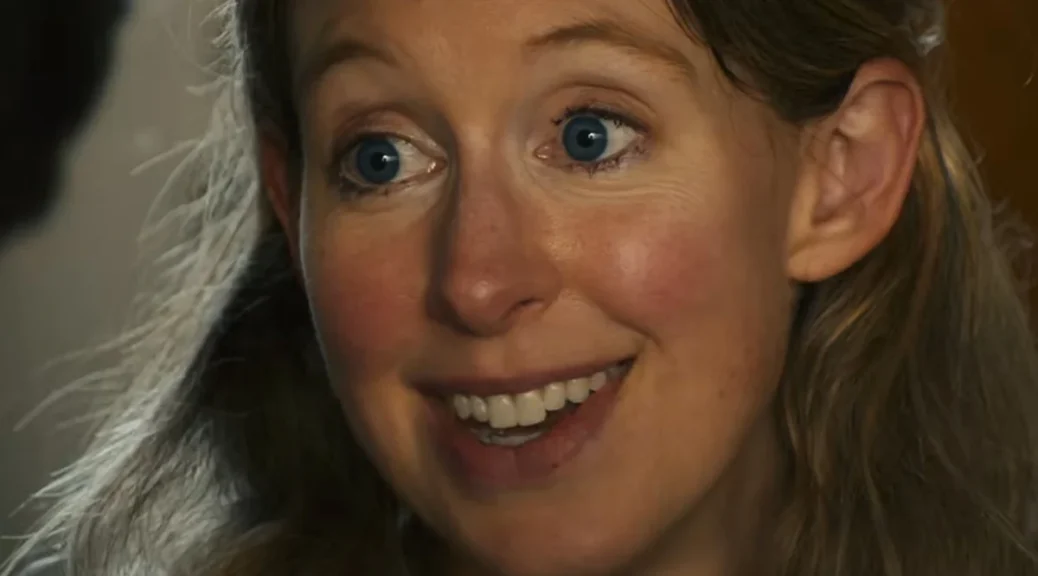
Freckle faced Freddy (Delaney Quinn) is the first to notice that something seems wrong with Buddy. Just a minute ago, Buddy was helping Josh (Luke Speakman) realize that he really did want to dance. Even though Josh was pretty clear that he did not want to dance.
But where is Josh? And why is Josh’s book all covered in blood?
Kelly mines the unwholesome within the wholesome thanks in large part to committed set design and spot-on child performances. Plus the voice talent is nuts. Keegan-Michael Key is Buddy, Patton Oswalt does the voice of a backpack named Strappy, and Michael Shannon voices a Howdy Doody style marionette.
Make believe set-up in place, Buddy jumps from TV land into the real world just long enough to hint at a larger tale.
Here Topher Grace (essentially playing Topher Grace) and Cristin Milioti (wonderful) are raising their two sons, but Mom feels like something is off. Wrong. Missing.
Kelly, writing with Jamie King, understands how to subvert TV logic, whether sit-com or live-action kid stuff. His instincts in the land of make believe are especially on-point. There’s something unsettling about those shows, dating back to Mr. Rogers and those terrifying puppets. Or Captain Kangaroo. What was his deal?!
And Quinn guarantees you’ve emotionally invested, which is a rarity in such Midnight Movie fare. Kelly pushes the limits of the idea with a running time just over 90 minutes, but Buddy is a real unicorn. The film is clever, funny, gory, and surprisingly moving.
Just in case Backrooms was too abstract about the anxieties plaguing Gen Z right now, It Ends arrives to hammer the point home more directly. Writer/director Alex Ullom’s feature debut is a well-constructed metaphor for a timely existential dread, with a slam-bang setup fueled by one early kickass jump scare.
Four twenty-something friends pile in a trusty four-door and head out. They’re laughing, talking and trusting their GPS until driver Tyler (Michael Cole) suspects that something doesn’t seem right.
He’s correct.
One wrong turn has trapped them on a never-ending backroad through the woods, where stopping for even a few minutes can be deadly. Don’t worry about the gas gauge, bathroom breaks or starvation, Ullom sees those questions coming. Instead, worry about how Tyler, Day (Akira Jackson), Fisher (Noah Toth) and James (Phinehas Yoon) will try to deconstruct this road trip rubric, and what they’ll learn as the miles add up.
If you’re thinking Exit 8, understandable, but that game offered a finish line that these drivers can only dream of.
They’re fresh out of college, and now they’re just facing an endless road of toil and frustration, managing a few fleeting moments of joy while they hang on to the hope that one day they might find salvation.
What kind of life is that?
Horror movies have always reflected generational fears, and this particular anxiety continues to resonate as an anchor for psychological torment. After that first act blast of terror, Ullom settles into a groove of introspection and gloom, with his four talented actors elevating a script that is a bit light on character development.
The important thing is, we believe these people are friends, and for the most part, their reactions to the situation (and, by extension, what it represents) seem genuine. The road only gets bumpy in act three, when Ullon seems desperate to reach a feature length runtime, spinning his wheels a bit before hitting us with his Rod Serling-esque finale.
It Ends still leaves a well-earned mark. It’s more proof that horror can be trusted to these talented young storytellers, and the future is looking scary good.
Before filmmaker Yeon Sang-ho thrilled and devastated in equal measure with his 2016 zombie masterpiece Train to Busan, he scared us with its animated prequel (Seoul Station). The filmmaker book a break from the undead after the underwhelming Busan sequel Peninsula, turning to religious horror and crime thrillers.
And while his latest, Colony, is not technically a zombie movie because the ravenous hordes are not, in face, undead, you should still steer clear of their mouths.
Colony is sort of REC meets Dawn of the Dead, but with a hive mind, a little 28 Days Later, a touch of The Thing, and a lot of mucous.
Professor Se Jeong (Jun Ji-Hyun) attends a conference that detours to chaos when a disgruntled scientist unleashes a biochemical that mutates the affected into a zombie-like mob with a single consciousness. As SWAT quarantines the building, which is attached to a mall, Se Jeong must try to deliver Patient X to the rescue team for use as a vaccine against infection.
The film seems to have a lot on its mind: the surveillance state, contagion anxiety and lockdown trauma, disinformation and vaccines, even a very polite form of fascism. And at just over 2 hours, you’d think Colony might have mined those ideas a little more powerfully.
Instead, it hints at these, mainly borrowing pretty liberally from films that dug in deeper. Nor does Yeon develop the emotional connections that has me bawling every time I watch Busan, although solid performances help the characters draw your empathy.
Still, the filmmaker injects an intriguing element with the communication aspect—the infected being able to share information, even see what each other sees. And his precisely choreographed bloody, gory, gooey action mayhem is again on point.
Colony won’t shred your nerves or emotions the way Train to Busan did, but maybe it’s unfair to expect Yeon to meet that high water mark. It’s a mainly clever, well staged and quick paced action horror.
Three years after Warner Brothers shelved Coyote vs. ACME for a tax write off, the delightful live action/animation hybrid finally hits big screens this week.
My interest hardly needed nudging after last year’s surprisingly entertaining The Day the Earth Blew Up: A Looney Tunes Movie. The fact that Coyote vs. ACME is about a soulless corporation willing to sacrifice cartoons because of its greed only increased its appeal. I love a good “art imitates life” story.
And this one did not disappoint. Will Forte is Kevin Avery of the injury law firm Avery, Jones, and Maltese—the first of about a billion nods to the brain trust that created the nearly century-old Looney Tunes. Kevin makes a living helping cartoon characters settle disputes with ACME for a couple hundred per case of backfiring rocket skates, anvil incidents, and whatnot.
Then Wile E. Coyote walks into Kevin’s office with a bottomless knapsack full of whatnot and suddenly Kevin’s facing a case that might be bigger than he even wants to deal with.
Kevin’s nemesis, ACME Corp’s slick talking attorney Buddy Crane (John Cena), offers a sweet settlement, but Mr. Coyote’s having none of it.
Coyote vs. ACME delivers a classic legal thriller punctuated with laughs and loving nods to animated history. Director Dave Green and a writing team led by Samy Burch (May December) follow in Who Framed Roger Rabbit’s footsteps in more ways than one. The filmmakers’ Looney Tunes love runs deep, and their knack for sight gags is as on-point as their instincts with a David vs. Goliath storyline.
It’s a smart script, and Forte, Cena, and P.J. Byrne (as Cena’s assistant) are a riot. Coyote vs. ACME never aims for the heights of Roger Rabbit (which was, let’s be honest, essentially a brilliantly disguised Chinatown for a new generation), but it doesn’t try to.
Green’s film celebrates generations of animated history with love and skill while it tells a story that’s relevance is as timeless as the Looney Tunes.
When scholarship student Dani (Cassady McClincy Zhang) is picked up for carrying a miniscule number of illegal pills, her life is forever altered in writer/director Merlin Camozzi’s film The Snare.
The two detectives (Royce Johnson and Elizabeth Stahlmann) who take Dani in are quick to accuse her of intent to sell. She insists she only got the drugs to celebrate her recent graduation. Whether they believe her doesn’t matter. They see someone they can use for their own ends.
Camozzi has crafted a stunning portrayal of the mental toll inflicted on confidential informants (CIs) who will do almost anything to avoid a prison sentence. In Dani’s case, a conviction would mean losing her scholarship to college. For a poor student who is reliant on this, it’s a devastating consequence for a minor mistake.
The psychological abuse inflicted on Dani by the two cops is appalling. They are absolutely convincing in their efforts to bend Dani to their will. By exploiting her, they hope to land a whale. And because she has everything to lose, she is easily backed into a corner.
The scenes between Dani and the detectives are sometimes maudlin and their effect is diminished by this. However, McClincy Zhang convinces us of the hopelessness Dani feels. She knows what they want her to do would hurt people she cares about, but the detectives use the desperation against her. It leaves the viewer with an overwhelming sense of being between a rock and a hard place.
Camozzi does an excellent job of showing Dani’s world. This is a world where children are abandoned by their parents or have parents who work multiple jobs to stay afloat. The relationship Dani has with her mom (Lucy Walters) and brother, Bison (Joaopaulo Malheiro) is convincing and sincere.
The film states it is based on a true story, and while it is not specific to any one person, it is an overarching look at the flaws in the system of CIs. It’s sobering to realize children as young as 13 might find themselves in a situation like Dani’s. The film makes you wonder if the system is worth the price.
Writers/directors Emily Bennett (who also stars) and Justin Brooks explore the concepts of sadism and masochism as vehicles for filmmaking in their spare, effective, bloody feature Blood Shine.
Bennett is the delicately lovely Clara, all alone in a big old farmhouse out in the middle of nowhere. We meet Clara as she answers her door late at night to the recently out-of-work Keith (Brendan Sexton III — Session 9’s tragic, mulleted, and tragically mulleted Jeff!).
It’s an effective prelude to the film to come of a zealot, a vessel, and an awful lot of blood given that the balance of the film consists mainly of two people.
The second of those two people, Brighton West (David Call) is a horror film director. Like Keith, Brighton West is not such a great guy. Call is convincing enough that it’s tough to care what happens to Brighton, but Blood Shine gives both Call and Bennett opportunities to surprise.
Though the film nods to Silence of the Lambs, American Psycho, Audition and some of the dreamier horror indies of the Seventies, that’s more in specific shot decisions than story. Bennett and Brooks have carved out something unique within the isolated zealot storyline and created a character in Clara that highlights Bennett’s skill as an actor.
The small but strong supporting ensemble—extended cameos, really—include Toby Poser and Larry Fessenden. Both are characteristically wonderful, each bringing a presence that alerts viewers to creepiness afoot.
The brings in filmmaking as a device, but it isn’t pieced well into the narrative and winds up feeling tacked on and unnecessary. But the one-on-one between Clara and Brighton, and Bennett’s increasingly brittle performance, compel attention.
It’s an effective lead up to a passable climax. Blood Shine is more invested in the journey than the destination. That journey is a dark one disguised in whites, between two people we shouldn’t care about heading in a direction we shouldn’t want them to go.
Hope & George review this week’s new releases: Tony, Sex and Death at Camp Miasma, Mutiny, Insidious: Out of the Further, The Magic Faraway Tree, Buffet Infinity, Bury the Devil, & Blood Shine!
“The magic of childhood is always forgot, but this is the story of one who did not.”
So begins The Magic Faraway Tree, director Ben Gregor’s fantasy about unplugging the family and rediscovering magic.
Tim Thompson (Andrew Garfield) is the one adult still searching for some joy, maybe even magic, for his family. When his wife Polly (Claire Foy) quits her corporate job (and the family immediately loses the corporate apartment and car), Tim has a grand idea. They’ll move to the country, live off the land and make pasta sauce.
Garfield’s a brilliant fit as the emotionally available dad, ready to make friends with a rooster and play Gregorian chants for his tomato plants. Tim and Polly’s kids fare less well without their devices, until they find a giant magic tree and make friends with the mainly friendly fae folk who live therein.
These folk include a fairy (Nicola Coughlan), a pixie (Hiran Abeysekera), and a saucepan man (Dustin Demri-Burns). What?
Writer Simon Farnaby (Paddington 2) adapts one of Enid Blyton’s beloved old books to tell a good story, but it’s caught in a trap. The fantastical elements are fun and brightly colored, but not nearly as interesting as the family drama.
This is partly a testament to the talent of the cast. Both Foy and Garfield are routinely wonderful but rarely does either get to play a loving parent and spouse finding silly ways to be with their family. Both seem to truly enjoy the work.
The child actors (Billie Gadsdon, Delilah Bennett-Cardy, and Phoenix Laroche) charm scene after scene. The crux of the drama falls on Bennett-Cardy, and she handles it beautifully.
Rebecca Ferguson, however, is criminally underused as the villainous Miss Snap. This is part of the trouble. The film gives more space to the non-magical side of the story, which leaves the magical portion feeling underfed.
It’s unfortunate that Gregor couldn’t find a more whimsical balance for the film, or simply streamlined the fae adventure to a more precise, if smaller, supporting side plot. Instead, the family drama feels like a full film often weighed down by a shapeless, overly busy but under developed side quest.
Because we already know what would be #1 if we didn’t limit it, and the thing is, it’s insane how many great horror films are based in Texas. Texas is like our very own Australia! So, here are our five favorites that do not include that one we always talk about.
5. Bubba Ho-Tep (2002)
Who wants to see Bruce Campbell play Elvis Presley?! We do.
Director Don Coscarelli (Phantasm) brings Joe R. Lansdale’s short story to the screen to depict the horror and sadness of aging, although its done with such humor that the film is impossible not to love.
Elvis never died, he swapped places with an impersonator who died and ever since then he’s been stuck living someone else’s life. And now he’s been stuck in this low-rent old folks home where his only real friend is a guy who believes he’s JFK (Ossie Davis). Obviously, when they realize that the recent spate of patient deaths is due to a mummy sucking the life from people through their assholes, who’d believe these knuckleheads?
The script is great and Coscarelli knows exactly how to make the most of budgetary limitations. The entire cast soars, but Campbell and Davis have such incredible chemistry that the film delivers not just laughs, message, and some scares but genuine tenderness.
4. Frailty (2001)
Director Bill Paxton stars as a widowed, country dad awakened one night by an angel – or a bright light shining off the angel on top of a trophy on his ramshackle bedroom bookcase. Whichever – he understands now that he and his sons have been called by God to kill demons.
Flash forward and we’re led through the saga of the serial killer God’s Hand by a troubled young man (Matthew McConaughey), who, with eerie quiet and reflection, recounts his childhood with Paxton’s character as a father.
Dread mounts as Paxton drags out the ambiguity of whether this man is insane, and his therefore good hearted but wrong-headed behavior profoundly damaging his boys, or is he really chosen, and his sons likewise marked by God? The film upends everything – repeatedly – until it’s as if it’s challenged your expectations, biases, and your own childhood to boot.
Paxton crafts a morbidly compelling tale free from irony, sarcasm, or judgment and full of darkly sympathetic characters. It’s a surprisingly strong feature directorial debut from a guy who once played a giant talking turd.
3. The Dark and the Wicked (2020)
Bryan Bertino is not a filmmaker to let his audience off the hook—if you’ve seen The Strangers, you know that. Like that effort, TD&TW is a slow burn with nerves fraying inside an isolated farmhouse as noises, shadows, and menacing figures lurk outside.
Bertino and cinematographer Tom Schraeder work the darkness in and around a goat farm to create a lingering, roaming dread. But where Bertino, who also writes, scores extra points is in crafting believable characters.
Too often in horror you find wildly dramatic behavior in the face of the supernatural. One character adamantly denies and defies what is clearly happening while another desperately tries to communicate with “it.” No one would do either, but this is the best way to serve the needed action to come in lesser films.
2. Pearl (2022)
Mia Goth has been impressive in every film she’s graced. But nothing prepared us for Pearl.
With her first writing credit and her first no-question-about-it lead performance, Goth delivers an unerring combination of innocence and psychosis that is as captivating as it is terrifying.
The writing is sly and the direction a magically macabre take on classic American cinema, like the most wrong-headed Judy Garland movie you can imagine. But it comes together seamlessly to deliver a concoction spellbinding concoction.
Goth’s 8-minute monologue and that truly insane frozen smile over the end credits will stay with you forever.
1. X (2022)
The Texas Chain Saw Massacre meets Boogie Nights?
Yes, please!
Filmmaker Ti West delivers an utterly unexpected and absolutely inspired horror show like nothing he’s made before. A group of good-natured pornographers descends upon an out-of-the-way ranch to shoot a movie, unbeknownst to the owners. Mia Goth leads a thoroughly entertaining cast, each actor making the most of the humor crackling throughout West’s script.
West explores some common themes, upending every one without ever betraying his clear love of this genre. Blending homages of plenty of Tobe Hooper films with a remarkable aesthetic instinct, West fills the screen with ghastly beauty.
Don’t make the mistake of assuming Jane Schoenbrun’s new feature Teenage Sex and Death at Camp Miasma is a slasher. Or a slasher spoof. Or a satire about slashers.
It’s a sexual awakening brought about by Gillian Anderson. Obviously.
Up-and-coming (pun intended) queer filmmaker Kris (a wondrously vulnerable Hannah Einbinder) has been tapped to reboot a problematic slasher IP. She hopes to convince the Final Girl of the first installment, Billy (Anderson the Great), to return to cinema and star in the film. Turns out, Billy’s a recluse who bought and now lives in the camp from the original film. She hosts Kris for several days of movies, junk food, pot, and deeply sensuous slasher nerdery.
This is—and I say this with as much delight as possible—the nerdiest horror movie ever. How nerdy? The very second you hear yourself saying “that’s a split diopter,” Schoenbrun stand-in Kris says it out loud. When Kris apologizes for asking too personal a question of Billy, fearing it could be a #metoo violation, Billy replies, “I auditioned for The Burning. You know who made that, right?”
Nerds! And the best kind of nerds. Horror movie nerds! Sleepaway Camp trivia meets Friday the 13th nostalgia in a gloriously queer, brazenly shameless, wonderfully horny new horror film.
Like their last two features, We’re All Going to the World’s Fair and I Saw the TV Glow, Teenage Sex and Death at Camp Miasma concerns itself with transformation, identity, and horror. But Schoenbrun’s latest drops the dreamy melancholy of the previous films in favor of something tender, beautiful, and accepting.
The gender iconography littered across every scene finds its zenith in Little Death (that name!), the transgender marauder with a double-blade spear and an air vent helmet. (Honestly, if you haven’t read Carol J. Clover’s Men, Women, and Chain Saws, you should. Schoenbrun certainly has.)
TSADACM, like Schoenbrun’s last two films, is a gorgeous watercolor fever dream. It’s funny, incredibly bloody, and unabashedly in love with the aggressively sexual and sexually ambiguous slasher, no matter how problematic. Perhaps because it’s problematic.
The film is not just a wonderful walk through another person’s psyche, although it is that. It’s also a fascinating, deeply satisfying kick of a horror movie. You should go.