Tag Archives: Screen Wolf

Fright Club: Body Swap Horror

The idea of someone walking around in your skin, of losing control of who you are, of becoming who knows what while who knows who cozies up inside your life – well, it’s a thought that has kept horror filmmakers up night. Thank goodness for us!

Here’s a look at our favorite body swap horror movies, recorded live at Gateway Film Center!

5. The Stepford Wives (1975)

Ira Levin’s novel left a scar and filmmaker Bryan Forbes and star Katherine Ross pick that scab to deliver a satirical thriller that is still surprisingly unsettling. What both the novel and the film understand is a genuine fear that the person you love, whose faults you accept and who you plan to age and die with, has no interest in what’s inside you at all. You – the actual you – mean nothing at all.

It’s the idea of trophy wife taken to a diabolical extreme (as even the outright trophy wife isn’t long to last, what with the inevitability of aging and all). The term Stepford Wife worked its way into the lexicon, and there’s a clear pot boiler, B-movie feel to this film, but it still leaves a mark.

4. The Faculty (1998)

The film exaggerates (one hopes) the social order of a typical Ohio high school to propose that it wouldn’t be so terrible if all the teachers and most of the students died violently, or at least underwent such a horrific trauma that a revision of the social order became appealing. 

Indeed, in this film, conformity equals a communicable disease. Adults aren’t to be trusted; high school is a sadistic machine grinding us into sausage; outcasts are the only true individuals and, therefore, the only people worth saving. Director Robert Rodriguez pulls the thing off with panache, all the while exploring the terrifying truth that we subject our children to a very real and reinforced helplessness every school day.

Interestingly, the infected teachers and students don’t turn into superficial, Stepford-style versions of themselves. For the most part, they indeed become better, stronger, more self-actualized (ironically enough) versions, which is interestingly creepy. It’s as if humanity – at least the version of it we find in a typical American high school – really isn’t worth saving.

3. Invasion of the Body Snatchers (1978)

Yes, we love the original. But we’re giving the remake the nod. Philip Kaufman’s Invasion of the Body Snatchers creates an oppressive, delirious atmosphere that will not let you go. San Francisco health department workers originally believe some friends are becoming paranoid, sensing a non-existent distance in their loved ones, but soon realize that an alien species is replacing human beings with replicas – exact duplicates, except for the lack of emotion.

The sound and visual effects are especially magnificent when compared to other films of the era, but they age well and give the film a gritty realism that feels unsettling against the fantasy storyline.

The cast is weirdly perfect – the unflappable Donald Sutherland, the naturally emotionless Leonard Nimoy, the effortlessly weird Jeff Goldblum, and Nancy Cartwright, who screams so well when aliens show themselves.

2. Possessor (2020)

Brandon Cronenberg’s created a gorgeous techno world, its lulling disorientation punctuated by some of the most visceral horror to make it to the screen in 2020. There is something admirably confident about showing your influences this brazenly.

Credit Cronenberg, too, for the forethought to cast the two leads as females (Jennifer Jason Leigh playing the remarkable Andrea Riseborough’s boss). The theme of the film, if driven by males, would have been passe and obvious. With females, though, it’s not only more relevant and vital, but more of a gut punch when the time comes to cash the check.

Possessor is a meditation on identity, sometimes very obviously so, but the underlying message takes that concept and stabs you in your still-beating heart with it.

1.Get Out (2017)

Opening with a brilliant prologue that wraps a nice vibe of homage around the cold realities of “walking while black,” writer/director Jordan Peele uses tension, humor and a few solid frights to call out blatant prejudice, casual racism and cultural appropriation.

When white Rose (Alison Williams) takes her black boyfriend Chris (Daniel Kaluuya) home to meet the fam, she assures him race will not be a problem. How can she be sure? Because her Dad (Bradley Whitford) would have voted for Obama’s third term “if he could.” It’s the first of many B.S. alerts for Peele, and they only get more satisfying.

Rose’s family is overly polite at first, but then mom Missy (Catherine Keener) starts acting evasive and brother Jeremy (Caleb Landry Jones) gets a bit threatening, while the gardener and the maid (both black – whaaat?) appear straight outta Stepford.

Peele is clearly a horror fan, and he gives knowing winks to many genre cliches (the jump scare, the dream) while anchoring his entire film in the upending of the “final girl.” This isn’t a young white coed trying to solve a mystery and save herself, it’s a young man of color, challenging the audience to enjoy the ride but understand why switching these roles in a horror film is a social critique in itself.

Wealth Without Tears

Paper Tiger

by George Wolf

James Gray seems to be a filmmaker unbothered by fashion, familiarity, or much of anything that might alter the story he wants to tell. Up and down a resume that includes Two Lovers, The Immigrant, The Lost City of Z, Ad Astra and Armageddon Time, Gray has continually found freshly emotional paths on well travelled roads.

The streak continues with Paper Tiger, a richly crafted crime thriller of easy money fraying family bonds.

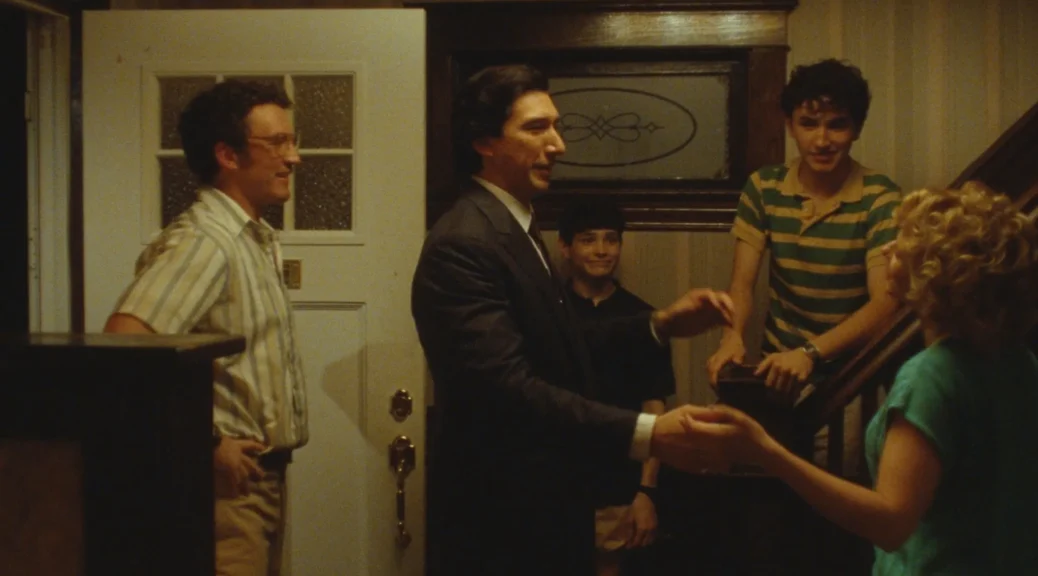
It is 1986 in Queens, New York, where Irwin (Miles Teller) and Linda (Scarlet Johansson) Pearl are living the usual middle class life with their teen sons. They have a decent house and happy times, but certainly wouldn’t mind a better place or the money to send their kids to an Ivy League school.

Enter Irwin’s older brother, Gary (Adam Driver), a fast talking, high rolling ex-cop with sweet suits, a slick haircut and a tempting offer.

There’s a two mile stretch of land down by the canal that needs cleaned up. Gary has been helping a Russian firm called Sheepshead Oil land the contract, so why don’t the Irwin boys start a consulting firm, and put Irwin’s engineering background to good use navigating the environmental regulations?

The mid 80s. Russian firm. Regulations. An ex-cop’s connections. Easy Money.

We know where this is going, right? Doesn’t matter, as once again Gray rides his own crackling script, committed, intimate direction and outstanding performances to breathe some taut new life into familiar beats.

Both Driver and Teller are as good as they’ve ever been, elevating this blood bond to an almost Shakespearian level of tragedy. We know from the first conversation where this “consulting firm” will lead, but Irwin’s wide eyed belief in his brother and Gary’s constant promises of “this is nothing” after every escalating setback raise the stakes with enough precision to build palpable tension.

And just when you might be wondering what drew Johansson to a generic supportive wife role, Linda becomes a pivotal part of the intrigue. No surprise, Johansson fills her own familiar beat with heartbreak, humanity and a wryly funny accent.

Gray gives these three terrific talents a dramatically stark playground. The sense of time and place is gritty and foreboding, and Gray’s use of light, shadow and earth tones add breathless layers of tension to set pieces that range from windswept fields to waterfront meeting rooms.

Paper Tiger is a thriller that feels somehow suspended in time and pop culture. A bruising dissection of fraternal loyalty and American dreams, it’s more proof that any story can find newly relevant life with the right storyteller.

Hollywood Swingin’

The Further Mis-Adventures of Cliff Booth

by George Wolf

You ever eat a tasty plate of spicy chicken wings on a great night out, then wake up later with an uneasy feeling? Disappointing. Watching The Further Mis-Adventures of Cliff Booth was mighty tasty. Finding out about the generative AI employed left the bad taste.

But man, it’s a wild and funny flaming cocktail from writer Quentin Tarantino and director David Fincher. At times it’s brutal, flirty, and shocking, always loud, and drenched in 70s Hollywood with a dark, pulpy cool.

Tarantino’s screenplay picks up with Once Upon a Time in Hollywood‘s Cliff Booth (Brad Pitt, oozing charisma) after his days as a stunt double seem done. He’s working a variety of odd jobs (theater projectionist, bartender, something else I won’t mention) and living with his father (Peter Weller) when a call from agent Karen Crosby (Elizabeth Debicki) comes in.

She represents TV star Charlie Peters (Scott Caan), and he wants a meeting with Cliff. Hmmm, Charlie’s not nearly tall enough to make Cliff his stunt double, so what’s up?

Turns out Charlie’s in quite a tough spot with some very dangerous people, his wife (Carla Gugino) is unaware, and Charlie has heard that Cliff is the kind of guy who can fix a situation like his.

Well, if you thought Cliff had skills before, you have no idea just how interesting this man becomes, or how raucously fun it is to see those skills in action. Because Tarantino and Fincher stay true to the film’s title by crafting a two hour and twenty-minute hang with a super cool dude, pulling us into his frenzied orbit of indelible characters, Tarantino dialog, funk-tastic needle drops and WTF excess.

Pitt is as irresistible as you’d expect as he digs into Booth’s full arsenal, and the entire ensemble (including Yahya Abdul-Mateen II and Timothy Olyphant) is terrific, with Debicki shining especially bright. Watching Karen’s attitude toward Cliff move from bemused pity to incredulous curiosity to undeniable attraction is authentic and delicious, and ultimately mirrors many of our reactions to Tarantino’s character revelations.

Fincher wraps them all in a winning swagger and pulsating visual aesthetic of Hollywood swinging in the 1970s. The soundtrack choices are always on point and the moments that seamlessly mix characters into actual pop culture from the time are a lot less charming when you realize Fincher defended his probable use of AI by declaring that he is “not a Luddite.”

Don’t expect a cinema milestone on the order of Pulp Fiction or Fight Club, just settle in for a fine R-rated plate of spicy fun. The Further Mis-Adventures of Cliff Booth delivers a riotous love song to LA, the Seventies, and amiable mayhem…with that disappointing aftertaste.

Screening Room: Hunger Games, I Play Rocky, Madden & More

Hope & George review this week’s new releases: The Hunger Games: Sunrise on the Reaping, I Play Rocky, Madden, Club Kid, Gentle Monster, Steps, Best Pancakes in the County, The Host, The Bulldogs, Influencer Project, and The Vile!

Holiday Turkey

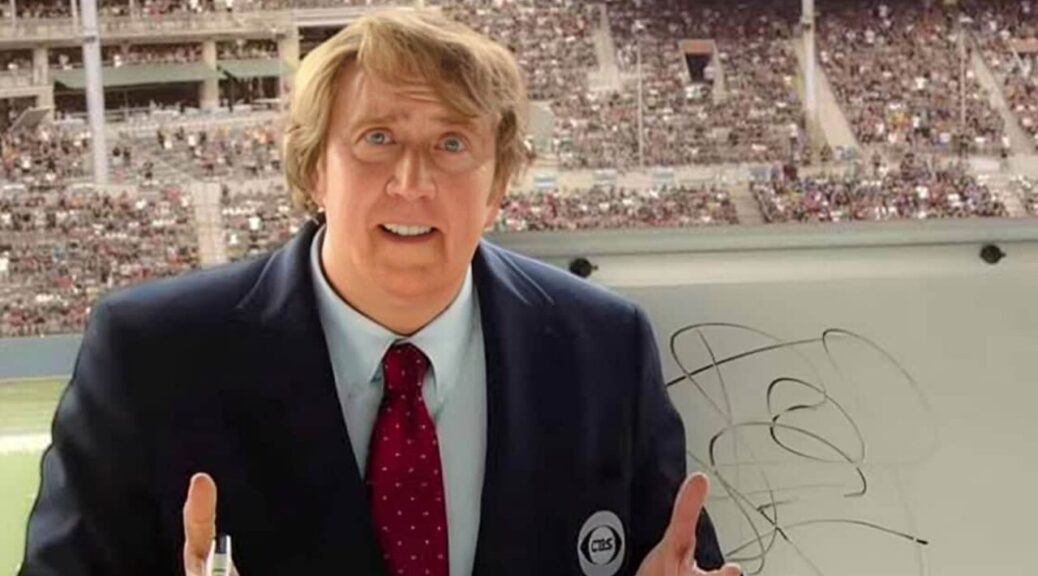
Madden

by George Wolf

Oh, I hate to do it, but I have to throw the flag on Madden, one of the most disappointing movies of the year.

I know, and I was really looking forward to this. It’s from co-writer and director David O. Russell, who is reminding everyone who didn’t know, or may have forgotten, that the Madden in the video game refers to a real person.

John Madden was a Super Bowl winning coach with the Oakland Raiders before he retired, due to health reasons and a demanding schedule, to become a beloved broadcaster, commercial pitchman, and turducken (a deboned chicken stuffed into a deboned duck stuffed into a deboned turkey) connoisseur. He was then recruited by the upstart gaming company EA sports and the name Madden soon became synonymous with a new brand of football.

The ensemble is stellar. You’ve got Nicolas Cage under a bunch of prosthetics playing the eccentric Madden. Christian Bale absolutely nails the equally eccentric persona of Oakland Raiders owner Al Davis, with great support from Kathryn Hahn as John Madden’s wife, Virginia, and Sienna Miller as Al Davis’s wife, Carol. Throw in John Mulaney as EA sports founder Trip Hawkins, and you’ve got a great cast to work with, but Russell starts fumbling from the opening whistle.

The tone is all over the place. It’s part biography, part The Office-style mockumentary. And too much of it looks cheap, like a bad SNL skit where some ex-NFL players and comedian Shane Gillis put on wigs and glasses to stand in as nerdy game developers while Mulaney starts riffing.

It’s awkward and sad, because Russell (Silver Linings Playbook, American Hustle, The Fighter) wastes some great talent and storytelling possibilities. You’ve got really two fascinating relationships to explore here, one between John Madden and Al Davis and one between John Madden and his wife. Plus, you’ve got terrific actors to go exploring with. But Madden goes off the rails from the start. Every avenue seems misguided, and it’s never clear what kind of movie this is trying to be. It’s just too distracted, never giving us a compelling reason to get invested for nearly two hours.

Penalty: unsportsmanlike. Could use a game reset.

The People’s Champion

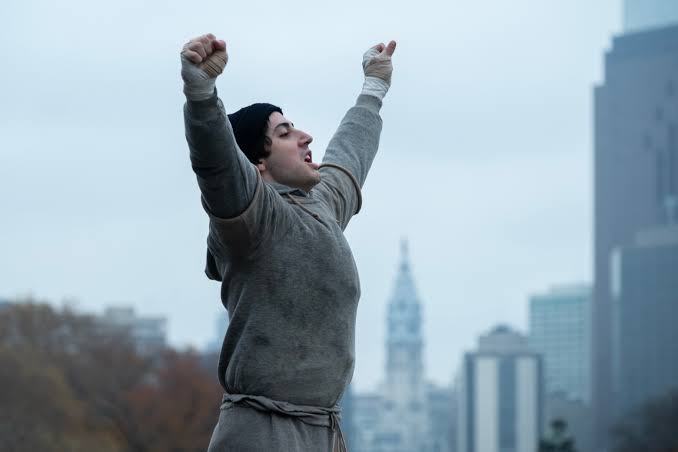
I Play Rocky

by George Wolf

Expect I Play Rocky to score a Best Picture Oscar nomination early next year. Does that mean it’s one of the ten best movies of the year? No.

But does mean it’s a very good one that pushes its feel-good buttons with skill and precision. Plus, this is the kind of film that the Academy loves. It’s about a real person with a very strong lead performance. It’s uplifting, tells a great story, and is centered in the world of filmmaking.

Of course, the film being made is Rocky, an Oscar winner itself for Best Picture in 1976. During Sylvester Stallone’s first interview on the Tonight Show to promote the film, Johnny Carson remarked that if they made a movie about how Stallone came to star in Rocky, no one would believe it. Fast forward 50 years, and you can believe it: I Play Rocky might have you shadow boxing home from the theater like so many of us did back in the day.

It is a tale of perseverance and commitment. Stallone was a down-on-his-luck, struggling actor when he began writing scripts so he could have the lead role. Producers Irwin Winkler (P.J. Byrne) and Robert Chartoff (Toby Kebbell) wanted his script for Rocky, but only as a vehicle for a big name like Burt Reynolds or Ryan O’Neal.

Sly said no. They kept throwing more money at him, believing they’d eventually hit a number he couldn’t refuse.

“No. I play Rocky.”

The rest is history, and it repeats itself here with Anthony Ippolito giving a fantastic, star-making lead performance of his own. He’s got the mannerisms, he’s got the look, he’s got the voice down, he’s got it all. And though Peter Gamble’s script doesn’t give Stallone any flawed edges for Ippolito to sharpen, he digs in to how Sly’s quiet confidence is constantly fighting to keep self-doubt and a less than supportive father (Matt Dillon) at bay. His chemistry with AnnaSophia Robb, as Stallone’s first wife Sasha, brings a tenderness to the scenes of hardscrabble L.A. life, and a stellar support cast gets scene-stealing boosts from both Tracey Letts as an exasperated studio chief and Stephan James as Carl “Apollo Creed” Weathers.

Director Peter Farrelly (Green Book) already a double Oscar winner, crafts some some truly uncanny recreations of scenes from the original Rocky. Yes, it’s good to remind everyone how great Rocky turned out. But as much as this new film respects Stallone for betting on himself, it also relies heavily on the goodwill that we already have for the source material. It would be shameless if it wasn’t so damn likable, and the acknowledgment of how important writers are in this creative process doesn’t hurt, either.

Way back when, Stallone was as big of an underdog as any unknown boxer taking on Muhammad Ali. I Play Rocky gives his fight for recognition the kind of stand up and cheer treatment that fuels a people’s champion. And a killer montage.

Screening Room: How to Rob a Bank, Victorian Psycho, Ebenezer & More

Hope & George review this week’s new releases: How to Rob a Bank, Victorian Psycho, Ebenezer, Once Upon a Time in Harlem, Mouse, and Heartland. PLUS a visit with Movie News & Notes from Daniel Baldwin, The Schlocketeer!

Hungry Like the Wolf Mask

How to Rob a Bank

by George Wolf

Don’t make it weird, but I dig it when people wear animal masks.

And How to Rob a Bank has plenty of that, along with a load of Luigi-approved anti-capitalist rage fueling its social media zeitgeist that feels especially in-the-moment.

Wait, isn’t this an Amazon movie? The irony is also special.

Nicholas Hoult is easy to root for as Ryan aka “The Wolf,” leader of a band of outlaw influencers behind the “Who’s Hungry?’ YouTube channel. They brazenly rob bank after bank in animal masks and high style and stream the result, taking the time to carefully explain how you can do it, too. And you should rob a bank, because it’s now become the only way to win a game that’s rigged against you.

Director David Leitch and writer Mark Bianculli use the group’s social videos to hit the fourth wall without breaking it, speaking directly to us and laying out the stats and figures to define how deep the rot goes.

The followers grow quickly, and though the Wolf’s declaration that “the algorithm rewards authenticity” lands with a curious thud, the belief that “audience is power” does not. And the Who’s Hungry crew (which includes another nice supporting turn from Pete Davidson) is getting plenty of both, along with a ton of money. FBI Agent John West (John C. Reilly) vows to unmask them, but he’ll need the help of an ankle-monitored coder (Zoë Kravitz) to decipher the tech he doesn’t get – like how to use AirPlay.

The Reilly/Kravitz pairing is good fun, and Bianculli gives us sympathetic moments for both the robbers and the cops while Leitch (Atomic Blonde, Bullet Train, co-founder of the John Wick franchise) frames the action with winning pizazz while the lessons get more and more spoon fed. The entire narrative sports a Fight Club for doomscrollers vibe that gives way to Third Act heist and one final “how to” surprise.

The film isn’t deeply layered, and the two-hour running time begins to feel a bit bloated, but it’s never less than timely, relatable and entertaining. You don’t need headlines or election results to know there is anger out there, and How to Rob a Bank feeds into that for an escapist good time. It may not be a standard bearer of social satire, but there’s still a place for tapping a vein that feels crowd pleasing and cathartic.

Screening Room: Godzilla Minus Zero, The Last Temptation of Becky & More

Hope & George review this week’s new releases: Godzilla Minus Zero, The Last Temptation of Becky, Jimmy, Possible Love, Silver Screamers, New Group, and The Restoration at Grayson Manor.