Tag Archives: movie reviews

Persona Non Grata

Clementine

by Matt Weiner

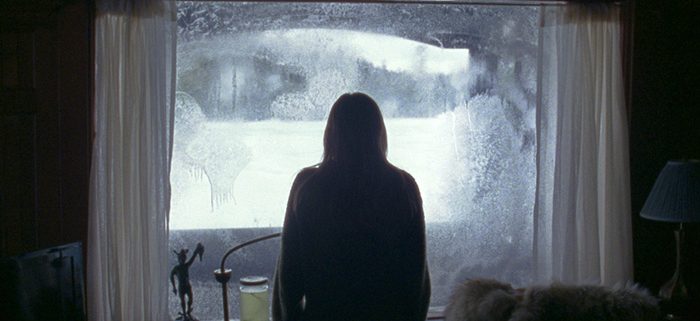
A woman trespassing in a cabin in the woods tends to foretell a very different kind of film than Clementine’s smart, sensual coming-of-age story.

But writer and director Lara Jean Gallagher’s feature debut, while exploring the relationships that make (and break) us, also doesn’t spare the menace lurking just beneath the surface. Maybe it’s the remote cabin in the woods vibe, but it’s also in large part due to the beautiful gauzy shots of the Pacific Northwest from cinematographer Andres Karu that manage to feel always just on the cusp of sliding from languid daydream to nightmare.

Gallagher brings the same inseparable emotions to the story. When Karen (Otmara Marrero) flees Los Angeles and a toxic relationship to break into her ex’s cabin in Oregon, she discovers that she’s not the only interloper in the area. A young aspiring actress Lana (Sydney Sweeney) is also crashing at a nearby house, but quickly finds herself drawn to Karen, open to either validation or love, but undecided on which would be more important.

Their relationship starts out relatively chaste, with Karen still smarting from her breakup and wary about the age gap between her and Lana. Driven by a powerful and nuanced performance from Sweeney, Lana’s mix of aloofness and desire turns even the slightest touch into a highly charged event that seems to stop time. 

There are the aching moments between Karen and Lana as the two bond over heartbreak and trauma. But the sharpest emotional insight that Gallagher brings to her tightly crafted coming-of-age story is to structure it as a psychological drama—one that gets increasingly fraught as the two women push and pull each other into their respective lives.

It makes perfect sense though. Trying to discover who we are as teenagers was horrifying enough, but Karen is an unsettling reminder that learning from these mistakes is an imperfect, lifelong process. The thought that adolescence can be a terror not so removed from Hitchcock is a sobering realization. That we might continue to repeat these traumas, and enact them on the ones we love most, is a horrifying one.

Seeking Harmony

Gay Chorus Deep South

by Brandon Thomas

On Tuesday, November 8, 2016, Donald Trump was elected president of the United States. Over the next few weeks and months, many Americans responded by organizing and protesting. The San Francisco Gay Men’s Chorus’s call to arms was quite different: tour the conservative American South. In the timely documentary Gay Chorus Deep South, director David Charles Rodrigues tackles the decades of discrimination, shame and emotion that led to this tour.

Choir director Tim Seelig has the best of intentions: he hopes to change hearts and minds with a tour of uncharted territory. Many of the choir’s members originally hail from the South, and they vividly remember the rejection and outright hate directed toward them. For these members, the tour is less about changing minds. This tour is about closing a chapter.

At times, Seelig and the choir wade directly into the belly of the beast. They appear on conservative talk radio. They meet with a church that ultimately doesn’t allow them to perform due to a newly-placed homophobic head pastor. Seelig expected these reactions, but it doesn’t soften the sting. 

The pain of past experiences vividly pours off the screen—tales of humiliation at the hands of adults who should’ve been there for protection. Seelig himself was separated from his children and cast out of the church he gave so much to. The film’s strength is in its devotion to these individual stories.

Through the choir members, Rodrigues is able to immerse the film in Southern culture rather than look at it entirely as an outsider. Seelig knows how to shrewdly navigate not only the Southern world but the religious one, too. The discrimination during the tour isn’t blatant as one would expect but is instead wrapped subtly inside the veil of Southern hospitality. This hypocrisy is something Seelig expected and isn’t afraid to constructively call out.

While politics is squarely at the forefront, Gay Chorus Deep South isn’t interested in political proselytizing. The “fish out of water” aspect to the film is political enough without dozens of talking heads telling the audience how to feel. Rodrigues wisely lets the choir members naturally move the story along as they navigate a complex, and at times uncomfortable situation.

While the music and performances are as impressive and moving as you would expect, the real heart of Gay Chorus Deep South is in those personal stories. Song and dance are easy to sell, but building community inside a structure of fear and hate takes conversation and empathy.

https://youtu.be/IGN_NDfo5gw


The Perfect Beast

How to Build a Girl

by Hope Madden

There may be nothing braver than an open heart. That kind of bravery accompanies a lack of cynicism that makes others hide their eyes. It is also what drives Coky Giedroyc’s big screen depiction of Caitlin Moran’s memoir (adapted by Moran herself), How to Build a Girl.

Though events have been condensed and details changed (including the main character’s name), Moran’s inimitable upbeat and insightful voice remains, finding its ideal avatar in Booksmart’s Beanie Feldstein.

Feldstein is Johanna, unrepentantly resilient odd duck. Friendless, in love with life, desperate for an adventure, Johanna is the fearless hero in this quest. Feldstein, aside from a few struggles with the accent, commands your attention and very best wishes. You root out loud for her.

After a local TV spot as student poet turns mortifying, Johanna’s brother (one of four) suggests she audition for a London magazine’s “gunslinger” opening as music critic. She unironically writes up a piece on the soundtrack to Broadway’s “Annie”—which nabs her an interview, but only as a joke. Undeterred, she overwhelms the smarmy hipsters into an assignment.

There are moments where How to Build a Girl transcends its coming-of-age trappings. Those are the moments when it directly quotes the book, giving us a peek inside the skill as a writer that will carry Johanna through it all.

The film bears a resemblance to Lady Bird, in which Feldstein portrayed shy bestie to Saoirse Ronan’s adolescent work-in-progress. Like Lady Bird, Johanna craves life outside her hometown. The two heroines also share a lovely knack for forgiveness (of self and others) as well as a strength for self-definition.

Feldstein’s work thus far (Neighbors 2, Lady Bird and, most notably, Booksmart) has announced her as the go-to for funny, brainy, less-than-popular teens—which is not to call her a one-trick pony. Part of her draw is her ability to carve out individuals, to recognize and unveil the human heart inside each girl. Her charisma is almost blinding in this film.

That’ll help you miss some of the weaker elements. Minor characters are allowed little opportunity to develop and the story feels boiled down to the most obvious plot points. There is nothing superficial about Johanna, but the film itself fails to dive far enough beneath the surface to do her justice.

Moran’s audacious humor sometimes feels muted, and that is an outright shame. Nonetheless, Feldstein’s a 1000 watt bulb who makes even the most ordinary scene glow happily. There is also something fearless in a film that decides it is up to every girl to build and rebuild herself in her own image.

No Mountain High Enough

South Mountain

by Cat McAlpine

Lila is trying to hold it together, but things keep falling apart. Her best friend has cancer. Her daughters have both left for the summer. Her husband might be leaving forever. The ants will be back soon.

Written and Directed by Hilary Brougher, South Mountain refuses to settle into one place.

At first, we follow the youngest daughter, Dara (Naian González Norvind), back home from the woods. Then the older daughter, Sam (Macaulee Cassaday), arrives home before her big sail across the Atlantic. We discover that father Edgar (Scott Cohen) has a secret. Gigi (Andrus Nichols) has a lump and her daughter is scared. Everyone has an opportunity, even if glancing, to be the main character. Life’s like that.

But it is Lila (Talia Balsam) with whom the camera stays. Lila is at the center of it all.

There is only one reference, in passing, to South Mountain’s namesake but the title still fits the tone of the film. Brougher never lets you forget how close the outside world is or how integral it is to this family’s backdrop.

We see nature in micro and macro as Lila’s journey comes in and out of focus. The credits open on a nearby waterfall, but as the story narrows, the details get smaller and more mundane. Flies are constantly zooming around the dining room. Fresh blackberries are picked for dessert. We even get a look inside the compost bin because life and leftovers are messy.

The narrative is loose. Sometimes new scenes are introduced with a date stamp. “June 22nd”, announces one, in unassuming white letters. Other scenes come and go without any anchor. The clothes change, the light shifts, and you simply realize that this must be a different day. Time never seems to move linearly, but it does keep moving forward. Paired with a shifting focus at the start, Brougher paints a more realistic story of grief and acceptance where some days matter and some do not.

Overall, what carries South Mountain is Balsam’s fantastic performance. The story can be too slow and too scattered at times. But it’s impossible to not keep watching Balsam as she moves from self-assured to train wreck to something in-between.

Is Lila going to be okay? There won’t be a definite answer but it’s worth the journey. Life’s like that.

I Can’t Go Out – Week of May 4

If you are feeling stir crazy, you’re starting to believe your own trapped family is leading you to lunacy, maybe even murder, have we got the movie for you! Indeed, it’s a stellar week for horror fans. Read on!

Click the film title to link to the full review.

The Lodge

Tigers Are Not Afraid (DVD)

Gretel & Hansel (DVD)

Greed (DVD)

Bloodshot (DVD)

I Still Believe (DVD)

She Said She Said

What She Said: The Art of Pauline Kael

by George Wolf

Even with the fragmented and ubiquitous nature of film criticism in the social media age, Pauline Kael’s summation may still be the best.

Kael believed it was her job to “alert or interest people,” and without critics, “it’s all advertising.”

Falling into a movie reviewing gig almost by accident in the 1950s, Kael rode her obvious passion and expressive prose to a seat of tremendous power in the film industry. Many credit her positive review of Bonnie and Clyde with saving the film from ruin, while her negative reaction to Lawrence of Arabia made director David Lean question his future.

For What She Said: The Art of Pauline Kael, writer/director Rob Garver gathers interviews with Kael, her daughter and various film industry faces, weaving in passages from Kael’s writings amid snippets – with occasionally cheesy placement – from hundreds of movies.

It’s a spirited, engaging celebration of not only Kael, but of film itself as a source of entertainment, inspiration and discussion.

Garver supplies pertinent biographical info, showcasing Kael’s unlikely rise through sexist attitudes and editors uneasy with a critic unafraid to buck popular sentiment. And though it never quite feels as if we get to know Kael well, Garver makes sure we are aware of her complexities and contradictions.

She was grateful to be “paid for thinking,” not caring much about dissenting opinions or any hurt feelings on the other end of her sharpest barbs. She championed American New Wave cinema, but openly dismissed arthouse elitism for a populist lean, favoring sentences with the “sound of a human voice.”

It is that voice that speaks loudest in What She Said, with clear illustrations of how her self-assurance (and yes, self-promotion) elicited hatred, praise, and even the respect of those whose work fell below her standards.

And though Kael died in 2001, the film’s parting shot shows her approach as one both original and prescient. Putting some of Kael’s memorable thoughts inside imagined tweets, Garver leaves little doubt her following today would be impressively large.

That’s what she said.

Killer Style

Deerskin

by Hope Madden

What makes a good midlife crisis? What gives it swagger? Physicality? Style? Maybe a little fringe?

Deerskin.

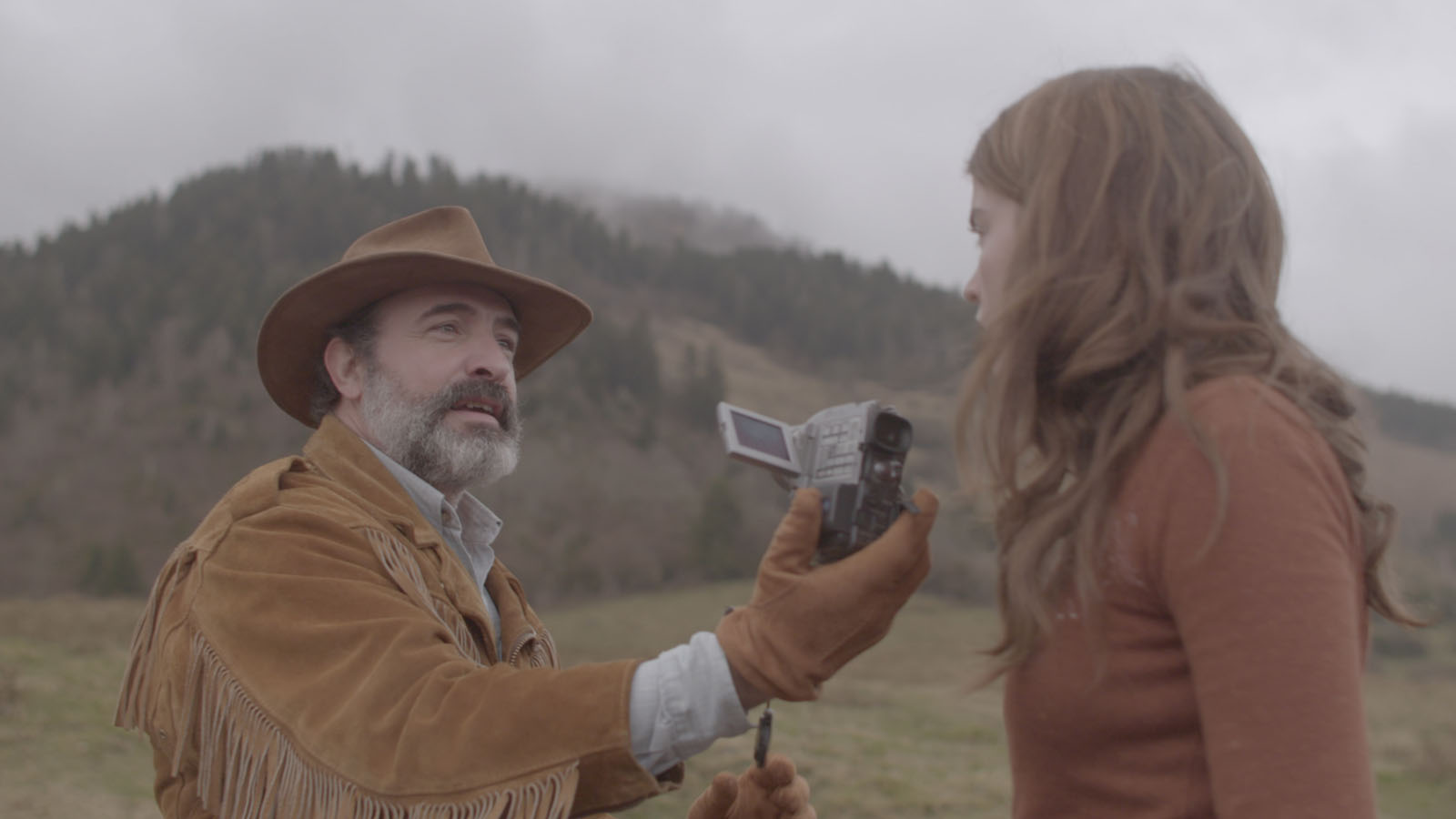
Oscar winner Jean Dujardin (The Artist) is Georges, a man willing to pay an awful lot for a jacket—so much that his wife locks him out of their account. No matter, Georges will just hole up in this little French town, learn how to use the digital camera that came with his purchase, and spend some quality time with his new jacket.

If that sounds absurd, it should. You’ve just stumbled into the one-paragraph synopsis of the latest bit of lunacy from filmmaker Quentin Dupieux. As he did with 2010’s Rubber (a sentient tire on a cross-country rampage), Dupieux sets up one feature-length joke.

It’s funny, though.

Again the filmmaker draws hysterically deadpan, even confused performances from the many nameless characters supporting his leads. Adèle Haenel (Portrait of a Lady on Fire), playing town barkeep and would-be filmmaker, offers a wily and enjoyable counterpoint to Dujardin’s earnestness.

Aside from a couple of utterly priceless Dupieux flourishes, it’s Dujardin that sells this film. He’s deeply committed to the wildly wrong-headed internal logic of the film and the character. There’s an underlying sadness to it, and the willful obliviousness required of a character so willing to commit to a plan as ludicrous as Georges’s. He’s wonderful.

Deerskin is also slyly autobiographical in a way Dupieux’s other films are not. An odd duck wants to follow his vision (in this case, the obsessive love of a deerskin jacket) and make a movie. Creative partnerships and collaboration, while possibly necessary, also soil the vision and make the filmmaker feel dumb.

No one understands him!

Or maybe they do and his ruse is up.

No matter. He still has killer style.

I Can’t Go Out – Week of April 28

The time will come within weeks that we have no post-theatrical releases to discuss. How insane is that? Until then, you can pass the time with two early 2020 releases that, according to box office, you probably missed. Both are worth a look – one is actually excellent.

Click the film title to link the complete review.

The Assistant

The Rhythm Section

Dishonor Among Thieves

The Wild Goose Lake

by Brandon Thomas

A vicious fight breaks out between rival gangs. Chairs fly. Knives are pulled. A spectator takes a bite of a pickle. A man has his prosthetic leg pulled from his body. 

And this is all within the first 10 minutes of The Wild Goose Lake.

Small-time mobster Zhou Zenong (Hu Ge) finds himself in the spotlight after mistakenly killing a police officer during a turf dispute with another gang. With dozens of police searching for him, and rival gangs looking to collect the bounty on Zhou’s head, he’s forced to team up with a mysterious woman (Gwei Lun-mei) and go on the run.

In the grand tradition of so many other neo-noir films, Wild Goose Lake walks a tightrope of mood and style. Many scenes play out long and with few cuts – drawing out the tension. The maze of buildings, streets and corridors are shot deep in shadows. The visual claustrophobia unsubtly mimics that of the main characters. And when the violence hits – it hits quickly and brutally. 

The depiction of violence is where the black humor comes out. There’s more Sam Raimi and Peter Jackson in the violence here than there is Francis Ford Coppola. A killing involving an umbrella had me hooting and clapping my hands in delight. Not to mention the inventive decapitation via forklift.

Hu Ge makes for a stoic lead as Zhou. At the beginning of his story, Zhou is a perfect example of cool, calm, and collected. In the opening fight, he casually dispatches opponents in a flurry of fists and kicks. Sharp contrast to later in the film when Zhou more or less resembles a trapped animal.

Gwei Lun-mei is equally impressive as the standard femme fatale, Liu Aiai. Like any good noir femme fatale, Liu’s motives remain murky at best. Like Zhou, Liu’s resolve begins to crumble as the weight of their situation bears down on her. Gwei does a terrific job of adding subtle layers to Liu. 

It’s hard to look at Wild Goose Lake and not be reminded of Fritz Lang’s noir masterpiece M. In M, Peter Lorre famously plays a serial killer hunted by both the police and the criminal underworld. The narrative themes and strong visual cues helped shape the noir genre as we know it today.

By embracing what makes film noir so riveting, Wild Goose Lake manages to satisfy movie lover’s expectations, and sometimes soar above them. 

Born in a Small Town

Pahokee

by George Wolf

If you’re the parent of a current high school senior, you’ll find some extra poignancy in Pahokee, an observational doc that follows four small town Florida teens through their last year at the predominantly African-American Pahokee High School.

B.J. is the football star on a team dreaming of a D1 State Championship. Jacobed is the Salutatorian who helps out at her parents taco stand. Junior already has a child at home. Na’kerria is running for “Miss PHS” and weighing community college vs. the full university experience.

For their first documentary feature, directors Patrick Benson and Ivete Lucas take a hands off, leisurely approach that gives the events plenty of room to breath – sometimes a little too much room. Some obvious questions (where’s the mother of Junior’s child?) are ignored in favor of following strands that could have been trimmed in a tighter edit.

But the film still finds its resonance in moments both large and small. From the face of the older white Harvard rep at the college fair, to Jacobed’s emotional description of her parents’ sacrifice, to the prom dress adorned with pictures of Trayvon Martin and other victims of excessive force, Pahokee serves plenty of subtle, evocative sequences that will make you care about these kids.

The further you are away from high school, the easier it is to dismiss what the class of 2020 has lost this year. Pahokee‘s class of 2017 serves a tender and truthful reminder of a crossroads unlike any other.