A bunch of movies to cover this week in The Screening Room, including Fast & Furious Presents: Hobbs & Shaw, The Farewell, Luz, Sword of Trust, Leo Da Vinci: Mission Mona Lisa as well as a whole slew of new movies available to watch at home.
Somewhere around its 6th installment, the Fast & Furious franchise tweaked its direction, abandoning logic and embracing ludicrous action as it jumped cars from skyscraper to skyscraper and waterskied off the back of launched torpedoes.
But things took off for real around Episode 7 when some mad
genius decided to pit mountainous government operative Hobbs (Dwayne Johnson)
against Limey nogoodnik Deckard Shaw (Jason Statham), each of them playing a
self-lampooning version of themselves. Fun!
Where to go from there? How about we drop that whole car
heist and espionage thing, expel Vincent Toretto and gang, bring in Idris Elba
and see what happens?
And for the very first time, I was kind of looking forward to a F&F film.
Fast & Furious Presents: Hobbs & Shaw boasts more than ampersands. Internal logic? Cohesive plot? Thoughtful insights on man’s inhumanity to man?
Why, no.
Cheeky fun? Indeed!
The film indulges in the best elements of F&F (action lunacy, self-aware comedy) and dispenses with its weaknesses (schmaltz, Diesel). F&F: H&S consists primarily of fistfights, gun fights and vehicular chicanery stitched together with comic lines. Unfortunately, there is a plot, but it doesn’t get in the way too much.
A virus meant to thin the herd falls (or is injected!) into the hands of a rogue (or is she?!!) MI6 agent. The CIA (or is it?!!!) pulls together the two old enemies for no particular reason, but Ryan Reynolds shows up in a decidedly peculiar cameo (one of several to look out for) that draws your attention away from the first of many gaping plot holes.
By this point (about 7 minutes into the film) we’ve been
through three separate fight sequences, each meant to articulate the character
of one of our leads: down-and-dirty badass (Hobbs), smoothly lethal sophisticate
(Shaw), smart and efficient and highly contagious (Vanessa Kirby as MI6 virus
thief Hattie), and Black Superman (Idris Elba, who gives himself the name, but
if it fits…).
Right. Enough with plot, on to stupifyingly illogical and imaginative action. Hobbs & Shaw offers quite a spectacle.
It bogs down when it gets away from the explosions, wheelies and punches. Whether devoting excessive time to pissing contests or to dysfunctional family backstories, director David Leitch—who proved his action mettle with Atomic Blonde—too often forgets that words are not this franchise’s strongest suit.
Still, there is something compelling about watching Black Superman V Samoan Thor. I don’t know that there’s enough here for a franchise springboard, but there’s plenty for a wasted afternoon.
Fast, brave and baffling, Tilman Singer’s experimental demon thriller Luz enters hot, exits quickly and leaves you puzzled. In a good way.
The film begins with a nightmarish vision leeched of color, as battered young cabbie Luz (a letter-perfect Luana Velis) tumbles into a banal police station lobby shouting about how the receptionist wants to live his life. Soon she’s seated in an equally bland hallway, mumbling blasphemies to herself in Spanish as two German police officers—one who doesn’t understand and one who refuses to translate—look on.
Meanwhile, in a dive bar across town…
It makes little sense to summarize the plot because the fairly slight premise unfolds in front of you, offering as many questions as answers. To spoil that seems pointless.
There is something fascinating happening in this film, though, and Singer has no real sense of urgency about clarifying what that is. Seedy, lifeless places become environments where those as baffled as we bear witness—or don’t—to a patient if tenacious courtship of sorts.
It all begins in dehumanizing but fascinating wide angle shots. Slowly, clip by clip, Singer draws us in closer to the diabolical unfolding in our midst. It’s the deconstruction of a possession film, a bare-bones experimental feature that hangs together because of its clever turns, solid performances and Singer’s own technical savvy with sound design.
Running about 70 minutes and boasting no more than 6 speaking roles, Luz is surrealism at its most basic, storytelling at its sparest.
Happy QT Day, everyone — that rare and special holiday where moviegoers love a movie made by an unabashed lover of movies. And this time, he’s made a movie about loving the movies.
It’s Once Upon a Time…In Hollywood, Quentin Tarantino’s clearest love letter to cinema both great and trashy. Spilling with nostalgia and packing more sentiment than his previous 8 films combined, Hollywood is the auteur’s most heartfelt film.
Not that it isn’t bloody. Once it hits its stride the film
packs Reservoir Dogs-level brutality into a climax that’s as nervy as
anything Tarantino’s ever filmed. But leading up to that, as the filmmaker asks
us to look with a mixture of fondness and sadness at two lives twisting toward
the inevitable, he’s actually almost sweet.
One of those lives belongs to Rick Dalton (Leonardo
DiCaprio), a one-time TV Western leading man who’s made a couple of poor career
choices and seems to be facing obsolescence. This would mean, domino-style, the
obsolescence of his best friend and stunt double with a sketchy past, Cliff
Booth (Brad Pitt).
But that’s not the second story, which instead belongs to the real life tragedy of Sharon Tate (Margot Robbie). Set in the LA of 1969, Once Upon a Time…In Hollywood uses the Manson family crimes (marking its 50th anniversary this August) as the thematic underpinning, a violent metaphor for the end of two eras.
Tarantino being Tarantino, though, he’ll use the movies to
make everything better.
From the foot fetish (more proudly on display than ever) to the familiar faces (even one who made the cutting room floor and the credits), the hiply retro soundtrack to the inky black humor, Hollywood hides no Tarantinoism. But the film establishes a timestamp more precisely than any of his other works. And on the whole, he shows unpredicted restraint.
The film moseys through the first two acts, with long, deliberate takes full enough of pop culture as to completely immerse you in time and place. Tarantino again frames sequences with alternating levels of homage, but dials back the dialogue from his usual quick-hitting crispness to measured ruminations often thick with intention.
In strokes stylish and self-indulgent, Tarantino is bidding adieu to halcyon days of both flower power innocence and the Hollywood studio machine. Here, he’s looking back on the Manson murders as a dividing line, and again wondering what might have been.
For us QT aficionados, Hollywood may feel at first like an odd, overlong duck, but its wandering nature gives you ample time to adjust. The cast shines from top to bottom, propelling an entertaining vision of humor and blood and irony and bittersweet nostalgia.
For fans, there is something endlessly fascinating about
Leonard Cohen. Maybe it’s because, regardless of the volume of his work—songs,
novels and poems—or the intimacy of his words, it’s still impossible to feel as
if you know him.
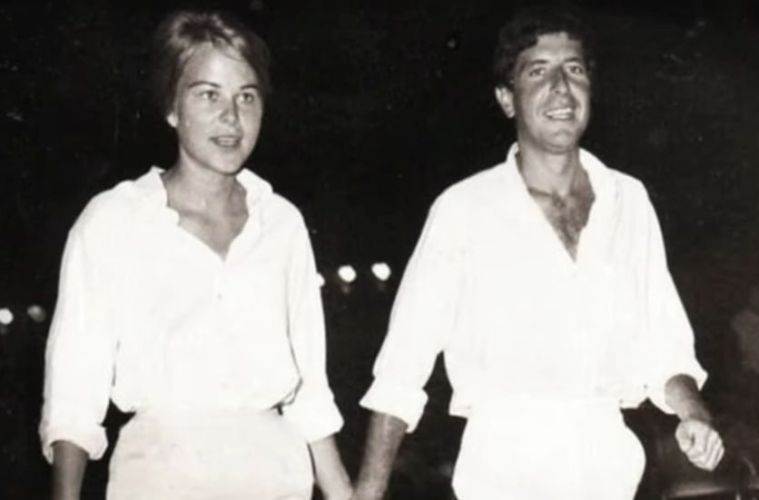
In Nick Broomfield’s latest documentary, Marianne & Leonard: Words of Love, it’s clear that Cohen’s longtime companion and eternal muse Marianne Ihlen felt the same way.
Ihlen inspired the Cohen classic So Long, Marianne, obviously, as well as dozens of others including Bird on a Wire. The two had one of those Sixties relationships—open but committed, tumultuous but loving, and ultimately doomed.
For eight years they lived together, on and off, along with Ihlen’s son Axel in a humble cottage on the Greek island of Hydra. An artists’ refuge of sorts, it was the kind of pre-hippie paradise where eccentrics engaged perhaps too freely in freedom.
It was there that Broomfield first met Ihlen. Their friendship and the director’s clear fondness for his subject give the film a fresh and odd intimacy.
Though his personal connection to Ihlen is an interesting inroad into this story, the doc sometimes feels like two separate and uneven pieces sewn together.
That seems partly appropriate, given that Leonard and Marianne spent increasing spans of time apart as the years wore on. And there’s no question that—for Leonard devotees, at least—the behind the scenes footage of Cohen on tour in the Sixties, commentary from his bandmates, and snippets of background intel from close friends is as engaging as it is enlightening.
Unfortunately, we lose Marianne almost entirely by Act 2.
The titular character becomes a bit of a ghost, and not even one who looms
large over the material in the foreground.
Of course, as the film was made posthumously (both Ihlen and Cohen died in 2016), their own insights are limited. In this way, though, Ihlen’s presence outweighs Cohen’s in that Broomfield dug up audio conversations in which she discusses the relationship.
The lack of Cohen’s own thoughts on their pairing—outside of one or two rambling, drug-riddled onstage song intros—makes its absence known.
Still, there is a melancholy beauty in the way Bloomfield’s documentary—his love letter to Marianne and Leonard—follows Cohen’s song lyrics, telling of a fractured, unconventional but nonetheless loving connection.
Indeed, it is Cohen’s final words of love to Ihlen, a note sent to her hospital room as she lay dying, filmed at her request, that illustrates that very point.
A bit disjointed but never uninteresting, Words of Love is an often compelling look at the relationship between muse and artist. For Cohen fans, it’s required viewing.
So, there’s this great animated movie that no one saw. It probably isn’t entertaining enough for the littlest kids, but everyone else should see it. There’s also a middling action flick and a sad, sad reboot.
Viscosity! That’s the name of the game today, and it’s a messy, messy game to play.
Today we slip and slide through the sloppiest movies we could find as we count down the most inspired use of body fluids in horror. The whole mess is recorded live at Gateway Film Center, so please listen.
And don’t forget to bring a towel!
5) Don’t Breathe (2016)
Fede Alvarez’s magnificent home invasion horror made this list, beating out the projectile vomit of The Exorcist, the melting bums of Street Trash, the medical what-not of Re-Animator and the viscosity of other films. How did it do it? It was not because of volume.
It’s really just the one scene.
The one with a turkey baster.
The one with the single hair.
Ew.
4) Dead Alive (1992)
The list doesn’t exist without Peter Jackson, let’s be honest. Any old horror director can work with blood. Jackson certainly can. That party scene? The arterial spray poor Lionel Cosgrove causes with his lawnmower is truly a site to behold.
But what Jackson can do with pus and a bowl of custard? Chef’s kiss right there.
3) We Are the Flesh (2016)
Emiliano Rocha Minter loves him some taboos. No one bursts through taboos like him – well, Takashi Miike, maybe.
He also really loves body fluids. We mean all the body fluids. His 2016 social commentary swims them all. All all all.
Taboos and body fluids. Sloppy!
2) Evil Dead (2013)
Peter Jackson’s Dead Alive held the record for most blood in a film – 1000 gallons – until 2013.
It’s a record Sam Raimi’s earlier Evil Dead franchise efforts had once held, but Fede Alvarez (making his second appearance on this list!) drenched all records when he poured out 50,000 gallons of fake blood in a single scene.
Allegedly It Chapter 2 tops that, but I don’t know how you out-soak a torrential downpour of blood.
Gozu (2003)
Who’s not afraid of taboos? Well, the great and prolific Takashi Miike has no fear of body fluids, either. Hell, Ichi the Killer’s title screen is done in semen and one of Audition’s most memorable moments sees a multiple amputee eating his mistress’s vomit.
But with Gozu, Miike’s not holding back: blood, urine, semen, lactation, pus and other discharges I’m not sure how to even categorize. Gozu is an inspired, viscous mess.
Do you know Alice Guy-Blaché? Documentarian Pamela B. Green thinks you should.
She is clearly right.
Guy-Blaché’s groundbreaking career has not been celebrated in the same way as her historical counterparts. She was not only the first female filmmaker, she was among the first four filmmakers, period. She boasts an output of around 1000 films, among them the first narrative film, the first color tinted, and one of the first two films with synchronized sound.
And yet, of the dozen or so filmmakers and actors Green interviews in the opening montage, including Geena Davis, Peter Farrelly, Catherine Hardwicke, Peter Bogdanovich and Ava DuVernay, only DuVernay recognizes the name.
Says Bogdanovich, “I’ve spent my life making films and have
written for years about film and I’ve never even heard of her.”
Well, clearly Peter Bogdanovich never took a Women in Film
class at Ohio State.
Whether you have or have not heard of Alice Guy-Blaché, Green’s film is bound to be informative, showcasing a figure with remarkable aptitude not only in business (she ran her own studio and produced her own films) but amazing artistic vision, pioneering much of the comedic and dramatic form we now take for granted.
Jodi Foster lends respectful narration (and spot-on French pronunciation!) to an earnest and loving—if sometimes tedious—exploration.
Green’s film is at its best during rare interview footage of the filmmaker, at the time nearing the end of her life and taking a wistful, reflective posture. Between that, footage from Guy-Blaché’s canon, and responses from modern filmmakers on that footage, Green pieces together some engaging and illustrative moments.
Her film gets sidetracked too easily, though, answering questions from those very filmmakers who did not recognize Guy-Blaché’s name, “I would like to see inside her studio,” “I’d love to hear how she managed to be a filmmaker and a mother during that time period…”
These offshoot moments feel disjointed, lessening the
intimacy with the subject the more successful moments nearly reach.
Green’s biggest misstep as a filmmaker is her preoccupation with her own sleuthing, some of which feels endearing in its enthusiastic amateurishness, but too often comes off as needlessly self-congratulatory.
Though Green herself struggles to create a film artistically worthy of the pioneering filmmaker, her heart is in the right place and her quest to help Guy-Blaché reclaim her own place in cinematic history is laudable.
In 2011, filmmaker Lucky McKee unleashed the subversive, feminist horror jewel The Woman to a lot of boos at Sundance. It’s tough viewing, no doubt—the screener we were sent to review prior to its release arrived wrapped in a vomit bag—but it amounted to an envelope-pushing miracle of modern horror.
The film itself was a sequel to the underwhelming 2009 cannibal horror penned by Jack Ketchum, Offspring. The point of both films was that only a doomed moron underestimates Pollyanna McIntosh.
McIntosh (The Walking Dead) returns to the feral, nameless role that’s caused such a ruckus over the years, this time taking charge of the woman’s trajectory by writing and directing the latest installment, Darlin’.
Darlin’ picks up some years after the end of The Woman. McIntosh’s alpha and Darlin’ (Lauryn Canny), the adolescent whose grown in her care since the events of McKee’s flick, approach a hospital. Filthy, communicating with grunts and probably smelling pretty foul, the two split up as the girl enters the hospital.
To the dismay of the unrealizing Woman, the system’s not about to let her back out.
What follows is a sloppy, superficial finger-wagging at
Catholicism, which is unfortunate. Not because the church deserves more respect
than that—it doesn’t, really—but because there may be no lazier strawman in
horror right now than the Roman Catholic Church, and McIntosh doesn’t even
bother to get a single dogmatic or ritualistic point accurate.
Let me pause. Pollyanna McIntosh is a sort of hero of mine and The Woman is an all-time favorite. You have no idea how much I wanted to like this film or how much slack I was likely to give. The raw truth is that very little about the film merits praise.
McIntosh still cuts a mighty impressive figure as the nameless beast running the show. Canny, however, struggles with her Tarzan-style dialog.
The always capable Nora-Jane Noone, playing the church’s one good nun, serves mainly as a painful reminder. Those of us who saw her breakout film The Magdalene Sisters remember how cinematically powerful the horrors of Catholicism really can be.
There’s an underfed side plot about a loving nurse and an
ill-fitting storyline about a group of homeless women, all of which coalesce with
the evil priest core story in a bat-shit climax that almost makes the ride worthwhile.
It’s unfortunate, because there are three or four moments in this film of unique, subversive horror. They flash across the screen and then are gone, drown out by lazily written, listlessly directed cliché.