Tag Archives: movie reviews

Run Through It

The River and the Wall

by Rachel Willis

Director Ben Masters has an interest in the land along the Rio Grande. In making The River and the Wall, he hopes to show us what makes the area so special.

Along with four companions – two wildlife filmmakers, an ecologist/ornithologist, and a Rio Grande river guide – Masters embarks on a weeks-long, 1200-mile trip from El Paso, Texas to the Gulf of Mexico. They travel along the Rio Grande, the potential site of a border wall that, if erected, would have a lasting, devastating impact on the land.

Most of the film screens like an adventure tale. The companions travel by mountain bike and mustang in places where the river is too shallow for boats. When the river is passable, they journey by canoe. By making the trip in this way, they hope to show the difficulty of the journey in numerous places. It’s an imperfect attempt to emphasize the unlikelihood that immigrants would choose these routes when attempting to cross into the United States.

Along the way, we meet people on both sides of the border. If there are people who live in these areas who are in favor of the wall, Masters and team don’t meet any. From people living in Mexico to ranchers in Texas, everyone recognizes the potential negative consequences to the proposed wall. Even the area U.S. representatives in Congress, Beto O’Rourke, a Democrat, and Will Hurd, a Republican, are opposed to the wall. Hurd states that building a wall “is the most expensive, least effective” method for border security. It’s a rare show of bipartisanship that should give those opposed to the wall some hope.

The cinematography is essential in a film that wants to impart upon the audience the beauty, vastness, and treachery of the land, and the crew is up to the challenge. Numerous shots highlight the diversity of the landscape as the five friends make their way along the river.

In some ways, The River and the Wall effectively states its case that the area around the Rio Grande should be protected. Ecologist Heather Mackey mentions over 150 bird species live in the area, some of which are only located in this area. A wall would disrupt migration patterns, bulldoze protected natural areas, and in effect, cede nearly 1 million acres of U.S. land to Mexico.

However, it is unlikely the film will change the minds of those in favor of the wall. Most likely because they won’t even bother to see it.

I Don’t Want to Go Out–Week of April 29

What’s worth watching this week? Most everything, really, even though one is more of a train wreck kind of thing.

Click the film title for the full review.

Arctic

Dragged Across Concrete (DVD)

The Hole in the Ground (DVD)

I Trapped the Devil

Serenity

I’ll Be You

JT LeRoy

by Hope Madden

Do you remember the JT LeRoy hubbub? Maybe you confuse it with the similar hullaballoo surrounding James Frey, author of A Million Little Pieces, the memoir that turned out to be highly fictional?

Please don’t. LeRoy’s bizarre fake nonfiction and ensuing scandal is so much more interesting.

Jeremiah Terminator LeRoy is a hoax perpetrated on an almost grotesquely willing public. Laura Albert, a frustrated writer, master manipulator and likely sufferer of mental health issues, invented LeRoy.

More than the nom de plume used to pen Sarah and The Heart Is Deceitful Above All Things, LeRoy became Albert’s literary persona. Albert herself didn’t exist in this world. She became LeRoy, the writer of lurid “autobiographical” pieces that, together with a mysterious nature, won the hearts of readers, media and celebrities alike.

In fact, Jeremiah Terminator LeRoy became so popular that he had no choice but to show his nonexistent face.

Enter Albert’s sister-in-law, Savannah Knoop.

The weird true-life tale of LeRoy’s fake-life tale has been documented twice in works of nonfiction (the documentaries The Cult of JT LeRoy and Author: The JT LeRoy Story, both worth viewing). Director Justin Kelly is the first to make fiction of the fiction with his aptly cast film, J.T. LeRoy.

Though the film doesn’t offer a great deal of insight beyond what you can glean from the two documentaries, it takes Knoop’s point of view for a refreshing change of pace. But its real strength is the film’s cast.

Kristen Stewart makes the ideal choice to play Savanna/JT. Effortlessly androgynous, moody, sensual and conflicted, Stewart gives the character a vulnerable center, balancing Knoop’s motivation between a sense of duty to Albert and a personal longing for artistic expression.

Naturally, Laura Dern shines, stealing scenes and oscillating between free spirit and opportunist. She does a fine job of illustrating Abbot’s view of creating this other personality who can take on her own pain, can amplify that pain and turn it into both an escape and art. At the same time, Dern’s the schemer, the survivor manipulating those around her. It’s interesting the way the veteran character actor weaves between artist and manipulator in a context that questions the difference between fiction and fraud.

The two leads become a great point/counter point and the film is strongest in their shared scenes. When JT wanders off alone, burdened by puppy love or struggling to keep up a persona of another’s creation, a certain spark goes out.

That’s not to say that the balance of the cast falters. Diane Kruger is particularly slippery as Eva, a thinly veiled version of Asia Argento. But as intriguing as her interplay is with JT, you miss the constant push and pull of wills when Stewart and Dern work off each other.

https://www.youtube.com/watch?v=w_UdqhTF9Fo

Game of Stones

Avengers: Endgame

by MaddWolf

“How many of you have never been to space before?”

There is a lot to resolve in Avengers: Endgame, but it’s the film’s commitment to character and character relationships as articulated by fun, throwaway lines like that, that continue to elevate this series above its single-hero franchisees.

The Avengers who haven’t yet done space travel put up their hands, and it instantly rings true, underscoring a pillar of the MCU.

In every group setting, the different heroes don’t fight for opportunities to remind viewers who they are—the angry one, the sarcastic one, the winsome one. Instead, each reacts to another character; duos and trios bicker or riff, and true character dynamics emerge.

Directors Anthony and Joe Russo, and writers Christopher Markus and Stephen McFeely, Marvel vets all, return to reap what they’ve been sowing for years. With that veteran cast bringing instant investment to their respective roles, the filmmakers cultivate relationships Joss Whedon sparked back in 2012 when he first put Tony Stark, Steve Rogers, Bruce Banner and Thor at the same table.

You may have heard, Endgame goes to new lengths in the MCU: three hours and one minute, to be precise. While you might skip the jumbo soda to avoid restrooms trips, you won’t begrudge this film its time. In fact, give Marvel props for not splitting it into two separate blockbusters that would have diluted the impact of such an apt, respectful and yes, emotional capper to the saga.

There’s plenty of humor here, as well, but never at the expense of the drama or action developing. Rather, it’s the natural ribbing born of well worn, familial relationships. (One Lebowski comment and another about “America’s ass” both land really well.)

On the other hand, we still cannot get behind where this series has taken the Hulk. These developments may have comic-book roots, we won’t pretend to know, but outside of a memorable scene with The Ancient One (Tilda Swinton) this Hulk is no smash.

Thematically, the film thinks big: time, love, loss, sacrifice. It moves impressively from ruminating on a post-9/11 reality to the importance of cherishing your own time and place, even while you accept the challenge of fighting for a better world.

There is plenty of fighting. The action is well-placed and well-presented, delivering fireworks without the dizzying, rapid-fire editing which can often reduce battles royale to battles of patience.

And we need to clearly see who is doing what when these Avengers assemble, because, let’s be honest, Thanos (Josh Brolin) and his Infinity Stones are a tough out, and it’s going to take all hands on deck to take him down.

For any upset fanboys who might still be wondering, that does include female heroes, a fact the film makes inescapably clear with a sequence that’s well-intentioned but maybe a tad pointed (or tardy?) in its parting defiance.

In the months since Infinity War, there have been plenty of theories about how Marvel will address that mountain of a cliffhanger they dumped on us.

Maybe you’ll guess some of it, maybe you won’t (you probably won’t), but wherever the MCU goes from here, Endgame is character capital well-spent,

As long goodbyes go, this one is satisfying and …pretty marvelous.


The Mancunian Candidates

Peterloo

by Matt Weiner

It should be a match made in heaven: British director Mike Leigh channeling an uprising that pitted reactionary government leaders against a working-class population with radical demands for reform.

And for a historical drama that revolves around grain tariffs as a pretty important plot point, Leigh succeeds on one key front: Peterloo abounds with righteous indignation, from start to finish. This comes at the cost of Leigh’s usual nuanced character sketches, though.

The radical reformers, journalists and magistrates inhabiting 1819 Manchester still benefit from Leigh’s verbal fireworks. On one side, there are the aristocrats and rulers living in real fear that even the British triumph at Waterloo might not be enough to quell the spirit of the French Revolution. And then there is the unruly mob: disparate factory workers, reformers and women’s groups seeking a number of Parliamentary reforms and representation.

Agitators are literally read the Riot Act. Harrumphs and harangues come in equal measure. There’s even an impassioned debate about the merits of centrism vs. proto-Antifa at political rallies. Peterloo isn’t wanting for passion, but where the whole thing falls short isn’t that it’s a polemic—Leigh is still a formidable talent when it comes to making a period piece feel relevant, even urgent.

Which makes it all the more frustrating to see the film so weighed down by its singular, bluntly fired message that much of the cast doesn’t get a chance to inhabit their roles as much as they mostly bluster through them. Real-life figures Henry Hunt (Rory Kinnear) and Samuel Bamford (Neil Bell) are among the more memorable orators, but it is Karl Johnson who looks like he’s having the most fun as the cruelly indifferent Lord Sidmouth, the Home Secretary.

The cast of characters to keep straight is large but they’re drawn in absurdly broad strokes so you can easily track who’s under the boot and who’s wearing it. For all the impassioned speeches, it’s ironic that Peterloo winds up feeling far less humane than Leigh’s other historical masterpieces, especially 2014’s Mr. Turner. (That film owes much to Timothy Spahl’s tour de force lead, but Leigh’s generous script also balanced grace with uncompromising characters in a way that’s sorely missed in Peterloo.)

Long-time Leigh cinematographer Dick Pope comes back along for the ride, but his presence is also missed for much of the 150-minute runtime. I assume the working-class Manchester milieus are sufficiently gritty, but it doesn’t really matter. Most of the (copious) meeting scenes feel as perfunctory as the characters themselves.

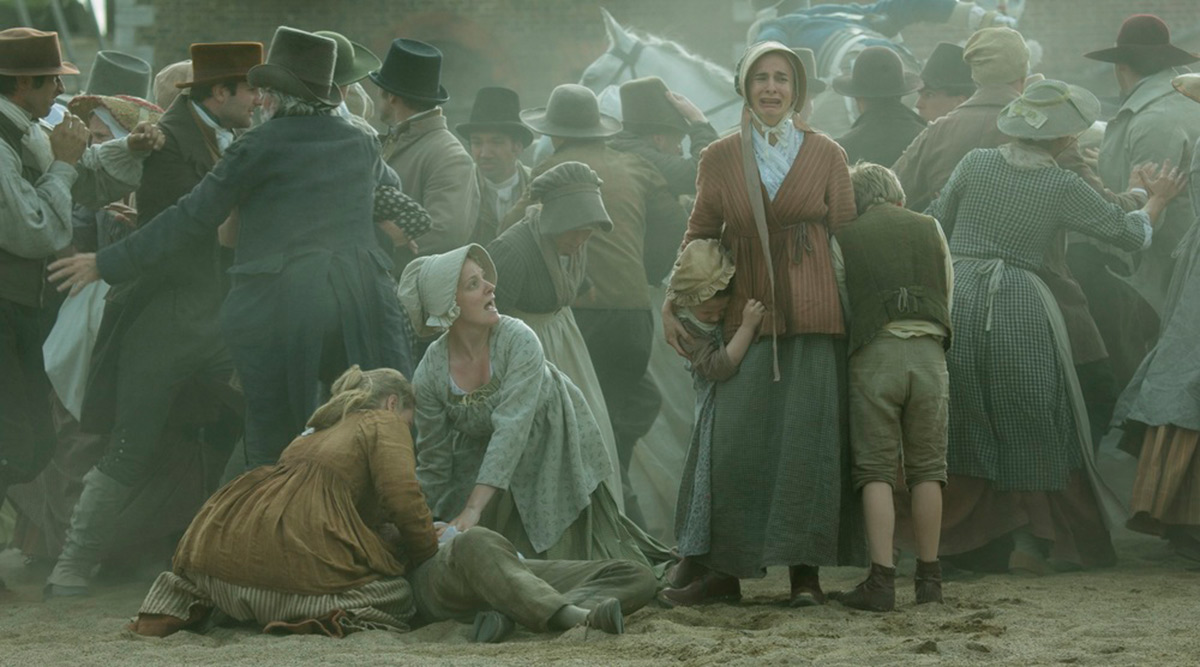
Thankfully, the film at least delivers on the rage that has been set to a nonstop boil for so long. Leigh captures the confusion and senselessness of the tragedy. It’s just a shame that the massacre itself is the only thing in the film that ever really takes on any dimension.


La La La La Llorona

The Curse of La Llorona

by Hope Madden

The Conjuring Universe loves the Seventies, doesn’t it? And why not? So many patterns to distract attention from your evil, so many bell bottoms to hide beneath. It’s also a time period before Catholicism became a horror movie unto itself, which makes it a safer space to depict a more wholesome view of the Church.

Not that Anna (Linda Cardellini, Green Book) would know. Her late husband was more of the religious one. But as Fr. Perez (Tony Amendola, Annabelle) points out, “You don’t have to be religious to have faith.”

Ah, yes, Michael Chaves’s The Curse of La Llorona is burdened by some seriously obvious dialog. That’s to be expected. The two people who wrote the film (Mikki Daughtry and Tobias Iaconis) are the same two people who wrote Five Feet Apart, the latest teen tragedy porn to wheeze its Boy in a Plastic Bubble riff into the hearts of Kleenex-clutching youth everywhere.

And yet, there is something of the old school charm that marks the best films in the Conjuring universe on display here. Simple fun house scares, primarily practical effects, kids in peril—these are all invoked in a quickly paced if somewhat nonsensical and conveniently plotted ghost story.

There is also a quick Scooby-Doo reference (this being 1976). Have you ever wondered why Cardellini always looks so familiar? Because she was Velma in the film series—making her sort of my own personal hero—and I, for one, was thrilled that LLL shouted that out. Plus, good parenting.

The story unfortunately skirts the real tensions to be drawn from questioning her parenting skills. Not that  LLL had a shot at reaching the terrifying heights of The Babadook, but for a moment it takes us down the path of calling a single parent’s fitness for the job into question.

This is quickly abandoned for the safer territory of a fierce mother protecting her cubs, which is too bad because Cardellini’s understated and graceful performance could probably have carried a more challenging script.

Instead we get bits and pieces of other films in the series, stitched together by a folk tale about a murderous mother. This is not inspired horror, but it’s not ridiculous, either.

It’s a spooky time waster.

The Hills Are Alive

Hagazussa: A Heathen’s Curse

by Hope Madden

Making a remarkably assured feature debut as director, Lukas Feigelfeld mesmerizes with his German Gothic poetry, Hagazussa: A Heathen’s Curse.

Settled somewhere in the 15th Century Alps, the film shadows lonely, ostracized women struggling against a period where plague, paranoia and superstition reigned.

Young Albrun (Celina Peter) and her mother (Claudia Martini) make their way back to their isolated cabin before darkness falls. With a minimum of dialog and a maximum of atmosphere, Feigelfeld quickly establishes the dangerous isolation facing mother and daughter.

It’s an episode that will haunt Albrun well into adulthood, where she (Aleksandra Cwen) is now the single mother, still an outsider, still isolated from the village.

It would be easy to mistake the story Feigelfeld (who also writes) develops as a take on horror’s common “is she crazy or is there malevolence afoot?” theme. But the filmmaker’s hallucinatory tone and Cwen’s grounded performance allow Hagazussa to straddle that line and perhaps introduce a third option—maybe both are true.

Isolation, shunning and bullying lead to one tragedy upon the next. The village and its priest having deemed Albrun a witch, the line that defines the reality of the situation and the spiritual ugliness blur for both Albrun and the audience.

The film lends itself to a reading more lyrical than literal. Feigelfeld’s influences from Murnau to Lynch show themselves in his deliberate pacing and the sheer beauty of his delusional segments. One goat milking episode, in particular, is both startlingly erotic and disturbingly articulate of Albrun’s state of mind.

MMD’s ominous score strengthens the film’s overall sense of hypnotic menace, echoing sounds we’re not sure will frighten or comfort this mysterious woman at the center of the film.

Albrun’s is a tragic story and Feigelfeld crafts it with a believable loneliness that bends toward madness. He’s captured this moment in time, this draining and ugly paranoia that caused women such misery, with imagery that is perplexingly beautiful.

He’s cast a spell and you should submit.


Crash: The Musical

Stuck

by Rachel Willis

Based on the musical of the same name, director Michael Berry’s film Stuck is the story of six strangers trapped on a subway car who change each other’s lives in meaningful ways.

Or at least, that’s what the movie tries to achieve. Unfortunately, it doesn’t accomplish its goal.

The characters are all one-note stereotypes. During their time trapped on a subway car, they reveal their own prejudices toward each other, as well as huge details of their lives. The personal stories, the elements that attempt to make each character unique, are all shared through song. However, it’s easy to guess who each character will be because they’re roles we’ve seen many times before.

As each person shares a little more of themselves with the others, the characters’ facial expressions are meant to convey internal change. There are sympathetic looks, a few words of apology, but none of it feels like true growth. The characters who enter the subway car are the same characters when they leave the subway car.

One of the most frustrating elements of the film is the “all is forgiven” attitude toward one character who has been stalking another character for several days before the events of the film. Though we learn the intentions are “innocent,” it’s angering to watch as the other characters give him a pass because he’s a good artist.

The musical aspects here are the strongest elements. The choreography, the lyrics, the musical arrangements, and the performances are all effective, with the individual character songs among the only moments where genuine emotion is conveyed. The musical styles are unique to each character, giving them more depth than the dialogue conveys.

All the actors are strong singers, which is refreshing since several movies lately have featured actors who can’t sing well, or at all, in singing roles. It’s one of the areas where Stuck succeeds. Ashanti is particularly powerful in her vocal performance, though Giancarlo Esposito also stands out as an impressive vocalist.

Though Esposito sings several of the film’s songs, his character is the least explored. He isn’t given a backstory like the others, and it’s unclear if he’s meant to be a conduit for the others to reveal themselves or a character in his own right.

In a film like Stuck, the point is to never judge a book by its cover. The people we pass on the street everyday are dealing with things about which we will mostly likely never know. Hardships in their lives may be the reason why they’re impatient or cruel, so it’s a reminder to treat everyone with kindness.

It’s not a bad message. But it’s one that’s been delivered before in more effective ways.


I Don’t Want To Go Out — Week of April 15

It’s the week of one-word movie titles. One of these couldn’t meet the high bar it set for itself, but it’s not such a bad movie. The other one is a bad movie. No question. Which is which? We’re here to clarify.

Click the title for the full review.

Glass

Replicas

https://www.youtube.com/watch?v=y77HoE4TtCg


Screening Room: Missing Link, Hellboy, Little, After, Master Z

Lots and lots to cover in the Screening Room this week: Missing Link, Hellboy, Little, After, and Master Z: Ip Man Legacy.  Plus just as many new home entertainment releases. Strap in!


Listen to the full podcast HERE.