There are solid reasons to avoid the out of doors this week and bond with your couch and whatever screen makes you happiest. Not all the reasons are good, but there definitely a couple. Let’s run through them.
Click the film’s title to link to the full review.
If the phrase “a love-letter to cinema” wasn’t clichéd by now, Paul Anton Smith’s new meta-film Have You Seen My Movie? at least sets the bar impossibly high for future directors.
Have You Seen My Movie? consists entirely of found
footage from other movies. From the early silents to the latest blockbusters,
Smith pieces together nearly a century of cinematic history to create a
distinct and visually stunning movie about movies and moviegoing, all told
through these re-cut clips.
Smith served as assistant editor for Christian Marclay’s The
Clock, a 24-hour art installation that used film and TV clips featuring the
corresponding time of day in their scenes. Marclay’s piece ebbs and flows
throughout the day, resulting in a delirious in-person experience that
questioned what film, narrative and time itself could be.
All of which is to say that Smith’s own spin on the found footage
clip show builds on Marclay’s approach. While it lacks the monumental sweep of The
Clock’s 24-hour marathon, Smith’s tight commitment to a feature-length film
with all the attendant emotional beats makes for a similarly impressive feature
experience.
Without continuity or context to rely on, Smith pieces
together a cohesive — and thoroughly engaging — narrative centered on emotion
instead of plot (with a big assist from the flashes of recognition that come
from picking out iconic scenes and characters).
Over the course of the movie, Smith weaves in every
imaginable genre and hundreds of classic films. The technical prowess stands on
its own as worth a watch, but it’s clear by the end that all Smith’s clever work
is in the service of something grander: yes, there are plenty of hidden
delights for cinephiles with a sharp eye. (The Criterion Collection could have
a field day with bonus features.)
But there’s also no denying the transformative power of film
and the dominant role it enjoyed for so long in shaping the culture. It’s a
convincing case from Smith, in all its sentimental and spectacular glory. And
in the middle of corporate consolidation, streaming silos and our current
blockbuster era, it’s also one that might be less victory lap and more requiem
for a dream.
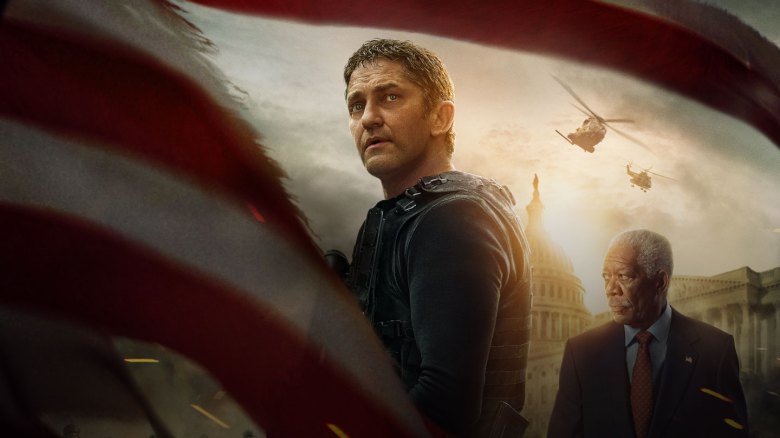
Olympus, then London, now Angel. They keep Fallen, must they keep getting up?
To be fair, Angel isn’t nearly the dumpster dive we took in London. It sports comic relief from Nick Nolte, a fun mid-credits stinger and a truly impressive performance from a baby.
Surrounding all that, though, is a pedestrian and all too often obvious gotta -clear-my-name frameup that underdelivers on the action front.
Gerard Butler is back as Secret Service hero Mike Banning, with Morgan Freeman returning to the franchise as now-President Trumbull.
Mike has headaches and insomnia after years of action, but debates leaving the field for a desk promotion. He is still great at knocking out all the baddies who are nice enough to walk blindly past a corner he’s hiding behind, but when there’s a drone attempt on the President’s life, Mike can’t keep his entire team from being wiped out.
Suddenly, mounds of incriminating evidence point to Mike as the would-be assassin, who then must leave his wife (Piper Perabo) and child (that baby is good, I’m telling you) and go full Bourne fugitive guy to root out the real villains.
Who wants the President dead? And why?
If the answers are supposed to be surprises, someone forgot to tell director Ric Roman Waugh (Snitch) and his co-writers, asAngel is telegraphed from many preposterous angles with all manner of heavy handed exposition.
And once Banning takes refuge with his long lost, off the grid, battle scarred Dad (Nolte), the attempts at debating the morality of war land with a thud of pandering afterthoughts.
Hey, if your just here for some mindless action highs, that’s fine, but Angel skirts them, curiously settling for repetitive shootouts and nods to first-person gaming enthusiasts.
Like Mike, this Fallen seems mostly tired. Even if it can get up, maybe it should reconsider.
Warning: this article contains some serious pro-Boss bias. Like, copious amounts.
Because a Springsteen fanatic like myself reviewing Blinded by the Light is somewhere close to your racist Facebook friend from high school reviewing Fox News. Expecting a thumbs down is like, oh, I don’t know….
Trying to start a fire without a spark?
Cool, we understand each other.
But beyond the singer or the songs, the real joyous triumph of the film is how it unabashedly adores not just this one particular artist, but the entire concept of inspiration.
Based on the memoir by Sarfraz Manzoor, the film rewinds to the late 80s when Javed (Viviek Kalra in an irresistible feature debut), a British teen of Pakistani descent, is trying to navigate high school amid the austere gloom of Thatcher conservatism and the ominous rise of far-right bigotry.
Drowning in a sea of synth pop, Javed’s life changes when his friend Roops (Aaron Phagura) gives him some Springsteen cassettes.
As both a veteran of that awakening and a witness for others, I can tell you director/co-writer Gurinder Chadha nails it with a perfectly rockin’ bullseye. Bruce’s lyrics dance across the screen and around Javed’s head, his fist pumping and his face beaming with a newfound sense of purpose.
Though his father (a terrific Kulvinder Ghir) bemoans the influence of “that Jewish singer” (“He’s not Jewish – and that’s racist!”), Javed, bolstered by encouragement from a sincere teacher (Hayley Atwell) and a new girlfriend (Nell Williams), takes the first steps toward a future of his own – as a writer.
Chadha (Bend it Like Beckham) manages a wonderful tonal balance, juggling humor (watch for that hilarious Rob Brydon cameo), coming of age pathos, blaring 80s hits, a mighty timely social conscience and even extended dance sequences.
Cynicism doesn’t stand a chance. Chadha keeps the heart on Manzoor’s sleeve beating loud, proud and unmistakable, knowing this borders on cornball and not giving a toss.
For Springsteen (who has been notoriously shy about licensing his songs) to give this project his complete blessing lends an immense layer of gravitas for longtime fans. Until that next Bruce concert, we are a choir eager for the preaching.
But replace Bruce with Aretha, Kurt Cobain, Ed Sheeran or Taylor Swift and the exuberant joy of Blinded by the Light still works.
Inspiration, wherever you find it, is worth celebrating. Embrace it, and it might even lead to your….glory days.
Dora the Explorer takes her backpack, her map and her
adventures to the big screen. Can you say surprisingly entertaining?
It helps that director James Bobin (The Muppets, Flight of the Conchords) has mastered the art of cheeky-yet-wholesome fun. Our story begins in the jungle where 6-year-old Dora (Madelyn Miranda) and cousin Diego (Malachi Barton) seek adventure under the somewhat watchful eyes of Dora’s parents (Eva Longoria and Michael Pena).
But Diego is off to the big city with his parents and, about
ten years later, Dora goes to stay with him while her parents seek the famed
Lost City of Gold.
She may be 16, but Dora (Isabela Moner) hasn’t changed,
which means the nightmare of high school is about to get worse for Diego (Jeff
Wahlberg – yes, he’s a nephew).
And though the bulk of the plot deals with a kidnapping, a
jungle adventure to find Dora’s parents, and an Indiana Jonesesque trek into a
lost city, the heart of the film is with outsiders and outcasts facing high
school.
Moner is an impressive talent, a point she’s proven with roles in Sicario 2 and Instant Family. She plays bright-eyed Dora with utter earnestness, allowing Bobin and a game cast to land plenty of jokes, none of them cynical or unkind.
This is definitely a family-friendly film, but you don’t have to be a preschooler to find enjoyment. Bobin’s good-natured humor winks at parents, the move to high school will endear the film to ‘tweens, but the high spirit and affection for the source material won’t be lost on little ones.
Is it a classic? It is not. And if you were one of the many middle aged men sitting alone in the theater yesterday, for shame. But Dora and the Lost City of Gold is a charmer and not a bad way to spend some time with the family.
So remember, high school is a horrible nightmare. Be yourself. And no swiping!
Was there a story you heard as a kid that scared you sleepless? Mine was Bloody Fingers, the tale of a mangled man who dragged his carcass toward you. You could hear him coming: thump, thump, draaaaag. My neighbor used to sneak up behind me muttering those terrifying words.
Writer Alvin Schwartz knew how to work a kid’s nerves even better than my neighbor. Inspired by campfire tales and urban legends, he spun yarns for maximum kid fright, then paired them—and this is the important part—with the inspired line drawings by Stephen Gammell. The result, Scary Stories to Tell in the Dark, became the go-to for kids who like to be scared and schools who like to ban books.
Director André Øvredal (TrollHunter, The Autopsy of Jane Doe) and co-writer Guillermo del Toro both know something about tingling the spine. Together with a team of writers—some veterans of horror, some of family films—they’ve created an affectionate and scary ode to the old series of books.
Set in Mill Town, Pennsylvania around Halloween, 1968—trees are turning, Nixon is about to be elected, Night of the Living Dead is showing at the drive in—Scary Stories to Tell in the Dark follows three wholesome high school outcasts and a handsome out-of-towner. On the run from the Vietnam-bound, letter-jacket wearing bully, they hide in the old, abandoned Bellows place. The town says the house is haunted.
Sounds a little cliched, right? The kind of story you’ve heard over and over, but that’s exactly the point. To begin to tell Schwartz’s tales—all of them pulled from the collective unconscious, all of them drawing on those same old stories that were new to us as kids—Øvredal sets a familiar and appropriate stage.
His framing device works well enough for a while. Stella (Zoe Margaret Colletti), who hopes to be a writer herself, swipes creepy old child killer Sarah Bellows’s book of stories, but when she gets them home, new stories write themselves in the blank pages and, one by one, the kids in Mill Town go missing.
This is what PG-13 horror should look like. Yes, like most of the genre films engineered for youngsters, Scary Stories rehashes tropes familiar to adult viewers, but Øvredal’s clear fondness for the terrifying source material, especially the illustrations, gives the film the primal, almost grotesque innocence of a childhood nightmare.
The film’s tone is spot-on, performances solid and the set design and practical effects glorious. This is more than an anthology of shorts. It’s a cohesive whole that contains a handful of Schwartz’s nightmares, but the whole is not as great as the sum of its parts. Too heavy with clichés in the framing device, the film loses steam as it rolls into its third act.
An analogy of lost innocence, nostalgic without becoming too sentimental, this is old school scary, as unapologetically unoriginal as its source material and almost as effective.
Anyone with two working eyes knows that the criminal justice system in the United States is far from perfect and rarely yields actual justice. The situation is even bleaker for young men of color. Even after their time is served, people convicted of a crime have a hard time finding work and maintaining new relationships.
As unfair as this is for everyone that goes through it, it can be especially grueling for people convicted of crimes they did not commit.
Brian Banks (Aldis Hodge) was once a star high school football player. He and his mother (Sherri Shepherd) had planned for Brian to attend college and hopefully make it to the NFL. All of that changed with a chance encounter that led to an accusation of kidnapping and rape. The barriers Brian faces after his release from prison lead him to a lawyer (Greg Kinnear) who might be able to clear his name and give him back his future.
Brian Banks is an interesting look at incarceration in that the film never once questions Brian’s innocence. In fact, the audience is clued in early on that Brian is a character we can trust. This film isn’t one that dwells on twists and turns. It’s more interested in Banks himself and what his plight says about our justice system. Unfortunately, that look tends to be one dimensional, and pushed through the lens of a mediocre TV movie-of-the-week.
Hodge (Hidden Figures, Straight Outta Compton) brings a humanity to this role that makes it easy to cheer for Banks despite the over-abundance of cliche. He does a wonderful job showing Brian’s frustration, hurt and disappointment all at once. It’s a tightrope performance, and Hodge pulls it off beautifully.
But there’s a cheapness to Brian Banks that makes it look like it would be right at home on the Lifetime cable channel. This is especially surprising since director Tom Shadyac spent the majority of his career making huge studio movies like Liar Liar, Bruce Almighty and The Nutty Professor. None of these films is exactly Lawrence of Arabia, but they still had a distinct visual flair.
Despite a strong lead performance, Brian Banks can’t overcome its reliance on age-old courtroom cliche and melodrama that ends up bringing the movie down. It’s a film that had something to say, but the message became muddled and/or lost along the way.
When a way of life not only makes you a social outcast, but presents increasing dangers to those closest to you, what would motivate you to cling even tighter?
It’s a premise that could easily lead to vilification, so credit filmmakers Britt Poulton and Dan Madison Savage for taking Them That Follow in a more resonant direction. Rather than relying on lazy condescension, they want to probe the psychological politics of control.
Mara (Alice Englert) is the pastor’s daughter in a small community of snake handlers in the Appalachian mountains. Her father Lemuel (Walton Goggins) preaches strict adherence to the Word, which requires frequent tests of faith, subjugation of women and shunning the ways of the material world.
But Mara’s interest is starting to move beyond the mountain, raising the suspicions of the stern Sister Slaughter (Olivia Coleman, recent Oscar-winner for The Favourite) and sparking the curiosity of her best friend Dilly (Kaitlyn Dever).
“Who you choose, girl, chooses your whole life,” Sister Slaughter cautions Mara. And Mara will soon face choices that will alter several lives.
Them That Follow benefits from a beautifully rustic production design and an unhurried pace, building earnest layers of authenticity that mirror a sublime ensemble cast (which includes a nice dramatic turn from comic Jim Gaffigan).
Poulton and Savage are not here to mock religious beliefs, but rather to question the motives of leaders who seek control by division. Followers are belittled by proxy (“They look down on you!”) while leaders make unhealthy demands and wash their hands of culpability (“It’s God’s law, not mine”).
While the film’s concerns are especially timely now, a third act that seems rushed and overly tidy loosens the grip of Them That Follow. The tail here has more bite than the head, but the serpent still deserves respect.