Tag Archives: movie reviews

Rage Inside a Machine

Unhinged

by George Wolf

I remember watching that classic TV movie Duel with my mom in the early 70s. It was tense and exciting (a young Spielberg directed!), but the thing that most unnerved Mom was the fact that…SPOILER ALERT… you never find out why that truck driver was terrorizing a frazzled Dennis Weaver.

Unhinged offers no such ambiguity. Russell Crowe is just really pissed off.

Well, the unnamed driver Crowe plays is, anyway. The Man has lost his wife, and his job, and now he’s in traffic getting beeped at, passed and gestured to by a woman in a big hurry.

The Man catches up, rolls down the window and calmly explains civility to young Kyle in the back seat (Gabriel Bateman from Lights Out and the Child’s Play reboot) while asking Rachel in the front for an apology. She declines, so The Man vows to show Rachel (Slow West’s Caren Pistorius) what a bad day really is.

Things get nasty in a hurry. And though the script from Carl Ellsworth (Red Eye, Disturbia) often flirts with ridiculous, it offers more clever construction that you might expect. The premise certainly recalls Falling Down, but Ellsworth isn’t interested in darkly comic social commentary. This is an overt explosion of murderous male rage, one that also manages – almost as an afterthought – to deliver a blunt cautionary tale about smart phone addiction as effective as any we’ve seen on film.

Director Derrick Borte (The Joneses) keeps the pace moving nicely with tension and bursts of brutality, which is perfectly fine for a disposable thriller. What’s even better, he knows what the real point of all this is.

Russell on a rampage. That’s it.

You want some of that? Crowe and Unhinged deliver it, with all the when’s, why’s, and how’s right up in your face.

You know, so Mom won’t be left hanging.

Chemicals React

Chemical Hearts

by Cat McAlpine

Henry Page is a romantic. He’s also unremarkable, he muses in moody voiceover. But senior year of high school might just be the year that something interesting finally happens to him. When Grace Town transfers on the first day of class and joins the school newspaper, Henry is immediately smitten. But people are rarely the things we imagine them to be.

Richard Tanne (Southside with You) wrote and directed this adaptation of Krystal Sutherland’s novel, “Our Chemical Hearts.” Tanne’s camera haunts dusk and after-dark more often than not, with even his daytime shots heavily shadowed. He finds gorgeous lighting in an abandoned warehouse and develops a grittier finish to this YA romance that’s rare for the genre.

But no matter how often Grace (Lili Reinhart) promises she’s “fucked up,” the film doesn’t go as dark as it wants to. In the end, Chemical Hearts is about a middle-class kid pining after a broken girl. While some twists and turns make the story more interesting, the narrative is distracted by Henry (Austin Abrams) who is as he promises to be – unremarkable.

Chemical Hearts also suffers from a heavy serving of quirky character traits. Henry’s not normal, he practices the Japanese art of kintsukuroi – repairing broken pottery with gold seams. Grace stands thigh deep in a koi pond, monologuing about humanity’s fate to be briefly rearranged motes of start dust. How did the koi end up in an abandoned warehouse? Spoiler alert, we never find out.

For all its false depths, Chemical Hearts also ruminates on death, guilt, and suicide in fair measure. But the grief is twice removed and mostly mystery. Grace’s healing process is constantly measured by her capability to fully love Henry. We don’t get the opportunity to explore her growth outside of him.

Chemical Heart’s constant insistence that being a teenager is the hardest part of life will fall flat for older viewers who have already survived the gauntlet of adolescence. Meanwhile, the younger audience will likely appreciate a story that reminds them that life doesn’t always go the way you want it to.

The Price of Justice

The 24th

by George Wolf

Take at look at some recent writing credits for Kevin Willmott: Da 5 Bloods, Black KkKlansman (which won him a deserved Oscar), Chi-Raq. Impressive. Go back to 2004, and you’ll find The Confederate States of America, which he also directed.

Without question, Willmott speaks eloquently and provocatively on the history of being Black in America. He’s back behind the camera for The 24th, a bold and clear-eyed take on the 1917 mutiny of the all-Black 24th U.S. Army infantry regiment after harassment from the Houston police department.

Willmott, co-writing with first time screenwriter Trai Byers, again shows an uncanny instinct for making history crackle with the urgency of a breaking news bulletin. Humanizing the conflict through the fictional Pvt. William Boston (Byers, also taking lead acting duties), the film builds from a slightly impatient first act into a final third full of resonant rage and tremendous emotional power.

Pvt. Boston’s education abroad and dignified air draw the ire of both his fellow soldiers and his white commanding officers, save for the thoughtful Col. Norton (Thomas Haden Church, playing impressively against type). Both Boston and Norton want the 24th to be the first Black regiment sent to the Normandy front lines, and the Col. recommends Boston for officer training.

Aspiring to lead by the example of valuing service over ambition, Boston resists the promotion, laying down the first marker in a character arc of weighty heartbreak, resignation and sacrifice.

The Jim Crow laws of Texas stop at nothing to oppress and brutalize the members of the 24th, even the private MP unit formed expressly to protect them.

As Boston prepares to give his local sweetheart (Aja Naomi King) a promise ring, the night of August 23rd, 1917 cascades into violence, leaving policemen, civilians and soldiers dead in the Houston streets.

The aftermath leaves Boston with a soul shaking choice, one made easier by an awakened and defiant resolve.

He still aspires to be an inspiration, but for a completely different reason. And it is this journey – made so deeply intimate by Byers and a superb Mykelti Williamson as Boston’s frequent adversary Sgt. Hayes – that carries the film’s early 1900s setting into the streets of today’s Black Lives Matter protests.

Making that leap with us, and not for us, is no easy trick, but The 24th is more proof of risk and reward. The ugliest corners of the mirror can be valuable teachers, and we need Willmott’s voice – as both a writer and a filmmaker – to keep us looking.

Tell and Tell

Words on Bathroom Walls

by George Wolf

Look, I know Young Adult is not the only genre to lean on a familiar blueprint, but we’ve reached the point where finding any YA film without voiceover narration or an essay-reading finale is going to feel like gazing upon the golden wonders of Marcellus Wallace’s briefcase.

There’s little glow surrounding Words on Bathroom Walls.

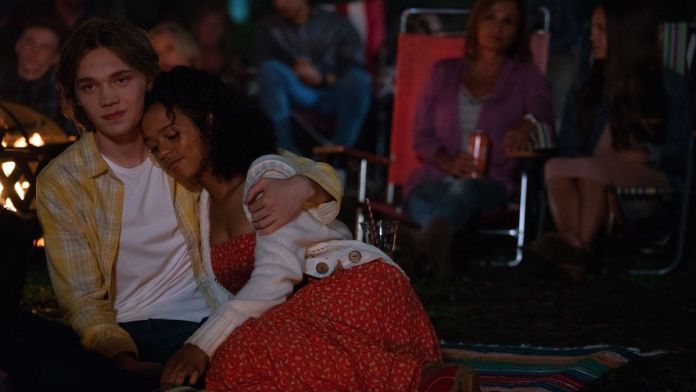
To be fair, writer Nick Naveda’s take on Julia Walton’s novel does at least try to develop an organic thread for the narration, as high schooler Adam (Charlie Plummer) talks to an unseen therapist about his struggles with paranoid schizophrenia.

Director Thor Freudenthal (Diary of a Wimpy Kid) manifests those struggles onscreen via three distinct characters (AnnaSophia Robb, Devon Bostick and the gloriously named Lobo Sebastian) whose voices are always lurking inside Adam’s head. It’s an early clue that the film’s handling of teen mental health will be an opportunity largely missed.

After a serious episode during class injures another student, Adam is expelled from his high school in the middle of senior year. On the upside, he’s accepted into a trial for a new schizophrenia drug, and into a prestigious local Catholic school which promises to be discreet.

Adam’s future plan to attend culinary college hinges on a high school diploma, which means Adam must make sure he a) takes his new meds, b) keeps his grades up, and c) passes a big exam which consists only of math questions and…..wait for it….an essay.

The obligatory tortured romance is between Adam and his math tutor, a classmate named Maya (Taylor Russell) who also has some secrets she’d rather not reveal.

And as with so many of these YA adaptations, all the narration and essay reading means the film is more tell, less show and nothing earned. Again, we get an invitation for teens to wallow in the angst of an inexperienced worldview simply by telling them what we think they want to hear.

Adam’s “you don’t understand me” posturing with his mother (Molly Parker), her new boyfriend (Walton Goggins, wasted) and an easygoing priest (Andy Garcia) serve only the manipulative and convenient use of Adam’s condition. Both Plummer (All the Money in the World) and Russell (Waves) have impressed before, but they’re given little chance to develop their characters into anything real or resonant.

All the familiar YA parts are here, and Words on Bathroom Walls keeps them comfortably close. But like those sentence-building magnets on the refrigerator door, just moving them around seldom leads to anything that makes much sense.

A Shot in the Dark

Tesla

by Matt Weiner

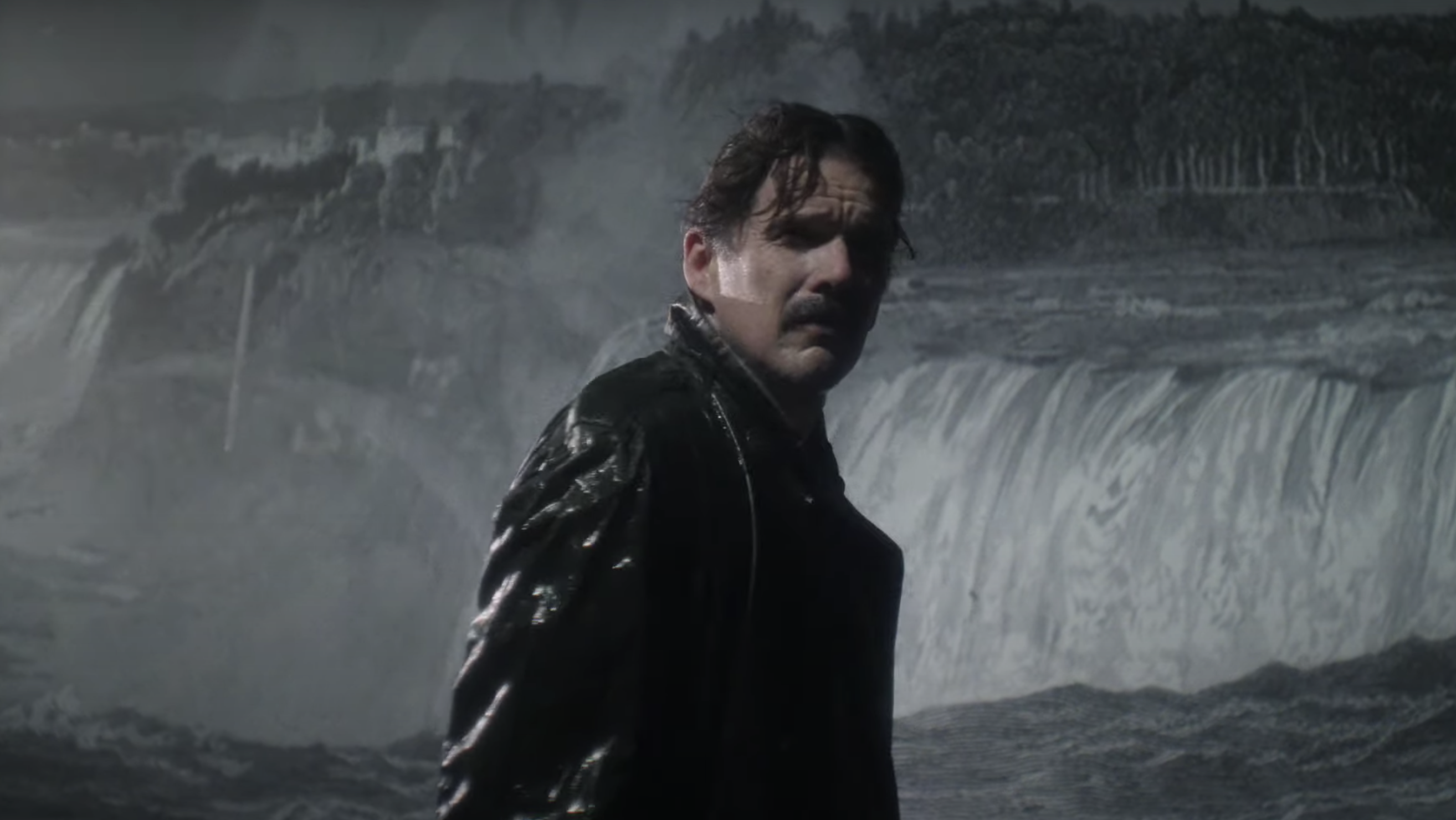
Nikola Tesla is having a moment. Hot on the heels of 2019’s The Current War comes Tesla, another take on the inventor from writer and director Michael Almereyda. And while both treatments are anchored around Tesla’s rivalry with Thomas Edison over electrifying the country, Tesla is so far apart in style and tone that the subject could be a completely different person.

Almereyda has already shown that he can handle big sci-fi themes on a small budget. His adaptation of Marjorie Prime was moving and challenging. Tesla also has the rhythm of a stage play, one where characters and dialogue take precedence over strict history.

This is still a biopic though. The story begins as Tesla (Ethan Hawke) splits from Thomas Edison (Kyle MacLachlan), and follows through his partnership with George Westinghouse (Jim Gaffigan) and his ultimate victory in the war of the currents.

But as Tesla’s personal and professional lives unravel, Almereyda takes his film off the rails as well. From historical counterfactuals and modern-day interruptions to an arresting musical number, Tesla the movie surrenders all control over its title character—and does so gleefully. These big swings don’t always connect, but the attempts are always compelling.

In Almereyda’s version, Tesla is a cipher. Hawke trades in his usual charm for a portrayal that blends tortured genius and mad scientist, and despite his quiet demeanor he fills every scene with an intensely heavy presence.

It’s up to the supporting cast, especially MacLachlan’s flighty yet imperious Edison, to draw out whatever they can from the inscrutable Tesla. It’s an unusual effect for a biopic, but it works. Tesla is the rare adaptation that seems determined to obscure its subject rather than illuminate him.

This Tesla is a man not so much ahead of his time but completely outside of it. Almereyda suggests that the enduring appeal of Tesla can’t be neatly captured in the war of the currents against Edison. There’s Tesla the pioneering genius who lit up the Chicago World’s Fair, and there’s Tesla who died penniless in a hotel room dreaming of death rays. And somewhere in between, there’s a man who raises the curiosity of everyone he meets.

But in this telling, the closest we can come to unsolvable mysteries are a reflection here, a spark there. This Tesla is a brief light guiding us toward some greater understanding, one that vanishes just as quickly.

Erotic City

Love Express: The Disappearance of Walerian Borowczyk

by Darren Tilby

Walerian Borowczyk – a writer/director of unparalleled sensuality, unequalled in the 1970s for his work on sexual freedom, but later labelled an erotic filmmaker, had a short but undeniably impactful career. By interviewing long-time collaborators, peers and fans of his work, Kuba Mikurda offers rare insight into Borowczyk’s art, which poses questions on society’s relationship with love and hate and the boundaries of artistic freedom, in a celebration of Borowczyk’s enigmatic and often controversial career.

Unlike Borowczyk himself, Love Express follows a fairly conventional (documentary-film) formula: it’s constructed from archival footage of Borowczyk at work and in interview, as well as contemporary interviews from those who knew him or his work. It’s a safe choice, one that works well, but still, I feel more could have been done here to differentiate it a little.

Long-time collaborator Noël Véry – who acted as a camera operator in many of Borowczyk’s films and was one of the people closest to him – leads and stays with us throughout the movie, which, at only 70-minutes in length, flows nicely and never outstayed its welcome.

From Borowczyk’s time as an animator (an identity which he never truly shed) manipulating and fetishizing objects, to live-action director (now manipulating and fetishizing his actors as he once did his animations), to his unfortunate and eventual pigeonholing as a pornographer, Mikurda takes us through it all.

Throughout the film’s five chapters (each detailing particularly important years and movies) we hear from an eclectic mix of people, all with varying interests in Borowczyk’s work: Terry Gilliam, Bertrand Bonello, Neil Jordan, Andrzej Wajda and Patrice Leconte to name but a few.

The interviews themselves are incredibly well-conducted—informative, absorbing, well-shot and with excellent sound quality. Small, almost playful, visual flourishes serve to illustrate the voiced opinion, in addition to keeping the viewer entertained.

More importantly, the film’s entirely successful in bringing to light the unique and often misunderstood talent of one of cinema’s most infamous and enigmatic filmmakers. I knew very little about Borowczyk or his process going into this movie, having seen only a couple of his films. I left feeling enlightened and determined—determined to find his older works.

And in the end, isn’t that the point?

Detroit Rock City

Creem: America’s Only Rock ‘n’ Roll Magazine

by Hope Madden

Documentarian Scott Crawford has an interest in location-specific counter culture. His 2014 doc Salad Days recounted a decade of unsurpassed DIY punk rock transforming the underground of Washington, DC.

Now he turns his attention to Detroit.

Creem: America’s Only Rock ‘n’ Roll MagazIne documents the inner dysfunction and outward impact of the Motor City’s “screw you” to the rock establishment. (Lookin’ at you, Rolling Stone.)

Launched in 1969 by Detroit head shop entrepreneur Barry Kramer, the magazine immediately defined itself among rock mags as the most personal, most irreverent, least sophisticated and most vital. Like the decaying, even dangerous city it represented, Creem Magazine existed outside the mainstream.

Boasting a litany of groundbreaking rock writers and more women on the editorial and writing staff than nearly any other magazine at the time, the magazine pushed boundaries. It didn’t just cover punk rock, it was punk rock. And like punk rock (or Detroit, for that matter), it was basically doomed.

Crawford’s gift is in establishing the period, time stamping the singular moment in rock history he wants to unveil. Archival footage and behind the scenes photos illustrate the hard core, nearly derelict quality of the working conditions. Kramer’s commitment was almost blind, and the untested staff—many of whom would reveal themselves to be rock writing geniuses—attacked their assignments with equal self-destructive passion.

We hear directly from many of them: Dave Marsh, Cameron Crowe, Jaan Uhelzski (who co-writes the film). We also hear from the rock stars that were covered (Alice Cooper, Gene Simmons, a very testy Joan Jett), as well as those modern day musicians whose young minds were warped by Creem’s pages (Michael Stipe, Kirk Hammett, Chad Smith).

The film’s production design does justice to its source material. Scott Gordon’s animated sequences are an inspired avenue into reenactments. Between the cartoons, stories, photos and excerpts of his writing, a provocative image of Lester Bangs emerges. And who could be more fitting to provide all the movie’s original music than MC5’s Wayne Kramer?

The film, produced by publisher Barry Kramer’s son JJ, is absolutely a mash note to rock’s most rebellious rag. For many it will be a lesson on the significance of Detroit, even after Motown, in the evolution of American music. More than anything, though, Crawford’s film is a testament to the legacy of America’s Only Rock ‘n’ Roll Magazine.  

License to Kill

Spree

by Rachel Willis

I am about as unplugged as one can be in this hyper-connected world. I have zero social media profiles and visit around five websites regularly (this one included). Considering my lack of presence online, I may as well not exist.

At least, according to Kurt Kunkle (Joe Keery, Stranger Things).

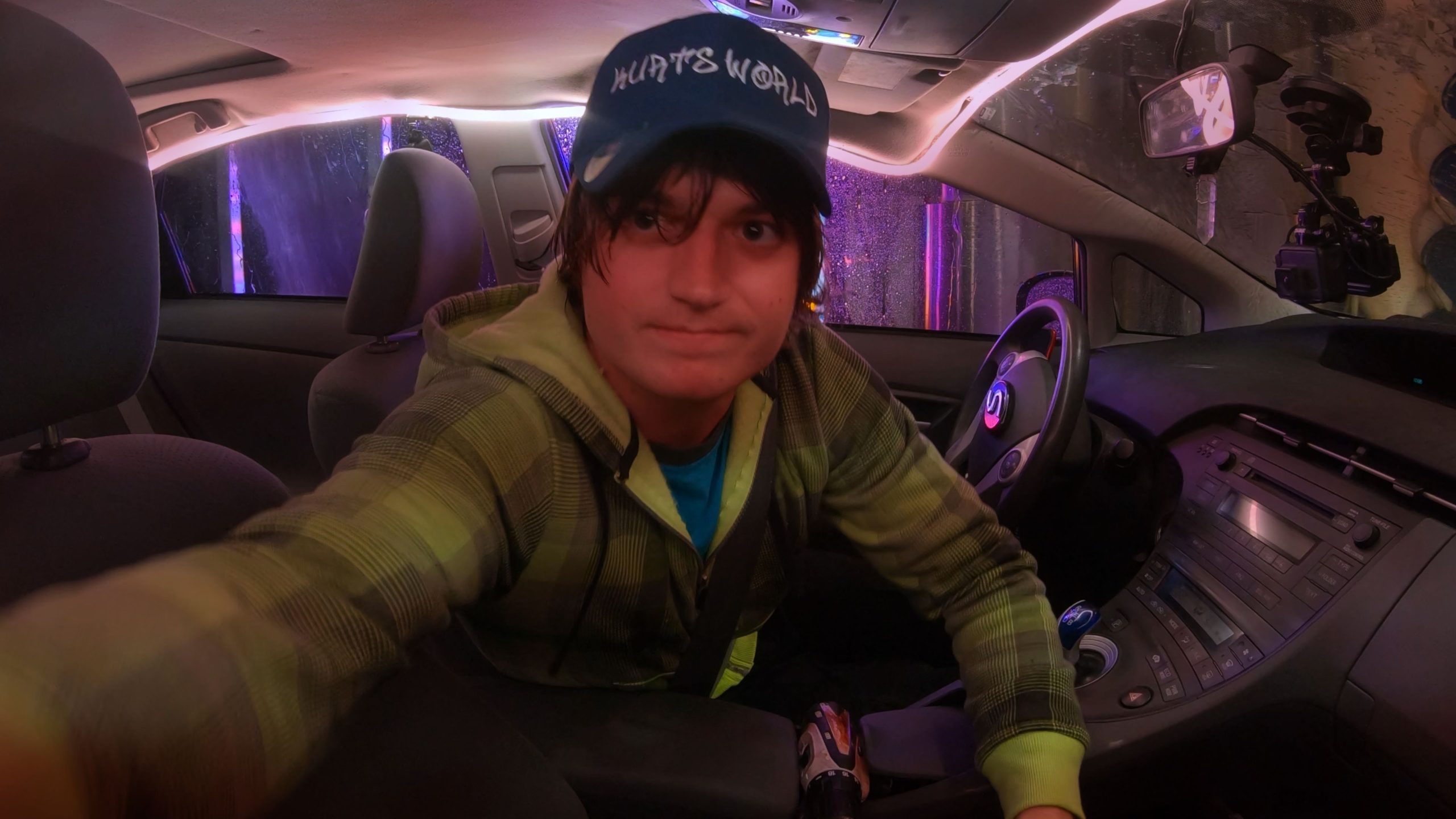
Kurt is the wannabe viral sensation at the center of director Eugene Kotlyarenko’s latest film, Spree. Deciding to live stream his evening as a driver for the ride-share company, Spree, Kurt – star of @KurtsWorld96 – has a lesson to share and knows this is his ticket to fame in the digital world.

Kotlyarenko, co-writing with Gene McHugh, wants to deliver a comedic observation of the effects of the digital world on the real one. It’s not a bad idea. It’s too bad the movie isn’t funny nor especially profound.

There are multiple cameras on Kurt throughout the movie – phone camera, dash cam, window cam, security cam, body cam – at times, the cinematography piles on the footage, using split screens to show us multiple views. A running commentary is sometimes seen at the bottom of one or two of the screens. This lets us know that everyone in cyberspace viewing Kurt’s night – which involves several crimes – thinks it’s staged. Occasionally, someone chimes in wondering if it’s real, but for the most part, they can’t discern fact from fiction.

It’s exhausting. Aside from one, blink-and-you’ll-miss-it shot that I couldn’t account for, every scene is delivered through a handheld or portable device. Watching the movie, it’s hard to imagine anyone consumes anything this way. If this is the way of the world, our attention spans will surely dwindle closer and closer to that of a goldfish (if they haven’t already).

The movie’s only plus is Sasheer Zamata (The Last O.G., Saturday Night Live). Her character, Jessie Adams, runs across Kurt early in his night and is everything he wants to be. Zameer delivers the right amount of comedy in a few spots that, had the movie matched her efforts, might have helped its appeal.

While the attempt at commentary on the larger culture does not go unnoticed, as one of Kurt’s followers says to him of his attempts to go viral, it’s “boring and awkward.”

Same goes for Spree.

Devil to Pay

Limbo

by Hope Madden

There’s a real thread of forgiveness, consequences and redemption in current horror. It fuels Romola Garai’s Amulet, Jayo Bustamante’s La Llorona, and now, Limbo, the cheeky neo noir from writer/director/producer Mark H. Young.

Jimmy (Lew Temple) looks like a pretty cut-and-dried case to Balthazar (Lucian Charles Collier). He shot a grandmother (Veronica Cartwright) in the head robbing a pawn shop, caught a bullet in the back and now he’s here, facing judgment. But why has the man upstairs deemed Jimmy worthy of his own defense angel (Scottie Thompson)?

Must be something big. Even the other guy’s getting in on the deal. Both sides are weirdly interested in the outcome of this one case.

Young (Feral) has a knack for efficient, low budget horror. His work is not inspired, but it definitely makes the most of its budget. And in this case, you also have to hand it to him for casting.  

Besides the always-welcome Temple and the great-to-see Cartwright, Limbo brings in familiar faces Richard Riehel (jump! to conclusions guy from Office Space), and James Purefoy as Lucifer.

Lauryn Canny (Darlin’) delivers the strongest performance as a prostitute back in real life that may or may not prove Jimmy’s worthiness of forgiveness, but everyone’s fun. Purefoy, who relishes these campy roles, chooses a hillbilly accent for Satan. Odd.

Odder still is whatever accent Collier is attempting, but that hardly sinks the film. It’s a goofy fantasy and just about anything flies.

The circular logic isn’t as tight as Young may think it is, but again, Limbo provides serviceable fun. No scares and not a ton of laughs—indeed, where Young is hoping to land on the horror-comedy spectrum is a bit muddy—but thanks mainly to a game cast, Limbo is still a pretty good time.

Horse Thief

Out Stealing Horses

by Hope Madden

So much for going Hollywood.

Prolific Norwegian filmmaker Hans Petter Moland follows up his first foray into blockbuster territory—a Liam Neeson-fronted English language remake of his own vengeance thriller Cold Pursuit—with the decidedly non-blockbuster, specifically Norwegian drama Out Stealing Horses.

This pensive and utterly gorgeous film sifts through time to land on the moment that irreversibly alters the course of a life.

In this case, it’s Trond’s life. It’s winter of ‘99—almost the millennium—and the aging Trond (Stellan Skarsgård) is just settling into hermithood. Though he’s been in Sweden for years, the death of his wife in a car accident (he was at the wheel) convinced him to cross the river back to his childhood home of Norway to sit quietly and think.

And then he meets his neighbor, who inadvertently stirs up memories and gives Trond’s meditation new direction.

Moland adapts Petterson’s beloved novel, streamlining until what’s left is an extremely intimate tale only mildly hampered by the tiresome flashback structure. Moland only hints at the novel’s historical context, instead developing a sense of fearful awe in the face of life, the small moments that determine an individual’s trajectory, and the insistent longing to imagine what could have been.

The technical mastery at work in this film—from sound design to lighting, from Rasmus Videbæk’s gorgeous cinematography to Kaspar Kaee’s unerring score—adds power to Moland’s every meditative moment. In perfect harmony with the team, Moland effortlessly evokes the senses throughout this sometimes Malick-esque photo album of the summer that everything changed.

Moland and team create the glimmering, lush and gorgeous memories Trond relives—too gorgeous to be exact, but exactly as gorgeous as needed to be memory.

Out Stealing Horses can’t quite make the current-day footage ache or resonate quite so clearly. The events adult Trond deals with feel artificial, a forced structure. But that doesn’t rob the film of its magic.