Screening Room: Lost City, Infinite Storm, Compartment No. 6 & More
by George Wolf
She’s a Finnish archeology student on the way to study some ancient cave paintings in remote northern Russia. He’s a blue collar Russian just traveling to where the work is. They share tight quarters in Compartment No. 6, a measured and often beguiling look at the mysteries of human connection.
Laura (Seidi Haarla) thought she’d be taking this trip with her girlfriend Irina (Dinara Drukarova). Instead, she’s solo on the train to Murmansk, and her first impression of roommate Ljoha (Yuriy Borisov) is not a good one.
He’s drunk and crude. She’s quiet and introspective. So the air in their little compartment might just get as bleak and cold as the view outside the train’s sterile, fogged up window.
Adapting the source novel by Rosa Liksom, director/co-writer Juho Kuosmanen draws effective contrasts between the two environments, especially when one of them begins to thaw. Buoyed by the two excellent lead performances and moments of dark humor in the script, Kuosmanen leans into the 1990’s setting to evoke a world that seems adrift in time and space.
Last year’s Grand Prix winner at Cannes, the film often feels like a slow journey for us as well, but don’t mistake the unhurried pace for aimlessness. Be patient and take the ride. Compartment No. 6 has a warm fuzzy feeling at the last stop.

by George Wolf
Just last month, The Desperate Hour showcased Naomi Watts in an almost one woman show. Infinite Storm adds a few more cast members, and this time Watts isn’t just figuratively carrying a film on her back, she’s literally carrying another human.
Based on the true life adventure that found search and rescue climber Pam Bales trying to descend New Hampshire’s Mt. Washington before a storm hits, the film leans heavily on Watts to make a rescue infinitely more emotional.
On her way down the mountain in Oct. 2010, Bales encountered a lone climber she called “John” (Billy Howle) immobile and unprepared for the bitter cold and biting, 50 mph winds. Risking her own life, Bales’s extensive training was often rebuffed by the uncooperative John as she tried to get them both safely home.
First-time screenwriter Joshua Rollins adapts Ty Gagne’s New Hampshire Union Leader article with added layers of sympathy designed to quicken our emotional attachment. Pam’s chosen to ignore the weather forecast and climb because it’s the anniversary of something traumatic in her life, and climbing “is cheaper than therapy.”
This isn’t a documentary, so bulking up the narrative is a smart play by Rollins and director Malgorzata Szumowska (whose excellent The Other Lamb was woefully underseen). Szumowska employs onscreen digital timekeeping to keep the pressure on, while deftly weaving Pam’s flashbacks into the harrowing, well-crafted set pieces filmed in the Slovenian Alps (cheaper than N.H.). Yes, we do eventually get to the source of Pam’s trauma, but the reveal is just slightly askew from what we’re expecting, which is welcome.
Watts again proves she’s more than capable of handling a film’s heavy lifting. She’s rugged throughout the physicality that’s required, and effortlessly human within the ordeal. Pam may not understand why John is acting the way he is, but her commitment never feels false or convenient.
And even if John is sometimes unresponsive, Watts has someone to talk to this time, helping Pam’s expressed inner thoughts feel more organic.
The common challenge for adventure films like this is to make an individual experience speak in universal terms. Watts pushes Infinite Storm past some by-the-numbers moments for a worthy reflection on struggle and healing.
Not to mention the value of a dry pair of socks.
It was a short year. It didn’t feel short, but in Oscar terms, it was unusually brief. In 2020, the Academy extended the awards window to make up for the fact that so few films were distributed during the beginning of the pandemic. Fair enough, but that meant the window for 2021 films was only 9 months long.
Plus, because the industry still hasn’t fully recovered, fewer films were released than had been between the months of March and December in pre-pandemic years. However you count it, the Academy had far fewer films to choose from than normal.
Still, some great movies emerged, and they generated some great Oscar nominations. Here’s who we think will take home gold.
Nominees
Should Win
Hope: Licorice Pizza
George: West Side Story
Will Win
Hope: CODA
George: The Power of the Dog
Nominees
Should Win
Jane Campion
Will Win
Jane Campion
Nominees
Should Win
Jessica Chastain
Will Win
Jessica Chastain
Nominees
Should Win
Benedict Cumberbatch
Will Win
Will Smith
Nominees
Should Win
Kodi Smit-McFee
Will Win
Troy Kostur
Nominees
Should Win
Kirsten Dunst
Will Win
Ariana DeBose
Nominees
Should Win
Flee
Will Win
Encanto
Nominees
Should Win
Flee or Summer of Soul
Will Win
Summer of Soul
Nominees
Should Win
Drive My Car
Will Win
Drive My Car
Nominees
Should Win
The Power of the Dog
Will Win
The Power of the Dog
Nominees
Should Win
Licorice Pizza
Will Win
Licorice Pizza (although we wouldn’t count out Don’t Look Up)
Should Win
“Just Look Up” from Don’t Look Up (but it wasn’t even nominated, so seems pretty unlikely…)
Will Win
“Dos Oruguitas”
Catch the 94 Academy Awards March 27th on ABC.
by George Wolf
By now, you’re probably pretty familiar with the premise of Cheaper by the Dozen. But really, the best way for adults to enjoy this new Disney version is by using it as a way to gently introduce small children to more grown up issues.
Otherwise, it’s pretty insufferable.
This time, the heads of the blended brood are Zoey and Paul Baker (Gabrielle Union and Zach Braff), who first meet cute at the L.A. breakfast joint he owns. Their marriage and eventual offspring create a blended family full of diverse and seriously precocious siblings, step-siblings, and later a wayward cousin in need of some guidance. Throw in two ex-spouses (Erika Christensen and Timon Kyle Durrett) who are never far from the shenanigans, and that’s the way they become the Baker bunch.
Director Gail Lerner and the writing team of Kenya Barris, Jenifer Rice-Genzuk and Craig Titley all have extensive credits in series television, which would be a good reason why everything about this film screams “TV sitcom.”
Plot points are hastily introduced and heavily contrived, while any conflicts are soft-peddled and quickly worked through with barely a bad mood or sass mouth in sight. One thing you will see is some surprisingly modest set design (especially for those high school basketball games, yikes) that too often seems fit for an afterschool special.
The Bakers get a corporate offer to franchise the diner and market Paul’s special cooking sauce, so the gang moves on up to a sprawling house in Calabasas that requires just one afternoon to completely move into.
But settling into a new home brings some challenges for everyone. There’s bullying, peer pressure, and dating drama for the kids, while the parents face bless-your-heart prejudices and questions about mixed-race parenting.
Union and Braff are both likable actors, and that’s all they are asked to be, because no one in the film comes anywhere close to resembling a real person. And much like these characters, all the worthy issues raised are treated with a “we got 23 minutes minus commercials” mindset and wedged in between telegraphed attempts at humor and constant mugging.
The PG rating is a bit surprising, because despite the warning of “thematic elements, suggestive material, and language,” everything here is as sanitized as a freshly minted urinal cake.
Cheaper by the Dozen, yes. And you get what you pay for.

by George Wolf
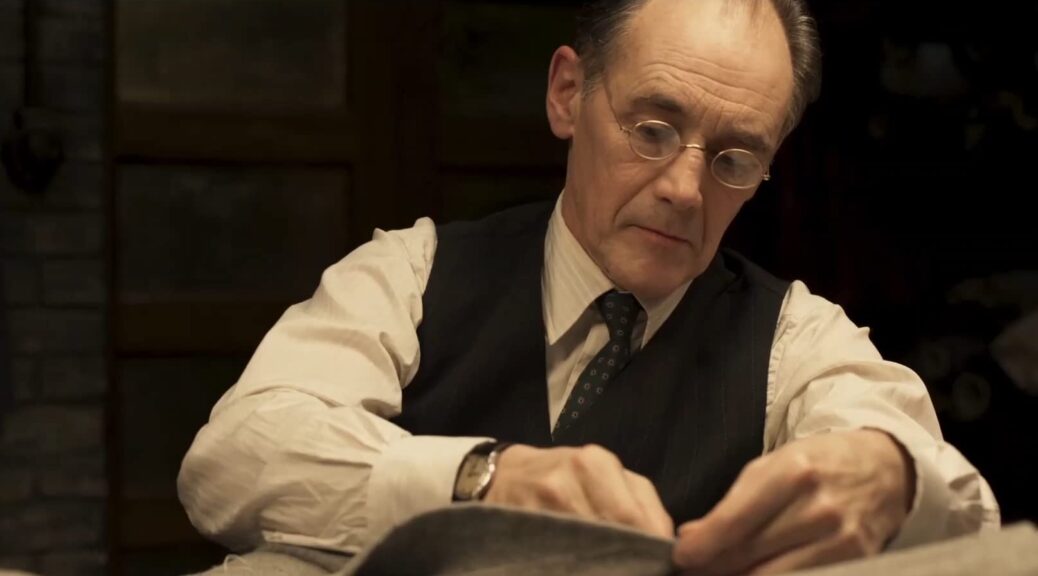
The opening minutes of The Outfit give us a master tailor named Leonard (Mark Rylance) describing his process. We see him measuring fabric, cutting and sewing while he outlines his skill in sizing up customers to give them what they most deserve.
Wait..is he still talking about suits?
Maybe, maybe not.
The setting is Chicago in 1956, where Leonard and his dreaming-of-a-better-life secretary Mable (Zoey Deutch) conduct business while local mobsters use Leonard’s shop to retrieve messages from a nationwide crime syndicate known as the Outfit.
One night after a shootout with a rival mob, gangsters Richie (Dylan O’Brien) and Francis (Johnny Flynn) barge into the shop in need of help and refuge. Richie, the son of local boss Roy (Simon Russel Beale) has been shot, and soon most everyone involved will have to fight to survive the long night.
Oscar-winning screenwriter Graham Moore (The Imitation Game) adds directing duties this time as well, for a nifty big screen debut that often homages early Kubrick and classic Hitchcock.
Essentially a two-room chamber piece, the film leans on a terrific ensemble to roll out a steady stream of delicious twists, relishing the nimble noir wordplay and skillfully keeping Moore’s sleight-of-hand from tipping its hand too early.
Fellow Oscar-winner Rylance (Bridge of Spies) is the perfect choice to bring Leonard to life, displaying a seemingly casual excellence right in line with who Leonard seems to be. Will underestimating the quiet shopkeeper prove to be a deadly mistake? Or is it Leonard who will learn a painful lesson tonight?
Rylance peels back the layers slowly, and Moore has good instincts for the pacing that allows for maximum fun. Deutch proves again that she’s a natural, making the most of a more limited role that still boasts an impressive ratio of secrets-to-screen time.
Despite getting a little too cute for the room come finale time, The Outfit is a solid directing debut for an acclaimed screenwriter. And while you can’t help feeling that this salute to the brainy introvert may be a personal one for Moore, it’s artful and engaging enough to rope in anyone who loves untangling a well-fitted suit of clues.
by George Wolf
Adrian Lyne hasn’t directed a movie in twenty years. It’s been twice that long since the 1957 source novel by Patricia Highsmith (Strangers on a Train, The Talented Mr. Ripley) has been adapted for the big screen.
They’re both back with a new vision for Deep Water, a sometimes frustrating erotic thriller that can never fully capitalize on all of its possibilities to be either erotic or thrilling.
Vic and Melinda Van Allen (Ben Affleck and Ana de Armas) are living a life of luxury in New Orleans with their young daughter Trixie (the incredibly cute Grace Jenkins). Vic developed a computer chip used for drone warfare, so his days of early retirement are mainly filled with watching Melinda openly flaunt her affairs at parties.
When one of Melinda’s past lovers turns up dead, Vic lets her latest boy toy (Brendan Miller) know that he’s the murderer. But Vic is only trying to scare the kid away, right? Neighbor Don (Tracy Letts with another standout supporting turn) is suspicious early on, and when another of Melinda’s lovers (Euphoria‘s Jacob Elordi) drowns at a pool party, plenty of others are looking at Vic as the prime suspect.
Screenwriters Zach Helm and Sam Levinson provide Lyne with undercurrents of subtext that are never fully explored. We assume Vic doesn’t want to subject Trixie or his finances to a messy divorce, but the deeper we dig, it’s clear this marital arrangement is feeding some need for both parties and fostering a concerning worldview for their child. Lyne showcases the aimless privilege of their daily lives to hint at a lesson on the rot of wealth, then pivots, often to Vic’s creepy but uneventful hobby of raising snails.
And though Lyne has made his name on the steamy sexual politics of 9 1/2 Weeks, Fatal Attraction and Unfaithful, there’s more smoke here than fire. And water, water everywhere.
You won’t notice grand chemistry between Affleck and de Armas, which is a credit to both. This is a marriage of psychological warfare, and it is Vic and Melinda’s contrasting plans of attack that keep us invested, especially in the early going. De Armas embodies the cruelly uninhibited as well as Affleck brings the condescending and calculated, which is a major reason the major twist to Highsmith’s original ending works as well as it does.
For these two, it feels right.
But only for a moment, because strangely, Lyne doesn’t let it linger. Instead, he quickly cuts from the credits to a performance from the adorable Jenkins singing along to a cheery pop ditty from the 1970s.
If it’s an attempt at chilling humor, it falls hard, becoming another anchor weighing down Deep Water just when it starts cruising.

We were so inspired by Kier-La Janisse’s documentary Woodlands Dark and Days Bewitched that we decided to dive into some of the best films her 3+ hour documentary couldn’t spend much time on. In particular, we wanted to highlight some of the greatest folk horror films not in the English language.
We highly recommend Roh (2019, Malaysia), La Llorona (2019, Guatemala), and Luz, The Flower of Evil (2019, Colombia). But here are our five favorites:
Drunken seminarians, farmhouses, witches – Viy sets you up from its opening moments for a classic folk tale. Three seminarians turned out for break get lost in the woods. They ask an old lady to let them sleep in her barn for the night. She’s not an ordinary old lady.
Konstantin Ershov and Georgiy Kropachyov’s silly, spooky yarn tells of class struggle and superstition. Poor Khoma, our bumbling, drunk hero, is screwed no matter what he does. State/religious authority will beat him, the wealthy will beat him, or supernatural evil will harm him in ways he can’t quite picture.
Even though there’s a clear element of silliness in this film, the core image of a man in over his head gives this Russian folk horror a punch.
Imagine a world in which Bergman’s Seventh Seal made it with Burton’s Edward Scissorhands and you kinda get a sense of Rainer Sarnet’s November.
At the center of the film lies the unrequited love of two peasants. Liina (Rea Lest) is hopelessly in love with Hans (Jörgen Liik). Hans has the hots for the daughter of the local German baron. Lina and Hans each try to capture the attention of their beloved while communing with ghosts, employing the services of kratts and witches, managing lycanthropy, evading the plague, circumventing arranged marriages, and avoiding starvation during the impending long winter.
The movie is a mishmash of comedy, romance, fantasy, political theory, and philosophy all shot in exquisite black and white. Somehow it comes together, like the kratts, in a way that seems fresh, bizarre, and interesting.
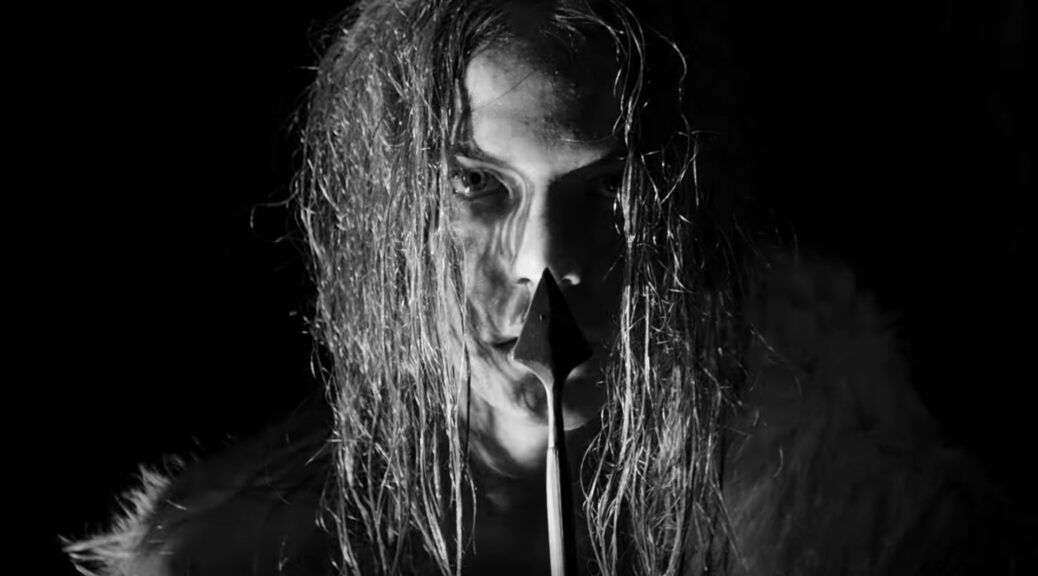
Making a remarkably assured feature debut as director, Lukas Feigelfeld mesmerizes with his German Gothic poetry, Hagazussa: A Heathen’s Curse.
Settled somewhere in the 15th Century Alps, the film shadows lonely, ostracized women struggling against a period where plague, paranoia and superstition reigned.
It would be easy to mistake the story Feigelfeld (who also writes) develops as a take on horror’s common “is she crazy or is there malevolence afoot?” theme. But the filmmaker’s hallucinatory tone and Aleksandra Cwen’s grounded performance allow Hagazussa to straddle that line and perhaps introduce a third option—maybe both are true.
The film lends itself to a reading more lyrical than literal. Feigelfeld’s influences from Murnau to Lynch show themselves in his deliberate pacing and the sheer beauty of his delusional segments. He’s captured this moment in time, this draining and ugly paranoia that caused women such misery, with imagery that is perplexingly beautiful.
“Why are you troubled?” Jesus asked, “And why do doubts arise in your hearts? Look at my hands and my feet. It is I myself. Touch me and see — for a spirit does not have flesh and bones, as you see I have.”
Though the true meaning of this quote won’t take hold until the final act, it presents many questions. Is this film supernatural? Demonic? Or, given the corporeal nature of the quote, is it rooted in the human flesh?
Yes.
That’s what makes the quote so perfect. Writer/director Hong-jin Na meshes everything together in this bucolic horror where superstition and religion blend. The film echoes with misery, as the title suggests. The filmmaker throws every grisly thing at you – zombies, pustules, demonic possession, police procedural, multiple homicides – and yet keeps it all slippery with overt comedy.
Among the many remarkable elements buoying the horror fable Lamb is filmmaker Valdimar Jóhannsson’s ability to tell a complete and riveting tale without a single word of exposition. Rather than devoting dialog to explaining to us what it is we are seeing, Jóhannsson relies on impressive visual storytelling instincts.
His cast of three – well, four, I guess — sells the fairy tale. A childless couple working a sheep farm in Iceland find an unusual newborn lamb and take her in as their own child. As is always the way in old school fables, though, there is much magical happiness but a dire recompense soon to come. It is an absolutely gorgeous, entirely unusual and expertly crafted gem of a film. You should see it.