Screening Room: Fantastic Beasts 3, Father Stu, Dual, Paris 13th District & More
by George Wolf
We’ve been grappling with the falseness of our social media identities long enough now that we should have expected this attack of the movie clones. Dual takes the premise of last year’s Swan Song and filters it through the high concept lens of The Lobster for an absurdist comedy that – as my grandpa used to say – is as black as the inside of your hat.
Karen Gillan is Sarah, who coughs up a great amount of blood and learns she is going to die. Sarah is told what she has is “painless…but killing you,” as writer/director Riley Stearns begins taking direct aim at our current state of anxiety.
To save her boyfriend (Beulah Koale) and mother (Maija Paunio) from the pain of losing her, Sarah signs up for clone replacement. But as Sarah2 arrives and starts the assimilation process, the original Sarah’s diagnosis is reversed, and now we have a problem.
“We can’t have two of you walking around forever. That would be ridiculous.”
Sarah2 has been in the world long enough to invoke her right to request a “stay,” which means that in one year’s time, a duel to the death will leave only one Sarah bathing in the cheers from both a stadium and broadcast audience.
So Sarah1 gets to work, in an effort to prove to her battle trainer Trent (Aaron Paul) that she really wants to live, and win back her mom and her man who already like Sarah2 better.
Stearns trades his thriller vibe from 2019’s The Art of Self-Defense for a near-future sci-fi landscape and finds delightfully organic ways to bring us up to speed on the rules of the game. And with Gillan (Guardians of the Galaxy, Avengers and Jumanji franchises), Stearns has the perfect partner to set the humor level on deadpan and never budge. The laughs come with a cynical, satirical bite, and while some may be a bit obvious, Stearns scatters other hilarious breadcrumbs just out of focus (don’t miss the title of the video Sarah is watching early on).
Dual doesn’t shy away from the absurdity of navigating a culture of death and winning Instagram posts. In fact, that’s where it lives, fully committed to finding out who really believes laughter is the best medicine.

by George Wolf
It shouldn’t be surprising to hear Mark Wahlberg was so committed to bringing the story of Father Stu to the screen that he funded much of it himself. Wahlberg’s own rough-and-tumble, sometimes unsavory past is hardly a secret. But now, as a devout Catholic, Wahlberg seems drawn to these stories of restless souls finding their way to the straight and narrow.
Stuart Long was a Montana native from a dysfunctional family who found some success as a Golden Gloves boxer in the mid 1980s before he decided California was the place he ought to be. Stu’s quest for movie stardom never got beyond a few commercials and bit parts, but his quest to win over a girlfriend (here named Carmen) got him a Catholic baptism and a surprising calling.
In her feature debut, writer/director Rosalind Ross frames Stu’s journey around the tenet that suffering brings one closer to God. Grief and disappointment have turned his father (Mel Gibson, effectively dialing down the SOB cartoonishness) into a bitter drunk and his mother (Jacki Weaver, always a pleasure) into a woman too afraid to be hopeful.
Wahlberg is natural and affecting as the Stu who responds to it all by forging ahead, always looking for the next angle to work or the next person to charm with an R-rated quip. As committed as he is though, Wahlberg has more trouble making Stu’s conversion feel like a true change of heart, instead of just his latest obsession.
Stu’s journey to the priesthood is interrupted by a tragic medical diagnosis, but the setback never lands as forcefully as it should. And while Ross rightly doesn’t shy away from Stu’s moral conflicts, his rivalry with a fellow seminarian (Cody Fern) often feels forced and manipulative.
Too profane to land in the “faith-based” stable, the film’s treatment of the sacred nonetheless manages moments that are nuanced and sincere. Ross juxtaposes Stu’s baptism with a wonderfully ironic soundtrack choice, while bringing a layered tenderness to the moments when Stu breaks the news to Carmen (Teresa Ruiz, terrific) that he will leave her behind for the priesthood.
The true story of Stuart Long is indeed a compelling one, and there are stretches of Father Stu that do him justice. But even with its embellished treatment, the film feels dramatically slight. It’s a sturdy and proficient testament to faith, but short of truly rousing.

by George Wolf
Blending a modern worldview with a slow-burn vibe, All the Old Knives reveals itself as a well-constructed thriller that often recalls those classic espionage yarns from the 70s.
The underrated Chris Pine gives another standout performance as Henry Pelham, a CIA vet who’s directed by his boss (Laurence Fishburne) to reopen a painful case from the past.
Back in 2012, they both were stationed in Vienna when counter-terrorism efforts to thwart a hijacking went tragically wrong. But new information has emerged that suggests the terrorists had help from a fellow agent, so Henry must revisit members of the team – including his old flame Celia (Thandiwe Newton) – to root out the mole.
Based on the best seller by Olen Steinhauer (who also pens the script), the film is admittedly heavy on dialog, but director Janus Metz (Borg vs. McEnroe, True Directive, Armadillo) proves masterfully adept at fleshing out important contrasts in past and present.
His camera remains purposefully static for the modern settings, while a more free-flowing approach to the flashbacks helps to offset all the descriptive recollections by pulling us into crisply detailed reenactments.
The ensemble (which also includes the great Jonathan Pryce) is top notch. Each actor digs in to the intelligent wordplay, picturesque locales and shadows of doubt on the way to crafting complex humans with something to lose.
The third act may bog down just a touch, with a hand that’s tipped perhaps a beat or two early, but none of that keeps the film from sticking its landing. There’s plenty of blame to go around in the often nasty business of global politics, and All the Old Knives makes that history lesson personal.
by George Wolf
I apologize in advance if I slip and call him Crash Bandicoot. I know it’s Sonic – Sonic the Hedgehog, but I’ve got limited first hand experience with any game after Frogger and sometimes get careless.
I do have experience with the first Sonic the Hedgehog movie from two years ago, so more of that same broadly-drawn, kid-friendly eye candy was not a surprise. What I wasn’t expecting was so much more of it, and those 30 extra minutes turn a harmlessly forgettable romp into a real test of patience.
Most of the gang returns from part one, including Ben Schwartz as the voice of Sonic, that speedy little alien who runs around Seattle looking for opportunities to earn the heroic moniker of “Blue Justice!”
But his human “dad” Tom (James Marsden) cautions Sonic of the need to grow up and remember that the moments that make a hero are not for him to choose.
Sonic will get those chances to prove himself, thanks to the return Dr. Robotnik aka “Eggman” (Jim Carrey) and a new, not blue meanie from space.
The ginger-maned Knuckles (voiced by Idris Elba) is a skilled Echidna warrior with an old score to settle against the hedgehog. That means Sonic and his buttcopter-powered pal Tails (voiced by Colleen O’Shaughnessey) will have to fight harder than ever to make sure the all-powerful Master Emerald does not fall into evil hands.
Director Jeff Fowler again shows a good feel for letting the effects department do some flexing, and the mixing of live action with animation is admittedly impressive.
But like the first film, the storytelling here is so exaggerated that even Carrey’s cartoonish mugging doesn’t seem that much over the top. Screenwriters Pat Casey and Josh Miller get an assist this time from John Whittington (The Lego Batman Movie), but are still committed to putting big, obvious eyebrows on nearly everything.
The welcome exception is Knuckles, and Elba’s perfectly authoritative delivery makes his character’s humorless interactions that much more humorous. It’s the one aspect of the film that doesn’t seem geared to keep the attention of easily distracted children.
But hey, kids, how do you like dance offs? Sonic 2 sets the needle drop and move busting level to unnecessary, pushing the run time to nearly two hours, even before the obligatory mid-credits peek at part three.
And all this time I thought speed was Sonic’s superpower.
Or maybe that’s Crash.

by George Wolf
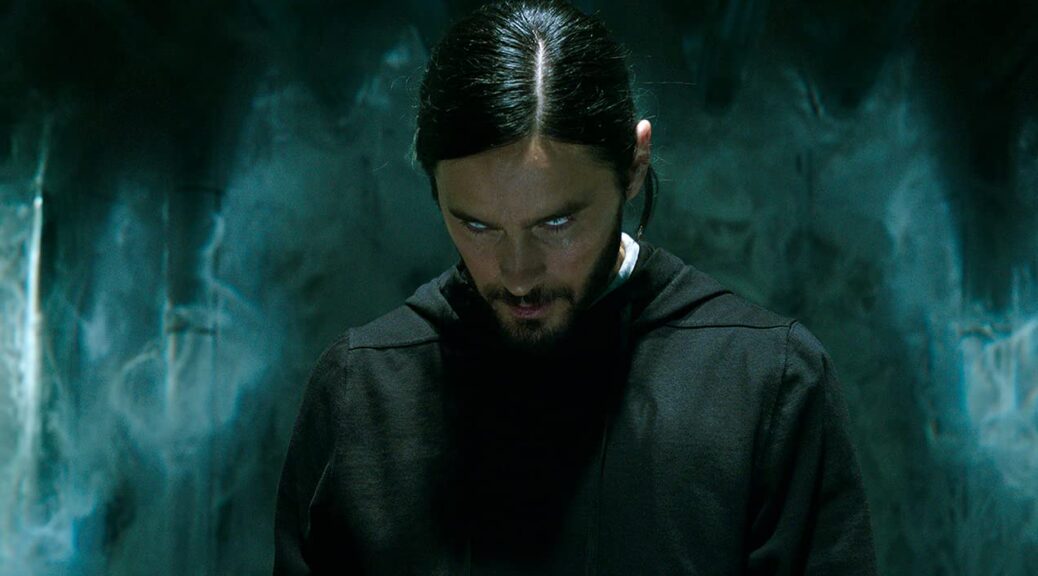
For a movie about a guy with a serious taste for blood, Morbius shows hardly any of it being spilled. That’s just one of the reasons the film feels hamstrung from what it wants to be.
What Dr. Michael Morbius (Jared Leto) wants to be is healthy. Born with a strange DNA abnormality that paired a genius mind with a broken body, Michael put “Dr.” in front of Morbius at age 19 on the way to becoming the foremost expert on blood borne diseases.
And now, his research with vampire bats from Costa Rica has yielded a breakthrough…with a catch. He gets super human, downright monstrous powers, but they wear off without more servings of blood. And while he’s getting by with the artificial variety for now, Morbius knows the time is coming when only human blood will do.
So the clock is ticking, and not just for Morbius. His colleague Martine (Adria Arjona) is feeling the heat, while Milo (Doctor Who‘s Matt Smith, who seems to enjoy hamming it up), Michael’s childhood friend who suffers from the same DNA abnormality, is eager for the cure – and fine with the consequences.
Director Daniel Espinosa (Life, Safe House) has plenty of fun with the CGI, and while the facial morphing is mighty impressive, the increased battle sequences end up trending more toward soulless, Van Helsing-style gymnastics.
Abrupt editing does Espinosa no favors, either, and the pace that initially feels nicely brisk leads to a narrative that just seems impatient. Many of the themes at work here are common to comic book adaptations, but just checking off the boxes is no substitute for development.
Screenwriters Matt Sazama and Burk Sharpless (the duo behind Gods Of Egypt, The Last Witch Hunter and Dracula Untold – all dreadful) try to inject some humor via a pair of detectives (Tyrese Gibson and Al Madrigal) hunting the “vampire killer,” but what the script needs most of all is to take Milo’s advice.
Embrace what you are!
This Morbius seems too desperate to sit at the cool Spider-Man table right now, skirting the commitment to a more fully formed, standalone character that would only reap dividends down the road. And yes, sit tight during the credits for two extra peeks in that direction.
But come on, this is vampire stuff, right? Throw off those PG-13 shackles and really dig in! Go for the jugular, if you will. Man, that could have been a rush.
This isn’t.
by George Wolf
A morality play rooted in family bonds, The Devil You Know looks to carve a modern-day Cain and Abel allegory from the ripples of a brutal murder.
Marcus (Omar Epps) is an ex-con who finally has a handle on sobriety and is hopeful for the future. He has a solid new job as an L.A. bus driver, a promising relationship with new girl Eva (Erica Tazel), and an extended family always ready to offer support.
But at the big family party in his honor, Marcus stumbles across something that appears to link his wayward brother Drew (William Catlett) to the home invasion killings that are dominating the news.
Should Marcus tell detective McDonald (Michael Ealy) what he knows? Or should Marcus keep quiet, covering for his brother and hoping that the local hoods Drew runs with (B.J. Britt and Theo Rossi) don’t eye him any more suspiciously than they already do?
Writer/director Charles Murray (TV’s Luke Cage and Sons of Anarchy) layers a compelling crisis of conscience through family strife that feels authentic thanks to a fine ensemble including veterans Glynn Turman and Vanessa Bell Calloway. It takes more than just stoically reciting the word “family” into the camera multiple times to reveal strength in conflict, and Murray has a good feel for this nuance.
Less successful are the TV and news reports of the murders (like old-age makeup, these continue to be a conundrum for filmmakers) and the tendency of Murray’s script to retrace some of the moral terrain it’s traveling. As a result, you start to feel the nearly two-hour run time as the pace develops some unmistakable drag.
But Murray seems like a TV vet with potential for compelling features. There is a thoughtful and effective thriller at the heart of The Devil You Know, and it’s often glimpsed through the moments of bloat that hold it back.
by George Wolf
First off, someone has earned a victory lap for that title, Let the Wrong One In. It’s perfect. Five words, and we instantly expect this film to be about vampires, and we expect it to be silly.
Done and done.
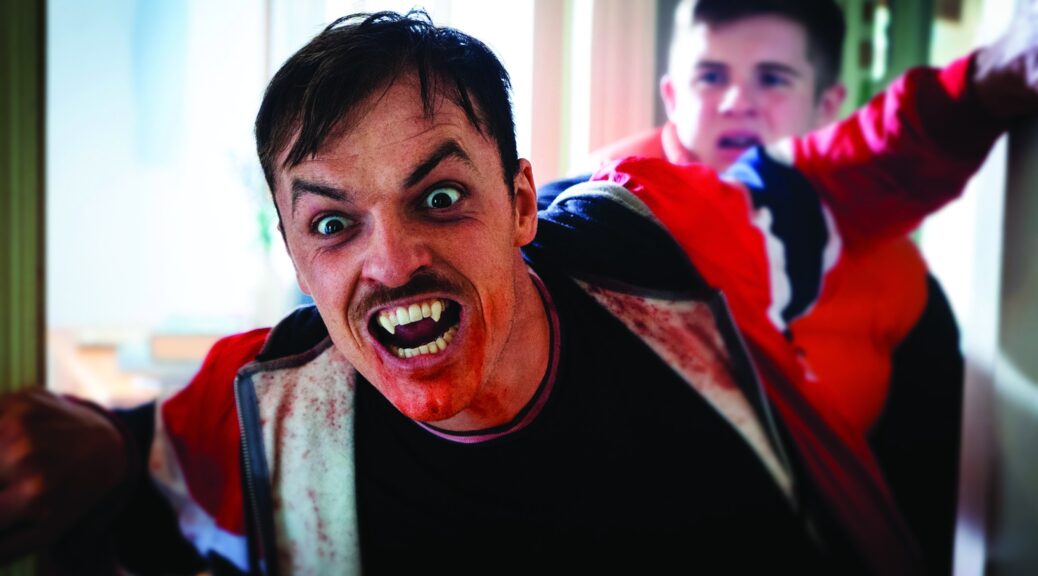
Writer/director Conor McMahon, the Irish goof behind Stiches and Dead Meat, brings his trademark nuttiness and thick, sometimes caption-worthy brogues to a story of love among the bloodsuckers.
Bachelorette Sheila (Mary Murray) is bitten during her hen party (in Transylvania, no less). Sheila comes home to the Emerald Isle and bites Deco (Eoin Duffy), whose sudden aversion to sunlight and garlic french fries doesn’t go unnoticed by his brother Derek (Jordan Lennon).
“You’re a vampire!”
“What are you insinuating?”
After calling in Dr. Henry (Anthony Head from TV’s Buffy the Vampire Slayer), the boys discover that the doc is also a vampire hunter (and train enthusiast) on the trail of his fiance Sheila and her gang of vamps.
There’s a showdown looming between the living and the undead, with McMahon and crew leaving a blood and guts-splattered trail along the way. The effects are low-rent and cheesy, the gags often obvious but always affable, and the nods to Kubrick and Edgar Wright unmistakable.
And if you’re thinking What We Do in the Shadows, this is a slightly different neighborhood. Let the Wrong One In is more working class, unbridled and often scattershot in its delivery.
But it does end up delivering on the promise of that title, with just enough zany bite to make the lifeless stretches easier to bury.
There are few spots on earth that generate more terror than a closet. Maybe the woods, the darkness beneath your bed, but what else? And why? We look into our favorite scary moments in cinematic closets for the latest episode, joined by filmmaker Timothy Troy, who knows a little bit about this topic.
There are so many moments in Tobe Hooper and Steven Spielberg’s Eighties gem to point to. But the clown alone, or the meat face alone, or any one of those memorable moments alone wouldn’t have made the film the classic it is. It needed that closet.
We’re used to seeing a closet as a small, dark, creepy space but at Cuesta Verde, it’s a gateway to another dimension. One that could suck your little pajama-clad daughter in. One that could belch out a giant beast that will eat your family whole.
The scene has been done to death by now, but when John Carpenter and co-writer Debra Hill first put Laurie Strode in that louver doored closet, audiences lost their shit.
Why would she do it? To buy time for the kids to escape because she’s smart and selfless. And then what? She’ll fashion a tool to take down the intruder. The scene cements Strode as the film’s true hero, but waiting in that tiny little space with slats of light and Michael’s breathing was a test of endurance for the audience. One that hundreds of horror movies have ripped off but none has recreated.
Who saw that coming? No one, that’s who.
Piper Laurie turns in one of the most gloriously villainous mother characters in cinematic history, terrifying and self-righteous. But this is a moment in Carrie White’s life (a luminous Sissy Spacek). Carrie is fighting back.
And you know what that means.
That means the closet.
We are very rarely fans of the jump scare, but we give it to director James Wan. He is the master.
And yes, it’s technically a bureau rather than a walk-in closet, but man, we jumped.