Tag Archives: entertainment

Daughters Out, Guns Out

The Old Way

by George Wolf

Nic Cage brings a Brimley-approved mustache and an itchy trigger finger to the The Old Way as Colton Briggs, meanest lowdown killer the Wild West ever saw.

But after an opening standoff that leaves plenty men dead and one young eyewitness without a father, director Brett Donowho jumps ahead twenty years, when the ‘stache is gone and…

…And a good woman has tamed this outlaw into a family man?

That’s right. Colton and his wife Ruth (Kerry Knuppe) run the Briggs Mercantile, while their pensive daughter Brooke (Ryan Kiera Armstrong from American Horror Story and last year’s Firestarter) looks for ways to challenge her smarts and curiosity.

So while Carl W. Lucas’s script scrapes together just enough reason for Colton to take a turn walking Brooke to school…

…Some gunslingers with an old score to settle pay a call to Mrs. Briggs, giving Mr. Briggs a mighty good reason to get out his guns and seek vengeance?

Right again. And though Ruth tells James McAllister (Noah Le Gros) and his crew that “you boys have woke up the devil!”, a face-to-face showdown is just what McAllister is after.

Obviously, nothing here is breaking any ground in the genre, as the real draw is Cage playing a grizzled killer in the Old West. He’s fine, just don’t expect any unhinged Caginess. Briggs is an always-restrained coil of intensity, as Donowho and Lucas instead try to craft some emotional heft from a father teaching his daughter the way of the gun.

Armstrong is clearly a talent, but both she and Cage are up against a script that leans too heavily on stilted, explanatory dialog and cliched exclamations (“You’re bringin’ Hell down on us, Jimmy!”). We’re told too much about who these people are without seeing enough to really care about them.

And by the time that showdown in the middle of a dusty trail finally plays out, what we do see doesn’t make for a memorable payoff.

It’s Nic Cage in a Western, so there are possibilities here. But The Old Way is too content to fall back on the old tropes to blaze anything at all.


Hooray for Hollywood

Babylon

by George Wolf

Well first, let’s talk about the elephant in the room.

There’s an elephant in the room. A real one, delivered to a film exec’s insane party by the ambitious young Manuel (Diego Calva). Wannabe starlet Nellie LaRoy (Margot Robbie) has also found a way past security, and as writer/director Damien Chazelle’s extended take winds us through some impressively staged decadence, Babylon begins its frantically entertaining chronicle of intertwining fates in early Hollywood.

Manuel and Nellie meet that night, each launching a dream to break into the movie business, where Jack Conrad (Brad Pitt) reigns as the king of silent films. While Manual begins climbing the ladder on the production side and Nellie’s persona as the screen’s new “wild child” makes her an in-demand sensation, the jaded Jack pines for innovation and laments that “the most magical place in the world” has become stagnant.

And before anyone can warn Jack about being careful with his wishes, “motherfucking sound!” comes to the movies.

Chazelle’s vision here is more ambitious than ever. Babylon is always big and often wild, swinging in all directions as it proposes a drug-fueled toast to the movies, the people that make them, and to the often cruel way those people are used and abused.

It’s a mess of humor, spectacle and emotion, with all angles fighting the urge to run off on their own. There’s surprising humanity in the arc of Sidney (Jovan Adepo), an African American horn player whose success in musicals can’t protect his dignity, but curious excess revealed in the strange cameo from Tobey Maguire as a scary guy with an alligator in his dungeon, as well as a sudden montage of classic movie moments that pops up in act three.

All three leads are terrific. Pitt exudes charisma and hard-earned wisdom as a man forced to admit bitter truths, Calva provides the film’s sympathetic heart and Robbie is flat-out ferocious, delivering a constant challenge for you to just try and look somewhere else. The always welcome Jean Smart is also a treat, stealing scenes with an award-worthy supporting turn as an influential gossip columnist.

Babylon isn’t just big, it’s large, with a three-hour-plus running time that Chazelle packs with enough pizazz and amazing craftsmanship to keep it constantly compelling. This film may be many things, but boring is not one of them.

Like Jack, the silent film star struggling in talkies, Chazelle knows the movie business may be at an important crossroads. But both men still believe in the power of movie magic, and that despite shame from the past and uncertainty in the future, Hollywood deserves the big loud hooray that explodes from Babylon.

Carry That Weight

The Whale

by George Wolf

By now you’ve probably heard plenty of accolades about Brendan Fraser’s “comeback” performance in Darren Aronofsky’s The Whale. It’s all true.

And that emotional standing O at Cannes? He deserved it.

It’s a stupendous performance, in a movie that’s always struggling to keep up with him.

Fraser, under some pretty impressive prosthetics and makeup, is Charlie, who pretends his laptop camera is broken so his online writing students won’t glimpse his obesity.

Charlie spends almost every moment of the day in his Idaho apartment, resisting face-to-face contact with anyone except his caring nurse Liz (Hong Chau, Oscar-worthy herself). Liz and Charlie share a connection to the traumatic event that sent Charlie down the path of eating himself to death, and Liz’s frustrated admonishments about Charlie’s habits seem to have little effect.

What does stir Charlie from his destructive routine are two surprise visits. One is from Thomas (Ty Simpkins), a missionary from New Life Ministries. The other is from Ellie (Sadie Sink from Stranger Things and Fear Street), Charlie’s angry, spiteful and estranged teenage daughter.

Screenwriter Samuel D. Hunter adapts his own play, and while Aronofsky offsets the chamber piece roots with sufficient cinematic vision, not all of Hunter’s themes make an equally successful transition.

The Moby Dick metaphor is frequent and obvious, but woven as it is through the lens of a composition teacher, settles in as an organic and relatable device. Similarly, Hunter’s points about the often judgmental and unforgiving nature of religious groups aren’t exactly profound, but their character-driven delivery is welcome.

But the heavily dramatic relationship between Charlie and Ellie – and later, Ellie’s mother (Samantha Morton) – suffers from the stage-to-screen edit. Emotions often escalate from two to ten in an instant, straining authenticity and pushing the manipulative wave that threatens to consume the film.

It doesn’t help that Aronofsky’s camera flirts with fetishizing Charlie’s shame, though Fraser’s tenderness is always the film’s saving grace. His every expression is etched with a soul-deep pain that’s finally being pierced by a last hope for redemption. Far from the maudlin exercise this character could have been, Fraser’s is an endlessly compassionate performance that will not let you give up on Charlie, or the film.

And you may very well see the resolution coming by the second act, but regardless, don’t forget to have the tissues handy for the third. Every time The Whale needs saving, fear not, Fraser will keep it afloat.

Come and Sea

Avatar: The Way of Water

by George Wolf

Week after week, really good films telling solid, compelling stories have been debuting in movie theaters and sinking like streaming-bound stones. What’s it gonna take for movies not named Top Gun to move people off the couch and back into the cinema?

James Cameron thinks the answer is to provide a sensory experience you just cannot get anywhere else. And on that front, Avatar: The Way of Water is a resounding success. See it on the IMAX screen, with the 3D glasses on your face, the thumping Dolby in your earholes and the high frame rate injected in your eyeballs and you’ll be transported to a theme park-like world of technical wonder.

The storytelling, on the other hand, is all wet.

Since we last left Jake Sully (Sam Worthington) over ten years ago, he and Neytiri (Zoe Saldana) have formed a happy family among the forest people of Pandora.

Their peace is shattered by a new invasion from the sky people, with a Na’vi clone of Colonel Quaritch (Stephen Lang) out to settle an old score. To keep the Na’vi from the fight, Jake and family flee to a village of the water people (including Kate Winslet and CCH Pounder) that’s led by Tonowari (Cliff Curtis).

But just as the forest family is bonding with their new water world, Quaritch and his troops come calling for a showdown.

You know who realized they shouldn’t run, that war would follow them and put others at risk? Neytiri did, the latest in a long line of smart women in James Cameron movies who no one listens to. That’s not the only throwback to Cameron films you may notice. Aliens, The Abyss, and Titanic are all over this film, and why not? Everybody else steals from them, why not Cameron?

The problem is not that he borrows from himself, but that he repeats himself. Scenes replay the same beats again and again. There’s so much wasted narrative space in this three-plus-hour film, and yet voiceover narration explains what that space could have been used to show.

And that’s the ironic weakness that consistently keeps Avatar 2 from resonating beyond surface-level amazement. Cameron (who also co-wrote the script) shows us so many wonderful delights, but precious few of them advance any investment in character, theme or narrative. It’s not that the ideals hitching a ride with the wizardry aren’t worthy, it’s just that they’re slapped together with so much obviousness and redundancy.

As the long-promised follow-up to the all-time box office champ, and carrying a budget in the hundreds of millions with several more sequels in the pipeline, there was already plenty riding on Cameron’s new vision. But a big return for TWOW could fast track a bittersweet bargain. The days of a rising tide at the multiplex lifting all boats seem to be fading fast, and one more huge wave might not leave room for anything on the big screen that’s less than pure spectacle.

Cruel Yule

Violent Night

by George Wolf

Maybe director Tommy Wirkola was kicking back with writers Pat Casey and John Miller one night, arguing about whether Die Hard was a Christmas movie. A few cold pops later, they’d swapped out John McClane for Santa Claus, added Die Hard 2 and Home Alone to the guest list, and Violent Night was born.

David Harbour is a hoot as a hard drinking Claus who’s not very jolly anymore. Kids are all greedy “little shits” these days, nobody believes, and maybe it’s time to hang up the sleigh.

But when he’s dropping off toys for bona fide nice list member Trudy Lightstone (Leah Brady, a cutie) on Christmas Eve, Santa becomes the monkey in the wrench.

Trudy’s grandmother Gertrude (Beverly D’Angelo, nice to see you) is obscenely wealthy, so the evil “Scrooge” (John Leguizamo) and his gang have invaded the festivities at the Lightstone compound. They want the millions hiding in the family vault, but they hadn’t planned on a red-suited party crasher and a little kid’s booby traps.

Santa’s not barefoot, but Wirkola (the Dead Snow films) and the Casey/Miller team (The Sonic the Hedgehog films) are not shy about re-creating sequences straight from the Die Hards and Home Alone. They do at least name check both films, and once the season’s beatings begin the film takes on a self-aware, R-rated vibe that’s plenty of ornery fun.

But what Trudy wants most this year is for her Mom (Alexis Louder, so good in Copshop) and Dad (Alex Hassell, The Tragedy of Macbeth) to get back together, and Violent Night can’t help undercutting its subversive streak with a nice, safe glass of milk and cookies.

The film backs away just when it could have been decking the halls with some raunchy hilarity, and that’s disappointing. This Santa likes his snacks with some “pre-War” brandy, and his hammers of the sledge variety. And when Violent Night is reaching into that brand new blood-soaked bag, it’s boughs of whiplash smiles.

Sole Man

Salvatore: Shoemaker of Dreams

by George Wolf

Have you ever seen a high-end shoe being assembled?

Director Luca Guadagnino makes it an oddly transfixing experience in the opening moments of Salvatore, Shoemaker of Dreams. We watch the construction silently, priming us for Salvatore Farragamo’s proud admission.

“I love feet, they talk to me.”

Guadagnino (Bones and All, Call Me By Your Name, Suspiria) may not have much audio or video of the celebrated shoemaker to help tell his story, but what he has is used wisely. Hearing from the actual Salvatore provides the needed personal insight to support the remembrances from family and friends, still photos, and narration from Michael Stuhlbarg.

And even if don’t share Salvatore’s skill as a foot whisperer, his is a truly compelling story of determination, celebrity and arch support.

Salvatore opened his first shop in his native Italy at the age of 12. He came to the U.S. as a teenager in 1915, settled in Santa Barbara, California and soon was outfitting the most famous feet in silent films. When the film business moved to Hollywood, so did Salvatore, also finding time to study anatomy at USC so he might understand how shoes could be made more comfortable.

“Fashion with comfort, that’s what I give.”

He applied for thousands of patents, got rich, went bankrupt and got rich again, forever changing society’s expectations of footwear style and comfort in the process.

Guadagnino’s inclusion of Martin Scorsese in the interview parade only underscores how Salvatore’s journey unveils like a classic American drama. It becomes a sprawling family legacy built on immigration, dreams and a solemn vow to never give up.

Shoemaker of Dreams is a fitting tribute to the fascinating life of a man ahead of his time. And while the focus on the earlier part of Salvatore’s story is more inherently interesting, Guadagnino crafts a sweet warmth for the film’s final act, complete with a surprise chef’s kiss.

The closing moments find Guadagnino collaborating with stop-motion animator Pes for a mesmerizing “shoe ballet” that sits perfectly poles apart from the no-frills intro.

These dancing shoes rival the synchronized shopping in White Noise for can’t-look-away sequence of the year, so keep your own feet right where they and don’t miss it.

How Much I Peel

Glass Onion: A Knives Out Mystery

by George Wolf

A good set of knives is always welcome around the holiday season. And while the new set from Rian Johnson is not quite as pointed, it’s still sharp, just as much fun, and even a good bit funnier.

2019’s Knives Out showed Johnson to be a new master of the whodunit. He skewered the 1% with wonderfully wry humor as he kept us engrossed in the deconstruction of a twisty murder mystery led by the fascinating Benoit Blanc (Daniel Craig).

Craig is back as the world’s greatest detective, one who’s suffering from a pandemic funk. The 2020 lockdown has Blanc itching for a new challenge. A strange puzzle box delivered to his door is the first step toward a satisfying scratch.

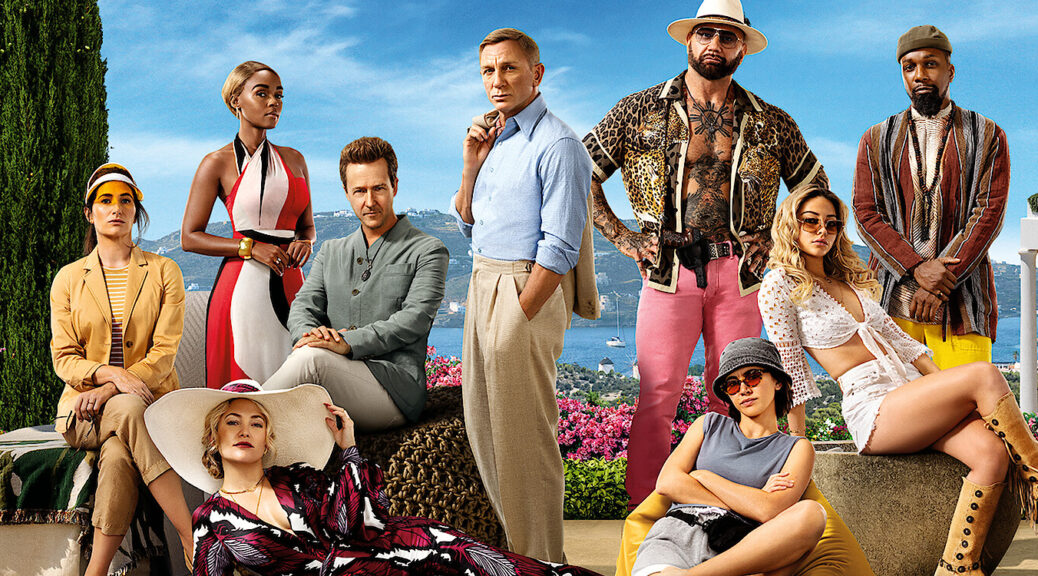
It’s an invite to the private Greek island of tech wizard Miles Bron (Edward Norton, a perfect billionaire man baby). Musk – er, I mean Miles – has gathered his old gang of buddies, who call themselves “The Disruptors,” for a lavish murder party. Can anyone hope to solve the mystery the brilliant Miles has concocted?

Blanc probably can. So why was he invited?

Good question. But the real joy of Glass Onion isn’t just finding the answers, it’s Johnson’s skill at peeling back all the layers of doubt and suspicion along the way.

But there’s another party guest who’s even more of a surprise. Andi (Janelle Monáe) had a serious falling out with Miles years ago, so the financial ties that bind the rest of The Disrupters to his ego-driven whims no longer apply.

But for fashion model Birdie (Kate Hudson), politician Claire (Kathryn Hahn), “alpha bro” blogger Duke (Dave Bautista) and scientist Lionel (Leslie Odom, Jr.), kissing Miles’s ring has long been part of the job description.

And that allows Johnson plenty of space to sink his blades into some perfect poster children for the vapid, self-important, privileged and clueless class. Admittedly, Glass Onion‘s fruit seems to hang a little lower than the original film, but the fun is still contagious.

Some well-placed cameos (including sweet farewells to both Stephen Sondheim and Angela Lansbury), obnoxious name-dropping (“Jeremy Renner’s small batch hot sauce!”) and one “I’m not here” live-in slacker named Derol (Noah Segan) add to the madcap zest. Craig puts all of it in his expertly tailored breast pocket while he steals the whole show.

Blanc is more flamboyant and fascinating this time, and Craig doesn’t waste one delicious chance to sell it. Blanc’s growing disgust with the worship of ignorant dickishness may not be especially original but it is tremendously rewarding to watch – almost as much as the case solving itself.

And man, Johnson has mad mystery skills. His script is funny, smart and intricate, always staying one step ahead of your questions while he builds the layers of whos and dunnits, only to tear them down and build anew.

No one’s claiming he invented this genre, but two mysteries down, you could say he’s well on his way to perfecting it.

Who is? Rian Johnson or Benoit Blanc?

Yes.

Forgotten Warriors

Devotion

by George Wolf

Both the title and the trailer hint at a formulaic, button-pushing war movie. Heck, seeing Glen Powell back in a cockpit might have Top Gun: Maverick fans hoping for a slice of Hangman’s family backstory.

Happily, neither pans out. Devotion does offer some thrilling air maneuvers, but reaches even greater heights with an inspiring, true-life account of two friends in a “forgotten war.”

Director J.D. Dillard (Sleight)and screenwriters Jake Crane and Jonathan Stewart bring hard truths and humanity to their adaptation of Adam Makos’s book detailing the bond between airmen on the eve of the Korean War.

Ensign Jesse Brown (Jonathan Majors) is the Navy’s first African American aviator. Lt. Tom Hudner (Powell), the “new guy,” is assigned to be his wingman. When Squadron 32 gets airborne, Dillard and cinematographer Erik Messerschmidt deliver the gripping goods. But away from the runway, two sterling performances and an understated script enable the film to bypass most of the usual cliches for an effective look at struggle, sacrifice and the need for true allies in the fight for equality.

Majors is so good, delivering his best work since The Last Black Man in San Francisco. His commanding physical presence comes easily, but the way Majors conveys the soul-deep pain beneath Jesse’s strong silence is never less than moving.

Powell is an impressive wingman here, as well, as a man of privilege who can’t ignore the contradictions between Jesse’s service and the treatment he so often endures.

So come for the aerial dogfights, you won’t be disappointed. But Devotion also serves up something special on the ground, and that’s worth saluting.

Over the Hills And Far Way

Strange World

by Hope Madden and George Wolf

So, one of the main characters here looks exactly like John Krasinski, but is voiced by Jake Gyllenhaal?

Strange World, indeed, but that’s just an amusing footnote in Disney’s latest animated feature, an enjoyable family adventure with a straightforward message and commitment to inclusion.

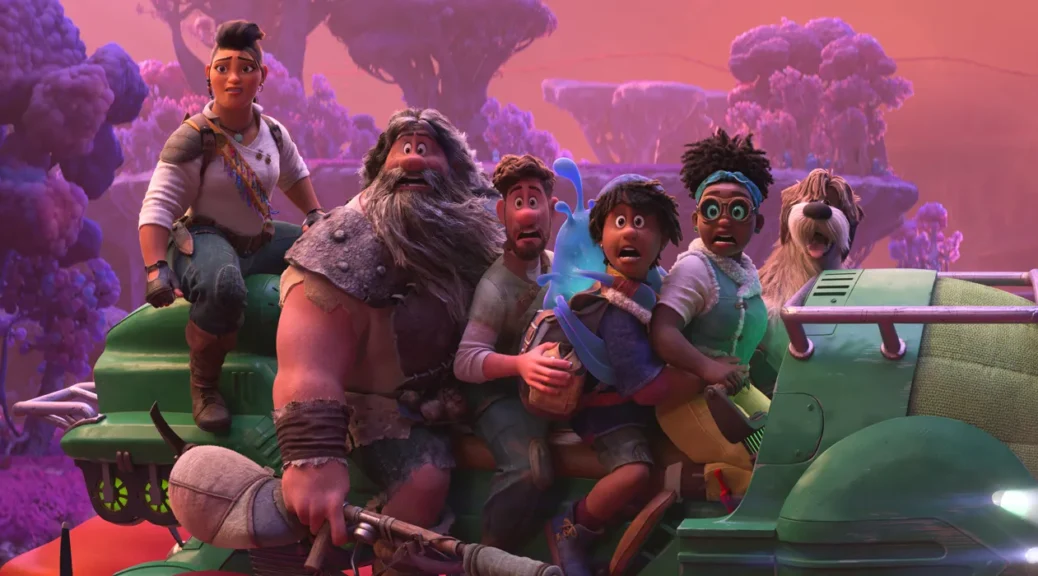
Jake is the voice of Searcher Clade, a contented farmer still dealing with the ghost of his famous father, Jaeger (Dennis Quaid). Twenty-five years ago, Jaeger vanished during the family’s quest to discover what lies beyond the mountains of Avalonia. But while Jaeger was lost on the expedition, Searcher brought back a vital new resource for his homeland: the Pando plant.

Pando now provides the energy that drives almost everything in Avalonia, which is all fine until the crops show signs of a serious infection. Putting aside a vow not to follow his father’s adventuring path, Searcher, his wife Meridian (Gabrielle Union), their son Ethan (Jaboukie Young-White) and their three-legged dog join President Mal (Lucy Liu) on a mission to cure the Pando plant and preserve their comfortable way of life.

Writer Qui Nguyen (Raya and the Last Dragon) joins his co-director Don Hall (Raya, Moana, Big Hero 6) to craft an ecological allegory seemingly inspired by the union of a role-playing board game and one of those cute posters you pass while waiting in the lines at Disney World.

The animation itself is stunning, whether snowy peaks, verdant village or trippy, drippy otherworld. Strange World lives up to its title, delivering a visual feast.

But there’s more on Nguyen’s mind than eye candy. His story offers a world where generations do not have to be defined by what they always believed was right, where masculinity has no concrete quality but is a term owned by the individual. More importantly, this Strange World is one where creature comfort is not more important than survival.

Often the film feels like it’s trying too hard to correct the stereotypes nourished by generations of children’s entertainment. But there’s a kindness and a sense of forgiveness throughout the movie that does make you yearn for a world like this one.

Drive-By

Lamborghini: The Man Behind the Legend

by George Wolf

The name “Lamborghini” probably brings to mind some beautiful, expensive cars that go very fast. In fact, they can reach speeds that are recommended only for the most skillful drivers.

That’s very much like the approach of Lamborghini: The Man Behind the Legend, writer/director Bobby Moresco’s drive-by telling of Ferruccio Lamborghini’s rise from the vineyards to the showrooms and the race tracks.

It is great to watch Frank Grillo dig into the lead role, though. He’s been a mainstay of action films for years, but here Grillo gets the chance to move beyond a reliance on brawn for a performance that shines with passion and charisma. He’s easily the best part of the film.

It’s also nice to see Oscar-winner Mira Sorvino as Ferrucchio’s loving-but-frustrated wife, Annita. But Moresco (who won his own Oscar for co-writing Crash with Paul Haggis) is simply content to check off the boxes of Ferrucchio’s journey, never giving any of them the depth or consideration required to resonate.

Moresco frames the biography around a late-night drag race between Lamborghini and rival Enzo Ferrari (Gabriel Byrne in a glorified cameo once pegged for Alec Baldwin). As the men trade steely glares and steady gear-shifting, Moresco quickly moves the flashbacks through Ferrucchio’s return from war, the launch of the company, personal and professional strife, success, and the constant drive for perfection.

The rush to get a car ready for the 1964 Geneva auto show instantly recalls James Mangold’s Ford v Ferrari, which is not a comparison that works in Lamborghini‘s favor. While Mangold wisely chose to limit his film’s scope so we could become invested in the lives and the details of a particular mission, Moresco is just reciting all these things that happened in a famous man’s life and hoping we might care as much as he does.

That’s rarely a winning formula. The film’s constant lack of authenticity undercuts any attempt to deconstruct Ferruchio’s need for recognition as more than a poor farmer, and Lamborghini: The Man Behind the Legend just can’t deliver the horses, or the power.