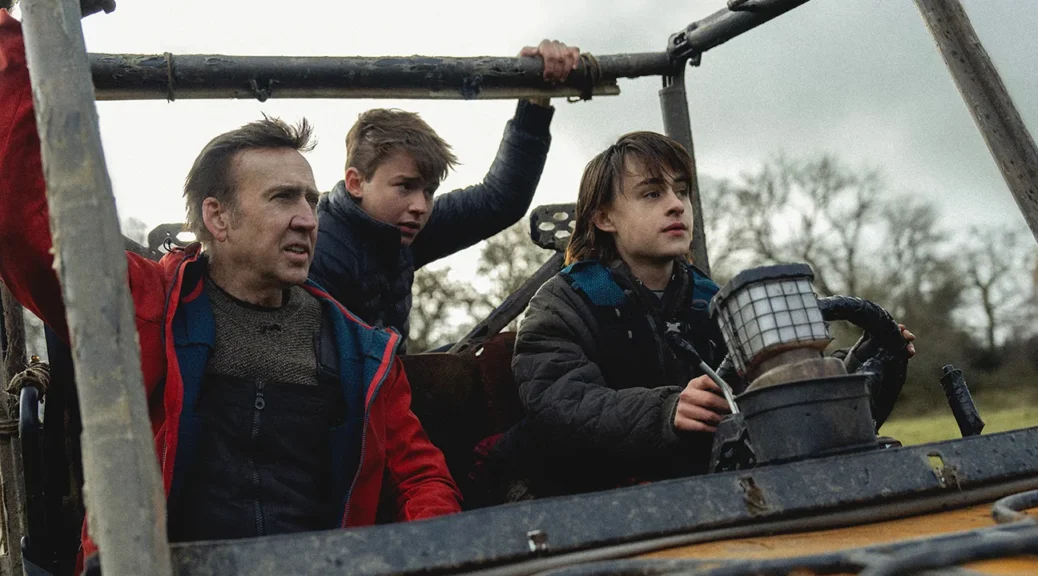
There is a secret to making great pancakes. I don’t know what it is, but adequate pancakes are still tasty with enough butter and syrup, so who cares?
Much the same can be said about a shoot-em-up set in a diner. Sure, a better chef than writer/director Ken Sanzel could wring more tension, comedy, and blood spray, but enough Nicolas Cage can make just about anything tasty.
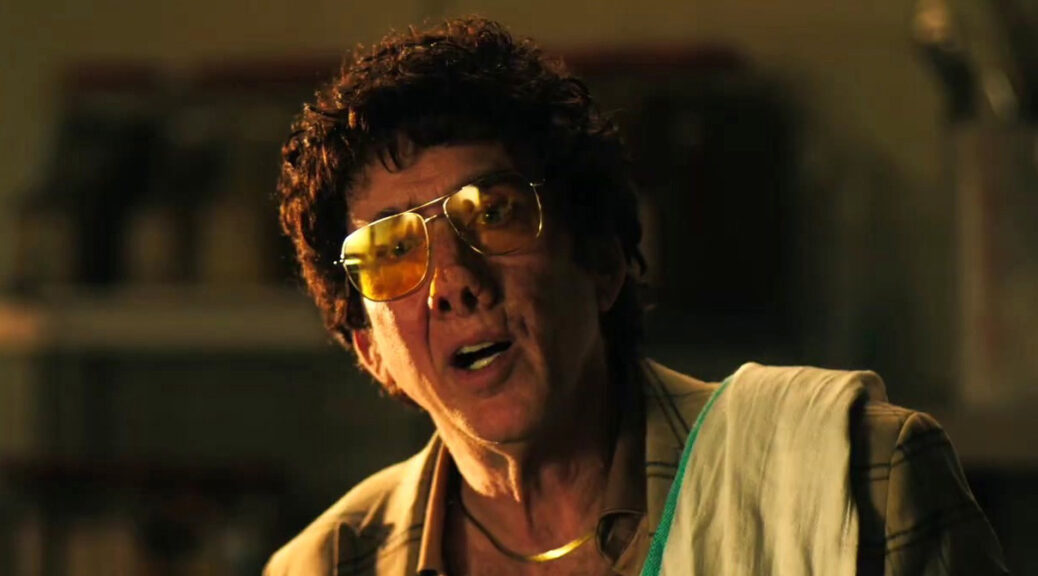
In Sanzel’s Best Pancakes in the County, Cage plays S.O.B. He’s got plaid suits, a piggish nose, a high voice, and an almost Mike Brady happening on his head. He’s also got a flash drive, stolen from some bad FBI types, and a little out-of-the-way diner perfect for a rendezvous to swap the drive for some cash.
When S.O.B.’s armed goons descend on the diner, Cookie (Justin Long) and Dolly (Shelley Hennig) don’t have many options except to keep grilling pancakes and filling coffee cups.
Then the rogue FBI agents also arrive, all matchy matchy, one Fed for one goon so nobody gets any funny ideas while they wait for S.O.B. to arrive.
Two years ago, Francis Galluppi dropped the similarly tasty morsel, The Last Stop in Yuma County. It was a better setup, felt less predictable, allowed set design details to do a lot of the exposition, the gunplay was inspired, and the casting top notch. Galluppi’s script was tight, leaving few questions but offering plenty of surprises.
Pancakes isn’t quite that gourmet, but it gets off some tense moments. Long’s a solid choice as the “let’s just get this over with” line cook, and Hennig delivers a bit of deadpan fun.
The twists are pretty telegraphed and very few of the henchmen get the chance to carve out much of a character. But Cage is the payoff, and he’s rarely predictable. We spend most of the film waiting, and the actor doesn’t disappoint. He’s goofy fun. Best Pancakes in the County is still nothing but empty calories, but it tastes OK.
Oh, I hate to do it, but I have to throw the flag on Madden, one of the most disappointing movies of the year.
I know, and I was really looking forward to this. It’s from co-writer and director David O. Russell, who is reminding everyone who didn’t know, or may have forgotten, that the Madden in the video game refers to a real person.
John Madden was a Super Bowl winning coach with the Oakland Raiders before he retired, due to health reasons and a demanding schedule, to become a beloved broadcaster, commercial pitchman, and turducken (a deboned chicken stuffed into a deboned duck stuffed into a deboned turkey) connoisseur. He was then recruited by the upstart gaming company EA sports and the name Madden soon became synonymous with a new brand of football.
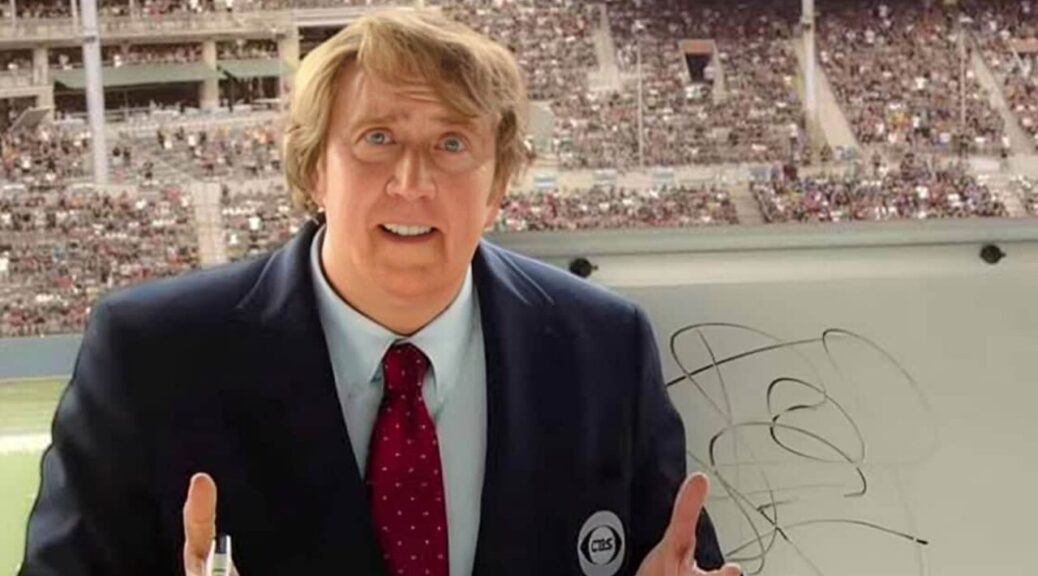
The ensemble is stellar. You’ve got Nicolas Cage under a bunch of prosthetics playing the eccentric Madden. Christian Bale absolutely nails the equally eccentric persona of Oakland Raiders owner Al Davis, with great support from Kathryn Hahn as John Madden’s wife, Virginia, and Sienna Miller as Al Davis’s wife, Carol. Throw in John Mulaney as EA sports founder Trip Hawkins, and you’ve got a great cast to work with, but Russell starts fumbling from the opening whistle.
The tone is all over the place. It’s part biography, part The Office-style mockumentary. And too much of it looks cheap, like a bad SNL skit where some ex-NFL players and comedian Shane Gillis put on wigs and glasses to stand in as nerdy game developers while Mulaney starts riffing.
It’s awkward and sad, because Russell (Silver Linings Playbook, American Hustle, The Fighter) wastes some great talent and storytelling possibilities. You’ve got really two fascinating relationships to explore here, one between John Madden and Al Davis and one between John Madden and his wife. Plus, you’ve got terrific actors to go exploring with. But Madden goes off the rails from the start. Every avenue seems misguided, and it’s never clear what kind of movie this is trying to be. It’s just too distracted, never giving us a compelling reason to get invested for nearly two hours.
There are plenty of great reasons to want Nicolas Cage in your movie. Downplaying it alongside a young Jesus probably isn’t one of them.
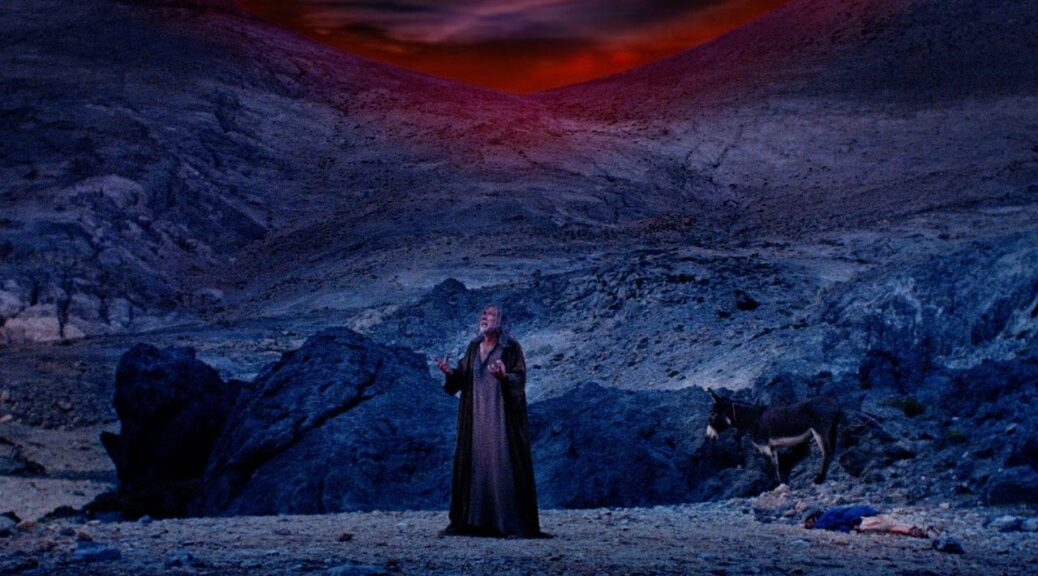
But writer/director Lotfy Nathan seems undaunted, and he guides The Carpenter’s Son around Cage’s often distracting presence for a Biblical tale rooted in a more historical approach.
Nathan has based his script on “the Infancy Gospel of Thomas,” one of the apocryphal writings by early Christians that describe events missing in the New Testament. Cage is The Carpenter, who smuggles The Mother (FKA Twigs, saddled with an underdeveloped role) and their infant son out of the city before King Herod’s officers can sentence The Boy to death.
The family lays low for years, but by the time The Boy is a teenager (Noah Jupe), whispers are starting to spread about his mysterious powers. How Nic Cage lays low is another mysterious question, with his neatly trimmed beard and distinctly American accent adding to the feeling that he may have wandered in from another set.
And early on, the film seems headed for a disastrous collision of awkward tone and misguided ambition. But slowly, as Nathan focuses more on The Boy’s growing friendship with The Stranger (Isla Johnston), a compelling narrative begins to emerge.
Jupe (Suburbicon, Honey Boy, A Quiet Place, Ford v Ferrari) continues to impress as a now young adult, and Johnston delivers a standout supporting turn of intrigue. With their relationship at the center, the film becomes a unique coming-of-age story that offers both a relatable humanity and a possibility of Divine Providence.
Another part of the curiosity around this film is just what audience Nathan is going after. The faith-based crowd will find moments of blasphemy while the non-believers will scoff at the silliness. Folk horror fans will question how it earned that label, and plenty more will be waiting for a Cage rage that never materializes.
While it’s not the trainwreck you’re afraid it’s going to be, The Carpenter’s Son can’t build anything that’s truly satisfying. The blueprint may be provocative, but the support system remains plenty wobbly.
Have you seen Wake in Fright, the 1971 Australian nightmare with Donald Pleasence? How about The Swimmer from ’68, where Burt Lancaster’s delusions of greatness are slowly punctured by the reality of his past?
The Surfer will hit harder if you can appreciate how it blends the two for its own deranged tale, as Nicolas Cage takes full advantage of another chance to come unglued before our eyes.
Cage stars as the titular surfer, who has come back to Australia’s Luna Bay in hopes of buying his childhood home. He brings his son along to surprise him with the news, but quickly finds the locals most unwelcoming.
“Don’t live here, don’t surf here!”
The “Bay Boys” rule the beach, and their guru Scally (Julian McMahon) takes the surfer and son aside to give them one polite warning: best move along.
They oblige, but the surfer won’t give up his dream so easily. He returns solo and things quickly escalate with the Bay Boys until the surfer is bloody and barefoot, without money, phone, car, or friends.
The font of the opening credits sets the perfect retro vibe, and director Lorcan Finnegan (Vivarium) leans into it from there. The minimalistic score, wide frames and dramatic punch-ins cast a spell of 70s Ozploitation that makes a fine launching pad for Cage’s slide into lunacy.
Australian accent? You think Cage needs one to sell this quest for survival? He doesn’t, and writer Thomas Martin weaves his lack of dialect into the thread of wry humor that runs throughout the film. Like Wake in Fright, circumstances hold a stranger prisoner in a foreboding Australian town, where – like The Swimmer – the past comes calling.
The Surfer is often smart but can be less than subtle, with some “hey don’t miss this” camerawork – which, to be fair, aligns with the throwback feel – and a lesson about toxic masculinity that’s well-meaning but repetitive.
But there’s much to like here, starting with Cage. The surfer is the kind of role that’s in perfect sync with his legendary eccentricities. He’s a man on the verge for ninety minutes, and nearly all of those are too much fun to look away.
Nic Cage makes, what, 18 movies a year? And every tenth or so is really worth watching, maybe because it’s fun, often solely because he’s a lunatic, and once in a long while you get a Pig, a Dream Scenario, a Mandy. But more often than not you get a Gunslingers.
Written and directed by Brian Skiba, the film opens with the worst AI New York skyline, circa 1904, you’ve ever seen. The scene that sets up the film amounts to a handful of quick cuts, gunshot sounds, and the worst CGI fire you’ve ever seen.
Cut to four years later and Thomas Keller (Stephen Dorff, a consistently solid actor who deserves better roles) is looking for the mythical town of Redemption, Kentucky. There he can lay down his guns and his name and take on a new, peaceful life, like every other citizen. It’s a town full of wanted men who’ve found…subtlety is not Skiba’s strong suit.
Hold your horses! That guy who was badly CGI burned? He’s on Thomas’s trail! And so is Val (Heather Graham), an “old friend” with a 4-year-old in tow. Who could be the father? What could Val want in Redemption? And how much exposition can Heather Graham be tasked with blurting out at opportune moments?
Well, old Thomas hasn’t been a citizen of Redemption long, but he’s already got friends in Redemption: town leader Jericho (Costas Mandylor); his daughter, the bartender (Scarlet Rose Stallone); his righthand law man (Tzi Ma in the worst wig you’ve ever seen onscreen); and the town religious zealot (Cage, dressed so anachronistically like a late ‘60s hippie it’s ludicrous).
Gunslingers feels like a grade school play written by a precocious 4th grader who watched a lot of Spaghetti Westerns. Skiba presents all the main beats of the genre with none of the connective tissue that gives them context or purpose. Every scene is contrivance plus shoot out plus convenient plot turn plus Val shouting exposition followed by Cage brandishing some kind of inexplicable tracheotomy sound to his vocal delivery.
It’s probably not the worst movie Cage has made, but lord, it is not good.
Very few 2024 films have been more eagerly anticipated by horror fans than Oz Perkins’s Longlegs. For some, it’s the filmmaker’s criminally underappreciated features The Blackcoat’s Daughter, Gretel & Hansel, and I Am the Pretty Thing That Lives in the House that compel interest in his latest effort.
For others, it’s lead Maika Monroe, a tremendous talent who routinely chooses challenging, satisfying horror, including It Follows, Watcher, The Guest and more. But for most people, let’s be honest, it’s the chance to see Nic Cage play a deeply deranged serial killer. (We are not made of stone!)
Cage excels, as does Monroe—both aided immeasurably by memorable support work from Blair Underwood and Alicia Witt. Monroe is Agent Lee Harker whose “hyper intuitive” nature has her assigned to a confounding case of whole families murdering one another, the only sign of an outside presence being an encoded note left at the scenes.
Monroe’s green FBI agent is as stiff and awkwardly internal as Cage’s psycho is theatrical. Her terror is as authentic as his lunacy.
Perkins shines as bright as ever, too. As always, his shot selection and framing evoke dark poetry. His use of light and shadow, architecture and space is like no one else’s.
His Longlegs direction and writing contain provocative notes of his own Blackcoat’s Daughter, but the plotting here is anchored by something slightly more predictable. I defy you to watch Blackcoat’s Daughter and figure out where it’s going, and yet it ends up exactly where it needs to be. For all the many fascinating flourishes and unsettling performances in Longlegs, there is something here that feels more obvious than any of the filmmaker’s previous films. Maybe it’s the clear influence of 90s thrillers: The Silence of the Lambs, Zodiac, maybe even a little bit of Se7en.
It is nagging—the sense, for the first time in any of his films, of recognizability. But don’t let that deter you. In many ways, it’s Perkins’s sleight of hand, his way of suggesting one thing while saying something else, of rooting audiences in something familiar expressly to pull that comfy rug away.
Longlegs is strangely beautiful, deeply unnerving, and a fine reason to be a horror fan.
We love him. You love him. Once considered one of the greatest actors of his generation, later deemed a nut job with unusual spending habits who would take any role, Nicolas Cage has finally set the debate to rest. He is obviously both.
Whether his masterpiece performances—Raising Arizona, Moonstruck, Wild at Heart, Leaving Las Vegas, Adaptation, Pig—or his many other great, good, mediocre and outright terrible films, Cage is a guy you can’t take your eyes off of. But what are his best horror films? Let’s dig in.
5. Renfield (2023)
They totally made a movie with a very saucy Nic Cage as Dracula. And a saucy Nic Cage is the best Nic Cage.
There’s at least one bloody toe in waters that send up rom-coms, satirize narcissistic relationships and homage a classic horror character while it’s also modernizing the themes that built him.
But experiencing Count Nicula alone is worth it. Plus, Nicholas Hoult is perfect as the put-upon sad boy with access to anti-hero superpowers and Awkwafina can wring plenty of humor from simply telling a guy named Kyle to F-off.
Renfield might be bloodier than you expect, but it’s just as much fun as you’re hoping for. Call it bloody good fun.
4. Grindhouse (2007)
Quentin Tarantino and Robert Rodriguez deserved more eyeballs when they released their giddy mash note to low rent B-horror features. Both films were great, but what was really inspired were the fake trailers they wedged between the two features.
One of the best trailers, and possibly the fest film Rob Zombie ever made, was this gem that looks like a realistic evolution of an old Sybil Danning film. (Danning herself co-stars as one of the She-Devils of Belzac). The chef’s kiss is Cage, cackling maniacally over the end of the clip as Fu Manchu.
3. Mom and Dad (2017)
I brought you into this world, I can take you out of it.
It’s a joke, of course, an idle threat. Right?
Maybe so, but deep down, it does speak to the unspeakable tumult of emotions and desires that come with parenting. Wisely, a humorous tumult is exactly the approach writer/director Brian Taylor brings to his horror comedy Mom and Dad.
So why do you want to see it? Because of the unhinged Nicolas Cage. Not just any Nic Cage—the kind who can convincingly sing the Hokey Pokey while demolishing furniture with a sledge hammer.
This is one of those Nic Cage roles: Face/Off meets Wild at Heart meets Vampire’s Kiss. He’s weird, he’s explosive and he is clearly enjoying himself.
2. Vampire’s Kiss (1988)
Sure, Nicolas Cage is a whore, a has-been, and his wigs embarrass us all. But back before The Rock (the film that turned him), Cage was always willing to behave in a strangely effeminate manner, and perhaps even eat a bug. He made some great movies that way.
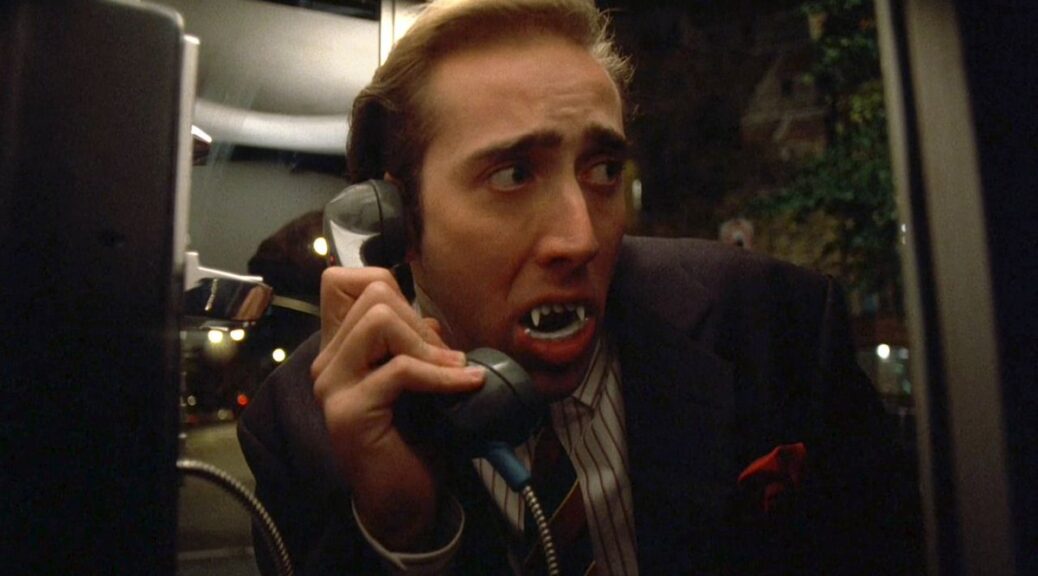
Peter Lowe (pronounced with such relish by Cage) believes he’s been bitten by a vampire (Jennifer Beals) during a one night stand. It turns out, he’s actually just insane. The bite becomes his excuse to indulge his self-obsessed, soulless, predatory nature for the balance of the running time.
Cage gives a masterful comic performance in Vampire’s Kiss as a narcissistic literary editor who descends into madness. The actor is hilarious, demented, his physical performance outstanding. The way he uses his gangly mess of limbs and hulking shoulders inspires darkly, campy comic awe. And the plastic teeth are awesome.
Peter may believe he abuses his wholesome editorial assistant Alva (Maria Conchita Alonso) with sinister panache because he’s slowly turning into a demon, but we know better.
1. Mandy (2018)
Writer/director Panos Cosmatos’s hallucinogenic fever dream of social, political and pop-culture subtexts layered with good old, blood-soaked revenge, Mandy throws enough visionary strangeness on the screen to dwarf even Nicolas Cage in full freakout mode.
Not just Nic, either. Andrea Riseborough, cannibal bikers on LSD, The Chemist, and a religious sex cult led by a terrible folk singer. Plus a sword, an axe, a lot of blood, and did I mention the LSD?
Like Cosmatos’s 2010 debut Beyond the Black Rainbow, Mandy is both formally daring and wildly borrowed. While Black Rainbow, also set in 1983, shines with the antiseptic aesthetic of Cronenberg or Kubrick, Mandy feels more like something snatched from a Dio album cover.
Nicolas Cage has become such a mythic figure in film culture that each new outing tends to bring questions.
Is this the unhinged “rage in the Cage?” Arthouse Cage? Mass appeal or self effacing Cage?
You can file Arcadian under “understated Cage leading a YA leaning creature feature.”
He stars as Paul, who’s living in a remote farmhouse with his twin teenage sons in a dystopian future. By day, the men follow a careful routine of security and sustenance. Because at night, there are visitors that really want to come in.
The exact details of the invasion are a little sketchy, but never elusive enough to derail our interest in the family’s survival.
Thomas (Maxwell Jenkins) is the impulsive, romantic brother, and his visits with Charlotte (Sadie Soverall) at the farm down the road have been keeping Thomas out dangerously late. His twin Joseph (Jaeden Martell) is the introspective thinker. Joseph has been studying patterns of the nightly attacks and believes the creatures have been testing, and planning.
He’s right.
Director Benjamin Brewer isn’t trying to reinvent anything here. He teams with producer-turned-screenwriter Michael Nilon for an unassuming horror thriller than benefits greatly from an impressive cast and a frightening creature design.
I don’t want to give anything away, but these bad boys have one specific trait that will get your attention right quick.
These themes aren’t new. There will be peril, bloodshed, and sacrifice as the creatures get smarter and the young begin to take on responsibilities of adulthood and cherish the things that matter. But thankfully, that familiarity doesn’t breed pandering. Brewer is also able to land some solid thrills, while the three younger co-stars provide impressive support for Cage’s elder statesman grace.
Ultimately, Arcadian doesn’t feel that much like a stereotypical “Nicolas Cage movie.” And the film is better for it.
Why does the zebra look the way it does? Can anyone think of a benefit to that pattern? Those stripes help zebras blend into the group, go unnoticed. And when no one notices you, you’re safe.
But wouldn’t everyone rather feel special?
Paul Matthews (Nicolas Cage) would. Too bad there is nothing particularly special about him. He’s a tenured professor, but not a researcher. He wants to write a book, just hasn’t actually written anything yet. And then, somehow, suddenly, everyone is dreaming about him.
Well, the dream is not about Paul, per se. But there he is, anyway, standing there and not participating.
Writer/director Kristoffer Borgli (Sick of Myself) once again analyzes and satirizes the cultural obsession with attention. But by moving the focus to a middle-aged, relatively ordinary man, Borgli removes the wag of the finger toward the young and their vacuous nature. Instead, Dream Scenario becomes an unnervingly accurate portrayal of our whole cultural attention span.
This is absurdist horror comedy at its best, leaning toward Charlie Kaufman’s take on humanity. That, of course, makes Cage an apt choice for the lead. Cage delivered two magnificent comedic performances in the Kaufman-penned Adaptation, garnering an Oscar nomination. In that film he played a neurotic intellectual and an oblivious dufus. In a way, he does that here, too.
Every half dozen films or so, Nic Cage reminds us of his singular talent. Pig (2021) again proved his humbling dramatic power. Dream Scenario (like Adaptation) recalls his nimble comedic skill.
Equally nimble is Borgli’s writing, coloring the all-too-real horror of celebrity with running jokes about ants, zebras and the Talking Heads. None of the richness in the script is lost on Cage or a game ensemble –including Julianne Nicholson, Michael Cera and Tim Meadows – mainly playing it straight so Cage can melt down gloriously.
The director slides so easily through tonal shifts that even one sincere, romantic moment feels at home. As does the film’s theme: none of this is real.
Nicolas Cage has done the wild West before. Of course, with 116 acting credits, he’s done most everything before. But he’s done this recently – earlier this year in The Old Way, and a couple of years back in Prisoners of the Ghostland. What’s new with Butcher’s Crossing?
Cage plays Miller, a buffalo hunter. He works for himself. And he knows the stragglers with their paper thin hides around these parts ain’t nothing compared to the majestic creatures he’s seen in the thousands over in Colorado territory. If only somebody’d pony up the dough, he could put together a hunting party and bring in the biggest haul this town’s ever seen.
Well, sir, that’s just what young Will Andrews (Fred Hechinger) wants to hear. He dropped out of Harvard in search of adventure, and this looks to be that.
Co-writer/director Gabe Polsky adapts John Williams’s gorgeous 1960 novel of bitter truth and American mythology. Visually striking, the film’s untamed beauty belies its meager budget. Creating an atmosphere with limited means is an instinct Polsky has shown since his impressive feature debut, Motel Life.
Miller, Will, the hyper-religious Charlie (Xander Berkeley) and the scoundrel Fred (Jeremy Bobb) head into the Rockies in search of buffalo. What they find, along with the beasts, is themselves, and that is not pretty.
Butcher’s Crossing becomes a descent into madness film. This should be where Cage excels. Madness is essentially his brand. The character isn’t written well enough to leave an impression and Polsky’s storytelling is too tight to let the veteran madman open up. Lunacy never materializes.
Hechinger, memorably naïve in News of the World, delivers well enough as innocence turned sour. Both Bobb and Paul Raci, as the bitter entrepreneur who warned the men against the hunt, add a bit of color to the story.
Butcher’s Crossing is an ugly story of greed. It’s an ugly story of America. The shots of bison carcasses make an impression – the photography throughout is impressive, but this sickening image is particularly something. Unfortunately, Polsky’s script and cast can’t quite match the visual clarity he gives the tale.