Movies, movies and more movies out this week for those of us too lazy to leave the damn house. You can watch a movie that will tear your heart out, or watch an about-effing-time teen romance. Middling horror and action also await your loungy ass, so dig right in!
At Veboli, we’re always thinking of ways to improve the movie advice we give the movie lovers on our site. Last summer we rounded up movie critics from all over the world, including five here at MaddWolf, to connect movie lovers to critics that best understand their own taste in movies. This, of course, generates a lot of data (Holy crap, there are more than 20,000 reviews!). With all that data, I wondered: how do you users compare to critics?
Before diving into the genres, let’s look at how the critics here at MaddWolf compare to the average user’s ratings on Veboli. George Wolf’s taste in movies is the most similar to the average Veboli user, Rachel Willis’ taste is the most unique. Below is a table of all the MaddWolf movie critics and their average difference from the average user rating on Veboli.
Critics
Average Difference
George Wolf
0.9
Hope Madden
1.0
Matt Weiner
1.1
Christie Robb
1.6
Rachel Willis
1.9
Take Fight Club and The Lion King for example. The average ratings on Veboli for these two movies are 7.6 and 7.3. George gave these two movies an 8 and a 7 whereas Rachel gave them a 6 and a 10. Most of George’s ratings are pretty close to the the average rating of all of the users on Veboli while Rachel has more ratings that are farther from the average.
Looking at the table, I at first thought MaddWolf’s got three pretty average critics and two more unique ones. Which it turns out was a pretty accurate statement. The average critic has an average difference per rating of 1.08. But this misses an even bigger pattern! The average user has an average difference per rating of 1.51. Users on Veboli are a pretty diverse group of movie lovers. Some of the users even have an average difference of higher than 5. That’s crazy! If users on average give a movie a 5, these users would give it either a 0 or a 10.
I thought that horror would have the largest average difference between users and critics. I thought laughing, sympathizing and thinking are things that most people generally like in movies. But being scared is something that some people love and others hate. But horror’s only the sixth most disagreed upon genre, with adventure, science fiction, action, fantasy, and drama all having slightly higher average differences in ratings by users and critics.
So what did I find? It seems like factual movies (documentaries and historical movies) are less controversial than the more fictional movies (fantasy, horror and science fiction). The more energetic, fast-paced movies (action and adventure) are generally the most controversial. Below is a table of all the genres and the average difference in ratings between users and critics. The lower the average difference, the more users and critics agree about the movies in that genre.
Genre
Average Difference
Western
0.9
Documentary
1.0
Music
1.0
History
1.2
Animation
1.3
Mystery
1.4
Family
1.4
Crime
1.4
Romance
1.4
Comedy
1.4
Thriller
1.4
Horror
1.4
Drama
1.5
Fantasy
1.5
Action
1.6
Science fiction
1.6
Adventure
1.6
Head over to Veboli to see more movies that users and critics disagree or agree on. If you’d like to see more of the data on how users compare to movie critics explored, let us know in the comments below!
PS, The Wizard of Oz has a difference of 2.3, critics seem to like it much more than users.
Now that Adam Kontras’s first documentary feature is out, he has time to sit back and savor the accomplishment.
“I completely regret attempting it,” he says. “Had no clue it would turn out the way it did.”
How’s that?
“The movie turned out well,” Kontras says. “I just wish it wasn’t me.”
The film is Fastest DeLorean in the World, Kontras’s first-hand account of mixing business with record breaking. The owner of a Back to the Future-style time machine, Kontras documented his attempt at setting a new DeLorean speed record.
It is a fascinating story, filled with frustration, thrills, more than a little personal anguish and much more debt than expected.
Kontras, a Columbus native, left home for Los Angeles in late 1999 with a performance art piece entitled 4TVs, in which he played each member of a mock boy band that performed via separate TVs due to mutual hatred. Kontras decided to update his ambitions for fans from his on-air work in Columbus radio at WTVN and CD101 (now CD102.5) with a series of videos dubbed “The Journey,” unknowingly blazing the video blogging trail.
“I had a good email following through my time in radio,” Kontras says. “I decided to include a video with the first email announcing my move to LA and chronicling the whole journey. I just made a page with each email and video on the 4TVs site and figured I’d do it until I ‘made it.’ Eighteen years later, that video blog became a sort of therapy to handle all the bullshit out here. Once I was recognized in 2009 as the first and longest-running ‘vlogger,’ it won’t be stopping anytime soon.”
And then, like so many Midwesterners chasing Hollywood dreams, Kontras built a golf course and bought an iconic vehicle.
“I built a minigolf course in my backyard,” he says. “I was theme-ing each hole, and in 2014 an actual DeLorean Time Machine seemed like the caviar dream. Long story short, I took a loan and figured I could make the money back renting the car out. If that failed, I could sell the car at the height of Back to the Future madness in October 2015 (the “future day” Marty goes to in part 2).”
Kontras credits that “madness” with doubling his investment in 2015.
“To date, it’s still my only means of income, which is hard for me to even comprehend,” he says. “The car is simply that popular.”
Needless to say, owning that car has taken Kontras to some interesting places.
“The three times I’ve had it on the Universal lot at Hill Valley will always be surreal,” he says. “Driving Lea Thompson into Dodger Stadium, driving it on an aircraft carrier—2015 was incredible for big events like that. But my favorite events are usually the smaller ones where we get to surprise fans. You forget how much this car means to people sometimes.”
It has also led to a firm friendship with Don Fullilove, who played Mayor Goldie Wilson in the Back to the Future films and joins Kontras in his documentary.
“(Don is) as genuine as he seems on-screen and I honestly feel he saves the film,” Kontras says. “He keeps the pace light-hearted, although the content is anything but.”
As Kontras sets out to modify his car enough to reach world record DeLorean speed, costs and setbacks mount. Kontras leaned on his gearhead brother Kenny for both advice and actual work on the engine, and some of the most effective moments in the film come after their differing visions lead to a gasp-inducing bit of deception.
“I’m still struggling with the aftermath of everything and it doesn’t look like it will end anytime soon,” Kontras says.
Though The Fastest DeLorean in the World is Kontras’s first feature, the film has polish in both framing and editing, thanks to his experience assembling The Journey vlogs.
“(The film) was edited in Premiere Pro, and we used so many different cameras,” he remembers. “Mostly smartphones, to be honest. When you’re doing a lot of guerrilla shoots, being able to hand off an iPhone Plus with the steadicam feature is worth its weight in gold. So many of the shots were by friends that were just there to see what happened and I’d hand them a phone. It made editing a nightmare but I’m used to that.”
Did Kontras get his speed record? The film takes you on a captivating ride to find that answer.
“The movie ends with one helluva cliffhanger,” he says. “We’re presently shooting the sequel, the content of which seems to change daily. I’m still living every second and have no idea what or when that will be.”
Filmmaker Ted Geoghegan has been making horror movies since 2001 when he began writing primarily low-budget European horror. His award-winning 2015 break out film We Are Still Here, a haunted house tale starring beloved genre staple Barbara Crampton, marked him as a director worth attention. He leveraged that success to tell a story he’d been mulling for years, a genre hybrid that breaks new ground called Mohawk.
Hope Madden: Did you set out to make a horror movie this time around: Ted Geoghegan: Even though it’s being marketed as an action-horror film, Mohawk‘s more of a sad, angry drama about marginalized people. It’s spiritually similar to We Are Still Here while also being a total, hard 180.
Madden: How’s that? Geoghegan:Mohawk‘s a very unconventional period film, from the relationship of its lead characters and hard synth score to the fact that it was shot completely with natural light and on actual Mohawk land. It’s a sad, angry, very political anti-Trump drama about colonialism, but it’s also got people being stabbed in the head. It’s awfully different and we take some bold creative choices, but I figure that’s what cinema is for.
Madden:Mohawk is possibly the first Western to take the Native American point of view, but definitely the first to make that perspective female. Did you set out to break that ground? Geoghegan: Absolutely. I’ve made it a point in my directorial works that my films are always anchored by a strong female lead. I am someone who relishes the idea of being able to tell the stories of marginalized people and encourage those people to be able to tell their own stories as well.
Madden: How did this story come about? Geoghegan: This story that has grown out of my youth in Montana followed by my present life in New York City. I grew up around a lot of Native and indigenous people and for me, it was a part of my daily life. Years ago, when I moved to New York City, I was surprised by the lack of Native faces on the streets. It greatly surprised me and saddened me.
I remember being surprised by the number of times I would see signs saying Mohawk Construction or Mohawk Steelwork or Mohawk Ironworks over a lot of the City’s buildings: the Chrysler building, the Empire State building.
While I was aware of the fact that the Mohawk were an indigenous people, I knew very little about them aside from the eponymous haircuts. I wanted to learn more, so I started reading up on these people who were very foreign to me but who were the original people who called the region that I call home their original home.
I was bowled over by a lot of what their society had gone through over the course of several centuries and found that it was a story that I might want to tell.
I am a white man of European heritage and for me, I understand the gravitas, I understand the weight of telling a story like this about the decimation of indigenous people and tried to make the point through all of the creative process to not only treat it with the respect that it deserved, but also the humility of telling the story of someone with a very different heritage.
Madden: How did you manage to stay out of your own way? Geoghegan: It is a topic that I try to treat with the utmost respect and responsibility.
I am a fan of war films, but my favorites are those that do not portray the heroes with halos and the villains twirling their mustaches. To me, war, like all aspects of humanity, exist in shades of grey. I think it’s important to portray that in your heroes and your villains.
Over the course of events in Mohawk, a group of scared, angry white men were making decisions based almost solely on fear and blind hatred. And you have a group of heroes who are making their decisions almost solely based on fear. These are not rational people and they are not necessarily making decisions that may be the best given the circumstances. I think it’s extremely important to acknowledge that no one is truly innocent, that everyone is in some way guilty.
Madden: Tell me about your cast. Geoghegan: Kaniehtiio Horn, is actually a Mohawk. She was rather wary about the fact that she was reading a script called Mohawk written by two white men of European descent, but she really responded well to the film. She felt like the story resonated and she was very appreciative of the fact that we had done our research. She did have a lot of notes, which we were so excited about. The fact that we were able to incorporate so many things in the script was beyond our wildest dreams.
I feel very blessed that I was able to work with Mohawk actors and native contributors to the film in terms of language consultants to make something that not only I could be proud of but they could as well.
Madden: And the wardrobe? Geoghegan: The wardrobe was created in cooperation with a historical producer we brought on to the film, Guy Gane. Guy spent the majority of his life researching the 1800s and he was so excited to tell a story set during the War of 1812, a war that’s been almost completely erased from cinema. It’s a war in which the US lost, so we tend to not talk about hose as much.
Guy brought in an amazing team of people who helped us create the very historically accurate wardrobe for both the native people and the new Americans. A lot of people might expect native wardrobe to look more traditionally cinematic. Guy really helped us understand that the Mohawk, in particular—who’d been trading with Europeans for centuries by that point—actually dressed in a rather modern style. The fact that Oak wears a red miniskirt is not anachronistic in the least. It’s actually exactly what young Mohawk women were wearing, down to the ribbon and down to the fabric. And it was such a joy to be able to work with him on that and help change a lot of expectations about what a lot of Mohawk people looked like and acted like at that time.
Madden: It’s interesting that the three heroes are in a sexual relationship. What made you decide to take that approach? Geoghegan: Upon researching Mohawk history, they are a polyamorous society. They are also a matriarchal society, which is interesting because of how patriarchal so many Native nations were.
Originally we tried to broach the fact that, while Oak is quite in love with these men, they’re in love with each other, too. Rather than have moments in the film where all three share a big, passionate kiss, I wanted to treat it as something that’s so normal it’s almost blasé.
I wanted to toy with traditional conventions about storytelling and that felt like an interesting way to do so. In studying the Mohawk people and just how truly unconventional and how anti-establishment they were as a society, I was inspired to include things like that. It also helps me understand why anti-establishment people now wear the Mohawk hairdo. It really comes full circle when you understand who the Mohawk people are as to why people decide to have this specific hairdo. It says a lot without saying much at all.
Madden: It’s similar to the way you address so much in the film without calling attention to it. You create a lived-in world where these unexpected choices—a female point of view, polyamorous relationships, matriarchy—feel like normal storytelling choices. Like, why not look at it this way? Geoghegan: You really hit the nail on the head when you used the phrase “Why not?” That’s what the society right now needs to wrap their brains around. This is reality and why not? People are going to love who they love and live where they live and unfortunately people are going to hate who they hate. That’s the basic core message behind this film is trying to find some sort of space where all of these human emotions can all live in one place together.
Madden: How much was this influenced by today’s political climate? Geoghegan: Extremely. It’s extremely, extremely influenced by what’s going on today and that’s actually the main reason why I made this film.
If the injustices that occurred in Mohawk were no longer happening today, I don’t know if those stories would have resonated as strongly with me. But the fact that so many marginalized people are screwed over every single day by other people, by blind hatred, by our government—I knew this was something that had to be addressed.
And again, given the fact that I am a white guy of European heritage, I had to take a very hard look at myself and my own ancestors and the fact that Holt (Cavalry officer) and his companions in Mohawk, those are the people that I am descended from. I think that I and everyone else in America needs to acknowledge this history of atrocity and do what we can to stop it from repeating itself, which it unfortunately seems like it is doing these days.
The fact that people are still being blindly persecuted because of the color of their skin or who they love or where they live is so unbelievable to me and I’ve often told people that I could remake Mohawk, set it in the year 2018 and change very few things and it would still work in exactly the same fashion, which is deeply unsettling.
After all of my impassioned speeches about it not being a horror movie, I now keep thinking – given that we’ve been living in a horror movie for the past two years – maybe it is.
Here’s to a time when stories like Mohawk aren’t as timely.
Mohawk opens in limited release and on VOD Friday, March 2.
Rarely is the Oscar ticket quite so easy to fill out. This year’s set of nominees offers more clear-cut front runners across the board than most previous broadcasts, but the other aspect of note is that the actual quality of the work is tighter than in years past. In nearly every category, the likely winner is fairly simple to predict, but category after category we find ourselves saying that we’d be pretty pleased no matter the outcome.
The talent and work being recognized this year is that impressive.
Best Female in a Leading Role
Sally Hawkins, The Shape of Water
Frances McDormand, Three Billboards Outside Ebbing, Missouri
Margot Robbie, I, Tonya
Saoirse Ronan, Lady Bird
Meryl Streep, The Post
Will win: Frances McDormand
Should win: McDormand. Sally Hawkins, always wonderful, was amazing in The Shape of Water. We’re so happy Margot Robbie got the notice she deserves for I, Tonya. Saoirse Ronan will certainly win an Oscar or two at some point in her phenomenal career. Meryl Street—is Meryl Streep. But there is no denying McDormand’s fiery, fearless Mildred Hayes. The performance is a career high for one of the most talented and formidable performers working today.
Best Male in a Leading Role
Timothée Chalamet, Call Me by Your Name
Daniel Day-Lewis, Phantom Thread
Daniel Kaluuya, Get Out
Gary Oldman, Darkest Hour
Denzel Washington, Roman J. Israel, Esq.
Will win: Gary Oldman Darkest Hour
Should win: Timothee Chalamet. Or Oldman. Either way, we’re good. We’d take Daniel Kaluuya, to be honest. And you can never go wrong with Denzel Washington or Daniel Day-Lewis. No, this is an impressive set of performances right here, and while Oldman is a near shoe-in (for good reason, after a long and impressive career, for an impeccable performance), Chalamet’s turn announces a breathtaking talent and he may have outperformed them all.
Best Supporting Female
Mary J. Blige, Mudbound
Allison Janney, I, Tonya
Lesley Manville, Phantom Thread
Laurie Metcalf, Lady Bird
Octavia Spencer, The Shape of Water
Will win: Allison Janney I, Tonya
Should win: Laurie Metcalf, although we will not weep when Janney takes the Oscar. Janney is a veteran character actor, one who leaves a mark on every single film, whether drama or comedy. She should have won at least one Oscar by now. But if, by chance (and it’s a long shot at best), Metcalf takes this one home for her fearless and faultless work as a piece-of-work mother in Greta Gerwig’s astonishing Lady Bird, well, we’ll be cool with that.
Best Supporting Male
Willem Dafoe, The Florida Project
Woody Harrelson, Three Billboards Outside Ebbing, Missouri
Richard Jenkins, The Shape of Water
Christopher Plummer, All the Money in the World
Sam Rockwell, Three Billboards Outside Ebbing, Missouri
Will win: Sam Rockwell Three Billboards Outside Ebbing, Missouri
Should win (GW): Rockwell
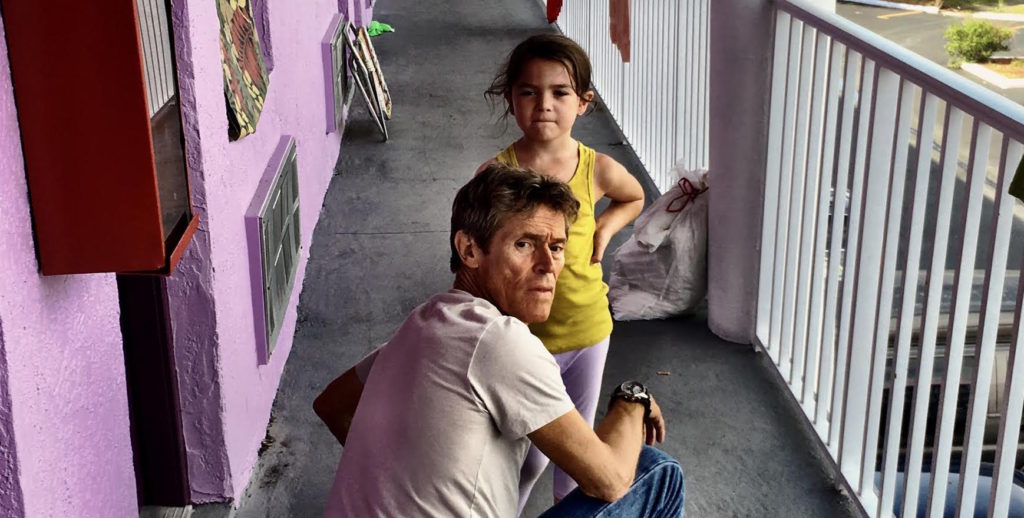
Should win (HM): Willem Dafoe. Too close to call for us, really, between Rockwell and Dafoe, two astonishing and under-appreciated American actors who should have several Oscars between them at this point. Rockwell’s racist volcano of a redeemable small-town cop gave the actor hundreds of opportunities to shine, but Dafoe’s understated, caring motel manager offers an emotional center of gravity for Sean Baker’s The Florida Project and we’d love to see him recognized.
Best Original Screenplay
The Big Sick, Emily V. Gordon & Kumail Nanjiani Get Out, Jordan Peele Lady Bird, Greta Gerwig The Shape of Water, Guillermo del Toro, Vanessa Taylor Three Billboards Outside Ebbing, Missouri, Martin McDonagh
Will win: Martin McDonagh Three Billboards Outside Ebbing, Missouri
Should win: Pick ’em. Honestly, whether this award goes go McDonagh and his sharp observation on anger and compassion, or whether it goes to Greta Gerwig’s pitch-perfect coming of age tale Lady Bird, or Jordan Peele’s epic piece of social commentary Get Out, or Emily B. Gordon and Kumail Nanjiani’s revelatory romantic comedy The Big Sick, or Guillermo del Toro and Vanessa Taylor’s monster love story The Shape of Water, there can be no complaint.
Best Adapted Screenplay
Call Me by Your Name, James Ivory The Disaster Artist, Scott Neustadter & Michael H. Weber Logan, Scott Frank & James Mangold and Michael Green Molly’s Game, Aaron Sorkin Mudbound, Virgil Williams and Dee Rees
Will win: James Ivory, Call Me by Your Name
Should win: James Ivory, Call Me by Your Name. Although we would cheer if the under-appreciated Mudbound picked this one up, there’s no denying the powerful storytelling in Ivory’s script and the way it drove Luca Guadagnino’s sumptuous direction.
Best Documentary Feature
Abacus: Small Enough to Jail, Steve James, Mark Mitten, Julie Goldman Faces Places, JR, Agnès Varda, Rosalie Varda Icarus, Bryan Fogel, Dan Cogan Last Men in Aleppo, Feras Fayyad, Kareem Abeed, Soren Steen Jepersen Strong Island, Yance Ford, Joslyn Barnes
Will win:Faces Places
Should win: Of the nominees, Faces Places, but this year’s biggest snubs are in the documentary category. No love for either Whose Streets? or Jane? Wow.
Best Foreign Language Feature
A Fantastic Woman (Chile) The Insult (Lebanon) Lovelss (Russia) On Body and Soul (Hungary) The Square (Sweden)
Will win:The Square
Should win: The Square, by an eyelash over A Fantastic Woman.
Best Animated Film
The Boss Baby, Tom McGrath, Ramsey Ann Naito The Breadwinner, Nora Twomey, Anthony Leo Coco, Lee Unkrich, Darla K. Anderson Ferdinand, Carlos Saldanha Loving Vincent, Dorota Kobiela, Hugh Welchman, Sean Bobbitt, Ivan Mactaggart, Hugh Welchman
Will win:Coco
Should win:Coco. It’s a pretty weak year in animated features, to be honest, so—like so many categories this year—the likely winner is pretty clear. Both Loving Vincent and Breadwinner are strong contenders, though no one saw either. Both Ferdinand and The Boss Baby are unworthy of the nomination. Coco is not Pixar’s strongest, and that can sometimes weigh too heavily on a film. You can’t put out a Toy Story or Up! every time, and Coco offers a touching, vibrant, skeleton-filled cultural extravaganza that is joyous to behold.
Best Director
Dunkirk, Christopher Nolan Get Out, Jordan Peele Lady Bird, Greta Gerwig Phantom Thread, Paul Thomas Anderson The Shape of Water, Guillermo del Toro
Will win: Guillermo del Toro
Should win (GW): Jordan Peele
Should win (HM): Any of them. This is the most gorgeous set of nominees we have possibly ever seen. We will celebrate no matter who wins because we adore every single one of these names: del Toro, Greta Gerwig, Jordan Peele, Paul Thomas Anderson and Christopher Nolan. In a wild variety of efforts—from taut, ensemble-driven war to period character studies to horror—the style, tone and detail in every one of these films showcases a master at the helm. Yes, it is a weird turn that Martin McDonagh didn’t get a nomination, but we wouldn’t drop anyone from this group.
Best Picture
Call Me by Your Name Darkest Hour Dunkirk Get Out Lady Bird Phantom Thread The Post The Shape of Water Three Billboards Outside Ebbing, Missouri Will win:Three Billboards Outside Ebbing, Missouri. In a dogfight with The Shape of Water, we think the compromise will be a director/film split decision.
Should win: So many great ones here, but we’ll say Dunkirk. (Or Get Out, or Lady Bird, or…)
The Academy Awards — again hosted by Jimmy Kimmel — will air live on ABC on this Sunday, March 4.
2017 was year marked by independents: original screenplays, original ideas, low-budgets, big returns. How beautiful is that?
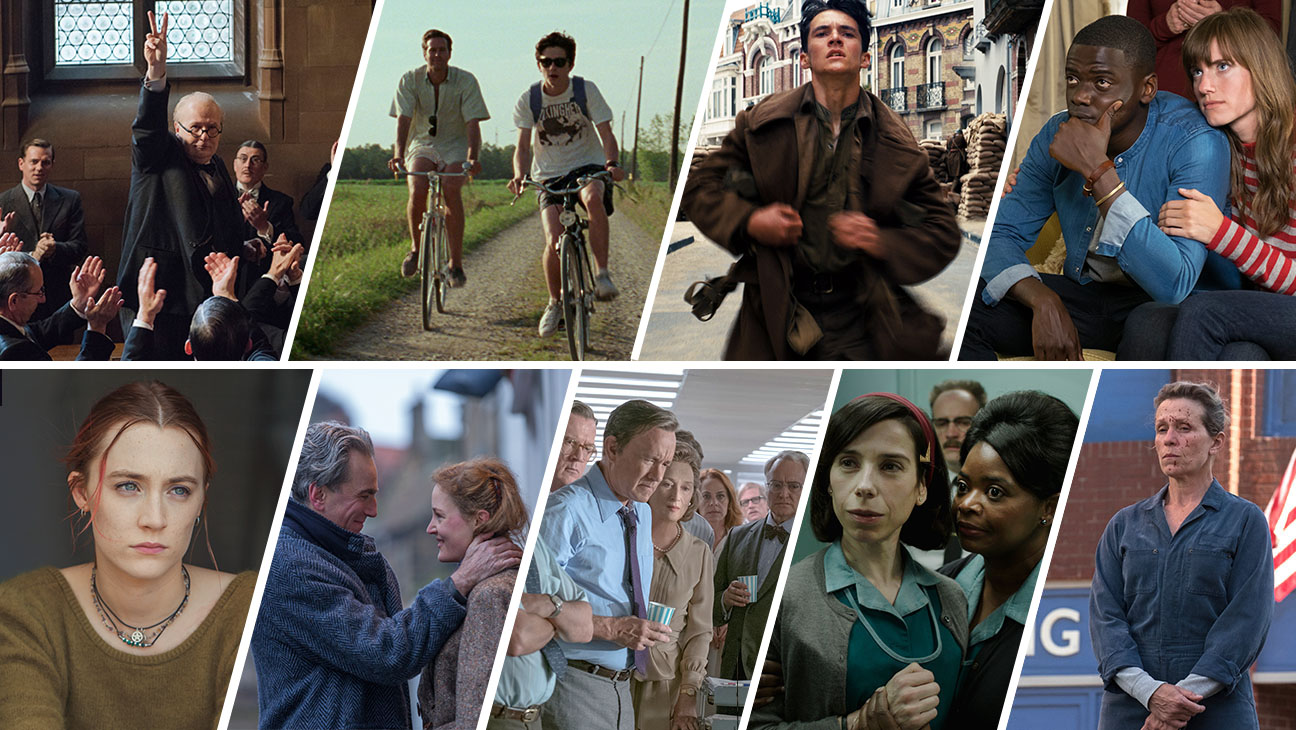
Bearing his most intimate vision yet, Guillermo del Toro’s The Shape of Water swept up 13 Oscar nominations, impressing voters in nearly every category, from technical achievement through acting and directing.
And Get Out represents the first full-blown horror film to be nominated for Best Picture since The Sixth Sense in 1999. The powerhouse indie not only earned more than $250 million, it also nabbed a total of four nominations, including acknowledgments for Daniel Kaluuya for Lead Male Actor and Jordan Peele for Original Screenplay and Director.
Slights were few and far between. Here’s a recap of the morning’s events:
Best Picture:
The biggest surprise here is probably Darkest Hour, a film marked by an outstanding performance and not much else. Mudbound or Blade Runner 2049, both with three noms themselves, would have been stronger choices. We would have loved to see a real long shot—The Florida Project, The Killing of a Sacred Deer or even A Ghost Story—in its place, but we know that’s dreaming.
“Call Me by Your Name”
“Darkest Hour”
“Dunkirk”
“Get Out”
“Lady Bird”
“Phantom Thread”
“The Post”
“The Shape of Water”
“Three Billboards Outside Ebbing, Missouri”
Director:
The unexpected exclusion here is not Steven Spielberg for The Post, but Martin McDonagh for Three Billboards Outside Ebbing, Missouri—a film nominated for 5 Oscars: three in acting, one for film editing and McDonagh for the original screenplay. But it’s hard to pick nits with this list. We love the diversity here and wouldn’t change a thing.
“Dunkirk,” Christopher Nolan
“Get Out,” Jordan Peele
“Lady Bird,” Greta Gerwig
“Phantom Thread,” Paul Thomas Anderson
“The Shape of Water,” Guillermo del Toro
Lead Female Actor:
This list consists of Frances McDormand and everyone else. If there is a sure bet this year—and, let’s be honest, there are two—one of them is McDormand in this category. We’re thrilled to see Margot Robbie grab a nomination, and while it’s tough to ever argue the inclusion of Meryl Streep, we would not have been unhappy to see a woefully underappreciated Salma Hayak get the slot for her lovely work in Beatriz at Dinner or Michelle Williams for All the Money in the World.
Sally Hawkins, “The Shape of Water”
Frances McDormand, “Three Billboards Outside Ebbing, Missouri”
Margot Robbie, “I, Tonya”
Saoirse Ronan, “Lady Bird”
Meryl Streep, “The Post”
Lead Male Actor:
Not many surprises here and no real bones to pick. And when Gary Oldman picks up his statue and comments on the amazing talent in his category this year, we will agree.
Timothée Chalamet, “Call Me by Your Name”
Daniel Day-Lewis, “Phantom Thread”
Daniel Kaluuya, “Get Out”
Gary Oldman, “Darkest Hour”
Denzel Washington, “Roman J. Israel, Esq.”
Supporting Male Actor:
As is often the case, it’s the supporting categories that are stocked to brimming, with an “I wish they would have considered” list that’s longer than can possibly be accommodated. Will Poulter (Detroit), Barry Keoghan (The Killing of a Sacred Deer), Michael Shannon (The Shape of Water) and Armie Hammer (Call Me By Your Name) all delivered performances that, in any other year, would have earned them a nom. But this list is beautiful.
Willem Dafoe, “The Florida Project”
Woody Harrelson, “Three Billboards Outside Ebbing, Missouri”
Richard Jenkins, “The Shape of Water”
Christopher Plummer, “All the Money in the World”
Sam Rockwell, “Three Billboards Outside Ebbing, Missouri”
Supporting Female Actor:
Like the supporting men, the list of worthy contenders here is huge. We couldn’t be more thrilled to see Lesley Manville get this credit for her pitch-perfect turn in Phantom Thread, or for Mary J. Blige’s stellar work bringing more attention to the beautiful Mudbound. We would have loved to see Hong Chau nominated for Downsizing, but it’s hard to know which nominee to drop in her favor.
Mary J. Blige, “Mudbound”
Allison Janney, “I, Tonya”
Lesley Manville, “Phantom Thread”
Laurie Metcalf, “Lady Bird”
Octavia Spencer, “The Shape of Water”
Original Screenplay:
Look how pretty! This list is suitable for framing. Glorious. The fact that so many others were worthy—The Killing of a Sacred Deer, Dunkirk, Baby Driver, The Florida Project—only proves that 2017 was an utterly spectacular year for original work.
“The Big Sick,” Emily V. Gordon & Kumail Nanjiani
“Get Out,” Jordan Peele
“Lady Bird,” Greta Gerwig
“The Shape of Water,” Guillermo del Toro, Vanessa Taylor
“Three Billboards Outside Ebbing, Missouri,” Martin McDonagh
Adapted Screenplay:
Here’s a category filled with surprises, which may represent a surprisingly weak year in adapted screenplays, but maybe that just means filmmakers took more chances on original work that paid off.
“Call Me by Your Name,” James Ivory
“The Disaster Artist,” Scott Neustadter & Michael H. Weber
“Logan,” Scott Frank & James Mangold and Michael Green
“Molly’s Game,” Aaron Sorkin
“Mudbound,” Virgil Williams and Dee Rees
Animated Feature:
Boss Baby? Really? It was a weak year for animated films—clearly—but who knew it was “Ferdinand and The Boss Baby get Oscar nominations” weak? Best bet would be to eject both of those, nominate Mary and the Witch’s Flower and just go with four.
“The Boss Baby,” Tom McGrath, Ramsey Ann Naito
“The Breadwinner,” Nora Twomey, Anthony Leo
“Coco,” Lee Unkrich, Darla K. Anderson
“Ferdinand,” Carlos Saldanha
“Loving Vincent,” Dorota Kobiela, Hugh Welchman, Sean Bobbitt, Ivan Mactaggart, Hugh Welchman
Best Documentary Feature:
Finally, bones to pick, and big ones: Whose Streets? and Jane. Sure, Faces Places has the upper hand in this category, but those two are glaring omissions. Boo.
“Abacus: Small Enough to Jail,” Steve James, Mark Mitten, Julie Goldman
“Faces Places,” JR, Agnès Varda, Rosalie Varda
“Icarus,” Bryan Fogel, Dan Cogan
“Last Men in Aleppo,” Feras Fayyad, Kareem Abeed, Soren Steen Jepersen
“Strong Island,” Yance Ford, Joslyn Barnes
Best Foreign Language Film:
Most of these haven’t screened in Columbus, but The Square was fantastic.
“A Fantastic Woman” (Chile)
“The Insult” (Lebanon)
“Loveless” (Russia)
“On Body and Soul” (Hungary)
“The Square” (Sweden)
The winners will be announced at the 90th Academy Awards ceremony March 4th
The Columbus Film Critics Association (CoFCA) gathered at that weird upstairs room at Ace of Cups last night to formally announce the winners of their 16th annual awards for the best in film of 2017.
Greta Gerwig’s coming of age indie Lady Bird racked up the most awards with a total of four: Best Film, Ensemble, Director (Gerwig) and Supporting Actress (Laurie Metcalf).
Jordan Peele’s Get Out, the second biggest vote-getter for both best film and director, also nabbed two first place nods for Peele, who came away with awards for Breakthrough Artist and Best Original Screenplay.
The Columbus Film Critics Association is collection of print, online and broadcast film critics based in the Columbus area. You can find them at cofca.org.
Complete list of awards:
Best Film
1. Lady Bird
2. Get Out
3. The Shape of Water
4. The Big Sick
5. Blade Runner 2049
6. Three Billboards outside Ebbing, Missouri
7. The Post
8. The Florida Project
9. Dunkirk
10. The Killing of a Sacred Deer
Best Director
Greta Gerwig, Lady Bird
Best Actor
Gary Oldman, Darkest Hour
Best Actress
Sally Hawkins, The Shape of Water
Best Supporting Actor
Willem Dafoe, The Florida Project
Best Supporting Actress
Laurie Metcalf, Lady Bird
Best Ensemble Lady Bird
Actor of the Year (for an exemplary body of work)
(Tie) Sally Hawkins (Maudie and The Shape of Water) and Tracy Letts (Lady Bird, The Lovers, and The Post)
Breakthrough Film Artist
Jordan Peele, Get Out – (for directing and screenwriting)
Best Cinematography
Roger Deakins, Blade Runner 2049
Best Film Editing
Jonathan Amos and Paul Machliss, Baby Driver
Best Adapted Screenplay
Virgil Williams and Dee Rees, Mudbound
Best Original Screenplay
Jordan Peele, Get Out
Best Score
Alexandre Desplat, The Shape of Water
Best Documentary Faces Places (Visages, villages)
Best Foreign Language Film BPM (Beats Per Minute) (120 battements par minute)
Best Animated Film Coco
Best Overlooked Film The Meyerowitz Stories (New and Selected)
 Nominees for the 16th annual Columbus Film Critics Association awards
The Columbus Film Critics Association, formerly the Central Ohio Film Critics Association, is pleased to announce the nominees for its 16th annual awards. Winners will be announced on the evening of January 4th, 2018.
Founded in 2002, the Columbus Film Critics Association is comprised of film critics based in Columbus, Ohio and its surrounding areas. Its membership consists of 26 print, radio, television, and online critics. COFCA’s official website at www.cofca.org contains links to member reviews and past award winners. A redesigned site will be launching on January 4th, 2018.
The 2017 Columbus Film Critics Association awards nominees are:
Best Film
-The Big Sick
-Blade Runner 2049
-Dunkirk
-The Florida Project
-Get Out
-The Killing of a Sacred Deer
-Lady Bird
-The Post
-The Shape of Water
-Three Billboards outside Ebbing, Missouri
Best Director
-Sean Baker, The Florida Project
-Guillermo del Toro, The Shape of Water
-Greta Gerwig, Lady Bird
-Martin McDonagh, Three Billboards outside Ebbing, Missouri
-Christopher Nolan, Dunkirk
-Jordan Peele, Get Out
Best Actor
-Timothée Chalamet, Call Me by Your Name
-James Franco, The Disaster Artist
-Daniel Kaluuya, Get Out
-James McAvoy, Split
-Gary Oldman, Darkest Hour
Best Actress
-Jessica Chastain, Molly’s Game
-Sally Hawkins, The Shape of Water
-Frances McDormand, Three Billboards outside Ebbing, Missouri
-Margot Robbie, I, Tonya
-Saoirse Ronan, Lady Bird
Best Supporting Actor
-Willem Dafoe, The Florida Project
-Richard Jenkins, The Shape of Water
-Barry Keoghan, The Killing of a Sacred Deer
-Sam Rockwell, Three Billboards outside Ebbing, Missouri
-Michael Stuhlbarg, Call Me by Your Name
Best Supporting Actress
-Hong Chau, Downsizing
-Holly Hunter, The Big Sick
-Allison Janney, I, Tonya
-Tatiana Maslany, Stronger
-Laurie Metcalf, Lady Bird
Best Ensemble
-The Big Sick
-Get Out
-Lady Bird
-Mudbound
-The Post
-Three Billboards outside Ebbing, Missouri
Actor of the Year (for an exemplary body of work)
-Timothée Chalamet (Call Me by Your Name, Hostiles, and Lady Bird)
-Woody Harrelson (The Glass Castle, Three Billboards outside Ebbing, Missouri, War for the Planet
of the Apes, and Wilson)
-Sally Hawkins (Maudie and The Shape of Water)
-Tracy Letts (Lady Bird, The Lovers, and The Post)
-Nicole Kidman (The Beguiled and The Killing of a Sacred Deer)
Breakthrough Film Artist
-Timothée Chalamet (Call Me by Your Name, Hostiles, and Lady Bird) – (for acting)
-Greta Gerwig, Lady Bird – (for directing and screenwriting)
-Kumail Nanjiani, The Big Sick – (for acting and screenwriting)
-Jordan Peele, Get Out – (for directing and screenwriting)
-Brooklynn Prince, The Florida Project – (for acting)
Best Cinematography
-Roger Deakins, Blade Runner 2049
-Hoyte Van Hoytema, Dunkirk
-Dan Laustsen, The Shape of Water
-Sayombhu Mukdeeprom, Call Me by Your Name
-Alexis Zabe, The Florida Project
Best Film Editing
-Jonathan Amos and Paul Machliss, Baby Driver
-Bob Ducsay, Star Wars: Episode VIII – The Last Jedi
-Lee Smith, Dunkirk
-Joe Walker, Blade Runner 2049
-Sidney Wolinsky, The Shape of Water
Best Adapted Screenplay
-Sofia Coppola, The Beguiled
-James Ivory, Call Me by Your Name
-Scott Neustadter & Michael H. Weber, The Disaster Artist
-Aaron Sorkin, Molly’s Game
-Virgil Williams and Dee Rees, Mudbound
Best Original Screenplay
-Greta Gerwig, Lady Bird
-Emily V. Gordon & Kumail Nanjiani, The Big Sick
-Liz Hannah and Josh Singer, The Post
-Martin McDonagh, Three Billboards outside Ebbing, Missouri
-Jordan Peele, Get Out
Best Score
-Carter Burwell, Three Billboards outside Ebbing, Missouri
-Alexandre Desplat, The Shape of Water
-Benjamin Wallfisch and Hans Zimmer, Blade Runner 2049
-John Williams, The Post
-Hans Zimmer, Dunkirk
Best Foreign Language Film
-BPM (Beats Per Minute) (120 battements par minute)
-First They Killed My Father
-Raw (Grave)
-The Square
-Thelma
Best Animated Film
-Cars 3
-Coco
-Despicable Me 3
-The LEGO Batman Movie
-Loving Vincent
Best Overlooked Film
-Brigsby Bear
-A Ghost Story
-Logan Lucky
-The Meyerowitz Stories (New and Selected)
-Wind River
COFCA offers its congratulations to the nominees.
Previous Best Film winners:
2002: Punch-Drunk Love
2003: Lost in Translation
2004: Million Dollar Baby
2005: A History of Violence
2006: Children of Men
2007: No Country for Old Men
2008: WALL·E
2009: Up in the Air
2010: Inception
2011: Drive
2012: Moonrise Kingdom
2013: Gravity
2014: Selma
2015: Spotlight
2016: La La Land
For more information about the Columbus Film Critics Association, please visit www.cofca.org or e-mail info@cofca.org.
The complete list of members and their affiliations:
Richard Ades (Freelance); Dwayne Bailey (Bailey’s Buzz); Sam Brady (I Am Sam Reviews); Logan Burd (Cinema or Cine-meh?); Kevin Carr (www.7mpictures.com, FilmSchoolRejects.com); Bill Clark (www.fromthebalcony.com); Olie Coen (Archer Avenue, DVD Talk); John DeSando (90.5 WCBE); Johnny DiLoretto (90.5 WCBE, PencilStorm.com); Chris Feil (FilmMixTape.com, TheFilmExperience.net); Frank Gabrenya (The Columbus Dispatch); Mark Jackson (MovieManJackson.com); Brad Keefe (Columbus Alive); Kristin Dreyer Kramer (NightsAndWeekends.com, 90.5 WCBE); Adam Kuhn (Corndog Chats); Joyce Long (Freelance); Rico Long (Freelance); Hope Madden (Columbus Underground and MaddWolf.com); Paul Markoff (WOCC-TV3); David Medsker (Bullz-Eye.com); Lori Pearson (Kids-in-Mind.com, critics.com); Mark Pfeiffer (Reel Times: Reflections on Cinema; WOCC-TV3); Melissa Starker (Freelance); George Wolf (Columbus Radio Group and MaddWolf.com); Jason Zingale (Bullz-Eye.com); Nathan Zoebl (PictureShowPundits.com).
The following information is not for publication:
If you would like comments about COFCA and these awards, please contact:
Mark Pfeiffer (mark.pfeiffer@gmail.com)
Reel Times: Reflections on Cinema
Co-host/co-producer, Now Playing, WOCC-TV3
The end is nigh, so let’s celebrate: celebrate the bold visions, surprise hits, underseen gems, beautiful storytelling, social commentary, scares, thrills and love the films of 2017 held in store for us. It was an amazing year for movies, from big budget to micro, horror to rom-com, comic book blockbuster to indie absurdity. Let’s revel. Here are the best of the year, as well as thoughts on nooks and crannies around the movie world.
25. War for the Planet of the Apes The rebooted Apes trilogy concludes with a thrilling, deeply felt and visually stunning rumination on the boundaries of humanity and the levels of sacrifice, where the wages of brutality are driven home in equal measure by both sweeping set pieces and stark intimacy. Ultimately, we’re left with a bridge to the original 1968 film in sight, and a completely satisfying conclusion to a stellar group of prequels.
24. Mudbound Director/co-writer Dee Rees layers this tale expertly, as the fates of two families come together in 1940s Mississippi. We’re drawn in through finely- crafted characters and excellent performances, as the film gradually builds our investment toward an emotional payoff at times hopeful, devastating, and profound.
https://www.youtube.com/watch?v=xucHiOAa8Rs
23. Baby Driver Baby Driver is as tasty a feast for the eyes as it is the ears. The game cast never drops a beat, playing characters with the right mix of goofiness and malice to be as fun or as terrifying as they need to be. For all its danceability, Edgar Wright’s film offers plenty of tension, too. Like much of the filmmaker’s work, Baby Driver boasts a contagious pop mentality, intelligent wit and a sweet heart.
22. Spider-Man: Homecoming As solid as the Marvel universe has been, it’s not hard to find moments (especially in Civil War) when the push for a hip chuckle undercuts the action. The humor in Homecoming hits early and often, but only to reinforce that the film’s worldview is sprung from the teenaged Peter Parker (Tom Holland). In this way, it feels more true to its comic origins than most in the entire film genre. Best of all, Holland re-sets the character to a place where its growth seems both unburdened and unpredictable. That’s exciting, and not just for Pete.
Best Fresh Perspective:
1. Get Out
2. The Big Sick
3. Wonder Woman
21. Raw In a very obvious way, Raw is a metaphor for what can and often does happen to a sheltered girl when she leaves home for college. But as writer/director Julia Ducournau looks at those excesses committed on the cusp of adulthood, she creates opportunities to explore and comment on so many upsetting realities, and does so with absolute fidelity to her core metaphor. She immediately joins the ranks of Jennifer Kent (Babadook) and Ana Lily Amirpour (A Girl Walks Home Alone at Night) – all recent, first time horror filmmakers whose premier features predict boundless talent.
20. The Square Writer/director Ruben Ostlund continues to bring visionary scope to his writing and direction. Nearly every frame becomes a lavishly fascinating microscope, probing deep into the inner impulses and outward pressures that are constantly forming our actions and reactions. The humor is dark and droll, often awkward and sometimes laugh-out-loud funny, but The Square (winner of the Palme d’Or at Cannes) is also alternatively weird and occasionally freakish.Regardless of whether you’re able to make sense of it all, it’s a visceral, thoroughly rewarding experience.
https://www.youtube.com/watch?v=zKDPrpJEGBY
19. Whose Streets? Moving like a living, breathing monument to revolution, Whose Streets? captures a flashpoint in history with gripping vibrancy, as it bursts with an outrage both righteous and palpable. Activists Sabaah Folayan and Damon Davis share directing duties on their film debut, bringing precise, insightful storytelling instincts to the birth of the Black Lives Matter movement. Together, they provide a new and sharp focus to the events surrounding the 2014 killing of 18-year-old Michael Brown by Ferguson, Missouri police officer Darren Wilson.
18. Hounds of Love Driven by three fiercely invested performances, Hounds of Love makes a subtle shift from horrific torture tale to psychological character study. In 108 grueling minutes, writer/director Ben Young’s feature debut marks him as a filmmaker with confident vision and exciting potential.
https://www.youtube.com/watch?v=UNEurXzvHqE
Best Nobody Saw It:
1. Columbus
2. The Survivalist
3. Brigsby Bear
17. Call Me By Your Name Awash in sensuality, Luca Guadagnino’s love story is unafraid to explore, circling Oliver (a terrific Armie Hammer) and Elio (Timothee Chalamet-astonishing) as they irritate each other, then test each other, and finally submit to and fully embrace their feelings for one another. Theirs is a remarkable dance, intimately told and flawlessly performed.
16. The Post Spielberg. Streep. Hanks. It is official: The Post has it all, beginning with the almost-too-relevant true story of a newspaper casting off its personal associations to hold the government accountable by sharing actual news with citizens of the United States and the world. Spielberg’s passion and polish come together here as an expertly crafted rallying cry. He’s preaching to the choir, but he preaches so well.
15. Columbus In yet another of 2017’s stunning debuts, writer/director Kogonada unveils a dreamily detailed study of two people (John Cho, Haley Lu Richardson – both stellar) stuck in Columbus, Indiana for very different reasons. The film’s magic is gentle and steady, slowly enveloping you in a beautiful meditation on the mysteries of human connection.
14. The Big Sick The Big Sick is that rare breed seldom seen in the wilds of the multiplex. It’s a smart and incisive romantic comedy that has something new and vital to say while it’s being both romantic and comedic. It also feels incredibly authentic, probably because co-writers Emily V. Gordon and Kumail Nanjiani are telling much of their own story. At times hilarious, sweet, emotional and even heartbreaking, The Big Sick has a case of charming that will follow you home.
Best Let’s Fight About It:
1. Star Wars: The Last Jedi
2. mother!
3. It Comes at Night
13. The Florida Project Co-writer/director Sean Baker follows up his ambitious 2015 film Tangerine with another tale set gleefully along the fringes of society. Baker’s many talents include an ear for authentic dialog, a knack for letting a story breathe and an eye for visual details that enrich a tale. But maybe what’s most striking is his ability to tell fresh but universal stories. The Florida Project certainly is one, reveling in the freedom and bravado of a young girl, but always aware of the dangerous edges when blurring childhood and adulthood.
12. The Beguiled The Beguiled marks a return to critical favor for writer/director Sofia Coppola, who won best directing honor at this year’s Cannes Fest Festival for her adaptation of Thomas Cullinan’s novel. Few frame delicate, ornate beauty quite like Coppola. She has found quite a palette with this film – the draping trees, columned porches, foggy woods, the tender grace of the inhabitants at Miss Farnsworth’s Seminary for Young Ladies, The result is a bewitching film – beautifully acted, gloriously filmed and haunting.
11. Star Wars: The Last Jedi The Last Jedi makes any letdowns seem light years away. With a deft mix of character-driven emotion, high stakes action and mischievous fun, it waves a proud flag for the legacy of this cinematic universe while confidently taking big strides toward crafting a new one. Visionary talent Rian Johnson (Looper, Brick) now has the con as both director and sole screenwriter. His affection for the franchise, coupled with an innovative sense of character arc and storyline, combine for a freshness that respects nostalgia even while priming you to move beyond it.
Best Foreign Language Feature:
1. The Square
2. Raw
3. B.P.M.
10. A Ghost Story Writer/director David Lowery has crafted a poetic, moving testament to the certainty of time, the inevitability of death and the timeless search for connection. Our vehicle through this existential exercise is the white-sheeted ghost of childhood Halloween costumes. The irony of such a childlike image representing themes so vast and existential seems silly, but only for a few moments, until Lowery’s stationary camera and long, elegant takes wrap you in a strangely hypnotic trance.
9. Detroit Kathryn Bigelow’s return to the screen burns with a flame of ugliness, rage and shame that simmers well before it burrows deep into you. It is brutal, uncomfortable, even nauseating. And it is necessary. Together with writer and frequent collaborator Mark Boal she brings craft and commitment to the story of Detroit’s infamous Algiers Motel Incident. Brilliant supporting performances from Will Poulter, John Boyega and Jacob Latimore keep you riveted even as you cannot wait for the ordeal to end.
8. The Shape of Water Along with a likely Oscar contender in Sally Hawkins, writer/director/unabashed romantic Guillermo del Toro crafts a dreamy mash note to outsiders. An ensemble like none other includes Michael Shannon, Octavia Spencer, Michael Stuhlbarg and Richard Jenkins—not to mention Doug Jones, again in a wet suit. But del Toro’s imagination is the real star here, touching on social anxieties of the Cold War that more than transcend to modern times and putting all of it in a blue-green dream of romance.
7. It Comes at Night Deep in the woods, Paul (Joel Edgerton, solid as always), Sarah (Carmen Ejogo) and their teenage son Travis (Kelvin Harrison, Jr.) have established a cautious existence in the face of a worldwide plague. They have boarded their windows, secured their doors, and enacted a very strict set of rules for survival. But what are the dangers, and how much of the soul might one offer up to placate fear itself? In asking those unsettling questions, It Comes at Night becomes a truly chilling exploration of human frailty.
6. The Killing of a Sacred Deer What if God exists and he’s an awkward adolescent boy? That’s not exactly the point of Yorgos Lanthimos’s latest, The Killing of a Sacred Deer, but it’s maybe as close a description as we can muster. The filmmaker’s unique tone finds its perfect vehicle in Barry Keoghan (also wonderful this year in Dunkirk). Unsettlingly serene as Martin, the teenage son of a patient killed on surgeon Steven (Colin Farrell) Murphy’s table, he controls the film and its events. With Martin, Lanthimos is able to mine ideas of God, of the God complex, of the potentially ludicrous notion of cosmic justice. All the while he sends up social norms, dissecting the concept of the nuclear family and wondering at the lengths we will go to avoid accountability.
Best Animated Feature:
1. Coco
2. Loving Vincent
3. The Lego Batman Movie
5. Blade Runner 2049 With Blade Runner 2049, director Denis Villeneuve returns us to the hulking, rain-streaked metropolis of another generation’s LA. We ride with K (Ryan Gosling), a blade runner charged, as always, with tracking down rogue replicants and retiring them. Few if any have delivered the kind of crumbling, dilapidating futurescape Ridley Scott gave us with his original. But between the stunning visual experience and meticulous sound design, BR 2049 offers an immersive experience perfectly suited to its fantasy. Picking at ideas of love among the soulless, of souls among the manmade, of unicorns versus sheep, Villeneuve channels Philip K. Dick by way of Scott as well as a bit of James Cameron and more than a little Spike Jonze. There’s even a splash of Dickens in there. Sounds like a hot mess, but damn if it doesn’t work.
4. Get Out You want to know the fears and anxieties at work in any modern population? Just look at their horror films. You probably knew that. The stumper then, is what took so long for a film to manifest the fears of racial inequality as smartly as does Jordan Peele’s Get Out. Opening with a brilliant prologue that wraps a nice vibe of homage around the cold realities of “walking while black,” Peele uses tension, humor and a few solid frights to call out blatant prejudice, casual racism and cultural appropriation. It’s an audacious first feature that never stops entertaining as it consistently pays off the bets it is unafraid to make.
3. Three Billboards Outside Ebbing, Missouri Writer/director Martin McDonagh provides his stellar ensemble with smart, insightful dialog that crackles with bite, poignancy and scattershot hilarity. His tale is offbeat but urgent and welcome, speaking as it does to grief, compassion, and navigating the contrasts between the good and evil in our flawed selves. McDonagh (In Bruges, Seven Psychopaths) compliments his usual knack for piercing wordplay with well-paced visual storytelling and some downright shocking tonal shifts. We are constantly engaged but never quite at ease, as McDonagh demands our attention through brutality and dark humor, holding the moments of humanity until they will be most deeply satisfying.
Best Documentary Feature:
1. Whose Streets?
2. An Inconvenient Sequel
3. Human Flow
2. Lady Bird Written and directed by Greta Gerwig, Lady Bird may be the most delightfully candid and refreshingly forgiving coming-of-age film we’ve seen. The plot and the comedy are less the point here than you might expect. They are really just a device Gerwig uses to explore adolescence and its characteristic stage of reinvention. Though Lady Bird’s landscape is littered with coming-of-age tropes, there is wisdom and sincerity in the delivery. Gerwig offers genuine insight rather than nostalgia or, worse yet, lessons to be learned. She’s aided by an awards-worthy ensemble. Literally everyone deserves an award, from the letter perfect lead Saoirse Ronan to sweetly tender Lucas Hedges, the downtrodden but loving Tracy Letts to certain Oscar nominee Laurie Metcalf. Oscar or no, what a gift they’ve already gotten from Gerwig.
1. Dunkirk Christopher Nolan’s storytelling here is simultaneously grand and intimate. To do justice to the story of the truly amazing evacuation of 400,000 British troops from certain death on the beaches of Dunkirk, France, he approaches it from three different perspectives and creates, with a disjointed chronology, a lasting impression of the rescue that a more traditional structure might have missed. Solid performances abound without a single genuine flaw to point out, but the real star of Dunkirk is Nolan. He dials back the score – Hans Zimmer suggesting the constant tick of a time bomb or the incessant roar of a distant plane engine – to emphasize the urgency and peril, and generating almost unbearable tension. Visually, Nolan’s scope is breathtaking, oscillating between the gorgeous but terrifying open air of the RAF and the claustrophobic confines of a boat’s hull, with the threat of capsize and a watery grave constant. What the filmmaker has done with Dunkirk – and has not done with any of his previous efforts, however brilliant or flawed – is create a spare, quick and simple film that is equally epic.
Actress Jennifer Titus has never been to a horror film festival. Hell, she’s never been to Columbus, but she’s all set to accompany her new film and enjoy Nightmares Film Festival this weekend.
Titus stars as Ashley, a serial killer’s neighbor with the skills to take care of herself in Tom Holland’s newest Rock, Paper, Dead. The film, which has garnered several festival nominations, will make its world premiere at Nightmares.
A longtime horror fan, Titus was thrilled to be offered a role in the film penned by Friday the 13th creator Victor Miller.
“My very first horror film was Friday the 13th,” she says. “Honestly, I was so honored to be reading this. And it was a page-turner. When I met Victor Miller, he was such a real, down to earth guy and such a calm, beautiful soul. And I thought, I would be honored to do this.”
Acting was not exactly her first career choice.
“When I was about 6 or 7, my grandfather asked me what I wanted to do when I grew up,” she remembers. “I said I wanted to be a professional figure skater, a doctor and a movie star. He told me, ‘Well I have no doubt you will do all three.’”
He was right.
A figure skater throughout her childhood, Titus turned professional at 18, touring the country and the world with ice shows. Eventually, she returned to school, earning a degree from UC San Diego in science and theater, then moving on to medical school.
“Toward my last year I really missed acting,” she says. “I just wasn’t getting that creative fulfillment in medical school, so when I graduated I got right back into acting.”
But her medical degree came in handy.
“I got into a situation where I was acting and they needed a doctor for an emergency,” she says. “We were actually in the jungle and there was a guy who had a bamboo stake driven into his leg underneath his muscle. I jumped right in and did field medicine surgery on the guy and I ended up saving his leg – bamboo is very toxic. When I visited him about three days later, about 30 people there to meet me and thank me. It was so rewarding I just thought to myself, I need to go back, get licensed.”
Titus returned to medicine, completed her residency, passed the board exam, got licensed and returned to acting.
“I always knew I wanted to do these things,” she laughs. “It’s not like I was confused and I was career jumping. I was just knocking them off the list.”
Titus sees a connection among the professions.
“When I was little, I was always interested in blood and guts,” she says. “Honestly, that’s one of the things I always loved about medicine. It never was scary to me or gross to me, it always fascinated me.”
Titus says her character in Rock, Paper, Dead—a black belt in karate—was the ideal role for her.
“My best friend and I, every Saturday night, would go down to the video store and rent one to two horror films. We’d get under the covers, cover our faces with pillows and squeal. That went on for years.”
“I specifically remember Nightmare on Elm Street 4: The Dream Master,” she says. “The main character was a girl that took on all the powers of her friends who were killed off by Freddy Krueger. She became just a ninja master by the end. And I thought, oh my gosh, that is just the coolest character I have ever seen in all these horror films. I thought, what a great example, finally, of a strong female who can take this guy on. And when I got this script for Rock, Paper, Dead, I thought, oh my gosh, it’s the dream master. I have to do it. It’s so cool.”
Nighmares Film Festival runs from Thursday, October 19 through Sunday, October 22.
Rock, Paper, Dead, which makes its world premiere this Saturday, October 21 at 8pm, is nominated in the categories of Best Thriller Feature and Best Screenplay Feature.