Tag Archives: movies

Back in Black

Men in Black: International

by Hope Madden

Someone somewhere at some recent point in history must have said, “What we need is another Men in Black movie.”

Someone else surely disagreed, suggesting that they’d beaten that dead alien long enough.

“We’ll change it up,” this imaginary and somehow sad conversation continued. “Hire a new director, new writers, new actors, take it international. It’ll be—”

“Great?!”

“—mediocre.”

And there you have it. F. Gary Gray (Straight Outta Compton) directs an entirely new batch of humans in black as they don sunglasses, erase memories and suss out an alien conspiracy in their ranks, this time on European soil.

Tessa Thompson shines, as is her way, starring as Molly, a tenacious nerd who’s tracked down this mystery organization in hopes of a shot at joining. Head of the US division, Agent O (Emma Thompson—no relation that we know of, but how cool would that be?!) reluctantly gives her a shot.

As expected, all scenes between the Thompsons spark. And, as T. Thom has proven twice already, she shares solid onscreen chemistry with Chris Hemsworth, here portraying her new partner, H.

Gizmo-riffic adventures follow, although it’s pretty soft. There are a couple of fun sight gags, especially one with a hammer. Kumail Nanjiani pops off a few drolly comical lines as this go-round’s cute little alien sidekick, Pawnie.

Then the three are off to Marrakesh, then a fortress island, back to London, a desert, and London again all in pursuit of answers about a tiny little device and the evil twins looking for it. But the storyline was never really the MIB selling point, it was the relationship between the partners.

Thompson and Hemsworth seem like fine choices, having shown both chemistry and comedic spark in Thor: Ragnarok. But Thompson’s early, geeky charm is given little opportunity to show itself once she dons the black suit, and Hemsworth—fun enough as he, once again, basically mocks his own persona—has even less opportunity.

Writers Matt Holloway and Art Marcum don’t articulate enough in the way of plot or character arc and Gray’s listless direction leaves us with a Summer popcorn muncher that coasts rather than thrills.

Off the Leash Again

The Secret Life of Pets 2

by Hope Madden

Illumination, the animation giant behind all things Minion, returns to their blandly entertaining dog franchise for the blandly entertaining sequel The Secret Life of Pets 2.

In the 2016 original, Louis C.K. voiced a neurotic terrier named Max who needed to loosen up a little once his beloved owner brought home a huge, lovable Newfie mix (in a NYC apartment?!). And while life lessons were the name of the game, the real gimmick was to take the Toy Story approach to house pets, giving us a glimpse into what they’re up to when we’re not around.

Because we really don’t want to associate him with children anymore, C.K.’s been replaced by Patton Oswalt, whose Max has all new reasons for anxiety. There’s a new baby, whose presence suddenly reinforces all those fears about the big, scary world.

In a move that’s as disjointed as it is interesting, returning writer Brian Lynch sends Max, Newfie Duke (Eric Stonestreet) and family on a trip to the country, creating one of three separate episodes that will eventually intersect. Well, crash into each other, anyway.

The  main story deals with trying to alpha Max up a bit with some problematically “masculine” training by way of farm dog Rooster (Harrison Ford), who, among other things, disregards therapy as weakness.

Basically, Lynch and director Chris Renaud think we’re all a little too precious (the clear message of the original) and what they’d like to do with their sequel is beat us about the head and neck with that idea.

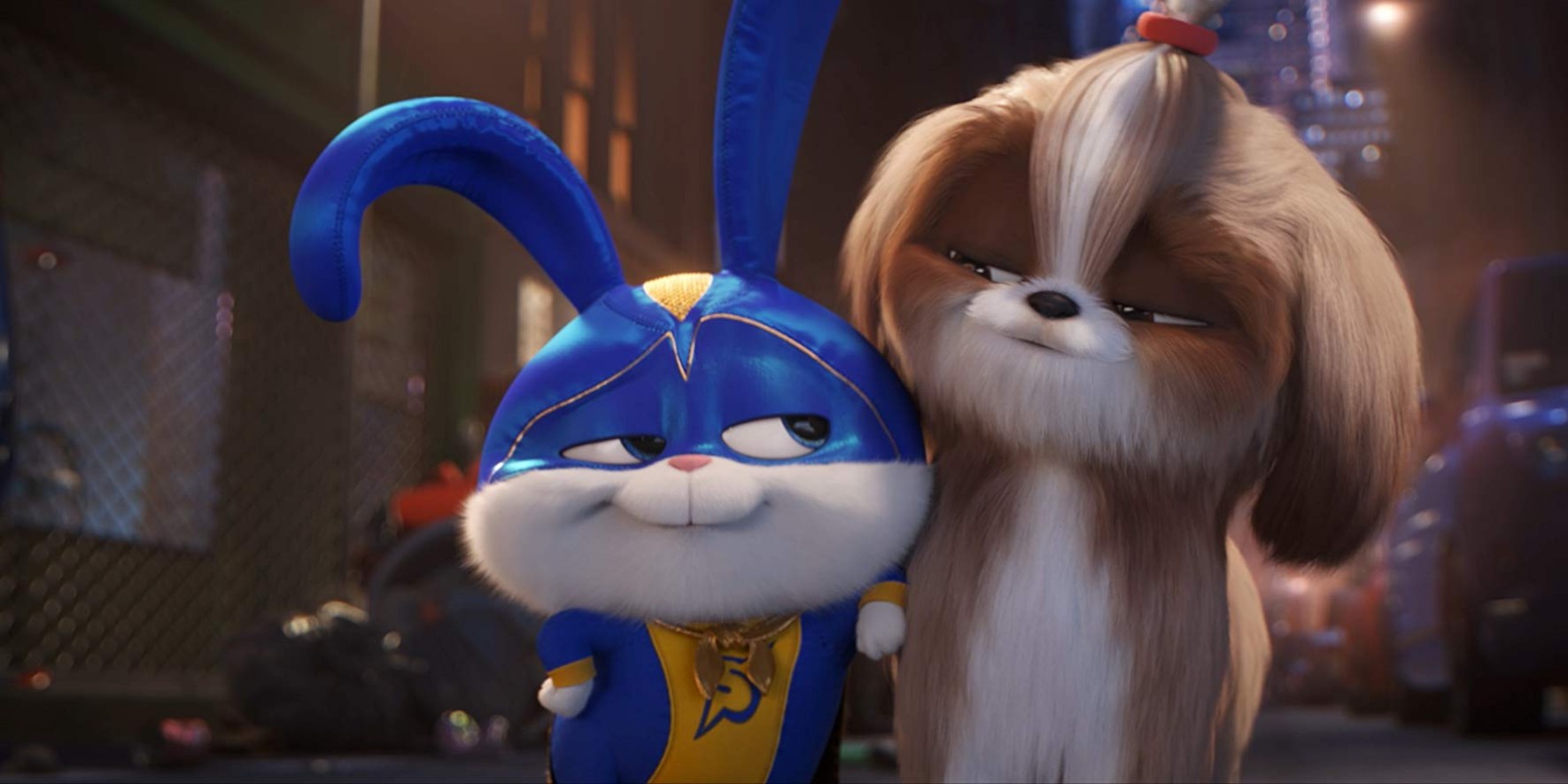
Meanwhile, back in NYC, Pomeranian Gidget (Jenny Slate) and Chloe the cat (Lake Bell – the film’s deadpan bright spot) train to retrieve a chew toy from a crazy cat lady’s feline-overrun apartment. And separately, Snowball the bunny (Kevin Hart), believing himself to be a super hero, befriends Shih Tzu Daisy (Tiffany Haddish), and together they save a baby tiger from an evil Russian circus.

For real.

That last bit gets seriously weird, I have no idea what they feed this baby tiger the whole time, and on average, the actual lessons learned are troublingly old school (read: conservative).

Teaching boys that pretending they’re not afraid so they can take charge of every situation = literally every single problem on earth right now. So let’s stop doing that.

Otherwise, though, Illumination offers yet another blandly entertaining, cute time waster.

Lizard King

Godzilla: King of the Monsters

by Hope Madden and George Wolf

Must we destroy everything that challenges us, or is humanity’s only salvation an intentional and aggressive thinning of our herd?

Or is there another way?

Nope, this is not the plot of the last two Avengers movies. Well, I mean, it is, but it’s also the basic underpinning of the monster movie that has always had societal anxieties on its mind.

Born in 1954 of a society reeling from nuclear annihilation, Godzilla was a parable of a world in need of a new god to save it from war and science. Sixty five years later, Godzilla: King of the Monsters recognizes that it’s not just the military and scientists who are destroying us. It’s all of us.

Columbus, Ohio’s own Michael Dougherty (Trick r’ Treat) takes the reins of the king of all kaiju franchises, grounding tensions in family drama and bombarding the audience with monsters, explosions, nuclear monsters, nuclear explosions, good-sized leaps of logic and so much nonsensical dialog.

Kyle Chandler is the handsome, damaged, underwhelming white guy at the center of things. Lucky, because the rest of the cast—primarily women and people of color—can’t quite figure out how to move forward without him to articulate the plan for them.

They talk about it a lot, though. Even when machines are in the midst of exploding, someone has the good sense to tell us, “Something’s wrong!”

When people aren’t droning on with exposition and explanation, we’re treated to plenty monster on monster action—exactly what Gareth Edwards’s 2014 Godzilla did so well. Unfortunately, for all the very cool Titans that director/co-writer Dougherty has to work with, he can’t create a thrilling fight sequence. There are lots of loud noises, plenty of toothy close ups and bright lights galore, but as for distinguishable monster bodies following a logical battle trajectory – nope.

In fact, repeated mentions of activity on “Skull Island” only remind you of the tonal and visual bullseye of Kong: Skull Island, a comparison that does not work in this Godzilla‘s favor.

Longtime kaiju aficionados should appreciate Dougherty’s clear respect for genre history – as well as Bear McCreary’s wonderfully retro score – but this new King is just treading water.

Screening Room: Aladdin, Booksmart, Brightburn, Shadow, Non-Fiction, The White Crow

A veritable smorgasbord of films available this weekend – something for every appetite. We run through Aladdin, Booksmart, Brightburn, Shadow, Non-Fiction, The White Crow and all that’s new in home entertainment.

Listen to the full podcast HERE.

College Prep

Booksmart

by Hope Madden

Every generation has its pivotal high school graduation film: Superbad, Say Anything, 10 Things I Hate About You, Grease, High School Musical 3.

I mean, not all of them can be classics. Making her feature debut behind the camera, Olivia Wilde hopes to join the ranks of the classics with her smart, funny, raunchy yet quite loving tale of two besties preparing to go their separate ways, Booksmart.

Amy (Kaitlyn Denver) and Molly (Beanie Feldstein) approach the last day of high school with a certain earned swagger. Both have been accepted into the Ivy League by dedicating their previous four years to little more than study and each other.

And every other soon-to-be graduate? As Molly’s morning ritual self-help tape says, fuck them in their fucking faces.

So, this movie is very definitely R-rated, FYI. But it never loses a sweet silliness, rooting its episodic adventures in a believable bond between two true talents.

The catalyst for their one wild night? Molly realizes at the last possible minute that her classmates all seem destined for just as much post-high school greatness as she, and they also managed to have fun. They had it all, while she had only study and Amy.

And there is just one night left to rectify that wrong.

From a script penned by four (Susanna Fogel, Emily Halpern, Sarah Haskins and Katie Silberman), Wilde spins a female-centric story without abandoning the fun, the idiocy or the laughs you hope to find in this very specific kind of film.

Wilde’s confident direction leans on her leads’ chemistry to drive what could otherwise be a string of sketches. Instead, taken together they provide a riot of color, laughter and misadventure that celebrates sisterhood.

She and her leads are helped immeasurably by one of the strongest casts assembled for a teen party movie. Billie Lourde (Carrie Fisher’s daughter) steals every scene she’s in. Meanwhile Skyler Gisondo and Molly Gordon are both very solid while adults Jason Sudeikis, Will Forte, Lisa Kudrow and Jessica Williams all deliver in small roles.

Some of the bits—Williams’s teacher trajectory, in particular—feel too random, an overall tone that occasionally threatens the narrative. But Wilde’s instinct to keep each situation invested more in the friendship than the sketch pays off.

There are definite missteps. For as much thoughtfulness as the film directs toward the emotional longing of its lesbian protagonist Amy, the movie’s gay male characters are exaggerated stereotypes. Disappointing.

Comparisons to Superbad are unavoidable, particularly since Feldstein’s brother Jonah Hill starred in Greg Mottola’s 2007 high water mark. And while Booksmart may not quite hit that target, Wilde’s comedy is the most fun flick to join the party since McLovin and the Lube.

You Can Dance if You Want To

The White Crow

by Brandon Thomas

When I think about ballet and film, I drift toward the easy ones: The Nutcracker, Billy Elliot and The Red Shoes. Of course it’s also fun to throw Black Swan and Suspiria into that mix as well. The visual lullaby of those films is present in The White Crow, but with a dash of political intrigue.

Rudolf “Rudy” Nureyev (Oleg Ivenko) has poured hours of blood, sweat and tears into crafting himself as one of Russia’s premier ballet dancers. A prestigious tour of France gives Rudy his first glimpse of life in the mysterious “West.” All at once, this arrogant, naive and inquisitive dancer is thrust into a culture that opens his eyes and reinforces his already rebellious nature. Despite having no concern for his home country’s politics, Rudy is forced to make a contentious choice when those same politics threaten to destroy his career and his life.

On paper, The White Crow sounds like pure, unadulterated Oscar bait. It has all of the trappings: a scrappy young protagonist, a period setting, an actor as director and, most importantly, it’s set in Paris! Thankfully director Ralph Fiennes (yes THAT Ralph Fiennes – Voldemort himself!) has more on his mind than that short golden statue.

On a character level, The White Crow succeeds at diving right into Rudy’s laser-focused psyche. Dance is Rudy’s life and everything else – including people – exist only on the periphery. He claims to not care what people think, yet he fishes for praise from his renowned dance instructor (Fiennes himself). Rudy’s drive and the enormous chip on his shoulder are born out of his ultra-humble beginnings in rural Russia, and the sense of inadequacy this has instilled in him.

Casting Ivenko, an already famous Ukrainian dancer, adds a level of authenticity that would be missing had Fiennes gone another route. The long shots of Rudy dancing allow the audience to buy into the character’s self-proclaimed skill. The passion and emotion behind his movement pour off the screen.

Fiennes shows a sure and steady hand behind the camera. The movie jumps back and forth in time, and the filmmaker uses this to present each period in a different aspect ratio and style. The scenes depicting Rudy’s youth are shot in “scope” widescreen and use a more classical, static approach. The cold, stark landscape of his youth is brought to life with minimal emotion, but heightened visuals. This is contrasted with Rudy’s story as it moves into adulthood and his travel to France. Fiennes isn’t afraid to let the camera get close – or allow it to become more intimate.

The balance of visually impressive and focused filmmaking, along with deep character analysis, makes The White Crow one of the most interesting dramas of the year thus far. 

I Don’t Want to Go Out – Week of May 20

The year’s first real candidate for the best animation Oscar is available to watch at home, so do yourself a favor and take advantage! Couple of others, too – we’re here to help you make tough choices.

Click the film title to read the full review.

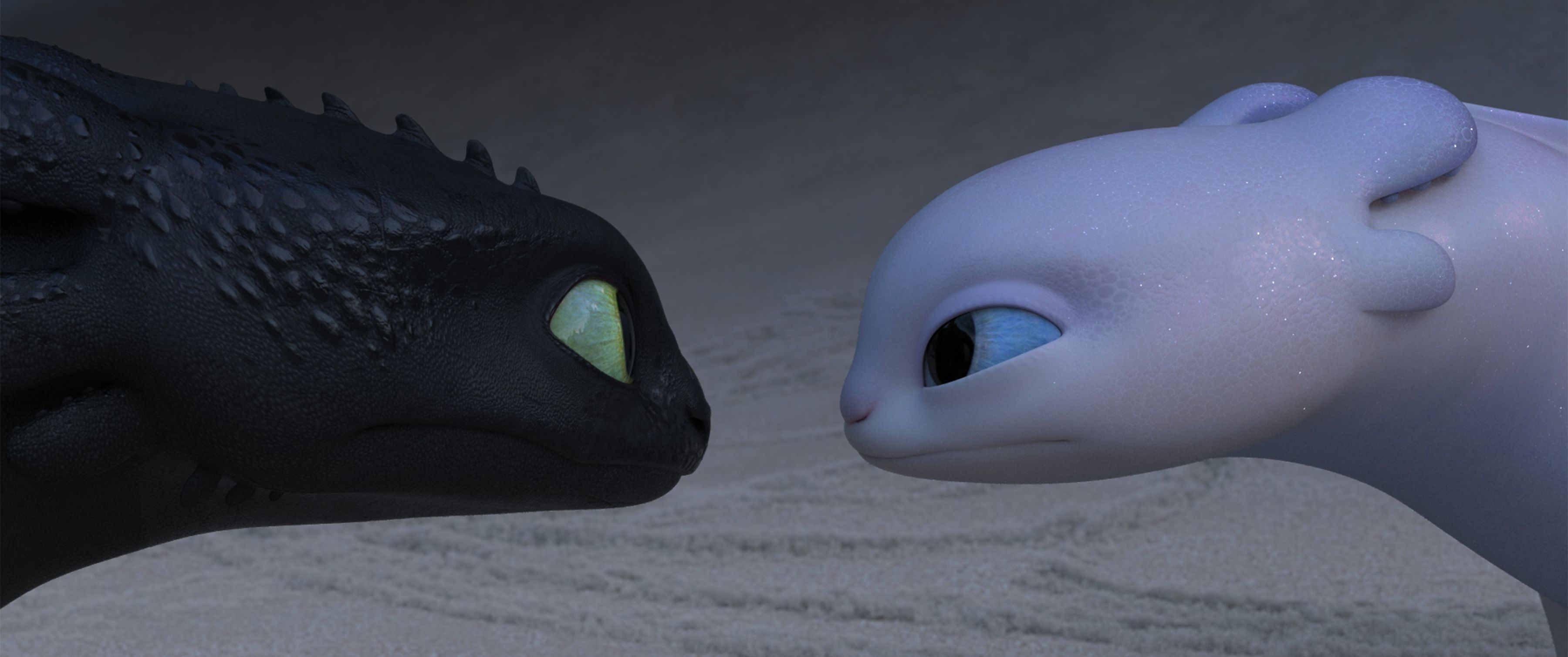
How to Train Your Dragon: The Hiden World (DVD)

The Upside

Isn’t It Romantic?

Not All Dogs Go to Heaven

A Dog’s Journey

by Cat McAlpine

An alcoholic single mother (Glow’s Betty Gilpin) falls out with her dead husband’s family and struggles to juggle her floundering music career and responsibilities with her precocious young daughter (Abby Ryder Fortson, and later Kathryn Prescott). Is this a harrowing tale about the resilience of women and the litany of roles they must play?

Nope. This is A Dog’s Journey, sequel to the controversial 2017 hit A Dog’s Purpose. And the single mother is the bad guy – for many reasons, but largely because she doesn’t like dogs.

The film is based on the book sequel of the same name by W. Bruce Cameron. Cameron also penned the adaptation for film, with the help of three other writers. It took four people to write this movie.

I’m a strong believer that you should judge a movie within the genre it exists. A dog movie, for example, probably shouldn’t be judged against the same standards as, say Mad Max: Fury Road.

And yet, I can’t work A Dog’s Journey into a sphere where it achieves any kind of quality. This script reads like the bullet points from a rejected Hallmark channel feature. This film has less compelling dialogue and character development than Netflix’s notoriously bad A Christmas Prince.  The human action only exists to serve up easy hits for a dog’s inner monologue about butts and bacon, but the action somehow also needs to be compelling enough that a dog’s spirit continually reincarnates.

To trick you into thinking this film is emotionally developed, they kill the dog at least four times, because anyone will cry at a dying dog. That’s the schtick in this series. If a dog loves you enough, it never truly dies, it simply returns as another dog.

What is this world, where it’s always golden hour and the river bank is littered with perfect clusters of sunflowers? Do these characters actually exist in a purgatory – where despite a perfect pastoral backdrop, nothing can truly die, and all living creatures remember their last violent death?

There’s an opportunity for a third movie which takes a sharp left into existential sci-fi horror, but I doubt that script would resonate with the crowd at my showing who repeatedly chuckled at Bailey (voiced by Josh Gad) rooting for romance with his catch phrase “Just lick faces already.” Maybe the existential sci-fi horror was that I had to watch this film in a room full of people who enjoyed it.

The reality is, people did and will enjoy this movie. It’s filled with easy to identify archetypes. It’s clear who the bad guys and the good guys are. There’s a bad mom, childhood hijinks, an abusive boyfriend arc, a car chase, a move to New York to “make it”, and a cancer scare and recovery all in 108 minutes.  This movie requires zero brain power to consume because it’s a bland amalgam of all the unremarkable scripts that came before it – but with Gad’s sickeningly sweet puppy voiceover throughout.

I don’t know if dogs go to heaven, but I do know I’ll be seeing this film in hell.