Tag Archives: MaddWolf

Fright Club: Looking for Love

Love is in the air! God help us, especially those who are throwing themselves into the love game. It’s horrifying, right? Scary, vulnerable, awkward, and really bloody once the power tools come out.

Horror filmmakers know a good subject when they see one. Here are our five favorite films focused on the quest to find and secure love.

5. Berlin Syndrome

Aussie photographer Clare (Teresa Palmer, better than she’s ever been) is looking for some life experience. She backpacks across Europe, landing for a brief stay in Berlin where she hopes to make a human connection. Handsome Berliner Andi (Max Riemelt) offers exactly the kind of mysterious allure she wants and they fall into a night of passion.

What follows is an incredible combination of horror and emotional dysfunction, deftly maneuvered by both cast mates and director Cate Shortland. The mental and emotional olympics Palmer goes through from the beginning of the film to the end showcase her instincts for nuanced and unsentimental performance. Clare is smart, but emotionally open and free with her own vulnerability. The way Palmer inhabits these characteristics is as authentic as it is awkward.

Even more uncomfortable is the shifting relationship, the neediness and resilience, the dependency and independence. It’s honest in a way that is profoundly moving and endlessly uncomfortable. Riemelt matches Palmer’s vulnerability with his own insecurity and emotional about faces. The two together are an unnerving onscreen pairing.

4. The Love Witch

Wes Anderson with a Black Mass fetish and a feminist point of view, Anna Biller wrote/directed/produced/edited/set-designed/costume-designed/music-supervised this seductive sorcery headtrip.

Elaine (Samantha Robinson – demented perfection) needs a change of scenery. Driving her red convertible up the seacoast highway toward a new life in northern California, her troubles – and her mysteriously dead ex-husband – are behind her. Surely, with her smart eyeshades and magic potions, she’ll find true love.

Expect a loose confection of a plot, as Elaine molds herself into the ideal sex toy, winning and then tiring of her trophies. This allows Biller to simultaneously reaffirm and reverse gender roles with appropriately wicked humor.

3. Alleluia (2014)

In 2004, Belgian writer/director Fabrice Du Welz released the exquisite Calvaire, marking himself a unique artist worth watching. Ten years later he revisits the themes of that film – blind passion, bloody obsession, maddening loneliness – with Alleluia. Once again he enlists the help of an actor who clearly understands his vision.

Laurent Lucas plays Michel, a playboy conman who preys upon lonely women, seducing them and taking whatever cash he can get his hands on. That all changes once he makes a mark of Gloria (Lola Duenas).

Du Welz’s close camera and off angles exaggerate Lucas’s teeth, nose and height in ways that flirt with the grotesque. Likewise, the film dwells on Duenas’s bags and creases, heightening the sense of unseemliness surrounding the pair’s passion.

Duenas offers a performance of mad genius, always barely able to control the tantrum, elation, or desire in any situation. Her bursting passions often lead to carnage, but there’s a madcap love story beneath that blood spray that compels not just attention but, in a macabre way, affection. Alleluia is a film busting with desperation, jealousy, and the darkest kind of love.

2. The Loved Ones (2009)

Writer/director/Tasmanian Sean Byrne upends high school clichés and deftly maneuvers between angsty, gritty drama and neon colored, glittery carnage in a story that borrows from other horror flicks but absolutely tells its own story.

Brent (Xavier Samuel) is dealing with guilt and tragedy in his own way, and his girlfriend Holly tries to be patient with him. Oblivious to all this, Lola (a gloriously wrong-minded Robin McLeavy) asks Brent to the end of school dance. He politely declines, which proves to be probably a poor decision.

Byrne quietly crafts an atmosphere of loss and depression in and around the school without painting the troubles cleanly. This slow reveal pulls the tale together and elevates it above a simple work of outrageous violence.

Inside Lola’s house, the mood is decidedly different. Here, we’re privy to the weirdest, darkest image of a spoiled princess and her daddy. The daddy/daughter bonding over power tool related tasks is – well – I’m not sure touching is the right word for it.

The Loved Ones is a cleverly written, unique piece of filmmaking that benefits from McLeavy’s inspired performance as much as it does its filmmaker’s sly handling of subject matter.

https://www.youtube.com/watch?v=olB5Wrg8Sxc

1. Audition (1999)

The prolific director Takashi Miike made more than 70 movies in his first 20 or so years in film. Among the best is Audition, a phenomenally creepy May/December romance gone very, very wrong.

Audition tells the story of a widower convinced by his TV producer friend to hold mock television auditions as a way of finding a suitable new mate. He is repaid for his deception.

Nearly unwatchable and yet too compelling to turn away from, Audition is a remarkable piece of genre filmmaking. The slow moving picture builds anticipation, then dread, then full-on horror.

By the time Audition hits its ghastly conclusion, Miike and his exquisitely terrifying antagonist (Eihi Shina) have wrung the audience dry. She will not be the ideal stepmother.


Cold Comfort

Arctic

by George Wolf

Arctic is a survival film that wastes no time getting to the survival.

Director/co-writer Joe Penna drops us somewhere in the Arctic Circle long enough after a place crash that lone survivor Overgård (Mads Mikkelsen) has had time to construct a makeshift camp. We get no backstory, no thrilling crash effects and no time to assess the situation, which is perfect on two fronts.

1) The situation is pretty damn clear, and 2) so are the film’s unflinching parameters. There’ll be no spoon-feeding here, are you in or are you out?

Mikkelsen is all in, with a supremely committed performance full of both strength and vulnerability. In a film that’s nearly dialog-free, Mikkelsen sparks a curiosity about his character that the film is in no hurry to indulge. Overgård is clearly meticulous and intelligent, cautious and resourceful, but it is after an early rescue attempt goes awry that Mikkelsen delivers the layers of humanity that add an ethereal beauty to the sterile, potentially deadly climate.

Suddenly, there is the safety of a badly injured woman (Maria Thelma Smáradóttir) to consider. As Overgård weighs the options of waiting for another rescue or striking out on foot, Mikkelson excels in making the emotional weight authentic, along with some simple joys that come from supplies found in the woman’s downed helicopter.

While it might be tempting to label this a snow-covered Castaway, the experience is closer to Robert Redford’s 2013 vehicle All is Lost. In his feature debut, Penna displays majestic wide-angle vistas without any photographic glamour that might betray what Overgård is up against. In trimming away all excess narrative, he immerses you only in the often gut-wrenching journey.

The result is never less than believable, a no muss, plenty of frigid fuss endurance tale that feels real.

And real cold.


I Don’t Want to Go Out—Week of February 18

This week’s home viewing options run the gamut from Oscar hopefuls to Razzie shoe-ins, plus some bare knuckle brawlers and Nazi zombies. That’s what we call variety!

Click the film title for the full review:

A Star is Born

Can You Ever Forgive Me?

Overlord

Green Book

Donnybrook

Robin Hood

Screening Room: Alita, Happy Death Day 2U, Isn’t It Romantic, Donnybrook, Capernaum

Lots of stuff coming out this week in theaters and home entertainment. We talk through Alita: Battle Angel, Happy Death Day 2U, Isn’t It Romantic, Capernaum and Donnybrook.

Listen to the full podcast HERE.

Little Boy, Big World

Capernaum

by Brandon Thomas

“I want to sue my parents!” a defiant pre-teen child exclaims inside of a crowded courtroom. Everyone – his parents, the judge, the attorneys – appears stunned. As his initial outburst lingers in the air, the boy explains further:

“Because I was born.”

Our world can be a horrific place. Unfortunately, children aren’t spared from these horrors. Capernaum follows one child as he tries to make sense of his place in a world that’s constantly placing greater and greater hurdles in front of him.

The streets of Beirut are the playground for headstrong Zain (Zain Al Rafeea). When not selling cheap cups of juice in the gutter, Zain spends his days working in a small shop to appease his parent’s landlord. Even at such a young age, Zain has been tasked with providing for his large family. The abrasiveness of Zain’s demeanor is quickly overshadowed by his need to take care of his siblings and keep them all together.

Capernaum isn’t subtle about where it lays blame. The neglect from adults is directly responsible for the misery these children endure. Zain and his siblings are only valuable to their parents because of what they can provide for them; not because they’re human beings. Even the lone caring adult in Zain’s life puts him in a situation that no child should be in.

The movie isn’t a miserable experience by any means, but it doesn’t shy away from the hardships these characters suffer. In fact, that honesty is what makes Capernaum so compelling. Knowing there are real children like Zain who live this kind of bleak existence helps give the story weight.

Al Rafeea is a revelation in his acting debut. A real life Syrian refugee, Al Rafeea conveys a weariness that cannot be faked. He plays Zain as a hardened, street-smart kid, but allows the cracks in that facade to show. Zain wants the chance to be a regular kid, and those few moments when he is truly happy are simultaneously joyous and heartbreaking.

The honesty of the story and the lead performance make Capernaum a riveting experience.

Hidden Figures

The Invisibles

by Rachel Willis

In 1943, the infamous Joseph Goebbels declared Berlin was “free of Jews.” However, 7000 Jewish residents remained in hiding in Germany’s capital. Director Claus Räfle brings this dark history to life with his docudrama, The Invisibles.

Focusing on the lives of four young Jewish men and women, Räfle showcases their struggles through a combination of dramatic reenactment and interviews.

The dramatic elements of the film play like any well-written, well-acted drama. The actors enliven the words of the survivors, whose interviews are interspersed throughout the film. Newsreel footage from the days of the war also help paint the picture for modern viewers.

It’s an interesting choice to retell the more dramatic elements of history through reenactments, but because of Räfle’s attention to detail and the actors’ commitment to the story, it works fairly well. Räfle understands how to balance the dramatic with the interviews,  frequently reminding us we’re watching a story about real people.

The strongest performance comes from Max Mauff, who portrays Cioma Schönhaus. By forging documents, Cioma manages to stay behind in Berlin when his parents are sent to a concentration camp. Because of his skills, soon friends ask for help with their own documents. His work gains the attentions of Dr. Franz Kaufmann, a member of the Third Reich, who assists Jewish men and women in escaping Germany., and he enlists Cioma’s help in creating fake passports and papers. Cioma’s work saves the lives of scores of other Jewish men and women.

Räfle tries to balance Cioma’s story with the stories from his other interviewees, Ruth Ardnt, Hanni Lévy and Eugen Friede, but he never quite manages to bring the same level of detail to their histories. Though Eugen participates in a resistance movement distributing leaflets to citizens, that fact almost feels like an afterthought. Ruth works in the house of a Nazi officer, who knows who she is, but the tension of such a situation is never fully explored.

In addition to the four survivors profiled, there are a number of men and women who assist in hiding Ruth, Hanni, Cioma, and Eugen. It’s hard to keep track of the names of those who risked their lives to do the right thing, which is unfortunate since their actions were critical in keeping people alive.

The Invisibles might have been better served by simply letting the survivors tell their stories in their own words, but even with the choice to dramatize the history, it’s a sensitive, emotional portrayal of one of the darkest times in human history.

Spare Parts

Alita: Battle Angel

by Hope Madden

Cyberpunk comes to the big screen in the form of a post-apocalyptic roller derby. I would not have guessed that’s how it would go.

Alita: Battle Angel is, among other things, director Robert Rodriguez’s best film in years. That isn’t saying a lot, but the truth is that the filmmaker does more with dystopian YA heroine tropes than most recent directors have.

In a terrestrial wasteland in the shadow of a sky city eternally out of reach, one kindly scientist (Christoph Waltz) scrounges a scrap heap looking for cyborg parts. He rebuilds something he finds there—something that reminds him of his own lost daughter. Though Alita (Rosa Salazar plus motion capture magic) has no memory of who or what she was, her instincts oscillate between earnest adolescent and battle-honed killer.

Based on a Manga series about a bounty hunter, Alita concerns itself more with the themes of today’s young adult franchises: empowering young women to be true to themselves, stand up to authority, own their own destiny, and only crush on boys who love you for who you truly are.

All fine lessons. A stocked supporting cast including two more Oscar winners (besides Waltz)—Mahershala Ali and Jennifer Connelly—elevate the sometimes threadbare dialog with sheer will and undeniable talent.

The film also showcases the latest cinematic tech wizardry at the disposal of co-scriptor James Cameron, wielded by Sin City’s visionary helmsman.

And it looks great. Better than the trailer makes you think it looks. The ruined city, the cyborg monstrosities, the action—all of it commands attention and refuses to be dismissed.

If nothing else, Alita absolutely marks a departure from the filmmaker’s traditional style. Indeed, it looks more like something Cameron would make: glossy and epic versus edgy and idiosyncratic.

There is nothing especially groundbreaking or memorable, however, about the film. There is nothing inferior about it, either. It pushes some boundaries in terms of content as well as movie experience and it entertains from start to finish. It’s Hunger Games with a more likable protagonist, Ready Player One with a plot.

It’s forgettable, cool looking and fun.

We Can’t Quit You, Rom-Com!

Isn’t It Romantic

by George Wolf

Every time someone on your social media thread pokes fun at the latest Hallmark Christmas special, you can get some pretty good odds they set the DVR to record it.

Isn’t It Romantic is all about indulging those guilty pleasures, laughing with friends as we all point out the reasons we shouldn’t love something that we’re going to keep on loving anyway.

Romantic comedies, why can’t we quit you?

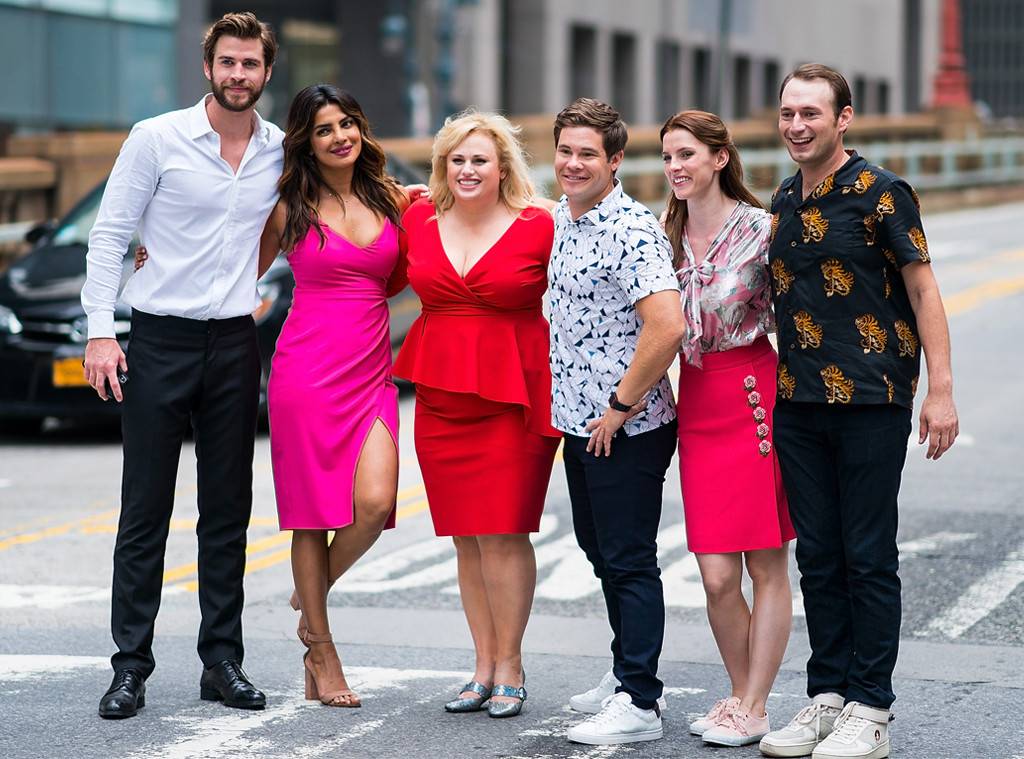
Natalie (Rebel Wilson) is a low-level architect at a NYC firm who chastises her co-worker Whitney (Betty Gilpin) about her love for predictable rom-coms like Notting Hill and 50 First Dates. As Whitney watches yet another one on company time, Natalie wags a finger and reminds us all of the romantic comedy playbook she’s soon to act out.

Fighting with a would-be purse snatcher, Natalie is knocked unconscious, only to awaken in a strange new world.

She’s glowing with full makeup in a lavish E.R., where sexy doctors are available at a moment’s notice and there’s voiceover narration for Natalie’s inner conflicts.

This can only mean one thing: Natalie’s living in a rom-com!

The screenwriting team has plenty of experience in the genre (How to Be Single, The Wedding Date, What Happens in Vegas), and rolls out the tropes with fun, familiar ease. Natalie is instantly pursued by the rich, handsome Blake (Liam Hemsworth) while her friend-zoned buddy Josh (Adam DeVine) hooks up with supermodel/”yoga ambassador” Isabella (Priyanka Chopra) and best pal Whitney suddenly becomes an office nemesis.

Gay sidekick? Of course, honey! It’s neighbor Donny, who shows up at inexplicable moments and is brought to scene-stealing life by Brandon Scott Jones.

“How did you get here??”

“I just said ‘Gay Beetlejuice’ three times and here I am, Booch!”

Wilson, usually adept at scene-stealing herself, seems a bit uneasy in the lead, as her supporting actors all manage to make solid impressions while she struggles to find a confident tone.

Credit director Todd Strauss-Schulson for a finely whimsical pace, pop-up music montages that pop, and plenty of subtle backgrounds that reinforce the wink-winks (there’s a cute little cupcake store on every corner!)

While never hilarious, Isn’t It Romantic manages consistent charm and an effective running gag about keeping it all PG-13. Everybody knows you know how it ends and that’s the point, right? Here comes another musical number!

Hey, if you want rom-com critique with bite, revisit Joseph Gordon-Levitt’s Don Jon. If you’re fine pleading guilty to the pleasure, Isn’t It Romantic will be plenty enjoyable.


The Great Outdoor Fight

Donnybrook

by Matt Weiner

Go into Donnybrook expecting an action movie about bare knuckle fighting and you’re going to be sorely disappointed: there’s more road movie than Rocky. But director Tim Sutton’s dissection of American desperation is out to expose the underbelly of more than just backyard brawling.

Sutton adapts Frank Bill’s novel with unrelenting sparseness. The movie centers on the intertwined lives of Jarhead Earl (Jamie Bell) and Chainsaw and Delia Angus (Frank Grillo and Margaret Qualley) as they pursue the limited versions of the American dream available to them in rural, addiction-ravaged Ohio.

Earl wants to win the Donnybrook, a legendary underground fight whose winnings will allow him to give his family a better life. Delia just wants to sell a bunch of meth so she can escape dead-end life with her abusive brother. And Chainsaw Angus just wants all that meth back that his sister stole. (You know a situation is dire anytime someone steals drugs from a person named Chainsaw.)

Donnybrook is violent but not gratuitous. As the characters’ lives converge on the road to the fight, the flashes of violence that build toward the climax serve mostly as a reminder of the pervasive despair everyone is running away from.

Grillo plays Chainsaw Angus as a relentless force that blows right through anyone and everyone he comes in contact with—men, women and children alike. There’s more than a touch of Coens-meet-McCarthy to Sutton’s adaptation, and not just in Angus’s almost elemental pursuit.

Earl’s milieu echoes the Appalachian noir of Winter’s Bone, but with a contemporary urgency all its own. Unfortunately, the film’s singular devotion to its economically downtrodden message leads to some shortcuts for the characters.

Delia doesn’t get the space to expand beyond her tragic archetype, but the movie is at least an equal opportunity offender when it comes to dispensing with supporting stereotypes: James Badge Dale’s alcoholic cop could be removed entirely and the story wouldn’t miss a beat.

The degree to which Sutton’s languid, dream-like depictions of this world succeed in amounting to a whole greater than their parts will probably come down to how much you think we need another Fight Club-style examination of a narrow (and uniformly white) male anger.

Giving that perspective such lyric treatment is certainly a choice. Even when the blows don’t connect, there’s something to be said for action with ambition.


A Very Merry Unbirthday

Happy Death Day 2U

by Hope Madden

Two years ago, writer/director Christopher Landon’s Happy Death Day managed the unexpected. It took an immediately tiresome premise—Groundhog Day meets Scream—and generated enough audience good will to entertain.

This was mainly thanks to Jessica Rothe, whose performance was funny enough to be simultaneously likable and detestable, and whose character arc mostly felt earned. (Bill Murray’s are big shoes to fill.)

Well, Rothe is back for a second helping of death day cake, as is Landon, who again writes and directs. Can the pair keep the story fresh for a sequel?

Why, no. Thanks for asking.

Where the original was a funny slasher with a SciFi bent, the sequel is a standard Eighties romcom with an occasionally morbid sense of humor. Think Real Genius, only dumber and more tedious.

Or Zapped. Remember Zapped?

Tree (Rothe) believes she’s broken free of her murderous time loop by killing the person who was out to kill her—and learning some hard-won life lessons in the meantime.

She was wrong, though, because the truth is that her boyfriend Carter’s (Israel Broussard) weird roommate Ryan (Phi Vu) has gotten all Timecrimes in the college lab and that’s what caused the loop. In fact, it’s causing another loop into a parallel dimension.

Everyone from the original is back and almost the same as last time (because this is a parallel universe). Any new character who is not white joins Ryan in the lab. Nerds – another sad Eighties theme that won’t stay dead.

Slapstick humor (Oh, this blind French thing is enough to make your brain bleed) and dumbfounding gaps in logic follow. A list of what does not follow: tension, horror, laughter.

Seriously, though, if you haven’t seen Nacho Vigalondo’s 2007 mindbender Timecrimes, you should definitely do that instead of going to HDD2U.

Oh! You know what else is great in that SciFi/time loop/horror neighborhood? The Endless.

The point is, if you are in the mood for some genre bending SciFi fun, you won’t find it here.