Be honest, when you saw the list of Oscar nominated animated
films, did you wonder whether Klaus was somehow the international title
for Frozen
2?
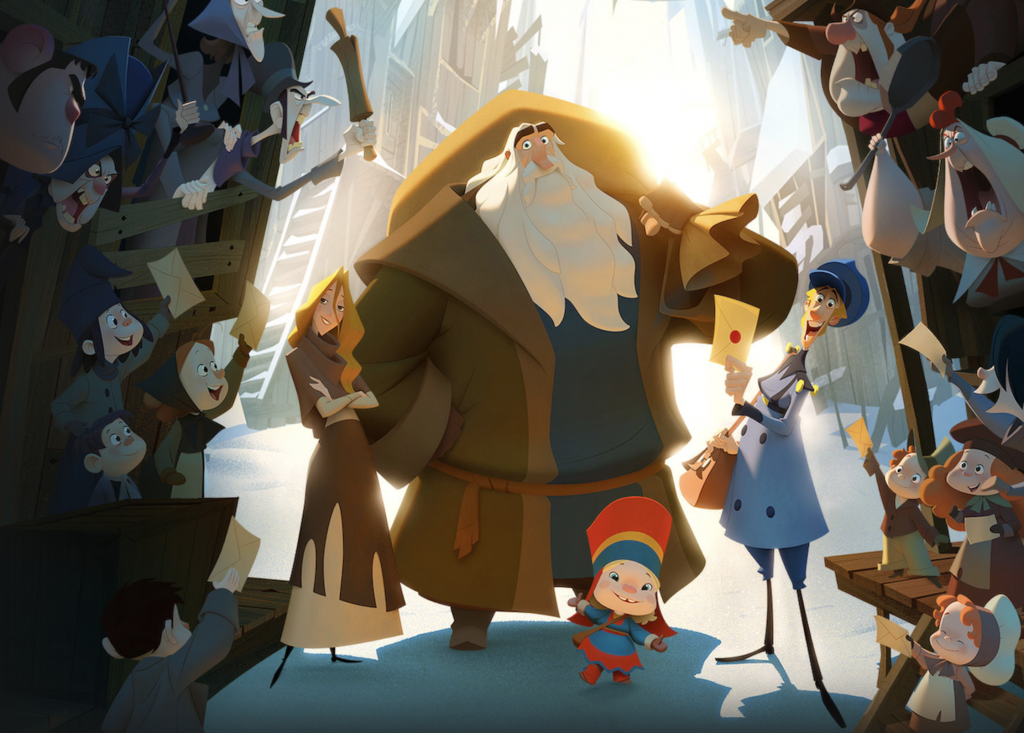
I have excellent news! It is not. Instead, it’s a clever,
not-too-sentimental Hatfields v McCoys take on the legend of Santa Claus.
Co-directors Sergio Pablos and Carlos Martinez Lopez develop
the story of a coddled would-be mailman named Jesper (Jason Schwartzman,
perfect). His Postmaster General father tires of Jesper’s spoiled ways and
sends him on a make-or-break assignment to the nether reaches of the north,
Smeerensburg.
All Jesper has to do is collect and deliver 6000 parcels
this year and he can go back to his warm, self-indulgent, cushy little home.
Naturally, there are obstacles. There’s a decades-long feud,
for one. It’s so bad the school teacher has turned her school house into a fish
market (parents won’t send their kids anywhere they might have to fraternize
with the other clan). And then there’s that creepy, disproportionately large,
old woodsman.
At times, the twisty tale threatens to collapse under its
own weight, but it does not. Instead, it takes risks you don’t often see in
family films and those risks mainly pay off. For a Christmas film, the movie
manages to mainly avoid schmaltz. It offers clever explanations as to how many
of the Santa Claus myths are born, affects just enough of a sense of wonder,
and entertains from start to finish.
The vocal talent certainly helps. Flanking Schwartzman are
the always welcome JK Simmons as the big guy himself, as well as Rashida Jones,
Joan Cusack and Norm MacDonald as a smarmy boatman.
The animation itself is beautiful, but not especially showy. The images won’t disappoint, but they won’t make your jaw drop, either. Instead, Klaus relies on the perfect blend of sentimentality and wit to delight children and entertain their parents.
When filmmakers Steve Bognar and Julia Reichert documented
the last days of Moraine, Ohio’s GM plant for their Oscar nominated 2008 doc The
Last Truck, they probably did not foresee a second nomination coming nearly
a decade later for what amounts to a sequel.
And yet, American Factory returns to the same scene,
this time to provide a fly-on-the-wall peek at the Fuyayo Glass Factory, a
Chinese/American experiment taking place inside those same walls.
The first film released by Michelle and Barak Obama’s Higher Ground Productions, American Factory is a case study in cross-cultural miscommunication and national personality clash.
After Moraine’s GM plant closed, the town sank into economic disaster—something Dayton’s own Bognar and Reichert certainly witnessed daily since the short film. Looking to expand their production in the States, China’s Fuayo Glass Industry Group purchased the old GM plant and instantly created quite a buzz.
What Reichert and Bognar capture is astonishing and
unnervingly honest. Chinese workers in Ohio are given a crash course in what to
expect from Americans, as management tutors them to expect blunt honesty and the
Americans’ belief that they are somehow special no matter who they are.
Meanwhile, American managers are treated to a company meeting in China where
the orderliness and productiveness of the workers inspires awe, the
propaganda-riddled pageantry alarms, and the sight of employees sifting through
broken glass to find pieces worth salvaging horrifies.
The human struggle at the plant mostly comes down to an
attempt to unionize, which Chinese management sees as an opportunity for lazy
Americans to gut productivity while the American labor sees it as an
opportunity to institute legal protections concerning safety, health code
regulations, wages and benefits.
It truly is as if the parties speak different languages.
Bognar and Reichert strive to provide a balanced point of view. Any finger- wagging is directed at both sides of the argument, but even that’s somewhat limited. The filmmakers and their film are more interested in the human side of the exchange. The film sheds light on the loneliness of the Chinese workers biding their time until their families can be brought overseas. We’re also privy to the early optimism and then heartbreaking disappointments faced by the Ohioans hoping for another chance to make an honest living.
While the cultural wreckage offers a fascinating sociological
experiment, the film ends far more ominously as automation proves to eliminate all
concerns over wages, hours, productivity, quality, jingoism, racism and any
other human frailty you can think of.
What the filmmakers encapsulate about humanity, culture and the future of labor is equal parts enthralling and frightening.
What does true art require of its maker? It’s an incredibly
common theme in film (and books and sculpture and painting and any other kind
of art) because, for an artist, it’s a common point of introspection. Why am I
doing this, why aren’t I better than this, what would I give to be really
great?
There’s such an underlying element of the diabolical and desperate in these questions that it’s only sensible so many horror flicks have sprung from this well. From Roger Corman’s A Bucket of Blood in ’59 to Sean Byrne’s Devil’s Candy in 2015, horror movies love to explore what we’re willing to become if only our art could be great.
Joe Begos returns to the concept with Bliss, an
unrelenting attack on the senses that equates artistic obsession with addiction
and monstrosity.
Frenetically paced and entirely reliant on Dora Madison’s
impressive performance, Bliss works like a hypnotic pulse. Madison plays
artist and malcontent Dezzy, who opens the film dodging her landlord, tooling LA
in her convertible caddy and panicking. She can’t finish her latest piece, her
agent wants to drop her, she’s about to lose her exhibit space.
Why isn’t her dealer answering the goddamn phone?
When she does catch up with him, he has something potent for her. She goes a little overboard and by the time she’s semi-conscious again, a house party is in full rage, the drugs, beat and sexy look from an old friend propelling Dezzy into a hypnotic night of excess and debauchery. But somewhere in the stew and slurry of the night, her painting starts to take shape.
It’s intriguing that the more minor the character, the more
likable the performance. Begos seems not to want you to care about the lead or
those closest to her, and that’s always an intriguing approach to a film.
The only real problem with Bliss is its lack of originality, but that’s a pretty big problem. Quick cuts and quicker tempo, nimble performances and concussive beat, like Gaspar Noe’s Climax, Bliss leaves you feeling worn out. But with little new to say, it mainly leaves you feeling more hung over than entertained.
Excellent week in lazybags theater. Stay inside and watch the best film of 2019, one hell of a performance, and an unreasonably underseen action flick in which Schwarzenegger gets off the funniest line of his career.
It’s the hap-happiest time of the year! Oh, our favorite thing about Oscar nominations is the excuse it gives us to dredge up those old horror flicks lingering in every good and bad actor’s past. This year’s crop was especially ripe, too. Here are the handful that made the final cut.
5. Al Pacino & Charlize Theron: The Devil’s Advocate
(1997)
A guilty pleasure, this one. Theron’s screen debut just two
years earlier came from an uncredited role in the clearly inferior Children
of the Corn 3, but she has no lines in that and how do we pass up a two for
one like this movie?
Al Pacino plays to type as Satan, disguised as NY lawyer
John Milton who invites unbeaten Florida lawyer Kevin Lomax (Keanu Reeves) to
join the firm (after Lomax knowingly gets a child molester acquitted). Lomax
and his saucy wife Mary Ann (Theron) head north, but Milton keeps Kevin working
late and Mary Ann becomes isolated and then paranoid and then possessed.
Theron’s performance is solid throughout and Pacino’s a lot
of fun chewing scenes and spitting them out. Reeves is Reeves. But this is such
a ludicrous, over-the-top morality play—one that Theron plays for drama and Pacino
plays for camp—that Reeves’s goofball in the middle feels somehow right.
4. Tom Hanks: He Knows You’re Alone (1980)
Tommy’s first show biz performance came by way of Armand
Mastroianni’s bride stalker, He Knows You’re Alone.
The first problem with the film is the plot. It is
absolutely impossible to believe that any knife wielding maniac is scarier than
a bride just 24 hours before her wedding. She’d kick his ass then slit his
throat, all the while screaming about seating arrangements.
The bride thing is a weak gimmick to introduce a slasher, so
we watch a shiny knife catch the light just before slicing through some friend
or acquaintance of bride-to-be Amy (Caitlin O’Heaney).
In the film that’s little more than a smattering of ideas
stolen from Wes Craven and John Carpenter, surrounded by basic stock images and
sounds from early 80s slashers, the only thing that stands out is Hanks. In an
essentially useless role, Hanks introduces the idea of comic timing and natural
character behavior. Too bad we have to wait a full hour for his first scene,
and that he only gets one more before his girlfriend’s head finds its way into
the fish tank and he vanishes from the film.
3. Renee Zellweger: Texas Chainsaw Massacre: The Next
Generation (1995)
Written and directed by Kim Henkel, Tobe Hooper’s
co-scriptor for the original, Texas Chainsaw Massacre: The Next Generation
amounts to one bizarre cabaret of backwoods S&M horror. You’ll think for a
while it’s a regular ol’ slasher, what with the unlikable teens, broken down
car, and bad decision-making. But if you stick it out, you’ll find it tries to
be something different – something almost surreal, kind of madcap. It doesn’t
work, but it counts that they tried, doesn’t it?
A profoundly unconvincing set-up involves Renee Zellweger as
well as several colleagues no longer in the acting profession. They deliver
teen clichés while wandering into a truly weird situation. The four prom-goers
are terrorized by Matthew McConaughey, now leader of Team Leatherface, and his
bizarre band. It’s not necessarily weird in a good way, but weird is rarely
ever entirely bad.
There’s a visit from a limo-driven S& M maestro of some
kind, paranoid delusions of Big Brother control, a more clearly cross-dressing
Leatherface, but absolutely no tension or terror, and shocking little in the way
of horror, either, regardless of Freaky Limo Guy’s line: I want these people to
know the meaning of horror.
(Hint: they should watch the original.)
https://www.youtube.com/watch?v=PNsgi_n-hro
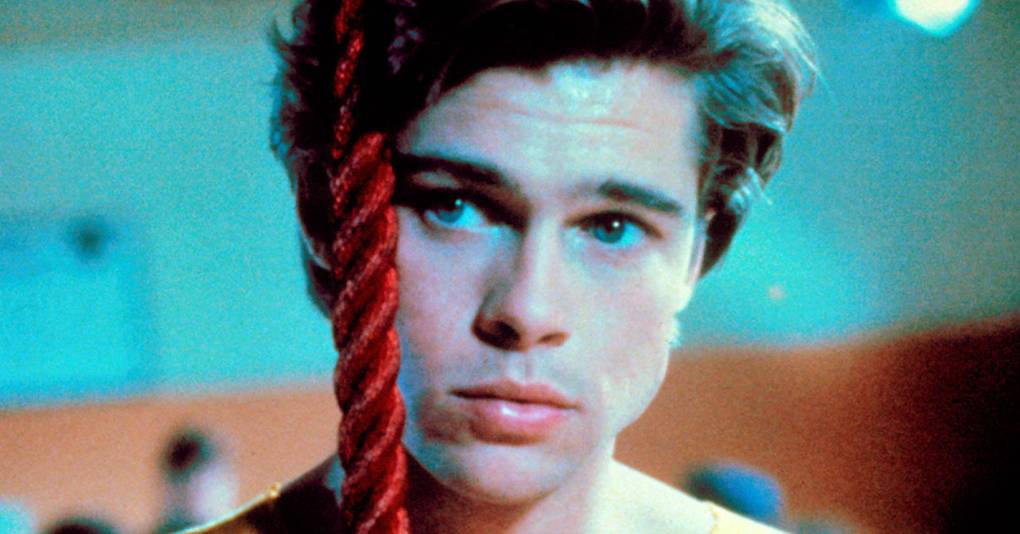
2. Brad Pitt: Cutting Class (1989)
Someone’s killing off folks at the nameless high school
where Pitt, as Dwight Ingalls, portrays the horny, popular basketball star
repressing rage concerning his overbearing father. Perhaps he’s bottling up
something more?
Sexual frustration, no doubt, as he spends every second on
screen trying to get somewhere with girlfriend Paula (Jill Schoelen, frequent
flier on bad 80s Horror Express).
Usually, when you look back on a superstar’s early career
and find low-budget horror, one of two trends emerges. Either the superstar
stands out as clearly the greatest talent in the film, or else they just cut
their teeth on a very small role. Sometimes both. In Pitt’s case, well, at
least he looks like Brad Pitt.
Still, it’s fun to see him try on some tics and
idiosyncrasies he’ll come to rely on in later, better roles. (Like Pitt’s
Oceans character Rusty Ryan, Dwight eats in every scene.)
The freakishly uneven tone, the film’s episodic nature, each
scene’s seeming amnesia concerning other scenes’ actions, and the whiplash of
comedy to psychological thriller to comedy all add up to an exercise in incoherence.
1. Laura Dern: Grizzly II: The Concert (1987)
Here’s the crowning jewel for nearly any Skeletons in the Closet feature. It
features not just a current nominee, but one past winner and ever-the-winner
Charlie Sheen. It’s hard to come by and even harder to watch. The sequel to William
Girdler’s 1796 forest-astrophe Grizzly was filmed in 1983 and never
completed, but sort of, kind of released anyway in 1987. Every death scene ends
just before the death itself, because the bear side of the struggle was never
shot. So, we get a lot of bear’s eye view of the victim, but never a look at
the bear side of the sequence. It’s surreal, almost.
Sandwiched somewhere between the non-death sequences is a never ending
faux-eighties synth pop concert. The concert footage is interminably long, nonsensical
enough to cause an aneurism, and awful enough to make you grateful for the
aneurism. You will lose your will to live. So, why bother? Because this
invisible grizzly puppet kills Charlie Sheen, Oscar nominee Laura Dern, and
George Clooney. (Dern and Clooney are making out at the time, which actually
probably happened).
“Remember this, my friends. There is no such thing as bad
plants or bad men. There are only bad cultivators.”
Victor Hugo penned those words as he watched the suffering
and oppression in the streets of Montfermeil.
Set in July 2018, when the World Cup victory made
celebratory compatriots of everyone in France, at first blush, Ladj Ly’s film Les
Miserables bears little resemblance to the saga of Jean Valjean and that
tenacious Javert. But it doesn’t take long for the filmmaker to use the story
of law enforcement and the population of modern day Montfermeil to show that
little has changed since Hugo set quill to parchment 150 years ago.
Damien Bonnard (Staying Vertical) plays Stéphane. Ly taps Julien Poupard’s camera to follow Stephane on his first day in Paris as part of a three man unit tasked with keeping an eye on a mainly poor, primarily Muslim district.
Stéphane’s new partners, Chris (Alexis Manenti) and Gwada (Djibril Zonga), have been on the job long enough to have developed relationships and tensions in the neighborhood. Thanks to an almost absurd subplot involving a traveling circus—whose lion delivers an apt metaphor and a heartbreaking scene—Stephane’s first days on the force will be regrettable.
Ly was inspired to write the film by riots that broke out in
his own apartment building and neighborhood in 2005. That authenticity lends
the film both a visceral dread as well as a complicated compassion.
Like Hugo, Ly seems unwilling to abandon those in authority
to the fate of villain any more than he’s willing to entirely forgive the
actions of the oppressed. Rather, each side is implicated (one far more boldly
than the other), but it’s the lack of tidy resolution that makes the fate of
these characters compelling.
While every performance is impressive, young Issa Perica is
the film’s beating heart, its undetermined destiny, and he’s more than up to
the task. His lines are limited but his performance is heartbreaking, his
character really the only one that matters.
A devastating social commentary masquerading quite convincingly as an intense cop drama, I’d say Les Miserables would do Hugo proud. The truth is, it would probably break his heart.
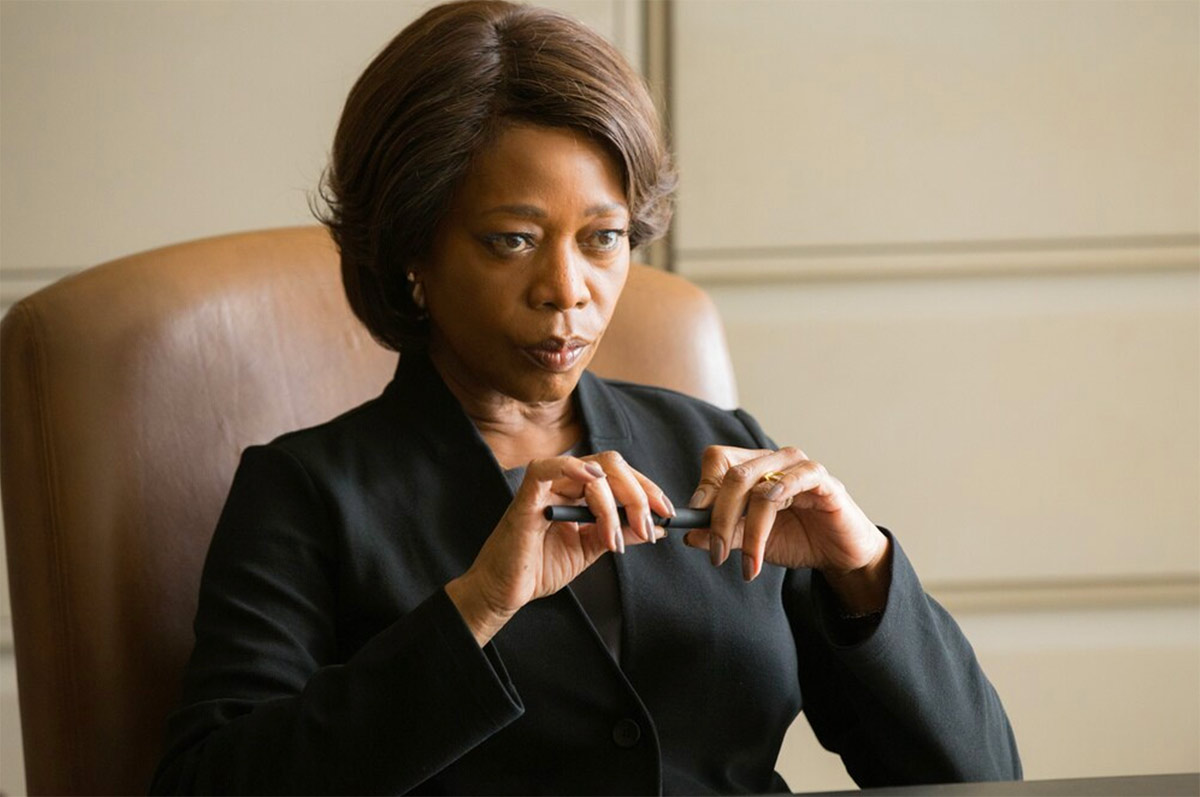
Alfre Woodard has primarily provided crucial supporting
turns in film and television since 1978. With writer/director Chinonye Chukwu’s
Clemency, Woodard delivers an astonishing lead turn as a prison warden dealing
with inmates on death row.
Examining capital punishment from the eyes of a prison
warden is certainly a novel approach. The warden has generally been
relinquished on film to a cowboy hat wearing good ol’ boy with no qualms about
flipping that switch. Chukwu and Woodard are disinterested in clichés. Instead they
carve out something truly new in this genre.
The thing Chukwu gets most right in this film is an
overwhelming sense of responsibility and grief, and it’s a tough line to toe. Warden
Bernadine Williams understands that, while her own grief threatens to swallow
her whole, it doesn’t compare with the pain she comes in contact with. For that
reason, she never defends her position or betrays her sympathies when
confronted by victims’ families, the families of the condemned or the condemned
themselves.
Her own grief is so acutely individual that she refuses to
seek sympathy and she outright rejects empathy, because who could put
themselves in her place? She is in charge but has no control. She is
responsible, yet she does not determine these men’s fates.
If Chukwu hits the right notes here, it’s Woodard who sings.
This journeyman has played just about everything across her four decades in the
business, and she brings a palpable sense of hard won wisdom to this role.
The film is essentially a character study, and one of a
character determined not to discuss or betray her feelings. That’s a tough nut
to crack because you have to let the audience know what’s going on without telling
us anything at all. More than that, what Woodard has to convey is far beyond
the scope of what anyone in the audience can really understand. And yet, she
succeeds poignantly.
Aldis Hodge, playing death row inmate Anthony Woods,
balances Woodard’s practiced stoicism with barely contained jolts of emotion. Clemency
gives Hodge the opportunity to shine and he grabs it, conveying a tumult of raw
feelings that will leave you heartbroken.
If Clemency is a miraculous package of performances, it doesn’t entirely work as a film. Bernadine’s story—her existential crisis—doesn’t have a beginning or an end, just an unhappy middle. But maybe that’s necessary for a film that breaks new ground while delivering the same message: we need criminal justice reform.
Such was modern dance legend Marce Cunningham’s wry, almost tickled description of one reaction to a performance. An enigmatic presence on and offstage, he makes for a fascinating if ultimately unknowable center to documentarian Alla Kovgan’s new documentary.
With Cunningham, the filmmaker seeks to reignite the
peculiar audience response the dancer/choreographer’s performances once
garnered, and perhaps drive wider appreciation for his work.
Kovgan chronicles the ways in which Cunningham challenged
the traditional concept of dance, combining ballet and modern choreography and
creating works without relation to music. His avant garde approach drew the
attention and collaboration of other boundary-pushing artists of the time,
including Andy Warhol, Robert Rauschenberg, and Cunningham’s eventual life
partner, John Cage.
Speaking of his interest in Cunningham’s work, Cage says, “I
would like to have an art that was so bewildering, complex and illogical that
we would return to everyday life with great pleasure.”
Kovgan goes about exploring not only that very work but the mind and imagination behind it through an appealing combination of archival footage, audio and onscreen text, as well as re-stagings of some of the artist’s most memorable pieces.
The result is provocatively piecemeal, a visually arresting
if intentionally untidy image of Cunningham’s life and work. Most often, Kovgan’s
style suits the content beautifully, but other times it’s a misfit.
Where Wim Wenders employed 3D to immerse the viewer in the
dance of Pina, Kovgan is as concerned with the surrounding as the movement.
She stages performances on rooftop, in meadows, among trees and within train
tunnels. While the combination creates a vibrant visual impression, it steals
emphasis from the movement itself, which feels out of step with Cunningham’s
most basic philosophy.
Kovgan takes chances, capturing the dance from above, close up, far away, and at odd angles. This sometimes creates a vibrant, off kilter sensibility that complements the material. At other times, you wish you could see more of the dancers, feeling as if you’re missing something amazing in favor of needless close up footage of a face.
It’s a small knock, honestly, with dances this arresting and accompanying material this compelling. Kovgan’s respect for the work as well as the life of her subject is clear and she’s captured much of that spirit.
HP Lovecraft has influenced horror cinema in ways too varied
and numerous to really articulate. But true Lovecraft is tough to bring to the
screen for a number of reasons, chief among them that his madness tends to
involve something indescribable: a color no one’s ever seen before, a sound
entirely new to the human ear, a shape that defies all laws of geography and
logic.
Alex Garland pulled inspiration from Lovecraft’s 1927 short Colour
Out of Space for his brilliant 2018 mindbender, Annihilation.
But for direct adaptations, Richard Stanley’s newest may be the best.
Naturally, the film’s success is due in large part to
Nicolas Cage’s performance, because who descends into madness quite as
entertainingly?
Cage plays Nathan Gardner. Nathan and his wife (Joely
Richardson), their three kids and their squatter (Tommy Chong – nice!) live a
quiet life in the New England forest not far from Arkham. A meteorite changes
all that.
Cage basically strums a favorite old tune, landing somewhere on his “nice guy gone insane” spectrum just this side of Brent (Mom and Dad) and Red Miller (Mandy). In fact, the voice that begins emerging once the meteorite hits is gleefully reminiscent of Peter Lowe from Vampire’s Kiss (a call back I can get behind).
Is that the only reason to see the movie? No. Tommy Chong is
a hoot, Richardson gets one especially creepy carrot chopping scene, and things
go a little Cronenberg just when you want them to.
There’s a lot wrong with the film, too. Scenes are sloppily
slapped together, one rarely leading to the next. The film’s budget is betrayed
by its FX and supporting performances are not especially strong.
But Stanley’s long-awaited comeback (this is his first narrative feature since being fired from The Island of Dr. Moreau in 1996) infuses Lovecraft with a much needed dark streak of comedy and entrenches his tale of madness within a loving family dynamic, offering an emotional center to the story that the author rarely delivered.
The film lacks the vibrant subversiveness of Mom and Dad and comes nowhere near the insane vision of Mandy, so Cage fans might be only mildly impressed. Lovecraft fans, though, have reason to be excited.