Many a film has used a building—a haunted house, for
instance—to represent the mental state of a character. From Shirley Jackson to
Stephen King to Daniel Kehlmann, writers have lured us into perfectly lovely structures
only to hold us inside, our ugly thoughts manifesting as danger, our madness
creating a labyrinthine, Escher-esque trap.
Such is the case for Relic, a compassionate but clear-eyed look at a different type of hereditary horror.
Edna (Robyn Nevin) has been missing for at least three days.
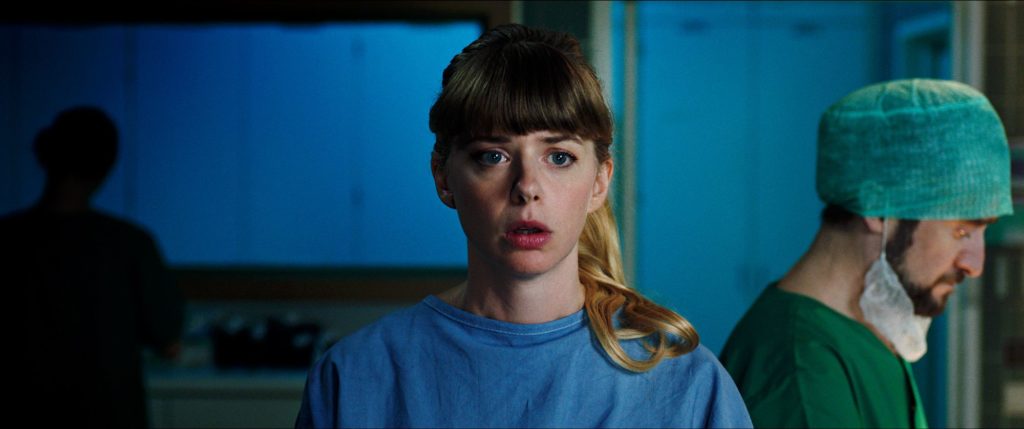
Her daughter Kay (Emily Mortimer) and her granddaughter Sam (Bella Heathcote)
move into Edna’s place to keep an eye out for her while local police
investigate.
And then, there she is, and it’s entirely likely she never
even left the house.
Well, that can’t be—unless there’s something seriously weird
about this house.
Co-writer/director Natalie Erika James keeps her metaphor right at the surface of the film. That keeps Relic from ever truly terrifying, honestly. There’s no simultaneous pull that something supernatural is afoot. But the sense of dread takes on a whole new tenor, and the film’s horror is honest as it hits on an emotional level.
Nevin does an admirable job with Edna, creating a fully dimensional
character, one who’s tough enough that when she becomes vulnerable, it comes as
a jolt.
Mortimer and Heathcote strike a believable love/disappointment/blame
balance and the emotional tug of war among the three women rings sadly true.
There’s not a lot of depth to this story. Relic isn’t hiding its themes—there are no subplots or red herrings, and the a-ha moments that allow Sam and Kay to piece together the mystery of Gram’s troubles feel almost perfunctory.
But James doesn’t shy away from the ugliness, guilt, anger or grief that fuel relationships tied up in this particularly painful genealogical horror. With its evocative analogy, Relic shows us what we are really afraid of, and it isn’t ghosts.
Films concerning the US’s two decade war in Afghanistan have
not managed to find much of an audience. I’m not sure Summer 2020—the year we welcomed
meth gators as a needed distraction from our own personal hell—will improve
those odds.
And yet, director Rod Lurie’s The Outpost bravely
ventures to the streaming environment this week to remind us that a solid,
understated war movie can still thrill.
The ensemble piece features Caleb Landry Jones and Scott
Eastwood as two sides of a coin. Eastwood’s Staff Sgt. Clint (that’s right)
Romesha is a born leader with quiet dignity, grit and a mind for strategy. Cynical
of the Army’s “frat boy” culture, Jones’s Staff Sgt. Ty Carter doesn’t quite fit
in.
Where doesn’t he fit in? A sitting duck army outpost situated
at the basin of surrounding mountains where Taliban forces travel, watch and
shoot.
Screenwriter Eric Johnson’s bread and butter has been teaming with Paul Tamasy to create the cinematic presentation of a true story. They nearly won an Oscar for Johnson’s first foray into feature length screenplays, David O’ Russell’s powerful The Fighter (with Scott Silver).
The duo join forces again, this time adapting Jake Tapper’s
investigative book concerning one extraordinary battle in our war in Afghanistan.
Understatement works in the film’s favor, Lurie favoring overlapping dialog and naturalistic settings to bombast and a leading score. In fact, much of the film plays without a score, a refreshing change that gives The Outpost a grittier, more realistic feel that serves it well. Because truth be told, a true tale that delivers this amount of sheer will, courage, perseverance and spirit is undermined by flapping flags and swelling strings. Lurie’s restraint says, “This is really what happened. Can you effing believe that?!”
That’s not to say The Outpost eliminates every cowboy moment. Indeed, this may be the first role in which Eastwood makes the most of his famous last name, clearly channeling his father in a performance punctuated by controlled, hushed rage and squinting blue eyes.
But Caleb Landry Jones, as remarkable and versatile actor as
you will find, is the broken soul of this film. Jones does “haunted” in a way
that makes every other performance feel like a performance.
Together Lurie, his writers and his cast sidestep clichés, delivering instead a clear-eyed look at bravery, failure, and the cost of war.
As little Anna tells viewers and her elementary school classmates, Madagascar is the 4th largest island on earth, and likely the single poorest country. Ninety three percent of Madagascar lives on less than $2 a day and half the population is children.
Madagascar is also devastatingly beautiful, not unlike Cam
Cowan’s documentary Madagasikara.
Beautifully photographed and expertly edited, Madagasikara
introduces you to a world you just didn’t know existed—one that’s never been
site to war and yet grows more ravaged by poverty daily. It’s a world where
breaking quarry rocks with hand tools offers the most stable occupation, for as
long as your body holds out. The world of this film is one so impoverished it
may as well be medieval—part of a long forgotten period where a family’s best
hope for the survival of their children is the convent.
For all the destitution, Cowan’s film is surprisingly joyous
at times, primarily because of the beautiful little faces surrounding the three
mothers—Deborah, Tina and Lin—that are the documentary’s main focus. It’s hard
to watch so many sweet, cute children and not feel joy.
Their pain is also more punishing.
A decade of botched elections put the island nation at the
center of a tug of war between a millionaire looking to exploit what he can for
his own gain (sounds familiar) and a pro-military dictator even less interested
in the wellbeing of his citizens. It also put Madagascar in the crosshairs of a
global community more focused on sanctioning its leaders than in feeding its
population.
Wisely, Cowan humanizes the tale of strife by dropping us into the day-to-day of three different women. Their struggles, joys and heartaches breathe life into statistics that could otherwise overwhelm, their resilience and their frailty speak powerfully to the human condition.
It’s hard to do zombies well anymore. Mainly, you have to either
come up with an entirely novel concept or hope that the bloody mayhem works in
your favor.
In Yummy, the concept is only marginally original,
but the bloody mayhem is more than on target. Co-writer/director Lars Damoiseaux
assaults your gag reflex with a viscous mess of a horror flick. Blood and
entrails, of course, but expect a pretty inspired use of pus, liquid body fat,
tendons and other tissues and goos.
It makes for some slick surfaces, I tell you what! Plus some
unexpected little monsters keep things interesting and fun.
Set inside a cut-rate Eastern European cosmetic surgery
clinic, the film follows a mother, daughter and her boyfriend into a very bad
decision. Mom (Annick Christiaens) is after a series of nips and tucks; daughter
Alison (Maaike Neuville) wants breast reduction; boyfriend Michael (Bart
Hollanders) is just a good dude willing to drive everyone even though he’s
afraid of blood.
Here is a ripe premise for horror. Mom is a Cronenberg-esque vehicle for body horror as well as vanity shaming. Alison provides comedic possibilities (no one in the clinic can begin to understand her point of view). Hemophobic Michael offers the clear hero’s arc. (Or he’ll simply die of shock by the gooey second reel.)
And no, it’s not incredibly novel—zombie movies so rarely
are. But it’s smart, witty and fun. Damoiseaux accomplishes much with his
budget. Practical effects are great, performances are delightful, and nothing
beats a little well placed Stooges. (The band, not the knuckleheads.)
Yummy represents Damoiseaux’s feature debut as
director and writer, but he’s garnered attention and awards for years with his
work in shorts. Award winning co-writer Eveline Hagenbeek (Rokjesdag)
channels her affinity for conversational comedy into a script that may follow a
familiar structure but delivers a believable, funny edge that the game ensemble
takes advantage of.
Their collaboration is no masterpiece, but it is a lot of sloppy fun.
A poetry of dread – that’s what the best in this business can conjure with the right framing, movement, stillness. Whether it’s Dick Pope creating that just-off feel of bucolic 1950s Idaho for The Reflecting Skin or Owen Roizman forever narrowing the screen, our gaze and our options in The Exorcist, the cinematographer is horror’s true master. Mike Giolakis kept us looking around us and behind us to see where the monster might be in It Follows. John Alcott (The Shining), Chung-hoon Chung (The Handmaiden) and Mo-gae Lee (A Tale of Two Sisters) haunted and mesmerized us with color, movement and atmosphere. Has anybody done it better?
Here are our nominees for the best cinematography in horror.
Gorgeous. If you’re looking for something theatrical, a true marriage between cinematography and set design, Masaki Kobayashi’s Oscar nominee Kwaidan delivers the goods.
Yoshi Miyajima lenses four different ghost stories, each almost entirely shot on highly decorated sound stages, and what he captures is the feeling of make believe that gives each story the sense that it is being told, being embellished for your spooky enjoyment.
Each story is given its own look, its own personality. It’s bold and memorable filmmaking, and an absolute sight to behold.
4. Antichrist (2009) – Anthony Dod Mantle
Whether it’s the utter poetry of the opening tragedy, the claustrophobic dread of the middle section, or the lurking menace of the final reels, Antichrist is an absolute treasure trove of emotional manipulation.
At times, Anthony Dod Mantle’s cinematography feels at odds with the actual content on the screen—particularly in Act 1. But mining for beauty in pain is one of many ways director Lars von Trier succeeds in surprising and horrifying with this film.
Mantle finds a terrifying beauty in ugly thing von Trier throws at you, and the end result is a mesmerizing and brutal work.
https://www.youtube.com/watch?v=w4U5rdi9w-U&t=20s
3. Nosferatu (1922) – Fritz Arno Wagner
We needed to pay our respects to some of the earliest and most memorable work in cinema. Why F.W. Murnau’s Nosferatu? Because nearly 100 years later, there are still images that haunt your dreams.
Fritz Arno Wagner (who also lensed Fritz Lang’s glorious M) capitalizes on the unseemly, vermin-like look of Count Orlock (Max Schreck, genius) with creeping silhouettes, lurking shadows, and camera angles that emphasized his hideousness.
Whether it’s the shocking rise from the coffin, the shadow on the staircase, or the image of the sole survivor of the ship recently decimated by “the plague,” Murnau and Wagner’s images are as evocative today as they were in ’22.
2. The Lighthouse (2019) – Jarin Blaschke
The atmosphere is thick and brisk as sea fog, immersing you early with Oscar nominee Jarin Blasche’s chilly black and white cinematography and a Damian Volpe sound design echoing of loss and one persistent, ominous foghorn.
Director/co-writer Robert Eggers follows The Witch, his incandescent 2015 feature debut, with another painstakingly crafted, moody period piece. The Lighthouse strands you, along with two wickies, on the unforgiving island home of one lonely 1890s New England lighthouse.
Salty sea dog Thomas Wake (Willem Dafoe) keeps the light, mind ye. He also handles among the most impressive briny soliloquies delivered on screen in a lifetime. Joining him as second is one Ephraim Winslow (Robert Pattinson)—aimless, prone to self-abuse, disinclined to appreciate a man’s cooking.
1. Pan’s Labyrinth (2006) – Guillermo Navarro
In 2006, Guillermo Del Toro’s masterpiece may have somehow been overlooked as Oscar’s Best Foreign Language Film, but at least the Academy had the common sense to notice Guillermo Navarro’s cinematography.
He manages to create an atmosphere equally imaginative and bitterly realistic, something befitting a child’s logic. Like a fairy tale, the screen blends the magical beauty of good and evil. His vision is as hypnotic as it needs to be, as childlike as we need it to be. It’s beautiful, innocent and utterly heartbreaking.
Most weeks there’s at least one streaming movie option that
will cost you. These are ostensibly the films that were meant to be theatrical
releases, as opposed to your garden variety direct-to-streaming options. The
idea is that you’re paying a premium to get to see it now, rather than waiting
for theaters to open up.
It’ll be interesting to see how long this tactic lasts, but one thing is for sure: You Should Have Left is not worth $20.
Always likeable, always reliable Kevin Bacon reteams with
his Stir of Echoes writer/director David Koepp to bring Daniel Kehlmann’s
novel to the screen.
Bacon plays Theo, a man with a past and a much younger wife
(Amanda Seyfried), Susanna. She’s a sought after actress and he’s feeling a
little neglected, so they decide to spend the three weeks between her shoots
with their 6-year-old Ella (Avery Tiiu Essex) in a remote rental property one of
them found online.
Which one found it, though?
From the early dream sequences to the small town shopkeep
with an accent, an attitude and a secret to—well, hell, every single thing—You
Should Have Left squeezes the life out of standard horror tropes.
Not that this is horror, really. It’s certainly not scary. I
wouldn’t call it a thriller, either, assuming those have to thrill at some
point. Nope, it’s just a boring, predictable waste of talent.
Seyfried, in particular, elevates her stale character,
sharing a believably conflicted lived-in chemistry with Bacon. Uncharacteristically,
it’s Bacon who struggles.
Theo’s internal conflict is weakly depicted, his arc equally
anemic, and for that reason, his epiphany feels unearned. The actor does
develop a lovely onscreen relationship with Essex, although she’s asked to do
little more than look pensive.
Or maybe she was bored. Hard to blame her when Koepp works
so hard to make the film tedious. Uninspired sound design and mediocre FX blend
together with the filmmaker’s hum drum storytelling to betray a tiresome lack
of imagination.
No way Universal believes they deserve your $20 for this.
7500, the emergency code for an airplane hijacking,
is the title of the feature debut for writer/director Patrick Vollrath. An
Oscar-nominated and much lauded filmmaker of shorts, Vollrath and his lead,
Joseph Gordon-Levitt, prove fine instincts for building tension while
maintaining understatement in a film that probably just shouldn’t have been
made.
Gordon-Levitt plays Tobias Ellis, co-pilot of a German
aircraft on its way to Paris. When Muslim terrorists attempt to overtake the
plane, Tobias finds himself in the unenviable position of refusing their
demands and witnessing the havoc they wreak.
We haven’t really seen JGL since Oliver Stone’s mediocre 2016 biopic Snowden. (He’s done a lot of voice work since, but we haven’t seen him.) But there was a time when the ageless actor (he’ll be 40 in February but he’s still playing baby faced 30-year-olds) appeared in almost every interesting film being released: Inception, The Dark Night Rises, Looper. And then came his own debut as writer/director: Don Jon—the best antidote for a romantic comedy perhaps ever.
Since then, even when his performance is solid (and it usually is), his film choice is not.
There are some exceptional reasons for the actor to show us
his face again in 7500. The role offers clear, no doubt fascinating
challenges. Much of the film is a one-man-show, and more intriguingly, the
actor and filmmaker work together to ensure that this hero is as dialed-down
and honest as he can be.
Vollrath’s film never revels in vengeance, never lusts after opportunities for comeuppance. And the downplayed emotion, the minutia of flying, the fear—all elements generally discarded in your Big Heroic Movie—give this film an unexpected air of humility.
Better still is the savvy use of limited vision, the claustrophobic
nature of air travel, the confinement of the hero to ratchet up tensions.
And yet.
For its subdued, humble approach, 7500 is a white
savior film about an American man protecting those in his care from scary brown
people. It picks a scab that’s been fingered to death, offers no real new take
and absolutely no excuse for its choice of antagonist.
This isn’t a true story. Vollrath could have imagined absolutely anyone to be hijacking this plane, and the subtlety of the filmmaking feels even more insidious because of his choice. No swelling strings, glib one-liners, flying flags or bombast mark this as pandering white supremacy.
Witches, starvation, ghouls, oppression, Church and governmental oppression—there’s a reason they call them the Dark Ages! Filmmaker George Popov (Hex, The Droving) joins us to discuss the best horror movies about the Dark Ages.
6. Black Death (2010)
What Christopher Smith (Severance) delivers with Black Death that few if any horror filmmakers tackling the same themes match is a clear eye as to the flaws and merits on both sides of the witch hunt.
Eddie Redmayne is an innocent and a believer; Sean Bean is no innocent, but he does believe. Both are part of a Christian army who get word of a village untouched by pestilence—a village where some say the dead have been raised.
What follows is a punishingly human drama about using religion to suit your own ends, about what evil we are and are not willing to accept, and about the end of innocence.
5. The Masque of the Red Death (1964)
The sixth of seven Roger Corman/Vincent Price Poe films—and maybe the best—sees Price in a role that delights in its own evil.
No Corman film has ever used color to such glorious extreme, a tactic absolutely in keeping with Poe’s text. The film works from a short story, padding with subplots (one from Poe, one from elsewhere) that work well within the story and generate a little emotional depth beneath the lurid color and debauchery.
Stay through to the end, whatever you do, but do give this one a chance.
4. Hex (2017)
Two soldiers separated from their companies during England’s Civil War chase each other into a deep forest. The rebel Thomas (William Young) is young, soft and open to the dark poetry and doom of witchcraft. He’s not long in the woods before he sees his true enemy is not the countryman behind him with his sword drawn.
Richard (Daniel Oldroyd) fights for King and Country, strident and single-minded, logic keeps him from believing until he has little choice.
There is more happening here than you realize, and it’s to the filmmakers’ credit that you only recognize the film’s purpose when they are ready for you to do so. The result is a satisfying tale with more power than just magic.
3. Army of Darkness (1992)
Easily the most fun you’ll have with a Dark Ages film, Army of Darkness is Sam Raimi’s third and silliest installment in his Evil Dead trilogy. In it, like a Connecticut Yankee, hero Ash (Bruce Campbell at his buffest) finds himself transported to dark times.
You know what he finds. Deadites.
Ash must woo the girl (and then maybe accidentally get her changed into a deadite, which will necessitate killing her), say the spell (which he may or may not entirely screw up, inadvertently raising an army of darkness), and save the day.
Endlessly quotable, utterly bananas, and just a thrill ride of Monty Python meets Three Stooges meets Ray Harryhausen fun, Army of Darkness is a treasure.
2. The Head Hunter (2018)
In a land of yore, the geography forbidding, a far off
trumpet calls for the hardiest of warriors—those equipped to fight beasts.
Director Jordan Downey shows much and tells little in his
nearly wordless medieval fantasy, The Head Hunter. The filmmaker parses
out all the information you’ll need to follow this simple vengeance myth, but
pay attention. Very little in this film is without meaning—no creepy image, no
creak or slam.
In what is essentially a one man show, Christopher Rygh
delivers a quiet, brooding performance for a quiet, brooding film. He cuts an
impressive figure as the Vikingesque warrior at the center of this adventure
and his work speaks of joyless endurance.
https://www.youtube.com/watch?v=5ZqtRbifT6Q
1.Hagazussa (2017)
Making a remarkably assured feature debut as director, Lukas Feigelfeld
mesmerizes with his German Gothic poetry, Hagazussa: A Heathen’s Curse.
Settled somewhere in the 15th Century Alps, the film shadows lonely, ostracized women struggling against a period where plague, paranoia and superstition reigned.
It would be easy to mistake the story Feigelfeld (who also writes) develops as a take on horror’s common “is she crazy or is there malevolence afoot?” theme. But the filmmaker’s hallucinatory tone and Aleksandra Cwen’s grounded performance allow Hagazussa to straddle that line and perhaps introduce a third option—maybe both are true.
The film lends itself to a reading more lyrical than literal. Feigelfeld’s influences from Murnau to Lynch show themselves in his deliberate pacing and the sheer beauty of his delusional segments. He’s captured this moment in time, this draining and ugly paranoia that caused women such misery, with imagery that is perplexingly beautiful.
Veteran British writer Frank Cottrell Boyce (Welcome to Sarajevo, Millions) adapts his own short story of a grieving if dapper tailor, a not-so-prodigal son, making the best of a sad substitute, and Scrabble.
Thanks to the vision of first time feature director Carl
Hunter, Sometimes Always Never enjoys an eccentrically stylish,
elegantly odd presentation. Hunter, in turns, finds those exact same characteristic
in its sublime lead, Bill Nighy.
The film tags along as dapper Alan (Nighy) and his son Peter
(Sam Riley) drive some distance together. They’ve been summoned to an
out-of-town morgue to identify a body.
Between Hunter’s deliberate framing and set composition and
Nighy’s droll but endearing presence, the film cannot help but charm. But the
delightful and eye-catching style belies a grieving heart.
Nighy, of course, is brilliant—and how fun is it to watch him lead a film rather than take the screen as some minor if wonderful character? In his hands, Alan is unknowable but not intimidating. He’s spry and precisely drawn, never sentimental for a beat, and yet endlessly tender. Nighy owes Boyce a great debt for creating such a beautifully layered odd duck, and all of us owe Nighy even more for bringing Alan to life in his inimitable way.
Hunter surrounds his lead with a solid ensemble committed to understatement. Riley’s emotional turmoil has a resigned, lived-in quality that’s both sad and sweet. Jenny Agutter and Tim McInnerny (Severance), likewise, deliver the human contradiction of comedy and tragedy, while Alice Lowe (Prevenge) is just the sweetheart the film needs for balance.
Balance is an excellent word—though it may not net as many points as some more strategic choices, or is it as fun to say as “soap.” But in terms of the visuals versus the dialog, or the emotional versus the comedic, Hunter keeps a grip and never lets the film tip this way or that.
That doesn’t always feel true to the profound tragedy that has befallen this family and has caused, slowly but surely over the many years, the fractures Alan is attempting to mend. This pain too often feels overlooked, becoming a slight that keeps Sometimes Always Never from reaching its own cinematic potential.