Tag Archives: Rod Lurie

I Can’t Live Without My Radio

Lucky Strike

by George Wolf

The song that plays over the closing credits of Lucky Strike couldn’t be a more appropriate choice. Co-written by Rod Lurie, who also co-wrote and co-directed the movie, the theme is passionate and well meaning. It is also overwrought and heavy handed.

So again, perfect for this film.

By all accounts, Lurie (The Outpost), co-director Todor Kotzev, co-writer Marc Frydman and their fellow producers have gone to great lengths to ensure this film gets the thumbs up from WWII historians. From the jeeps to the artillery, the terrain and beyond, the clear aim of the production was to create an authentic bridge between recorded history and battlefield reality.

And on the note, Lucky Strike hits the mark. An authentic feel for the characters being developed proves a much harder target.

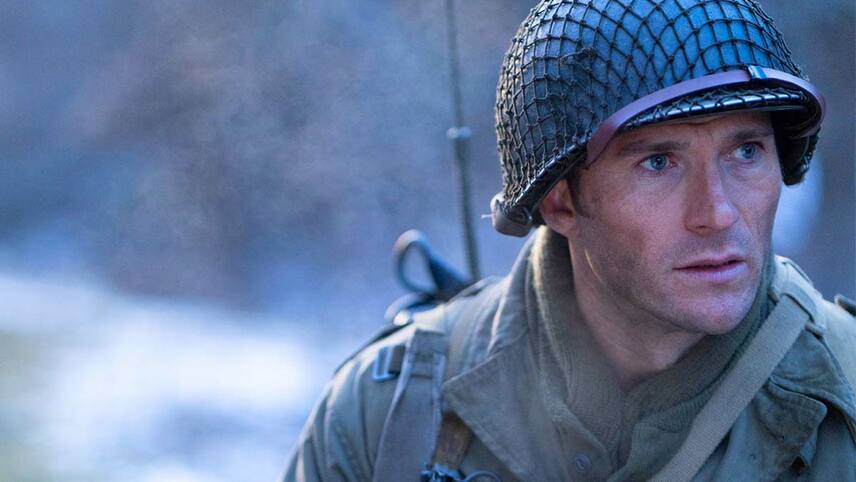
Scott Eastwood takes the lead as Capt. John Castle, who in December 1944 is ordered by his superior (Colin Hanks in a brief cameo) to oversee the blockade of a road in the Ardennes forest often used by German soldiers.

Castle and his team come under heavy fire, eventually leaving John and his invaluable radio “Lassie” – which will become even more valued later on – alone behind enemy lines.

Based on true events from the legendary Battle of the Bulge, the film becomes one man’s journey of commitment and survival, as Castle sets out on the 30km trek to safety in Elsenborn, Belgium.

As correct as all the details may be, the writing and direction never miss the opportunity to overplay a hand. Despite some tense and well orchestrated one-shot action sequences, much of the dialog lacks nuance, the editing and reaction shots continually aim for the back row, a third act twist isn’t hard to see coming, and there’s even the inclusion of an actual pale horse (apparently ridden by subtlety).

Eastwood shoulders a big load but doesn’t show the family gift of understatement, and cannot elevate any of this material. Only the great Aunjanue Ellis-Taylor, as a grieving mother in some touching bookend scenes with Eastwood, can give the film a fleeting layer of humanity.

Lucky Strike needed more of that. There’s plenty to respect here on a technical and historical level, but any true emotional connection is lost in the wilderness.

Unforgiving

The Outpost

by Hope Madden

Films concerning the US’s two decade war in Afghanistan have not managed to find much of an audience. I’m not sure Summer 2020—the year we welcomed meth gators as a needed distraction from our own personal hell—will improve those odds.

And yet, director Rod Lurie’s The Outpost bravely ventures to the streaming environment this week to remind us that a solid, understated war movie can still thrill.

The ensemble piece features Caleb Landry Jones and Scott Eastwood as two sides of a coin. Eastwood’s Staff Sgt. Clint (that’s right) Romesha is a born leader with quiet dignity, grit and a mind for strategy. Cynical of the Army’s “frat boy” culture, Jones’s Staff Sgt. Ty Carter doesn’t quite fit in.

Where doesn’t he fit in? A sitting duck army outpost situated at the basin of surrounding mountains where Taliban forces travel, watch and shoot.

Screenwriter Eric Johnson’s bread and butter has been teaming with Paul Tamasy to create the cinematic presentation of a true story. They nearly won an Oscar for Johnson’s first foray into feature length screenplays, David O’ Russell’s powerful The Fighter (with Scott Silver).

The duo join forces again, this time adapting Jake Tapper’s investigative book concerning one extraordinary battle in our war in Afghanistan.

Understatement works in the film’s favor, Lurie favoring overlapping dialog and naturalistic settings to bombast and a leading score. In fact, much of the film plays without a score, a refreshing change that gives The Outpost a grittier, more realistic feel that serves it well. Because truth be told, a true tale that delivers this amount of sheer will, courage, perseverance and spirit is undermined by flapping flags and swelling strings. Lurie’s restraint says, “This is really what happened. Can you effing believe that?!”

That’s not to say The Outpost eliminates every cowboy moment. Indeed, this may be the first role in which Eastwood makes the most of his famous last name, clearly channeling his father in a performance punctuated by controlled, hushed rage and squinting blue eyes.

But Caleb Landry Jones, as remarkable and versatile actor as you will find, is the broken soul of this film. Jones does “haunted” in a way that makes every other performance feel like a performance.

Together Lurie, his writers and his cast sidestep clichés, delivering instead a clear-eyed look at bravery, failure, and the cost of war.
