The film community lost another of its greats, and we want to celebrate the wonderful and the weirdly watchable of Tobe Hooper.
Hooper’s ability to pervert social expectations, his unsurpassed gift for creating terrifying atmospheres among America’s backwoodsfolk, and his nonchalantly visceral presentation made every film an experience worth attempting. Not every one paid off, but those that did left a nasty mark.
5. Eaten Alive (1976)
We open on a backwoods Florida whore house. A bewigged young pro loudly protests the request of her new customer, Robert Englund, who plays a hillbilly who prefers backdoor action. She’s cast out of the cathouse with nowhere to go and nothing to do with that ridiculous wig, until kindly maid Ruby (Betty Cole, wardrobed in a traditional maid’s uniform because hookers are such sticklers about the way their help looks) offers her a stack of cash so she can afford a room at the nearby motel.
Unfortunately, the guy who runs that motel is a sadistic pervert who feeds his problematic borders to the gator out back.
Hooper’s follow up to The Texas Chainsaw Massacre is a lurid affair once again focused on delicious interlopers who misunderstand the customs of the locals.
Eaten Alive tries more openly at humor, mostly failing to find laughs (other than the ironic sort) but succeeding in creating an unsettling atmosphere for the carnage. It’s a B-movie, the kind that screams for a drive-in theater and a tub of greasy popcorn, but there is a time and a place for those movies, too.
https://www.youtube.com/watch?v=MSRpivA1mgo
4. Lifeforce (1985)
A naked alien vampire woman sucks seemingly willing men dry on her first trip to London.
Nope, Lifeforce is not a porno. It’s a silly horror film, especially if you come in expecting the kind of visceral gut punch Tobe Hooper tends to deliver. But as a SciFi guilty pleasure (and mash note to Hammer’s Quatermass and the Pit), it’s a bit of fun.
Mathilda May sure is naked. She plays one of three aliens saved from an otherwise decimated space ship found hiding in the tail of Halley’s Comet by European astronauts. Mysteriously, that European ship meets its own disaster before safely dropping off the three aliens on earth.
But wait! Don’t open her case!!
Of course they open her case, and she and her two henchmen begin sucking the life force from all they can find, creating their own kind of Brit zombipocalypse in one of the film’s nuttiest and greatest scenes.
The movie is a mess that lacks any hint of the characteristic Tobe Hooper vision, but it is more than peculiar enough to be compelling.
3. The Funhouse (1981)
Hooper creates a creepy atmosphere on the Midway with this periodically tense freak show. Double dating teens hit the carnival and decide to spend the night inside the park’s funhouse. What could go wrong?
Well, as would become the norm in every carnival-themed horror film to come, the ride is the secret hideaway of a carny’s deformed and bloodthirsty offspring. He hides his misfortune beneath a Frankenstein mask, but he can’t contain his violent rage when teased. (Not that it’s ever wise to pick on a premature ejaculator, particularly in a horror film.)
Sure, The Funhouse follows all the protocol of a slasher set inside an amusement park, and is, for that reason, somewhat predictable. Still, Hooper delivers pretty well. He develops a genre-appropriate seediness among the carnies, as well as an unwholesome atmosphere. He also pays open homage to the genre throughout the picture. (As a way of paying him back, the genre would rip off this film for years to come – most blatantly in 2006’s Dark Ride.)
It’s hard not to find Hooper’s post-Texas Chainsaw Massacre films lacking. This one’s no masterpiece, but it is a tidy, garish, claustrophobic and unsettling piece of indie filmmaking.
https://www.youtube.com/watch?v=BMoQQ7OsX5M
2. Poltergeist (1982)
This aggressive take on the haunted house tale wraps Hooper’s potent horrors inside producer Steven Spielberg’s brightly lit suburbia. In both of Spielberg’s ’82 films, the charade of suburban peace is disrupted by a supernatural presence. In E.T., though, there’s less face tearing.
Part of Poltergeist’s success emerged from pairing universal childhood fears – clowns, thunderstorms, that creepy tree – with the adult terror of helplessness in the face of your own child’s peril. JoBeth Williams’s performance of vulnerable optimism gives the film a heartbeat, and the unreasonably adorable Heather O’Rourke creeps us out while tugging our heartstrings.
Splashy effects, excellent casting, Spielberg’s heart and Hooper’s gut combine to create a flick that holds up. Solid performances and the pacing of a blockbuster provide the film a respectable thrill, but Hooper’s disturbing imagination guarantees some lingering jitters.
1. The Texas Chainsaw Massacre (1974)
Not everyone considers The Texas Chainsaw Massacre a classic. Those people are wrong. Perhaps even stupid.
Tobe Hooper’s camera work, so home-movie like, worked with the “based on a true story” tag line like nothing before it, and the result seriously disturbed the folks of 1974. It has been ripped off and copied dozens of times since its release, but in the context of its time, it was so absolutely original it was terrifying.
Hooper sidestepped all the horror gimmicks audiences had grown accustomed to – a spooky score that let you know when to grow tense, shadowy interiors that predicted oncoming scares – and instead shot guerilla-style in broad daylight, outdoors, with no score at all. You just couldn’t predict what was coming.
He dashes your expectations, making you uncomfortable, as if you have no idea what you could be in for. As if, in watching this film, you yourself are in more danger than you’d predicted.
But not more danger than Franklin is in, because Franklin is not in for a good time.
So, poor, unlikeable Franklin Hardesty, his pretty sister Sally, and a few other friends head out to Grampa Hardesty’s final resting place after hearing the news of some Texas cemeteries being grave-robbed. They just want to make sure Grampy’s still resting in peace – an adventure which eventually leads to most of them making a second trip to a cemetery. Well, what’s left of them.
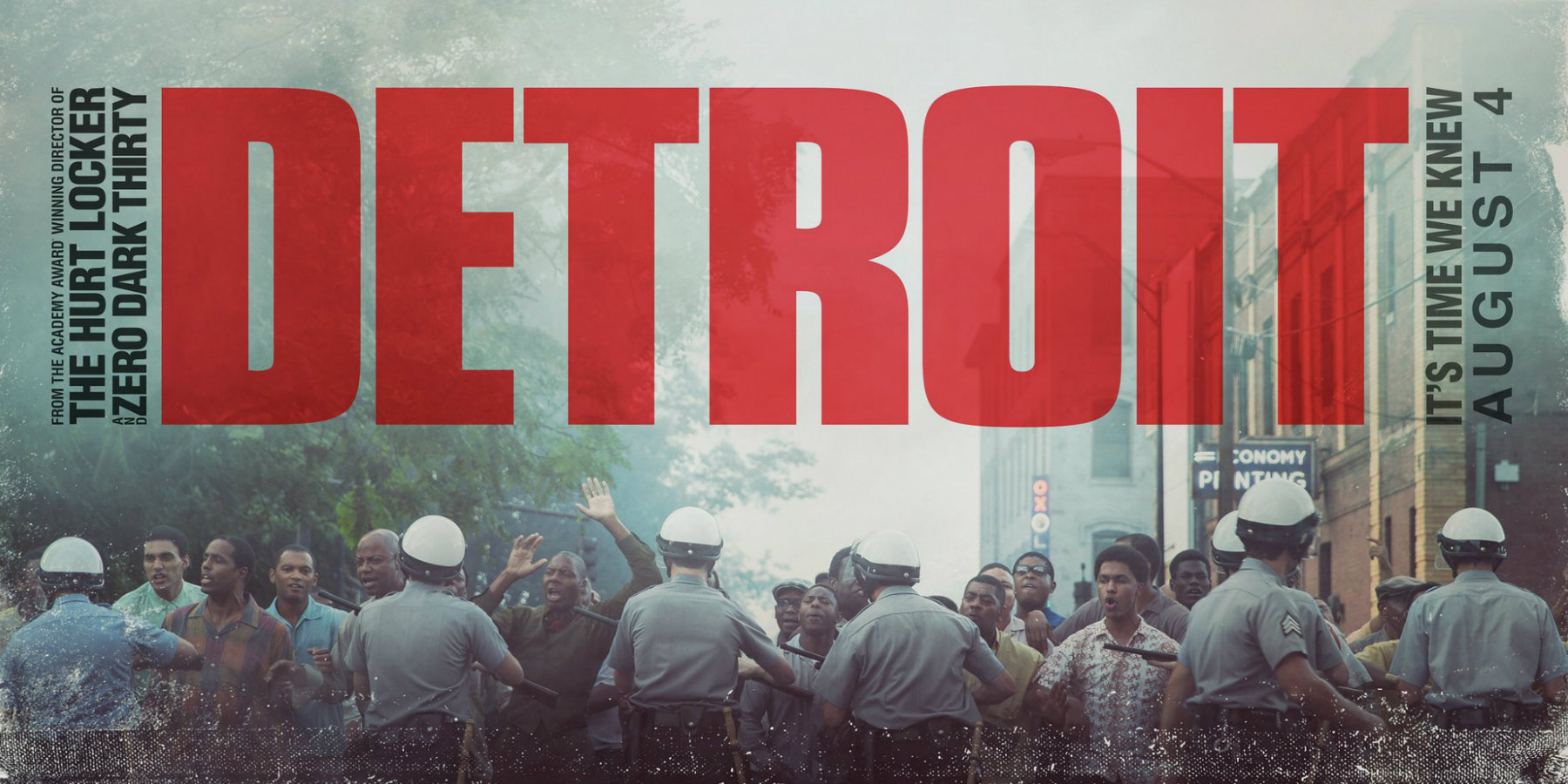
Click HERE to joins us in the Screening Room to break down Detroit, The Dark Tower, Kidnap, An Inconvenient Sequel: Truth to Power, Landline and what’s new in home entertainment!
Let me admit this from the start – I may have liked Kidnap better than I should have. Why? Well, I saw it immediately after The Dark Tower, and it is Citizen Kane compared to that festering pile.
In this film, Haley Berry plays Liam Neeson. It’s her second time in the role, actually.
Back in ’08, Neeson – with help from the pen of Luc Besson – revolutionized film with the (wildly over-appreciated) genre flick Taken. Mid-budget “I have a particular set of skills” thrillers have littered the cinematic landscape since, wreaking righteous vengeance and prolonging the careers of middle aged actors everywhere.
In 2013, Berry made The Call, which was not a bad B-movie thriller and her first turn as Liam Neeson. Kidnap sees the Oscar winner playing a loving mother whose 6-year-old (a very sweet Sage Correa) is nabbed from a busy park. Mom sees the napper shoving her son into a car, she jumps in her minivan and the pursuit begins.
The film amounts to a 90-minute car chase with one unreasonably attractive mom behind the wheel. Several of the action sequences are interesting and flashy (for a film with this level of budget – do not go into this hoping for Fast and the Furious: Minivans).
Writer Knate Lee can’t really justify the lack of cell phone or police presence, but he does what he can. Meanwhile, director Luis Prieto ably assembles car chases and panicked driver close ups, then competently shifts tone for a final act that toes the line between thriller and horror.
There’s nothing exceptional about Kidnap. Not one thing. You’ll forget it existed as quickly as you forgot The Call was ever made. But for a getting-the-phone-bill-paid flick, it’s not too bad.
So, there’s this tower, see. And it sits at the center of all the parallel worlds of the universe and as long as it stands, it keeps the monsters away. Why? How did it get there? No time!
Anyhoo, an evildoer (Matthew McConaughey) wants to knock it down, let in the monsters and rule it all. But there’s this kid – you know what, let me not summarize what amounts to little more than a summary in the first place. Suffice it to say, The Dark Tower is not very good.
There are a lot of bad Stephen King movies. But even Dreamcatcher, The Night Flier and Sleepwalkers (three of the worst) offered a sort of B-movie charm. The Dark Tower is not even the fun kind of bad. It’s tedious, lumbering and schmaltzy, visually unappealing, narratively embarrassing and a woeful waste of Idris Elba.
McConaughey, on the other hand, makes the most of his time onscreen as Walter – which is a much funnier name for the prince of darkness than Man in Black. As the antagonist, he brandishes a restrained evil and moves with a little swagger, plus there’s that wig. Glorious! Real Shatner – hell, even Travolta-esque.
But McConaughey and Elba – true talents, no doubt – are hamstrung from the beginning by the production’s meat-cleaver-and-band-aid approach to screenwriting.
Nobody is more convinced than I am that Stephen King uses too damn many words. Too damn many! Succinct he will never be. But to believe you can boil his multi-volume, many-thousand-page Dark Tower series into a coherent 90 minutes is just brazen idiocy. No offense to the team of writers working on the adaptation – some of whom have talent; the other one is Akiva Goldsman.
Director Nikolaj Arcel (A Royal Affair– also credited with writing) is zero help, managing to take this Cliff’s Notes version of King’s prose and still produce something bloated and slow.
I remember reviewing the Tom Cruise debacle The Mummy earlier this year and thinking, this isn’t even any fun, it’s just bad. Dark Tower makes The Mummy feel like a rollicking good time.
But, hey, the trailers for It look great, don’t they?
Damn, a lot of stuff is coming out for home enjoyment this week – much of it is not at all enjoyable, though, so there’s that. What should you watch? Let us help you make that call.
Click the title for a full review. And as always, please use this information for good, not evil.
Click HERE to joins us in the Screening Room to break down Atomic Blonde, A Ghost Story, The Emoji Movie, It Stains the Sands Red and what’s new in home entertainment!
Jenny Slate is the perfect mix of raunchy and sweet to anchor an indie dramedy. Co-writer/director Gillian Robespierre tested that theory in 2014 with the character study and edgy rom/com Obvious Child.
Following on those proven results, Robespierre re-tests her theory with the 1995 family saga Landline.
Slate plays Dana, the older, almost-married sister in an upscale Manhattan family. But she and her ever-since-college beau Ben (Jay Duplass) are maybe not everything Dana hoped they’d be.
Her own entanglements with infidelity happen to exactly coincide with a discovery younger sister Ali (Abby Quinn) makes of their father’s (John Turturro) erotic poetry, written for someone who is definitely not their mother (Edie Falco).
Things begin to fall apart. Ali’s lived-in resentment toward her overbearing mother is tested and turned instead toward her sweet, laid back father. Meanwhile Dana embraces recklessness and begins hanging out with her boundary-pushing teenage sister, drinking during the day and sneaking away for clandestine sexual encounters with Nate (pitch-perfect Finn Wittrock).
So, crumbling family dynamics in a well-to-do Manhattan family. Not exactly as edgy as a romantic comedy written around an abortion.
Still, between its loving nostalgia for the pre-cellphone days of the mid-Nineties and its truly game cast, Landline keeps you interested and entertained.
Falco and Turturro are unfortunately underused. Both are spectacular talents, and their well-worn relationship offers each the opportunity to create moments of sudden, honest, everyday heartbreak.
The characteristically effervescent Slate charms, and her off kilter chemistry with Quinn serves the film well. They’re irritated and protective, bitching and admiring all in the same breath. They often feel unsure of their own feelings toward each other, which reads as very authentic.
Quinn is the real heartbeat of the film. Equally vulnerable and mean, she’s less the cinematic equivalent of a conflicted adolescent than she is a conflicted adolescent, and the film takes on a sharp focus whenever she’s onscreen.
Unfortunately, that’s not all the time, and Robespierre – writing again with Elisabeth Holm – loses focus too easily. Landline, for all its insightful moments and clever lines, feels a bit unwieldy and murky.
If you watch much of horror, there’s something you might notice. People lose a lot of limbs in these movies. Naturally, we decided to look into this. We spent some time with the tragic (or maybe deserving) amputees of Audition and American Mary and others, but there turned out to be so many badasses who only get cooler once the limb is missing that we decided to hang out with them.
Thanks to the B Movie Bros for joining us for the podcast to talk through the list. Listen in HERE.
6. Arlen (Suki Waterhouse) – The Bad Batch (2017)
Writer/director Ana Lily Amirpour creates another unusual heroine with this one. Arlen’s a vane bit of white trash deemed part of “the bad batch.” Shortly into her investigation of her new home, she learns that at least one of the neighborhood communities is less welcoming – if better fed – than the other.
No crybaby, though, Arlen faces life as a double amputee with a lot of nerve and eventually some hallucinogenic drugs. What she does more than anything is refuse to conform and instead paves her own path.
https://www.youtube.com/watch?v=PVfpKaftzv4
5. Alonzo (Lon Chaney) – The Unknown (1927)
When Tod Browning makes a movie about side show freaks, color us excited. In this unseemly tale, the great silent monster Lon Chaney is The Amazing Alonzo, an armless knife thrower/sharp shooter/guitar player/smoker in a circus. He has eyes for his show partner Nanon (Joan Crawford, pre-wire hanger), but the circus strongman is hot for her.
So, it all sounds a tad like Browning’s infamous Freaks. But Nanon spurns the strongman because she can’t stand to be groped by men’s hands – which makes it seem like Alonzo is a shoe-in, except that he is not what he appears to be.
Camera trickery, an actual circus performer, and Chaney’s convincing performance work together to create a believable side show character in Alonzo. Browning couples this unsettling performance with an air of seediness and some bizarre plot twists to leave a lasting impression.
4. Candyman (Tony Todd) – Candyman (1992)
Oh my God, that voice! Yes, Candyman is a bad dude, but isn’t he kind of dreamy?
Like a vampire, the villain of Cabrini Green needed to be both repellant and seductive for this storyline to work, and Todd more than managed both. With those bees in his mouth and that hook for a hand, he is effortlessly terrifying. But it’s Todd’s presence, his somehow soothing promise of pain and eternity, that makes the seduction of grad school researcher Helen (Virginia Madsen) realistic.
Todd would go on to love again in the Candyman sequel Farewell to the Flesh, proving that you do not need two working hands to wreak bloody havoc.
https://www.youtube.com/watch?v=XROa2ZOqh8Q
3. Mia (Jane Levy) – Evil Dead (2013)
With the helpful pen of Oscar winner Diablo Cody (uncredited), Fede Alvarez turns all the particulars of the Evil Dead franchise on end. You can tick off so many familiar characters, moments and bits of dialog, but you can’t predict what will happen.
One of the best revisions is the character of Mia: the first to go and yet the sole survivor. She’s the damaged one, and the female who’s there without a male counterpart, which means (by horror standards), she’s the one most likely to be a number in the body count. But because of what she has endured in her life she’s able to make seriously tough decisions to survive – like tearing off her own damn arm. Nice!
https://www.youtube.com/watch?v=pxrbNDDWass
2. Cherry (Rose McGowan) – Planet Terror (2007)
Losing a leg – in most horror movies, this would spell doom for a character. Not in Robert Rodriguez’s half of Grindhouse, though. Indeed, for Rose McGowan’s Cherry Baby, an amputated limb turns her to the film’s most daring badass.
A machine gun for a leg! How awesome is that?! McGowan strikes the right blend of hard knock and vulnerability to keep the character interesting – beyond the whole leg of death thing. I mean, you’d hardly call her boring.
The entire film is a whole lot of throw-back fun – gory, lewd, funny, gross (so, so gross). It’s so much fun that even a lengthy Tarantino cameo doesn’t spoil things. And it makes the point that people who’ve been struck by physical disabilities can still be total badasses – not to mention hot as F.
https://www.youtube.com/watch?v=jmMApNy48Sc
1. Ash (Bruce Campbell) – Evil Dead 2 (1987)
What?! Like you didn’t know he’d be #1. Hell, he’s the entire reason we did this list.
When his hand turns evil, Ash does what he needs to do. Of course he does – he’s already dismembered nearly everyone who’s ever meant anything to him, what loyalty does he owe his own hand at this point?
Plus, if Cherry Baby was cool with a machine gun leg, how awesome is Ash with a chainsaw for an arm?!
Charlize Theron is a convincing badass. (You saw Fury Road, right?) She cuts an imposing figure and gives (and takes) a beating with panache.
Director David Leitch understands action, having cut his teeth as a stunt double before moving on to choreographing and coordinating action for the last decade. With the help of a wicked soundtrack and about a million costume changes, he also makes 1989 seem cool – which is a real feat.
Together, Theron and Leitch take on Antony Johnston and Sam Hart’s graphic novel The Coldest City, under the far more rockin’ title Atomic Blonde.
It’s Berlin in ’89. The wall’s about to come down, the Cold War’s coming to an end, but there’s this pesky double agent issue to contend with, and a list of coverts that has fallen into the wrong hands. MI6 sends in one lethal operative, Lorraine Broughton (Theron), to check in with their embedded agent Percival (James McAvoy) and work things out.
What to expect: intrigue, Bowie songs, boots – so many boots! – and a great deal of Charlize Theron beating up on people. Mayhem of the coolest sort.
From the opening car crash through half a dozen other expertly choreographed set pieces to the action pièce de résistance, Theron and Leitch make magic happen. Each sequence outshines the one before, leading up to a lengthy, multi-villain escapade shot as if in one extremely lengthy take. (It isn’t, but the look is convincing and the execution thrilling.)
Theron delivers. Reliable as ever, McAvoy is once again that guy you don’t know whether to love or hate – probably because he always looks like he’s smiling and crying simultaneously. He makes for a wild and dicey counterpoint to Theron’s sleek, ultra cool presence.
Precise and percussive, the action propels this film. Leitch’s cadence outside these sequences sometimes stalls, and not every casting choice works out.
Sofia Boutella, saddled with an underdeveloped character who makes idiotic choices, suffers badly in the role. Other supporting characters, though – including the always welcome Toby Jones and John Goodman – take better advantage of their limited time onscreen.
The storyline itself is equal parts convoluted and obvious, with far too many conveniences to hold up as a real spy thriller. But unplug, soak up that Berlin vibe and appreciate the action and you’ll do fine.