Screening Room: Ready or Not, Peanut Butter Falcon, Angel Has Fallen, Nightingale, One Child Nation
by George Wolf
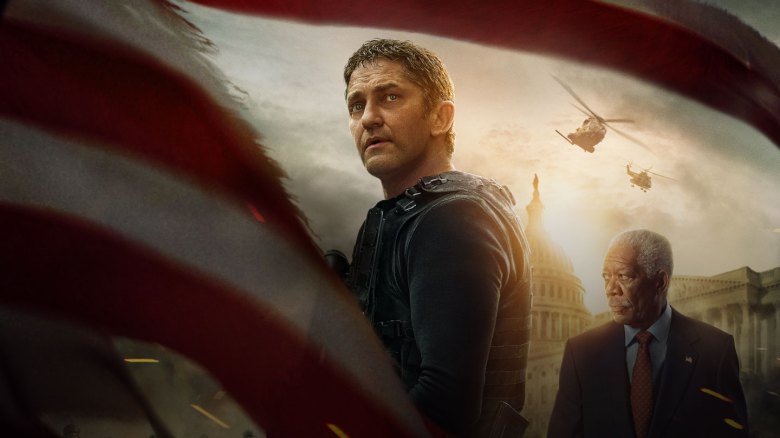
Olympus, then London, now Angel. They keep Fallen, must they keep getting up?
To be fair, Angel isn’t nearly the dumpster dive we took in London. It sports comic relief from Nick Nolte, a fun mid-credits stinger and a truly impressive performance from a baby.
Surrounding all that, though, is a pedestrian and all too often obvious gotta -clear-my-name frameup that underdelivers on the action front.
Gerard Butler is back as Secret Service hero Mike Banning, with Morgan Freeman returning to the franchise as now-President Trumbull.
Mike has headaches and insomnia after years of action, but debates leaving the field for a desk promotion. He is still great at knocking out all the baddies who are nice enough to walk blindly past a corner he’s hiding behind, but when there’s a drone attempt on the President’s life, Mike can’t keep his entire team from being wiped out.
Suddenly, mounds of incriminating evidence point to Mike as the would-be assassin, who then must leave his wife (Piper Perabo) and child (that baby is good, I’m telling you) and go full Bourne fugitive guy to root out the real villains.
Who wants the President dead? And why?
If the answers are supposed to be surprises, someone forgot to tell director Ric Roman Waugh (Snitch) and his co-writers, asAngel is telegraphed from many preposterous angles with all manner of heavy handed exposition.
And once Banning takes refuge with his long lost, off the grid, battle scarred Dad (Nolte), the attempts at debating the morality of war land with a thud of pandering afterthoughts.
Hey, if your just here for some mindless action highs, that’s fine, but Angel skirts them, curiously settling for repetitive shootouts and nods to first-person gaming enthusiasts.
Like Mike, this Fallen seems mostly tired. Even if it can get up, maybe it should reconsider.

by George Wolf
Zack Gottsagen wanted to be a movie star.
Filmmakers Tyler Nilson and Michael Schwartz told Zack there just weren’t many roles available for actors with Down Syndrome.
He asked if they could write him one.
The result is The Peanut Butter Falcon, an irresistibly endearing adventure powered by an unwavering sincerity and a top flight ensemble that is completely committed to propping it up.
Zak (a terrific Gottsagen), getting an assist from his elderly roommate (Bruce Dern), makes a successful break from his nursing home quarters with a mission in mind: finding the wrestling school run by his idol, the Salt Water Redneck (Thomas Haden Church).
Tyler (Shia LeBeouf) is also running – from a big debt to a small time tough guy (John Hawkes) – and when Zak stows away on Tyler’s rickety boat, the two embrace life on the lam as Zak’s case worker Eleanor (Dakota Johnson) slowly closes in.
The quest carries obvious parallels to the real Zack’s Hollywood ambitions, and the Nilson/Schwartz directing team lovingly frames it as a swamp-ridden fable full of Mark Twain homages.
You get the sense early on that this is the type of material that would crumble if any actor betrayed authenticity for even a moment. It also isn’t long before you’re confident that isn’t going to happen here.
LeBeouf is tremendous as the wayward rogue whose inner pain is soothed by his bond with the stubbornly optimistic Zak. The chemistry is unmistakable, and ultimately strong enough to welcome the arrival of Johnson, who gives her Eleanor layers enough to embody our fears of the “real world” puncturing this fairy tale.
The surrounding ensemble (including Jon Bernthal and real-life wrestling vets Mick Foley and Jake “the Snake” Roberts) and rootsy soundtrack color in the last spaces of a world wrestling with convention.
Sure, you’ll find glimpses of feel good cliches. What you won’t find is condescension, or the feeling that anything here – from the characters or the filmmakers alike – is an act of charity.
Often similar to last year’s Shoplifters, The Peanut Butter Falcon is all about embracing family where you find it.
Following a dream, Zak finds it. And we feel it.

by Hope Madden
There is a moment in George Miller’s 2015 action masterpiece Mad Max: Fury Road. The empty bridal chamber is revealed quickly. Scrawled on the wall: Who killed the world?
It occurred to me partway through Jennifer Kent’s sophomore feature The Nightingale that Miller isn’t the only Aussie director with that question on the mind.
The Nightingale is as expansive and epic a film as Kent’s incandescent feature debut The Babadook was claustrophobic and internal. In it she follows Clare (Aisling Franciosi), an Irish convict sentenced to service in the UK’s territory in Tasmania.
What happens to Clare at the hands of Leftenant Hawkins (Sam Claflin), the British officer to whom she is in service, is as brutal and horrifying as anything you’re likely to see onscreen this year. It’s the catalyst for a revenge picture, but The Nightingale is far more than just that.
As Clare enlists the aid of Aboriginal tracker Billie (Baykali Ganambarr, magnificent) to help her exact justice, Kent begins to broaden her focus. Those of us in the audience can immediately understand Clare’s mission because we witnessed her trauma in its horrifying detail. Kent needed us to recognize what British military men were capable of.
What she wants us to see is that the same thing—the worst, almost imaginable brutality—happened to an entire Australian population.
In the second act, Clare—on a higher social rung than her tracker, and just as condescending and racist as that position allows—and Billy begin to bond over shared experience. Franciosi’s fierce performance drives the film, but Ganambarr injects a peculiar humor and heart that makes The Nightingale even more devastating.
Kent’s fury fuels her film, but does not overtake it. She never stoops to sentimentality or sloppy caricature. She doesn’t need to. Her clear-eyed take on this especially ugly slice of history finds more power in authenticity than in drama.
Her tale becomes far more than an indictment of colonization, white male privilege, domination and subjugation. It’s a harrowing and brilliant tale of horror. It’s also our history.

by Hope Madden
Fucking rich people.
I don’t know about you, but this is a sentiment I can get behind.
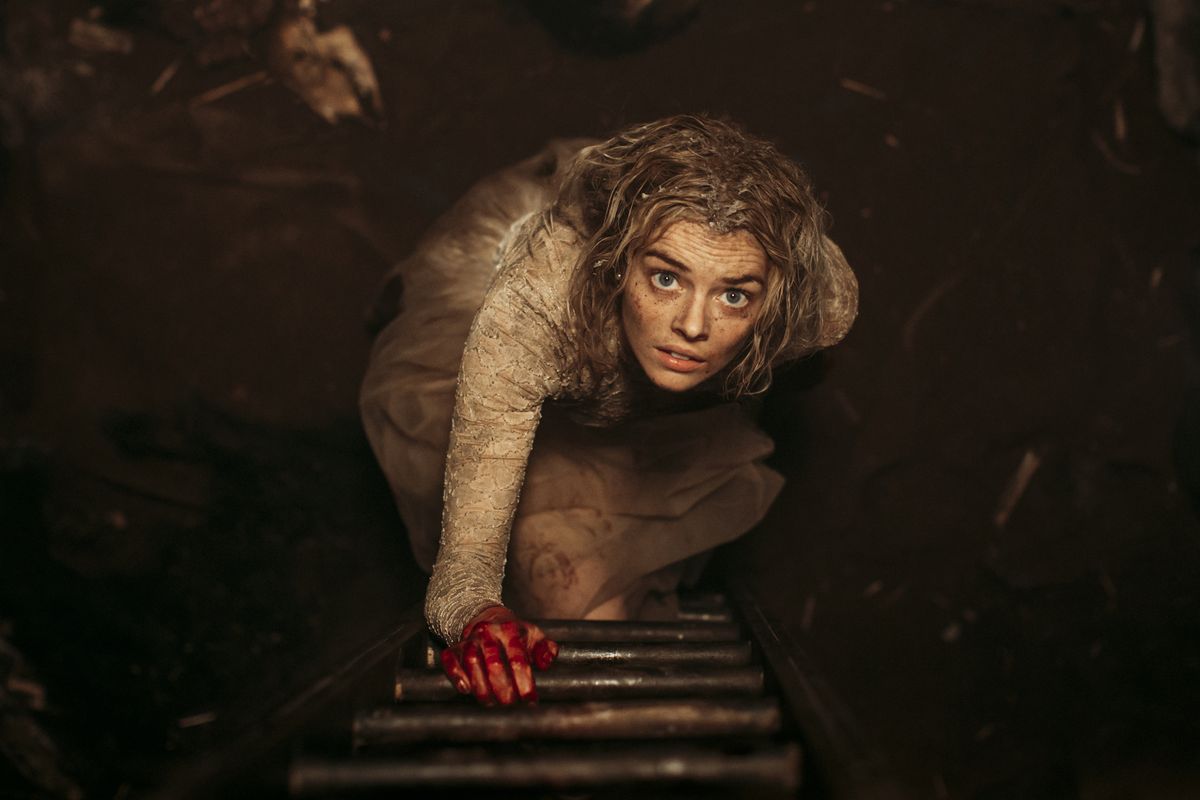
Grace (Samara Weaving, Mayhem) doesn’t know whether her soon-to-be in-laws are eccentric or they just plain hate her. Or maybe they are as evil as her groom Alex (Mark O’Brien) and his drunk-but-amiable brother Daniel (Adam Brody) say they are.
The brothers are just kidding, right?
Directors Matt Bettinelli-Olpin and Tyler Gillett (Devil’s Due—meh) invite you to join the happy couple as they plunge into a world where the wealthiest among us would rather commit murder than do without what none of them worked very hard to earn.
At midnight on Grace and Alex’s wedding night, everyone assembles in the Le Domas family game room: Mom and Dad (Andie MacDowell and Henry Czerny), Aunt Helene (Nicky Guardagni), other siblings and in-laws. It’s a ritual. Just one quick game of hide and seek. What could go wrong?
The inky black comedy plays like a game of Clue gone mad with arterial spray, the film’s comic moments coinciding most often with the accidental slaughter of servants.
The filmmakers take advantage of Weaving’s grit and comic timing, skipping from one bloody comic set up to the next. The plot and the chase move quickly enough to keep you from dwelling on the shorthand character development, the errant plot hole and the occasional convenience. It’s fun, it’s funny, and it’s a bloody mess.
And yet, the film feels safe, as if it is loath to truly represent the wealthy as people who’d leech the life from those beneath them (a la Get Out). Although, like Jordan Peele’s horror classic, Ready or Not introduces a deeply disturbing song almost as chilling as Get Out’s “Run Rabbit, Run.”
Weaving is proving herself to be reliably badass in the genre, her central performance elevated by the sometimes inspired work of the ensemble. MacDowell, in particular, seems to be enjoying herself immensely.
Even with the clever turns and cheeky performances, the film lacks substance. I mean, yes, I can indulge my secret belief that the rich are evil all day long. So, thank you Ready or Not for playing that card. In the end, though, the film’s just a slight and entertaining (and gory) way to waste your time.
Wow, there are a lot of movies coming home this week. Some of them are so bad. Just really, extraordinarily bad. But hidden in there are a couple of decent horror flicks you might have missed.
Click the film title for the full review.



There is something primally terrifying in the idea of missing persons – losing someone or being lost. Where are they and what is happening to them? No mater which side of that question you are on, the imagination conjures terrifying images.
Listen to the full podcast, including a special interview with Hounds of Love director Ben Young.
John Erick Dowdle’s film is a difficult one to watch. It contains enough elements of found footage to achieve realism, enough police procedural to provide structure, and enough grim imagination to give you nightmares.
Edward Carver (Ben Messmer) is a particularly theatrical serial killer, and the film, which takes you into the police academy classroom, asks you to watch his evolution from impetuous brute to unerring craftsman. This evolution we witness mainly through a library of videotapes he’s left behind—along with poor Cheryl Dempsey (Stacy Chbosky)—for the police to find.
Cheryl is Carver’s masterpiece, the one victim he did not kill but instead reformed as his protégé. It’s easily the most unsettling element in a film that manages to shake you without really showing you anything.
Aussie photographer Clare (Teresa Palmer, better than she’s ever been) is looking for some life experience. She backpacks across Europe, landing for a brief stay in Berlin where she hopes to make a human connection. Handsome Berliner Andi (Max Riemelt) offers exactly the kind of mysterious allure she wants and they fall into a night of passion.
What follows is an incredible combination of horror and emotional dysfunction, deftly maneuvered by both cast mates and director Cate Shortland. The mental and emotional olympics Palmer goes through from the beginning of the film to the end showcase her instincts for nuanced and unsentimental performance. Clare is smart, but emotionally open and free with her own vulnerability. The way Palmer inhabits these characteristics is as authentic as it is awkward.
Even more uncomfortable is the shifting relationship, the neediness and resilience, the dependency and independence. It’s honest in a way that is profoundly moving and endlessly uncomfortable. Riemelt matches Palmer’s vulnerability with his own insecurity and emotional about-faces. The two together are an unnerving onscreen pairing.
Back in ’88, filmmaker George Sluizer and novelist Tim Krabbe adapted his novel about curiosity killing a cat. The result is a spare, grim mystery that works the nerves.
An unnervingly convincing Bernar-Pierre Donnadieu takes us through the steps, the embarrassing trial and error, of executing on his plan. His Raymond is a simple person, really, and one fully aware of who he is: a psychopath and a claustrophobe.
Three years ago, Raymond abducted Saskia (Johanna ter Steege) and her boyfriend Rex (Gene Bervoets) has gone a bit mad with the the mystery of what happened to her. So mad, in fact, that when Raymond offers to clue him in as long as he’s willing to suffer the same fate, Rex bites. Do not make the mistake of watching Sluizer’s neutered 1993 American remake.
Blair Witch may not date especially well, but it scared the hell out of a lot of people back in the day. This is the kind of forest adventure that I assume happens all the time: you go in, but no matter how you try to get out – follow a stream, use a map, follow the stars – you just keep crossing the same goddamn log.
One of several truly genius ideas behind Blair Witch is that filmmakers Daniel Myrick and Eduardo Sanchez made the audience believe that the film they were watching was nothing more than the unearthed footage left behind by three disappeared young people. Between that and the wise use of online marketing (then in its infancy) buoyed this minimalistic, naturalistic home movie about three bickering buddies who venture into the Maryland woods to document the urban legend of The Blair Witch. Twig dolls, late night noises, jumpy cameras, unknown actors and not much else blended into an honestly frightening flick that played upon primal fears.
Driven by a fiercely invested and touchingly deranged performance from Emma Booth, Hounds of Love makes a subtle shift from horrific torture tale to psychological character study. In 108 grueling minutes, writer/director Ben Young’s feature debut marks him as a filmmaker with confident vision and exciting potential.
It is the late 1980s in Perth, Australia, and at least one young girl has already gone missing when the grounded Vicki (Ashleigh Cummings) sneaks out her bedroom window to attend a party. This isn’t nearly as dumb a move as is accepting a ride from Evie White (Booth) and her husband John (Stephen Curry).
As the couple dance seductively and drink to celebrate, Young disturbingly conveys the weight of Vicki’s panicked realization that she is now their captive. It is just one in a series of moments where Young flexes impressive chops for visual storytelling, utilizing slo-motion, freeze frame, patient panning shots and carefully chosen soundtrack music to set the mood and advance the dreadful narrative without a spoken word.
by George Wolf
A heartbreaking, sometimes devastating and absolutely necessary history lesson, One Child Nation turns a filmmaker’s very personal story into a profile of shared helplessness.
Nanfu Wang grew up in China during the nation’s strict “one child per family” social policy. Launched in 1979 and added to the Chinese constitution three years later, the policy endured until 2015, leaving scarred generations of parents and children in its wake.
Wang (who also provides frequent narration and commentary) and her co-director Jialing Zhang detail the shocking number of people affected by the policy, the horrifying lengths with which it was enforced, and the splinters of impact it continues to leave on families living oceans apart.
With interviews often reminiscent of Joshua Oppenheimer’s unforgettable doc The Act of Killing, Wang looks back on atrocities with those who personally carried them out. The repeated defense of “I had no choice” is layered with startling and timely reminders of both Orwellian propaganda campaigns and the worldwide struggle for women’s rights.
In another deeply poignant segment, we meet an elderly midwife desperately using the last years of her life in hopes of atonement for her past.
But the success Wang has with many of these interviews only makes the film’s main weakness more glaring.
Where are the women who personally endured the forced abortions and sterilizations? Where are the mothers whose newborn daughters were casually abandoned or sold? Despite an early warning for Wang to “not make trouble,” there is no clear explanation why this seemingly necessary perspective is lacking.
Otherwise, One Child Nation – disturbing as it often is – attacks an inhuman policy with an effectively informed humanity, along with a dire warning about whitewashing history.
“No child should be separated from their parents.”
Imagine that.
Another week chock full of movie options. Guilty pleasures to disappointments, poetic fables to fanboy riots. Check them out:
by Hope Madden
Low-key visionary director Richard Linklater, inexhaustible talent Cate Blanchett and wildly popular source material exploring creativity, motherhood and existential angst—Where’d You Go, Bernadette could work.
The title suggests two things. Metaphorically, it refers to a disappeared genius. Bernadette Fox ceased to exist when she abandoned her architectural artistry for parenthood and, as far as the creative world knew, vanished.
In a less metaphorical manner, the title refers to the actual mystery driving the plot of Maria Semple’s novel—the story of a teenager using emails, news clippings and notes to try to piece together the whereabouts of her now-literally-missing mother.
That mystery is mainly gone from Linklater’s film adaptation, as Bernadette (the ever-exquisite Blanchett) doesn’t up and vanish until well after the 90-minute mark, and because the audience knows where she is all the while.
Instead, Linklater focuses on why she left in the first place. Because, what could have been an ideal situation for another woman—wealthy husband (Billy Crudup) and his super-attentive administrative assistant, precocious and adoring daughter (Emma Nelson), nice neighborhood (even if the neighbors hate her), good schools, money to burn on virtual personal assistants (who turn out to be Russian identity thieves)—welp, it just doesn’t seem to be enough for Bernadette.
There’s a lot to like about Where’d You Go, Bernadette, including a game cast and some gorgeous footage. Unfortunately, under all that is yet another fantasy about a rich white woman who needs to find herself.
In its worst moments, the film falls back on catty mean girlisms, as if the greatest nightmare a woman could face would be for the withering cliquishness of high school to survive into adulthood, the popular moms making you feel like an outcast all over again.
The filmmaker hits his stride, unsurprisingly, when pairing Blanchett with, well, basically anybody. Her one-on-one moments with Nelson, Kristin Wiig (as prissy neighbor Audrey), Laurence Fishburne (playing a former colleague) and Crudup (neutered as his character is) almost make up for the blandly directionless narrative.
Linklater can do comedy (School of Rock!!). He can certainly dive into motherhood (Boyhood). Nobody’d argue his insight and artistry when it comes to documenting a romantic relationship with its ups and downs (Sunset series). Frustratingly, with this film he simply cannot seem to decide which direction to take.
Comedic moments are abandoned before they land, emotional messiness is tidied into submission, dramatic moments are undercut before they can generate any tension.
The resulting, meandering tale doesn’t go much of anywhere.