Pace that Kills

Running with the Devil

by Hope Madden

A tale told in bathrooms, Running with the Devil travels with The Cook (Nicolas Cage), a high ranking jefe in an international cocaine cartel.

He’s a jefe, but he’s not El Jefe. That’s Barry Pepper, as The Boss, and he has other pressing concerns. El Jefe needs The Cook to travel with his product from the farm where it’s produced through the forests, mountains, backstreets, highways and checkpoints to the hands of the dealers who sell it, so he can determine just where the other problem lies.

So while The Agent in Charge (Leslie Bibb) and Number One (Peter Facinelli) investigate suspicious OD’s stateside, The Cook heads south for his own form of investigation.

A word about character names. Writer/director Jason Cabell offers labels as opposed to your traditional Paul or Paulas. That would be interesting if the labels were fun or even on-the-nose, but The Cook? This isn’t meth. He actually just owns a restaurant on the side, which has nothing to do with anything, but I guess Cartel Middle Manager didn’t have the right zing.

Another word about Number One (Facinelli). This guy. He’s the trusted back up to The Agent in Charge. He’s the guy who gets stuck heading to the border to wait for the shipment. And he is the single most conspicuous person on earth. He’s like a Tom of Finland illustration come to life and dressed in JC Penney’s best.

Anyway, Cabell structures his film to draw tension and excitement from the inevitable collision between The Cook (Cage) and The Man (Lawrence Fishburne).

OK.

They may be borderline-geriatric badasses, but both have certainly cut interesting cinematic figures. What can they do together?

Well, in this case, they can disappoint. You can’t lay this on Fishburne’s portrayal. His commitment to the pursuit of cocaine and prostitutes impresses.

Unfortunately, this is one of those Nic Cage movies where he doesn’t cut loose—doesn’t go all Nic Cage on you. This means he has to act, but he more or less chooses not to. You get a flash here, a flutter there, but the naked truth is that Nicolas Cage has no idea how to behave like a regular person. The Cook is too ordinary a man for Nicolas Cage to properly portray.

And without the needed distraction of a Full On Cage, it’s tough not to notice the narrative inconsistencies, trite dialog, stupid character names.

I mean, Facinelli does what he can with that mustache to keep your attention, but when it comes to the school of Glorious Explosive Train Wreck Acting, he’s no Nic Cage.

Hell to Pay

Hell House LLC 3: Lake of Fire

by Brandon Thomas

I’m an easy mark for found footage movies.

When done well, their use of unseen horror gets under my skin like no other kind of scary movie. There’s a heart-pounding anticipation prevalent in these movies that tends to hit everything I find terrifying.

Of course, this reaction comes with good found footage movies. Does Hell House LLC 3: Lake of Fire rank up there with the greats? 

Yeah… not so much.

Right before its demolition, Russell Wynn (Gabriel Chytry) swoops in to buy the infamous Abaddon Hotel. He’s young, showy, rich… and full of potentially bad ideas, such as using the hotel as the venue for his popular interactive show, “Insomniac.” Along for the ride is a journalist and her camera crew, a handful of actors for the show, and Russell’s dedicated, but ultimately naive, staff.

The original Hell House LLC delivered a budget-friendly, but fun, offering into the found footage canon. The filmmakers weren’t reinventing the wheel, but they understood what they could produce with the premise and money available to them. Director Stephen Cognetti’s knowledge of how to make basic scares work lifted the film to a higher level. 

The slow-building of dread is a staple in this genre. It’s what gets the audience to squirm well before the proverbial shit hits the fan. Hell House LLC 3 peaks early with its scares and doesn’t quite finds its footing again. The climax ends up being more chaotic than scary with conveniently placed camerawork being substituted for well-placed frights. 

The film truly stumbles by relying too heavily on the installments that came before. There’s far too much time spent building a mythology that brings in characters from the other two movies. As a result, Hell House LLC 3 never gets to work as a singular piece of filmmaking.  

Outside of a few clever scares, this third installment in the Hell House LLC series never manages to rise above being a middling effort.

https://youtu.be/k3BpmE10u4E


Fright Club: Amusements in Horror

A perversion of childhood innocence in an attempt to create anxiety and fear—that, basically, is the definition of carnivals, circuses, theme parks. Maybe that’s why the amusement park and its inhabitants make for such excellent horror movie fodder. Let’s discuss.

5. Zombieland (2009)

Writers Rhett Reese and Paul Wernick (Deadpool) take the tried-and-true zombiepocalypse premise and sprint with it in totally new and awesome directions. An insane cast helps: Woody Harrelson, Jesse Eisenberg, Emma Stone, Abigail Breslin, Bill Murray. That’s eight Oscar nominations and one win, that’s what that is. Plus, I cannot imagine a better cameo in a film than Murray’s in this one.

I give you, a trip to a loud and well-lit amusement park is not a recommendation Max Brooks would make during the zombiepocalypse. Still, you’ve got to admit it’s a gloriously filmed piece of action horror cinema.

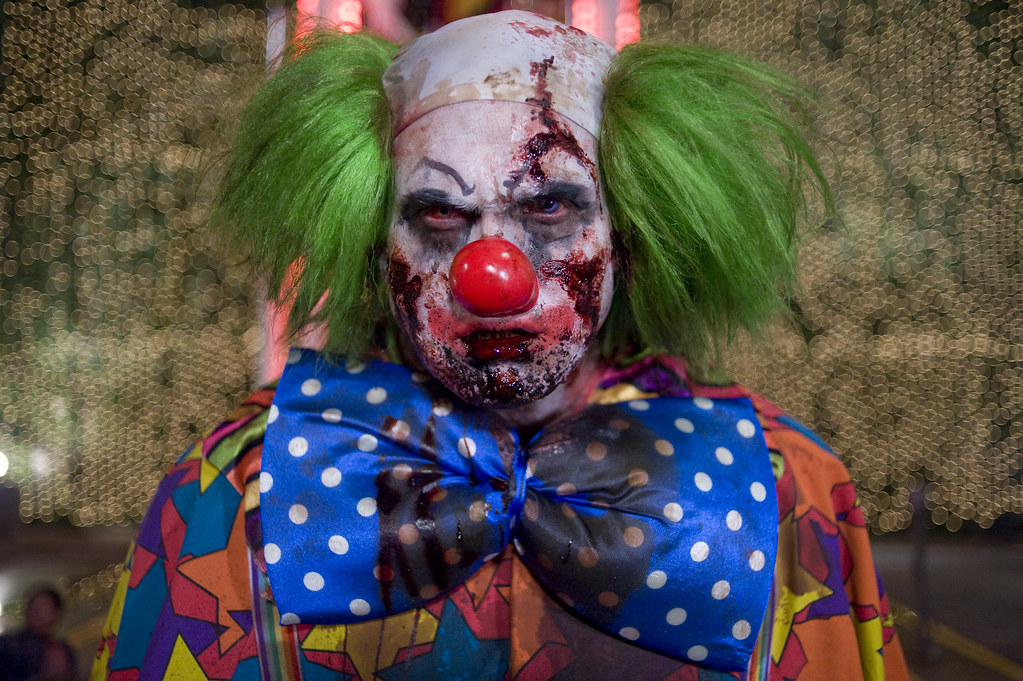
Between the sisters trapped on a ride slowly lowering them toward hungry mouths (good thinking on those boots, ladies!), Columbus’s rule breaking heroism with that effing clown, and the all-time great Tallahassee shoot out, director Ruben Fleischer directs the hell out of the amusement park portion of this movie.

4. It (2017)

Clowns are fun, aren’t they?

The basic premise of It is this: Little kids are afraid of everything, and that’s just good thinking.

Bill Skarsgård has the unenviable task of following a letter-perfect Tim Curry in the role of Pennywise. Those are some big clown shoes to fill, but Skarsgård is up to the challenge. His Pennywise is more theatrical, more of an exploitation of all that’s inherently macabre and grotesque about clowns.

Is he better than the original? Let’s not get nutty here, but he is great.

Director Andy Muschietti shows great instinct for taking advantage of foreground, background and sound. Yes, It relies heavily on jump scares, but Muschietti’s approach to plumbing your fear has more depth than that and he manages your rising terror expertly.

3. The Last Circus (2010)

Who’s in the mood for something weird?

Unhinged Spanish filmmaker Alex de la Iglesia returns to form with The Last Circus, a breathtakingly bizarre look at a Big Top love triangle set in Franco’s Spain.

Describing the story in much detail would risk giving away too many of the astonishing images. A boy loses his performer father to conscription in Spain’s civil war, and decades later, with Franco’s reign’s end in sight, he follows in pop’s clown-sized footsteps and joins the circus. There he falls for another clown’s woman, and stuff gets nutty.

Like Tarantino, Igelsia pulls together ideas and images from across cinema and blends them into something uniquely his own, crafting a film that’s somewhat familiar, but never, ever predictable.

The Last Circus boasts more than brilliantly wrong-minded direction and stunningly macabre imagery – though of these things it certainly boasts. Within that bloody and perverse chaos are some of the more touching performances to be found onscreen.

2. Us (2019)

From a Santa Cruz carnival to a hall of mirrors to a wall of rabbits in cages, writer/director Jordan Peele draws on moods and images from horror’s collective unconscious and blends them into something hypnotic and almost primal.

But Us is far more than a riff on some old favorites. It’s as if Alice’s Adventures in Wonderland turned into a plague on humanity.

And it all starts innocently enough with a family outing to the carnival—an environment that has always been a perversion of innocence, a macabre funhouse mirror of the playthings and past times of children. Peele takes advantage, using this stage to create an even wilder and more bewildering look at who we are.

1. Freaks (1932)

Short and sweet, like most of its performers, Tod Browning’s controversial film Freaks is one of those movies you will never forget. Populated almost entirely by unusual actors – midgets, amputees, the physically deformed, and an honest to god set of conjoined twins (Daisy and Violet Hilton) – Freaks makes you wonder whether you should be watching it at all.

This, of course, is an underlying tension in most horror films, but with Freaks, it’s right up front. Is what Browning does with the film empathetic or exploitative, or both? And, of course, am I a bad person for watching this film?

Well, that’s not for us to say. We suspect you may be a bad person, perhaps even a serial killer. Or maybe that’s us. What we can tell you for sure is that the film is unsettling, and the final, rainy act of vengeance is truly creepy to watch.

Screening Room: Hustlers, Brittany Runs a Marathon, Tigers Are Not Afraid, Haunt, Depraved

A Series of Infuriating Events

Official Secrets

by Christie Robb

Director Gavin Hood grounds the shitshow that was the 2003 Iraq invasion in the intimate true story of the British Intelligence whistleblower, Katherine Gun (Keira Knightley).

Gun comes across an NSA email directing the British government to spy on smaller nations in the UN Security Council in order to blackmail them into voting for war. Attempting to avert an unjust war and save lives, Gun leaks the document to the press. But in doing so, she’s in violation of the Official Secrets Act.

The Observer’s front-page story, based on the email, makes international headlines. Unfortunately, it’s almost immediately delegitimized when an office drone tragically runs the article through spell check, changing the Americanized spelling of “favorite” to the British “favourite”—causing speculation that the entire email was a fake planted by the then-popular antiwar movement.

Gun confesses to the leak and is arrested, throwing her life into chaos. Knightley spends most of the film believably portraying a woman constantly on the edge of throwing up as she is bullied relentlessly by the state.

The film is praiseworthy in the way it covers a civilian taking a moral stand against a corrupt state.

Unfortunately, it’s also a bit unfocused, splitting attention between Gun,
her lawyer (Ralph Fiennes), and reporter Martin Bright (Matt Smith). Director Hood (Eye in the Sky, Ender’s Game) never manages to create a single narrative out of his multiple threads, making it tough to remain invested with any one particular storyline.

She-Wolves of Wall Street

Hustlers

by George Wolf

“You don’t have to believe me. I’m used to people not believing me.”

“Destiny” (Constance Wu) is telling her tale to Elizabeth (Julia Stiles), a writer in the midst of a story on a gang of high-end strippers who were busted for drugging clients and fleecing them for thousands.

The disclaimer is a clear yet-not-overbearing sign that our window into the world of Hustlers may not necessarily be the most clear and reliable. It’s one of many wise choices made by writer/director Lorene Scafaria in her adaptation of Jessica Pressler’s article on “The Hustlers at Scores.”

Wu is terrific as the naive newbie, overshadowed only by a completely magnetic Jennifer Lopez as Ramona, the stripping legend who teaches Destiny (and by extension, us) the ropes of spotting the highest-rolling Wall St. d-bags to milk for all they can.

But when the crash hits in ’08, times get tough for everybody, and it isn’t hard to justify hatching a plan to swindle the swindlers.

Scafaria ((Seeking a Friend for the End of the World, The Meddler) is not shy about the Scorsese influences, and seeing Will Ferrell and Adam McKay as executive producers makes The Big Short-syled humor all the more understandable.

No matter. This is still a supremely assured vision from Scafaria, cleverly constructed with visual flair, solid laughs, a sizzling pace and some truly memorable sequences.

One of the many great soundtrack choices comes right out of the gate, as Scafaria sets the stakes with Janet Jackson’s spoken-word opening to “Control.”

Who’s got it? Who doesn’t? And who’s badass enough to go get it?

It’s a wild, intoxicating high of girl power. And when it all comes crashing down, the moral ambiguities are scattered like dollar bills under the pole. As Ramona is quick to remind us, if there’s money being thrown, there will always be people ready to dance.

Different Drum

Linda Ronstadt: The Sound of My Voice

by George Wolf

You may have heard that Linda Ronstadt can’t sing anymore, her incredible instrument silenced by Parkinson’s disease. But Ronstadt’s harmonies with a nephew in The Sound of My Voice are gentle and effective, and rendered more bittersweet by her quick, self-deprecating dismissal.

“This isn’t really singing.”

The ironic truth in this engaging documentary is that the sound of her spoken voice is what gives the film the warmth it needs to register as more than just a big screen fan letter.

Ronstadt initially balked at the pitch by directors Rob Epstein and Jeffrey Friedman (Howl, Lovelace) but they won her over with a promise to let her tell the story and define its terms.

So while we don’t get any juicy intimacies or sordid details, we do get some fantastic highlights from her archives and a unique, first-person perspective of being a queen in a king’s game.

For anyone under 40, the film is also a great intro to one of the most successful female singers in history. I know Taylor Swift is great and all, kids, but in the 1970s, her name was Linda Ronstadt.

An Arizona native who was raised on a multitude of musical styles, Ronstadt came to L.A. as a teen. After first raising interest and eyebrows as the defiant girl singer not wanting to be tied down to just one lover on the Stone Poneys’ 1967 hit “Different Drum,” Ronstadt’s 70s solo success reached unprecedented levels for a female artist.

With hits on the pop, R&B and country charts, a string of platinum albums and magazine covers, she was everywhere. Later decades brought torch song projects with Nelson Riddle, a starring role in Gilbert & Sullivan’s The Pirates of Penzance, a record-breaking Spanish language album paying tribute to her father’s heritage, and forming a legendary country trio with Dolly Parton and Emmylou Harris.

It is truly an incredible career, and reminding us of that fact seems to be goal number one for Epstein and Friedman. Their mission is more than accomplished, and with Ronstadt herself as the guide, it’s like getting a backlot studio tour from Spielberg.

You hear wonderful anecdotes about how Ronstadt handled sexism both systemic and casual (former boyfriend J.D. Souther asked her to cook him dinner – she handed him a PB&J), how her backing band left to start a little combo called the Eagles and how none of the successes could quell the nagging feeling that she was never good enough.

She was. The Sound of My Voice is all the proof you need.

Running for Her Life

Brittany Runs a Marathon

by George Wolf

In a surprisingly touching circle of art and life and imitating, Brittany Runs a Marathon charts its main narrative course with humor, charm and insight, while solid doses of humanity are never out of sight.

It may be the based-on-truth story of a woman taking control of her life, but in the process, it’s also the story of longtime supporting actor not only taking the lead, but literally transforming before our eyes.

Writer/director Paul Downs Colaizzo, a playwright and TV director making his feature debut, drew inspiration from close friend Brittany O’Neil, who got her messy affairs in order by making some big changes.

One of those was a commitment to running, and a goal to complete the New York City marathon.

The film version finds Brittany Folger (Jillian Bell) out of shape and out of sorts. Allowing herself to be used by friends and randos, Brittany is the fat, funny sidekick who uses her quick, caustic wit as a suit of armor.

Early on, Brittany is just the sort of vessel Bell has used to steal big and small screen scenes for years. She nails the setup with hilarity, which isn’t surprising. But the most impressive layer in Bell’s performance is how she ups her game when the laughs don’t come as often, dodging any false notes in Brittany’s wake up call.

We knew Bell could do funny, but this is a performance full of drama that’s equally impressive (if not more).

Credit Colaizzo for some equally deft maneuvering, making sure this is more complex that the standard “get hot to get happy” makeover fantasy you could hardly be blamed for expecting.

Brittany may joke about people who “missed the point of those Dove ads,” but when she tells her attractive friend that “my life is just harder than yours,” it rings with the capital that Colaizzo’s script has earned.

The in-the-moment nods are numerous but not overdone, contrasting Brittany’s self-loathing with the emptiness of comparing real life to social media staging or quick assumptions from afar.

As hard as it is for Brittany to stick with running, dropping the pounds is the easy part. She has to grow emotionally, starting with accepting the fact that she’s worthy of the friendship her running pals (Michaela Watkins, Micah Stock) are offering.

And what’s up with Jern (Utkarsh Ambudkar- terrific), who pulls the night housesitting shift the same place Brittany handles the daytime? Is he stuck in the friend zone? Is she?

Sure, the film has a convenient plot turn or two, but this is some sneaky good crowd-pleasing. Brittany Runs a Marathon ropes you with the comfort of formula, then dopes you with emotional complexities, warm sincerity and a knockout lead performance.

Winner winner sensible dinner.

Hello Cleveland!

Haunt

by Hope Madden

Have you ever noticed how adorable Browns fans are during pre-season every year? Every year! There is always reason for optimism.

That’s how I feel about filmmakers with the “haunted house attraction that’ll really kill you” premise. Year after year (The Houses October Built, 2014; 31, 2016; The Houses October Built 2, 2017; Hell Fest, 2018) somebody wheels out the stinky old corpse of an idea and says, “This year, we’ll get it right!”

The 2019 attempt belongs to writers/directors Scott Beck and Bryan Woods, who struck silent film gold last year with the screenplay for A Quiet Place. (In retrospect, maybe we didn’t give co-writer/director John Krasinski enough credit for that one.)

Haunt follows a handful of college students seeking thrills on Halloween. They stumble upon an isolated haunted house attraction—with not one single visitor. On Halloween night. Kids! Come on! Clearly it’s either the lamest thing on earth or it will kill you. This isn’t rocket science.

And yet, they give up their cell phones, sign some waivers and enter.

Katie Stevens is Harper, damaged but mainly wholesome brunette and center of gravity for the group. Will Brittain is Nathan, pre-requisite “will they or won’t they” nice fella who sees past Harper’s prickly exterior.

In truth, the actors playing the six gullible youths all perform above expectation and, mercifully, Beck and Woods choose not to subject us to the couple that just can’t keep their hands to themselves.

Made sensibly and economically, Haunt sticks to what it knows and focuses on what it came to do. Gaps in logic are few (they’re there, but they’re not distracting). One or two of the kills offer intrigue and the villains are, if not especially impressive, at least kind of fun.

It’s adequate. Unlike the Browns. The Browns are going all the way this year. No doubt. No doubt about it.

Hope Madden and George Wolf … get it?