All posts by maddwolf

Once More, with Feeling

Little Women

by Hope Madden

Just when you think They’re making Little Women again? Greta Gerwig steps in and gives this beloved story a fresh, frustrated perspective.

Gerwig’s presentation tosses sentimentality to the wayside, thankfully. The vibrant retelling brims with empathy, energy and laughter as well as those prickly emotions that dwell within a family.

In fact, settling into those very petty realities of sisterhood is a conscious choice Gerwig makes with her retelling. Those who’ve always controlled what we see may see nothing of value in so mundane a story as that of four somewhat coddled, routinely bickering sisters on the precipice of adulthood, but who says those men are right?

Gerwig understands and illustrates the political, economic and often lonesome choices to be made, couching those in the equally honest tensions of disappointing your sisters when you choose.

Gerwig’s writing, respectfully confident, brings conflicts more sharply to the surface in clear-eyed ways that reflect the characters’ bristling against unfair constraints and expectations.

Self-discovery and camaraderie still drive the piece, but Jo’s fiery independence has more meaning, Marmie’s self-sacrifice contains welcome bitterness, Aunt March’s disappointment feels more seeped in wisdom, and spoiled Amy is an outright revelation.

Saoirse Ronan, Gerwig’s avatar in the brilliant Lady Bird, is impeccable as ever. It’s her sometimes frenetic, sometimes quiet performance that delivers Louisa May Alcott’s own sense of lonesome independence.

Ronan’s flanked by superb supporting work including that of Timothee Chalamet, Tracy Letts and Meryl Streep (naturally). But it’s Florence Pugh, having a banner year with Fighting with my Family and Midsommar in her rear view, who entirely reimagines bratty Amy, turning her character into the sister we can best understand.

In all, this remarkable filmmaker and her enviable cast make this retelling maybe the most necessary version yet.

Fear and Loathing in Long Island

Uncut Gems

by Matt Weiner

There’s something acutely familiar right now about watching a consummate New York macher unable to help himself as he pursues more and more wealth, drawing everyone around him into his increasingly unstable house of cards until it all collapses.

But Uncut Gems, the latest panic attack from the Safide brothers (Josh and Benny, who also co-wrote the script with frequent collaborator Ronald Bronstein), captures so much more than our current moment. For one, there’s the career-great performance from Adam Sandler. His take on Howard “Howie” Ratner buzzes seamlessly from typical Sandler ease to pathetic helplessness to manic moments of triumph.

Howie is a fonfer extraordinaire—a bullshit artist whose jewelry business in the Diamond District functions to help him continually feed his sports betting debts and keep his mistress (Julia Fox) happy with a Manhattan love nest. Whatever scant love and money are left over go to Howie’s family on Long Island (a point that sets up maybe the greatest music cue of the year, and one of the funniest moments in a movie that’s full of them).

When Howie gets caught up in his latest round of juggling debts, family drama and especially a rare Ethiopian black opal—a mysterious MacGuffin that transfixes anyone who sees it—the race is on to come up with enough money to appease his debtors while chasing the high of that one big score.

As Uncut Gems takes place in the long-ago days of 2012, that score revolves around a Celtics playoffs run. The Safdies throw a bone to New York sports with a Mike Francesa cameo, but it’s Kevin Garnett playing himself who almost steals the movie as one of Howie’s more fateful customers. Celebrity and proximity to power infuse Howie’s life almost as much as gambling—the Weeknd also puts in a memorable turn as an important buyer, and lends his moody, drug-fueled R&B to the soundtrack as well.

That prevailing mood is a defining feature of Uncut Gems. There’s the nonstop anxiety, but the Safdies and Sandler punctuate it with plenty of humor—and pathos. The Safdies are in a class of their own when it comes to drawing you in and making you care deeply about terrible people. Howie might be enjoying more outward success than Connie from the Safdies’ last movie Good Time, but it’s just as illusory. All debts must be paid.

And as with Good Time, the Safdies serve up subtle (and not-so-subtle) reminders that our actions have consequences, even for those who seem to have put together a successful life around assiduously evading them.

The film opens with a scene of misery thousands of miles away from Howie’s cocooned suburban Long Island life. It’s a non-sequitur worthy of the Coen brothers, our other great chroniclers of anxiety and morality.

But the threat goes from menace to promise that none of us are immune from consequence, and the Potemkin lifestyles of the elite are built on shaky foundations. It doesn’t take much for it all to come crashing down.

Tusk

When Lambs Become Lions

by Rachel Willis

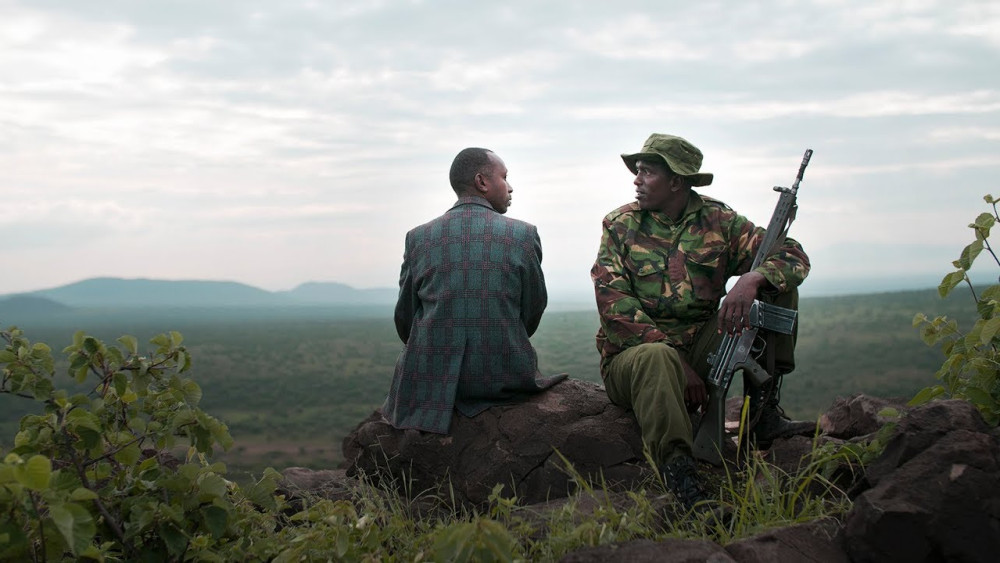
In examining the world of poaching, director Jon Kasbe has crafted a very personal story with his documentary, When Lambs Become Lions.

At the heart of Kasbe’s film is ‘X’, a poacher whose trade is ivory. Working with a small team, X hunts elephants, hoping to harvest the ivory before he is discovered by rangers whose job is to protect the area wildlife. If caught, the rangers will have no mercy. The punishment for poaching is death, and it might be a brutal one.

Wisely, Kasbe doesn’t show the more barbarous aspects of poaching. In this way, he lets the human element of the story take center stage. However, the natural world infuses the documentary with life. When a unit of rangers comes across a lone bull elephant feeding in the trees, it’s hard not to be infected by the same wonder that infuses the rangers. The elephant is oblivious to the war that wages around him, even though he and his kind are at the center.

On the opposite end of the poaching spectrum is Asan, X’s cousin, and a ranger. The rangers’ line of work is grueling and dangerous. Though heavily armed, they run the risk of being ambushed and murdered. They spend their time patrolling the vast landscape, hunting for poachers. On top of these dangers, we learn Asan and his unit of rangers haven’t been paid in months. With a pregnant wife and son at home, the situation for Asan is becoming desperate.

It’s impossible not to sympathize with Asan’s plight, and Kasbe wants the audience to understand why people make the choices they do when tough decisions are in front of them. In this way, he helps us to understand that poaching may be reprehensible, even vile, but the situation is far from ideal. If the rangers were paid on time, if the market for ivory dried up, there might be a situation in which the battle for the natural world would no longer need to be waged.

Kasbe lets the story unfold without judgment. We follow X and Asan as they interact with their families, there are a few particularly touching moments between the men and their sons, and as their jobs take them into the wilds of Kenya. The parallels between the two men are not lost on Kasbe. Both strive to take care of their families, and it’s easy to see why a person might turn to poaching when the venture is more lucrative than the alternatives. 

As Asan’s wife hopes, perhaps our children will be better educated, giving us a future where these choices will no longer need to be made.  

Boat Against the Current

A Hidden Life

by George Wolf

“Sign this paper and you’ll go free.”

“I am free.”

One man’s moral courage provides the anchor for A Hidden Life, writer/director Terrence Malick’s affirmation that a life well-lived is a beneficial one, no matter how small the spotlight.

Malick brings his dreamlike focus to the story of Franz Jagerstatter, a conscientious objector who refused to fight with the Nazis in World War II.

Franz (August Diehl) and his wife Frani (Valerie Pachner) are living happily in an Austrian farming village with their three young daughters. The work is hard but the peasant villagers share a strong communal spirit, still untouched by the winds of war.

Malick showcases the mountain landscape with his customary visual brilliance, teaming with cinematographer Jorg Widmer to envelope us in an expansive and idyllic old world setting among the clouds. But those clouds soon turn literally and figuratively stormy, and as Hitler’s rhetoric is parroted by the villagers, Franz’s commitment to conscience turns him into a prisoner and his family into outcasts who “sin against the village.”

Franz finds little comfort from his church elders, who urge appeasement and seek a compromise. But even an assignment away from the front would require an oath of allegiance to Hitler and the Nazi cause – a line Franz refused to cross.

The hushed voiceovers, forced perspectives and dreamlike imaging that served Malick so well in his masterfully personal The Tree of Life here seem a bit ill-fitting when paired with someone else’s legacy. A frequent return to lingering shots such as clasped hands thrust into the air lose resonance with repetition, creating a subtle tedium that betrays the nearly three hour running time.

Not that Malick’s latest doesn’t deliver emotional power, it certainly does, most pointedly during Franz’s visit with a church artist. Suffice to say the exchange features some of Malick’s most brilliantly concise dialogue, using one man’s honest introspection to frame another’s moral quandary in a heartbreakingly beautiful new light.

Try hard, and you can imagine Malick working in a purely historical context, giving a deserving salute to a lesser known man for all seasons.

But on its face, the film presents a climate that is all too familiar, one where a rising tide of hate divides families, reduces religious tenets to twisted rationalizations, and where blind rage requires no subtitles. A Hidden Life is at its best when those stakes are clear, and Franz’s unwavering conviction is a sobering history lesson.

Atomic Blondes

Bombshell

by Hope Madden

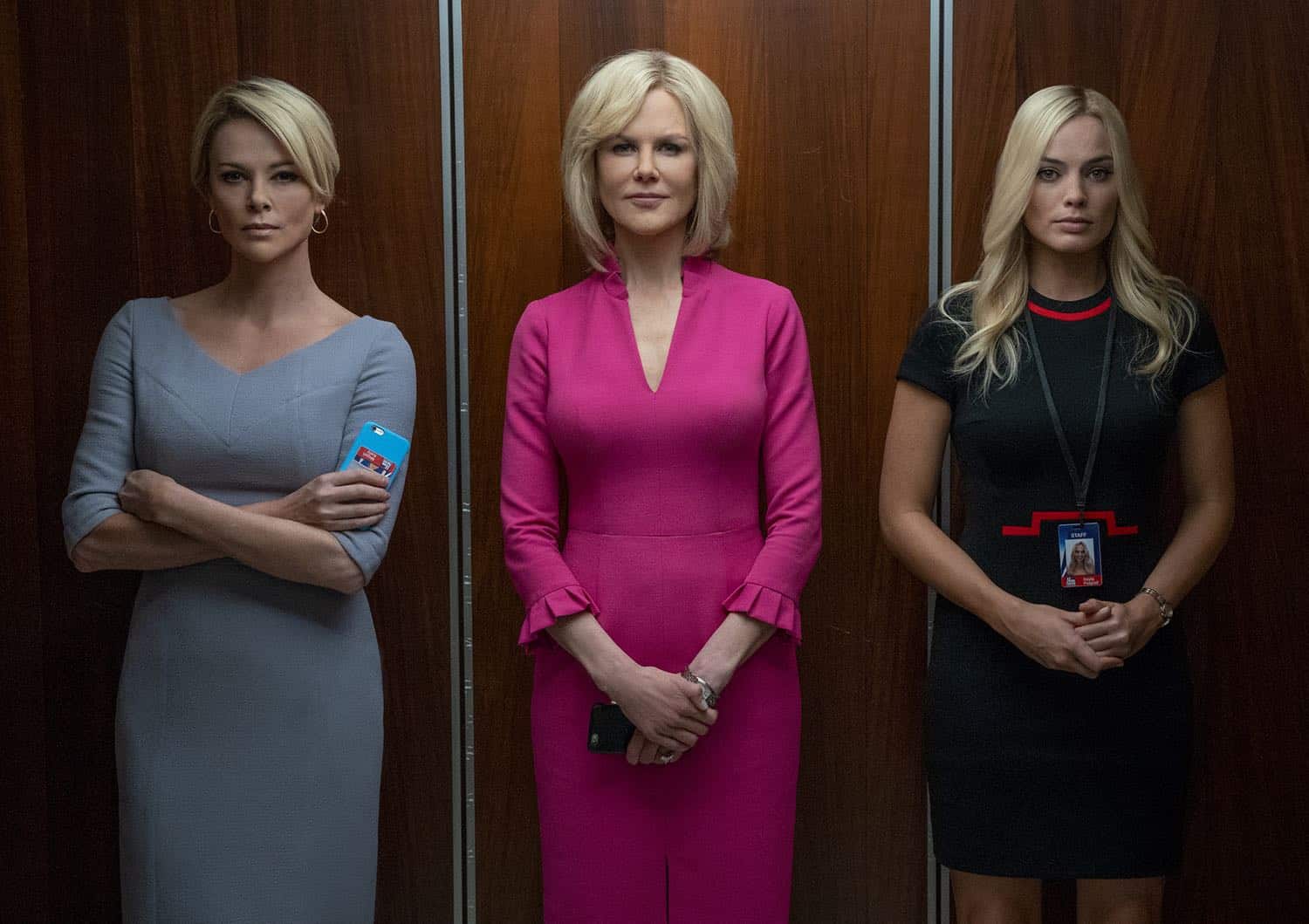
Bombshell, Jay Roach’s depiction of the unrepentant sexual harassment that poisoned the work atmosphere at Fox News, is equal parts cathartic and depressing.

Buoyed by strong lead performances in a trio of unerring talent—Charlize Theron, Nicole Kidman and Margot Robbie—the film also leans on an incredible and sizable ensemble to deliver a surprisingly nuanced look at the shades of grey, of complicity and responsibility when it comes to sexual harassment.

“It’s no one’s job to protect you,” Theron’s Megyn Kelly tells newbie Kayla (Robbie).

“It’s all of our jobs,” she disagrees.

No surprise the script comes from The Big Short scribe Charles Randolph. Roach’s film benefits from the same kind of thoughtful, informative, funny and “can you believe this?” approach, but Bombshell lacks much of the rage and outright comedy of an Adam McKay film.

Like McKay, Roach left comedies behind in favor of headier, sharper, more political material. Also like McKay, his comedic sensibilities breathe some life into the efforts, helping this film serve the dual purpose of entertaining and informing. And, like McKay, Roach knows how helpful a well-placed comedian can be.

Kate McKinnon actually does a lot of the film’s narrative heavy lifting. (Is it wrong I wanted her to play Rudy Giuliani as well?) As a Bill O’Reilly producer who befriends Kayla and helps her better understand the Fox New world, she allows Roach to make salient points about the network and the way it’s run, but because McKinnon is naturally funny and incredibly talented, it feels organic.

Her character’s position when it comes to rocking the boat also offers a clear-eyed take on why toxic work environments can go unchecked for so long. Since McKinnon’s character is in many ways the one the audience will most relate to, this is a sly and successful maneuver to keep us from feeling too superior and enabling us to better empathize with characters we may not like as well.

Enough cannot be said for the work of Roach’s makeup department, especially that of prosthetic make up designer Kazu Hiro. Theron’s imperceptible prosthetic—along with her own posture and voice work—turn her into an alarming replica of Kelly. Ditto Nicole Kidman, and John Lithgow, whose performance as Roger Ailes also delivers a wallop.

Not that any of this matters if the three central performances lacks in any department. They don’t. Characteristically, Theron, Kidman and Robbie deliver exceptional work, each willing (as they always are) to depict a woman who is not always (or, in some cases, is rarely) likable but who deserves respect and empathy for her suffering and courage.

Wisely, Roach and team don’t get swept away by the bracing change and empowerment of victory. Indeed, Bombshell’s final act is a smack I still feel. But its power is its honesty.

Look What the Cat Dragged In

Cats

by Christie Robb

People say that you’re either a cat person or a dog person. I’m a cat person, but definitely not a Cats person. But if you are, there’s a lot to enjoy in the new film version of Andrew Lloyd Webber’s 1981 musical based on poems by T.S. Eliot.

How else could you possibly get tickets to see a show with this cast? Taylor Swift. Idris Elba. Rebel Wilson. James Corden. Jennifer Hudson. How else can you watch a feline Dame Judi Dench curl up convincingly in a basket? Or glimpse Sir Ian McKellen lap from a bowl of milk?

A movie is a very egalitarian way to enjoy a Broadway musical. This one is about an assemblage of cats who have gathered together under the full moon to decide which one of them will be chosen to be reborn into a new life. Their best life. They pitch their case by singing the song of themselves. There’s very little in the way of traditional narrative structure although director Tom Hooper (Les Misérables) does tinker around with the play a bit to try to tease one out. It’s more like a musical revue designed around a central theme.

Initially concerned about falling into the uncanny valley of CG feline effects on the actors’ familiar faces, after some early creepy moments I got used to it. The realistic tail twitches and subtle changes in the angle of an ear serve to give additional cues as to the interior life of a cat that mere facial expressions alone can’t provide. (The opportunity to see emotional reactions through closeups is another advantage of a screen version.)

Occasionally the feline illusion is broken (most often by Swift and Elba) and instead of seeing a cat you are confronted with a dancing furry naked person with Barbie-doll genitalia. But most of the time, it works.

Wilson and Corden are amusing. Watching Francesca Hayward (principal ballerina at the Royal Ballet) dance the role of Victoria is a delight. But the true star of this show is Jennifer Hudson as Grizabella, a former “glamour cat” now old and suffering through hard times.

As in Les Mis, Hooper has his cast sing live, and it is Hudson’s performance of the signature song “Memory” that far outshines every other musical number here. It’s likely what you’ll be humming as you walk out of the theatre, and the one thing you’ll most remember about these Cats.

The End

Star Wars: The Rise of Skywalker

by George Wolf and Hope Madden

Not that long ago in a galaxy near and dear to us, J.J. Abrams brilliantly re-packaged our Star Wars memories as The Force Awakens. Rian Johnson’s The Last Jedi took an opposite approach two years later, bringing a challenging and welcome nerve that sent a clear signal it would soon be time to move on.

Abrams is back as director and co-writer to close the saga with The Rise of Skywalker, which ends up feeling less like a course correction (which wasn’t needed) and more like a sly meeting of both minds. The fan service is strong with this one, indeed, though it never quite smacks of panicked fanboy appeasement.

In fact, the echoes of Johnson’s vision only make Abrams’s franchise love letter more emotionally resonant. We were told this goodbye was coming, and now here it is, so grab hold of something.

And that doesn’t mean just tissues (though you may need them), as Abrams delivers action that comes early and more than often. From deep space shootouts to light saber duals amid monstrous ocean waves, the heart-racing set pieces are damn near non stop and seldom less than spectacular.

But let’s be real, this is the Rey and (Kylo) Ren show.

We knew their fates would collide, we wanted that collision, and here we get it, propelled by two actors in Daisy Ridley and Adam Driver who are able to fully embrace the weight of their respective arcs. As all our questions are eventually answered, Driver and Ridley never let us forget what drives their characters: the closure of identity.

And from a new hope to the last hope, it is precisely those bloodlines and destinies that have always driven this entire franchise. Abrams makes sure he honors that legacy with a satisfying sendoff bursting with fandom in nearly every frame.

Yes, you’ll find some awkward dialogue and underused characters, but that’s not a bad scorecard considering all that The Rise of Skywalker throws at us. From welcome hellos (Lando!), to sad goodbyes (Carrie Fisher’s is handled with heroic grace), political relevance (“there’s more of us” in the resistance) to stand up and cheer moments, this is a one helluva farewell party.