Hey! The actual movies mainly suck now, so why not stay home? Well, sir, here are two fine reasons to do just that.
First Reformed
Deadpool 2
Hey! The actual movies mainly suck now, so why not stay home? Well, sir, here are two fine reasons to do just that.
by Rachel Willis
When Nick Young (Henry Golding) asks Rachel Chu (Constance Wu) to be his date to a wedding in Singapore, she expects a nice, but simple trip to her boyfriend’s home. She’ll meet his family, and they’ll take an important step forward in their relationship. It’s what Rachel doesn’t know – that Nick is a member of a family known as “Singapore royalty” – that sets up the comedy and drama of Crazy Rich Asians.
Director Jon M. Chu’s adaptation of Kevin Kwan’s novel is an entertaining look at the culture clash that happens when Rachel attempts to fit in with Nick’s family.
“Crazy rich” is an accurate descriptor for Nick’s family and their class of friends. Born and raised in New York by a single, working mother, Rachel isn’t prepared for the ostentatious wealth that surrounds Nick’s family. Though proud of her life and career – economics professor at NYU – she realizes that she’s seen as an unremarkable outsider in this world of wealth and power, especially by Nick’s mother, Eleanor (Michelle Yeoh – outstanding as always). Efforts to sabotage their relationship begin before Rachel even leaves New York.
There are a lot of characters in the movie. Too many, really, and the important side characters suffer a lack of necessary development. A second narrative thread involving Nick’s cousin, Astrid (Gemma Chan), and her husband, Michael (Pierre Png), never hits the stride it deserves.
But there’s a lot to like about the movie. Nick and Rachel rank among the best – and most realistic – rom-com couples. As Rachel’s friend Peik Lin, Awkwafina provides the film’s funniest moments. She’s also the dose of reality Rachel needs when dealing with the crazy rich. And despite being 120 minutes, long for a romantic comedy, the film never drags.
Crazy Rich Asians is the kind of fluffy, fun, romantic summer fare that will leave almost everyone satisfied.
by Rachel Willis
A single act of teenage rebellion is the catalyst for a family’s destruction in director Sadaf Foroughi’s feature debut, Ava.
It’s a harmless action that tears apart the family’s fragile peace – Ava (Mahour Jabbari) tells her parents she’ll be studying at her friend, Melody’s, house only to sneak out to meet a boy and win a bet with a few of her classmates. Trying to prove she’s won, she’s late to meet her mother. Because of this, Ava’s mother, Bahar (Bahar Noohian), begins a campaign to weed out any element she deems unsavory from her daughter’s life.
It’s a hard world for a teenage girl. Gossip runs rampant, and it’s not just fellow teenagers spreading rumors, but teachers and parents, too. One mistake can ruin a young woman’s reputation and determine the course of her life. It’s not surprising that Bahar treats her daughter’s single offense with such vehemence. However, when Ava discovers a buried family secret, her rebellion takes on greater significance.
As Ava, Mahour Jabbari is sympathetic and compelling. Her desire for independence is understandable, but her actions are careless. Few of the women in her life show any compassion toward her choices. Only her father (Vahid Aghapoor) stands by her as someone who believes what she says and supports her decisions. However, his support puts him at odds with Bahar, who knows better than her husband how deeply a single mistake can affect a woman’s life.
Both Aghapoor and Noohian are stellar. Each character is confused by their daughter’s choices and her attitude, but how they handle the situation elevates the tension. They turn on each other; a once happy couple becomes another source of stress in Ava’s life.
Unfortunately, some of Foroughi’s stylistic choices are more distracting than beneficial. Blurry images dominate the frame, while the focal point is relegated to a small image in the corner. Arguing characters will be shown from the neck down, their heads cut off at the top of the screen. The commentary Foroughi hopes to achieve, unfortunately, doesn’t really come across.
Ultimately, though, the filmmaker has crafted a compelling, thoughtful portrait of a family in crisis.
Welcome back to The Screening Room, where we discuss all that’s new and fit to watch in theaters and home entertainment. This week we run through Skyscraper, Sorry to Bother You, Hotel Transylvania 3: Summer Vacation, Leave No Trace and The Devil’s Doorway. We also cover what’s new in home video.
Listen in HERE.
by Rachel Willis
These days, whenever an animated movie is released, it’s a near guarantee it will become a franchise. A few of these sequels are as good or better than the originals that spawned them, but most of them aren’t.
There’s nothing inherently problematic with milking successful movies for more material, provided the new stories are able to stand alone. Hotel Transylvania 3 manages to do so, but there are areas of the film that suffer from the same problems as other sequels.
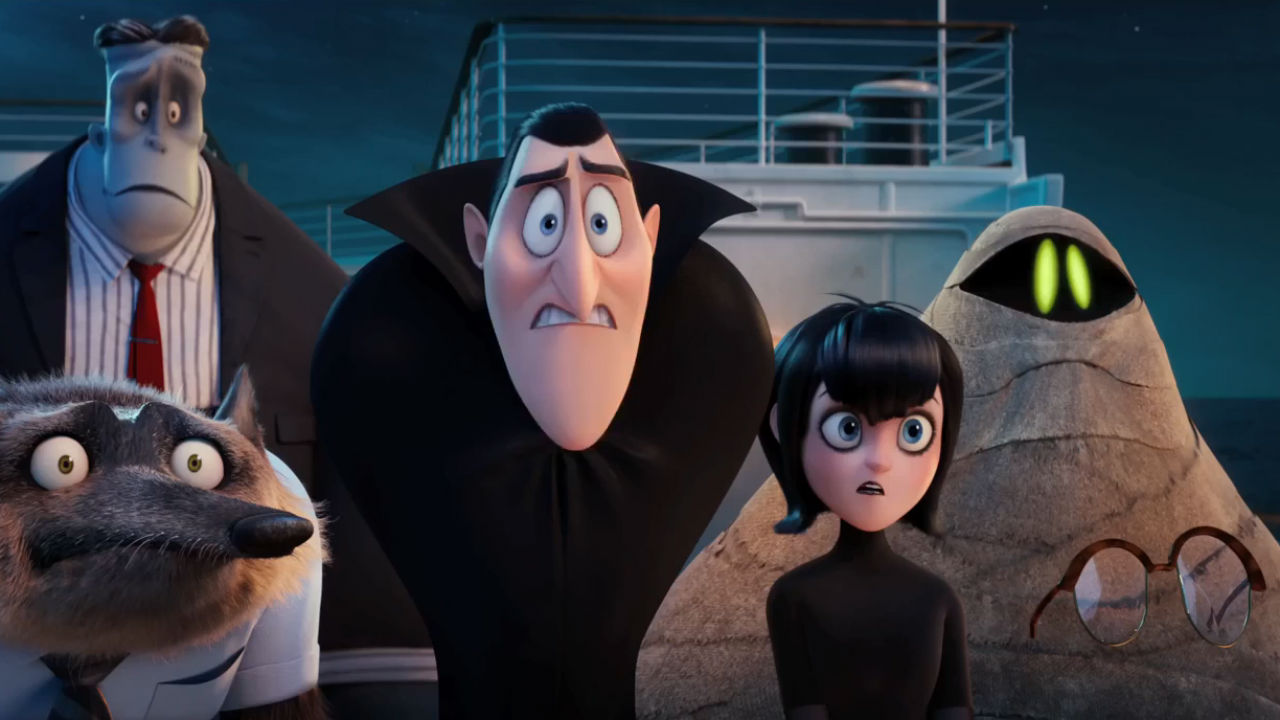
The latest installment in the Hotel Transylvania series introduces us to the centuries-long feud between Dracula and the Van Helsing family. A brief montage shows the audience Abraham Van Helsing’s many failed attempts to destroy Dracula. When it finally seems Van Helsing will no longer be a threat, we’re brought to the present day Hotel Transylvania to catch up with Dracula, his daughter Mavis and their clan of family and friends.
Deciding her dad needs his own vacation based on his more-spastic-than-usual behavior, Mavis books a family trip on a monster cruise. Along for the ride are a number of characters from the previous films, but the new film would have been better served if they’d been left behind in favor of fleshing out the new faces. Aside from Mavis and Dracula, none of the previous films’ characters seem to have been given much thought.
As Dracula, Adam Sandler brings a new aspect to a centuries-old character. Instead of menacing, Dracula is a spaz. While trying to woo the captain of the monster cruise, Ericka, he’s a nervous wreck. It’s an interpretation that serves the franchise well as it provides moments of humor for both children and adults.
Kathryn Hahn as Ericka is a good addition to the series, though her character’s animation is reminiscent of Tweety Bird. She’s a humorous character, and her scenes are among the movie’s best. Hahn plays well against Sandler, and together, they’re the glue that binds the film.
Director Genndy Tartakovsky has helmed all three films in the Hotel Transylvania series, and he’s done well with the material. The latest film will likely appeal to children of all ages, though their parents may surreptitiously check their phones once or twice.
So you’ve got some time off work this week, maybe you want to just hang in, avoid the crowds and the heat, eat some Doritos and watch some flicks. We hear ya! Most all your options are solid this week, whether you’re looking for comedy, drama or horror. Here’s the rundown:
https://www.youtube.com/watch?v=tP5N5XpGlYo
by Rachel Lewis
Director Brett Haley and co-writer Marc Basch have crafted a tender story of a father and daughter who spend a last summer together bridging their differences through a shared love of music.
Nick Offerman is charming as Frank, a man who’s never outgrown his dream of being a musician. Though his days are spent behind the counter of a record store, he wishes for something bigger. It’s his daughter, Sam (Kersey Clemons, from Dope and Neighbors 2: Sorority Rising), who is the family’s realist. Her goal is to go to college and become a doctor. The conundrum is that Sam has talent. A lot of it. Upon discovering how much talent Sam has during a family “jam sesh”, Frank’s dreams are reignited.
Much time is spent on the music itself. We watch as songs are written, revised, practiced, and recorded. These original tunes, written by Keegan DeWitt, are effective at highlighting the film’s themes, and the title song is catchy enough to stay in your head long after the credits roll.
The problem with this amount of attention on the music is that other areas of the film suffer for it. The relationships between characters are thin. We’re told there’s history present, but we never feel it. If the focus was kept on Frank and Sam, rather than expanding their world to include romantic relationships and a grandmother who adds little to the story, the audience connection might have gained more strength. As it is, we’re told to care about characters who have little dialogue and next to no screen time. Though this imbalance exists, the actors do their best with what they have.
There is a sweetness to the film, and Frank’s excitement is so contagious, Sam’s lack of enthusiasm is painful next to it. It’s a touching portrayal of a father and daughter who’ve grown apart, but find a way to reconnect. Terse conversations deepen as musical bridges are hammered out, with memories brought to the surface and shared through poetic lyrics. Moments that reveal pieces of the past are subtle, yet striking.
There’s much to like about Hearts Beat Loud, even if it does rely too much on the music to carry it.
by Rachel Willis
What happens to parents when they’re confronted with the truth about their child? In A Kid Like Jake, the titular Jake is not the kind of five-year-old boy who likes trucks and cars, but rather princesses and fairy tales. His parents, Alex and Greg (Claire Danes and Jim Parsons), see it as a harmless phase. But when it seems possible it’s more than a phase, they’re forced to confront their own fears and prejudices.
Writer Daniel Pearle (adapting from from his play) and director Silas Howard address a topic that deserves attention. With a sensitive touch, they’ve crafted a film that is heartfelt and earnest.
The film’s main shortcomings occur during the first act. It takes the film a while to get to the meat of the issue, spending too much time on inconsequential details, including a montage of private school tours that has no real bearing on the story. Rather than focusing on this minutia, the film would have been better served if some of the ancillary characters were given more to do. Friends and family members are introduced (and played well by the likes of Octavia Spencer, Ann Dowd and Priyanka Chopra), but never satisfactorily weaved into the main drama.
As Jake’s parents, Danes and Parsons work best together when they’re at odds. The dialog during Alex and Greg’s most charged moments is impeccable. Their idyllic scenes, on the other hand, are shallow. The attempt at showing us a loving family is superficial, and it’s hard to root for people we never get a chance to know.
However, there are interesting dilemmas explored in the film. When Jake wants to dress as Rapunzel for Halloween, Alex instead brings home a pirate costume for him. Her rationale is that she wants to avoid weird looks or negative comments. She wants to “protect” her son. But as Jake acts out, it’s clear that her protection is misguided. Rather than defending her son, she’s part of the problem. Greg comes to this realization more quickly, recognizing his son’s change in demeanor as a sign he’s unhappy. It leads to confrontations that are uncomfortable, yet recognizable.
As for Jake, most of what we learn about him comes from exposition. This is likely a result of the transition from stage play to film. In some ways, it works, as Jake knows who he is. But in a world that needs greater representation for gender nonconformity and transgender men and women, it would have been nice to spend time with Jake instead of only seeing him through other people’s eyes.
by Rachel Willis
Reminiscent of both Andrei Tarkovsky and Robert Bresson, writer/director Paul Schrader delivers a nearly flawless meditation on faith and despair with First Reformed.
Schrader’s film centers around Reverend Toller (Ethan Hawke), overseer of the small church, First Reformed. Reverend Toller lives a simple life. He delivers a Sunday sermon to a very small congregation, gives tours of the 250-year-old church, and occasionally ministers to a youth group. It’s a simple, but seemingly pleasant existence.
His life changes drastically when he’s approached by a young, pregnant woman named Mary (Amanda Seyfried). Mary seeks counsel for her despondent husband, Michael, and Toller agrees to meet with him. It’s a decision that will open the door to the question: Will God forgive us?
Much of the film’s success rests on Hawke. In what is possibly his best performance, he perfectly portrays the inner turmoil and anguish that seizes Reverend Toller. It’s a slow slide from a pleasant façade to destructive rage, and Hawke perfectly captures every emotion, every nuance of Toller’s internal crisis and its external manifestations.
The majority of the supporting cast is able to meet Hawke’s intensity with equal verve. Seyfried’s Mary is the dynamic foil to Toller, and she mostly manages to stay on Hawke’s level. At times, however, she seems out of place, unable to convey the depths of Mary’s feelings.
Schrader’s commentary on the state of the world is bleak, and there’s not much hope to be found in First Reformed. However, it can be seen in simple moments Toller spends with Mary. It provides a few moments of balance, and light, as Toller questions the right way forward.
As the tension builds, the understated score plays a phenomenal role in pulling the audience into Toller’s world. As he contemplates his future, there is a sense of dread that stays just beneath the surface, waiting to be released. There are many moments in which the stress is palpable.
Schrader’s film is a masterful character study that asks thoughtful questions about how our choices will be viewed in the eyes of God.
by Rachel Willis
There are a few directions a film can take when focusing on a hotel with the kind of history as the Carlyle Hotel in Manhattan. A historical retrospective of its place in New York would have cemented the hotel as one of the city’s vibrant hearts. A simple history of the hotel itself and its early struggles after opening during the Great Depression and its rise to prominence could have proved an interesting subject if explored.
However, director Matthew Miele focuses his documentary, Always at the Carlyle, on the shallowest of subjects—the hotel’s many famous guests.
A good chunk of the film feels like a promotional advertisement. Interviews with hotel staff highlight the hotel’s charms without diving too deeply into those charms. One of the staff was given the opportunity to stay in the room that Princess Diana frequented on her visits to New York. When asked by Miele if the room’s $10,000 per night fee is worth it, she says yes. It’s hard to imagine her saying anything else.
The rest of the film is interviews with its rich and famous guests. From George Clooney to Angelica Huston to Lenny Kravitz to Sofia Coppola, we’re told repeatedly why they find the Carlyle so inviting. They hint at scandals and extravagant parties, but no one ever divulges anything truly interesting.
There’s a lack of cohesion to the story Miele is trying to tell, so it’s not entirely clear what he hopes to accomplish. Part of the documentary focuses on the upcoming arrival of William and Kate, the Duke and Duchess of Cambridge. From the initial call booking the room to the couple’s arrival, it could have been a lynchpin for the movie, but their story is abandoned half-way through the film. Instead, it’s simply another entry into the Carlyle’s roster of celebrity guests.
Miele’s film is, in some ways, representative of the worst of our celebrity-obsessed culture. It equates wealth with class, fame with sophistication, and the past as a time when things were “better.” It’s the same kind of culture that led to the death of the hotel’s frequent visitor, Princess Diana.
While The Carlyle may have an interesting story to tell, this documentary doesn’t do it.