Tag Archives: Rachel Willis

Splash

Lu Over the Wall

by Rachel Willis

To give away too much of the plot of Lu Over the Wall would be to steal the joy of experiencing this unique, quirky film. Director Masaaki Yuasa has crafted a sweet fantasy that explores the moving friendship between a boy and a mermaid.

The first half of the film offers an unpredictable journey that follows Kai as he gets to know the buoyant Lu. Along for the ride are Kai’s friends, Yuho and Kunio.

Before Lu, Kai is sullen and morose, having recently moved from Tokyo to a small fishing village with his dad following his parents’ divorce. Yuho and Kunio try their best to engage Kai, even talking him into joining their band. But it isn’t until Lu appears, drawn by Kai’s music, that he begins to open up to the world around him.

Though the first half of the film is unusual, and, at times, downright weird, the second half falls into a more predictable pattern. However, the shift into a more traditional story doesn’t detract from the film. And though the second section is more certain, the quirks and oddities of the story are maintained through the animation. Lu and Kai, along with Yuho and Kunio, face challenges as old prejudices and new curiosities are aroused by the arrival of Lu.

At times, the animation is reminiscent of Hayao Miyazaki’s work, but it also occasionally has the slapstick style of Tex Avery’s old Bugs Bunny cartoons. The blending of styles, along with the film’s own specific elements, merge together to serve the unconventional story well. From the monstrous creatures to the everyday people to the village’s shops and streets, the visuals are the most memorable part of the film.

Music also plays an important role, but the soundtrack is a little stale when paired with the rich animation. Too often, the score and soundtrack fade forgettably into the background when the movie would be better served by sound that enhanced the animation onscreen.

Though often strange and unusual, Lu Over the Wall is a touching tale.


Unsane Worldwide

12 Days

by Rachel Willis

Like a fly on the wall, Raymond Depardon takes his audience inside a world most will never see, and many may never want to see again.

In France, anyone committed to a psychiatric hospital without consent must be seen by a judge within 12 days. At that time, the judge will decide whether to continue their treatment or release them from care. Each patient’s doctor, or group of doctors, provides recommendations to the judge. In every case Depardon is privy to, the doctors never recommend release for their patients.

Only one woman is okay with this decision. She admits she needs additional care and seems happy with the judge’s decision to continue her treatment for another six months. For the rest, they desire their freedom.

Many of the patients are lucid. They argue their cases before the judge, promising to seek treatment from their own doctors, find jobs, and do what they can to lead healthy lives. When they’re remitted back into the care of the hospital, they promise to appeal the decision (they have ten days to appeal any decision made by the judge).

For others, it is clear their mental health is poor. One man is unable to answer questions from the judge; it’s as if he is having a separate conversation, one that only makes sense to him. Another man begs the judge to find his father and have his father come visit him. Only after he leaves the room does the judge comment on why his father will never visit.

It’s an interesting conundrum for the judges, who must rely on the recommendations of the doctors to make their decisions. Do they struggle with their decision when patients have clear goals for their lives outside of the hospital?

Depardon doesn’t give us any answers. He remains an unbiased observer never offering a narrative to sway the viewer. We’re never given any information outside of what we see inside the small, claustrophobic courtroom. This may irritate some viewers who may wish to know more about each of the individuals seen before the judges or the circumstances surrounding their care. For those open to simply taking what Depardon gives, the film is likely to raise many important questions about the nature of mental health care.

Great Outdoors

Leaning Into the Wind: Andy Goldsworthy

by Rachel Willis

Patience.

It’s the first word that comes to mind while watching Thomas Riedelsheimer’s documentary about artist Andy Goldsworthy. But that’s not a critique on the film itself, rather a reflection on the meticulous nature of Goldsworthy’s work, as well as Riedelsheimer’s.

Crafting art from nature, Goldsworthy spends a lengthy amount of time gathering his materials—leaves, flower petals, branches—then fastidiously arranges and assembles his materials into stunning works of art. It’s not only an exercise in creativity, but patience. When a gust of wind destroys hours of work, Goldsworthy takes it in stride, even though it’s the kind of setback that would leave many fuming.

To truly sink viewers into Goldsworthy’s world, into his thought process, Riedelsheimer is with Goldsworthy from start to finish as he assembles each new piece. Interviews and time spent on the sidelines observing while he works is as close as one can get to being inside the mind of an artist.

With breathtaking cinematography, the film itself is a work of art. As the viewer follows Goldsworthy around the world, the film captures the beauty of nature as Goldsworthy sees it. Knotted tree roots take on deeper meaning. Ants marching become more than insects on the ground, but a reflection of society. One of Goldsworthy’s more impressive installations is sparked by the ants. Riedelsheimer is there to capture the moment of inspiration as it turns into a stunning work of art.

There are times when the film covers the same ground. Much of the viewer’s time is spent watching as Goldsworthy (sometimes alone, sometimes with his daughter, at times with an entire crew) works on different installations. While interesting to see, it’s also repetitive, and the documentary is most engrossing when we’re allowed to follow Goldsworthy as he mines the continent for ideas.

Often the film has the feel of a nature documentary. The camera fades into the background as Goldsworthy works, becoming a silent observer, which gives the viewer an intimate look into his world. Goldsworthy becomes a part of the environment around him. Using his body, he becomes absorbed in the environment. The viewer feels the same absorption as we’re drawn deeply into his universe.

Leaning Into the Wind is a gorgeous, glorious film.

I Don’t Want to Go Out—Week of March 5

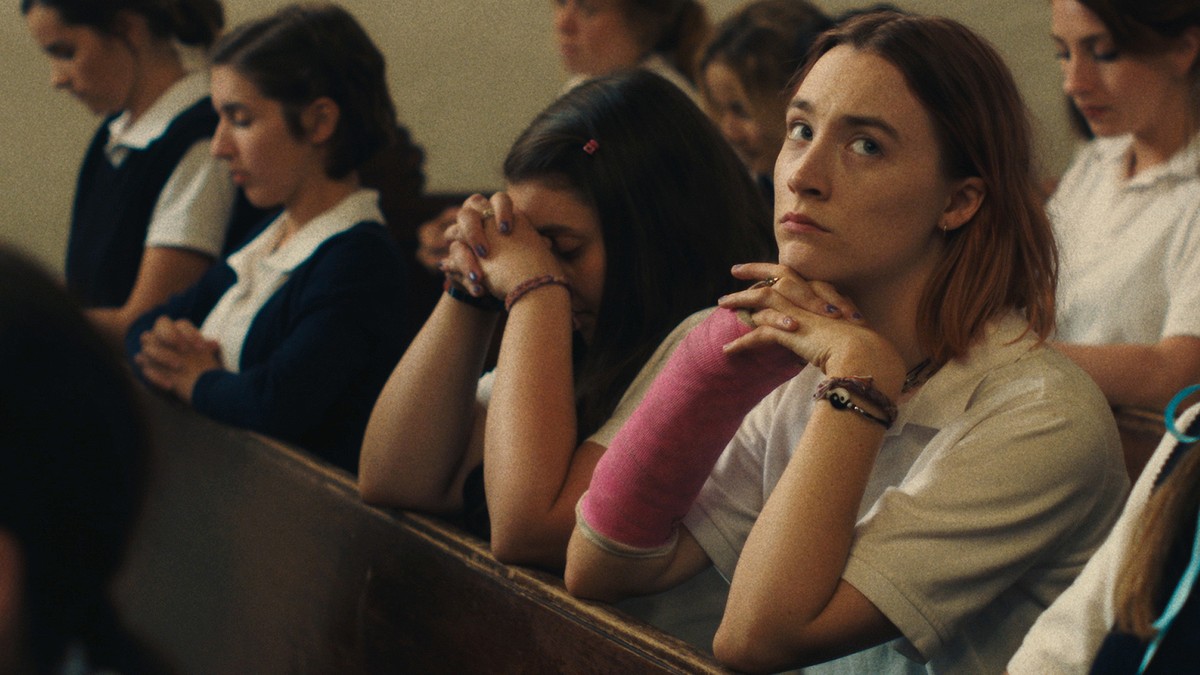
Some super kick-ass women available to entertain you with tales of adolescence, murder, God and mayhem this week. Nicely done, ladies.

There’s also a man who invented Christmas, but honestly, only a man would claim to have invented Christmas. Sheesh.

Click film title for the full review.

Lady Bird

Mohawk

Midnighters

The Man Who Invented Christmas

Novitiate

Wonder Wheel

She’s a Brainiac, Brainiac…

The Female Brain

by Rachel Willis

It seems strange that in 2018, romantic comedies continue to follow the same tired clichés. While some have mined new territory, The Female Brain isn’t taking any risks.

Focusing on four couples, the film explores the ups and downs of relationships through the studies of neurologist Julia (Whitney Cummings, who also co-writes and directs). Looking at how brain chemistry affects the way men and women behave, why they make certain romantic choices, and why they continue to make the same mistakes, Julia seeks to find answers to her own relationship traumas.

The film’s biggest issue is its lack of cohesion. The couples never share screen time, save one moment in which Steven (Deon Cole) and Adam (James Marsden) discuss how their significant others have changed or are trying to change them. And while it seems the couples are part of Julia’s study based on a few voice-overs, that fact is never quite clear. The movie would have been much stronger if it had kept a tighter focus on Julia’s story or found a better way to connect the couples and their foibles to her study.

There is some humor to be found, primarily from Cole and Cecily Strong. SNL veteran Strong shines, and plays well off of NBA veteran Blake Griffin, who does occasionally hold his own against his much funnier on-screen spouse. Unfortunately, most of the comedy falls flat, as the script relies too much on overused stereotypes: Women are either trying to change men or are too emotionally closed off to accept love.

Cummings is a capable actress. As Julia, she is sympathetic while managing to mine the humor from her role. However, as a director, she never manages to find her footing. The film’s pacing is off, resulting in a movie that feels much longer than its actual runtime. Cummings’s script (co-written with Louann Brizendine and Neal Brennan) suffers from banal dialogue. Any potential moments of originality are undermined by reliance on formulaic ideas of romance.

Hiding behind the guise of being scientifically sound in examining the difference between male and female brains, we’re sadly left with a film that reiterates the same stereotypes and problems of many romantic comedies.

The Oscar Nominated Short Films: Documentary

by Rachel Willis

This year’s batch of Oscar nominated documentary short films offers a look at wide-ranging subjects. From an artist’s struggles with mental illness, to the problem of elder care, to the effects of the opioid epidemic in Huntington, West Virginia, these documentaries will evoke a gauntlet of emotions.


Edith + Eddie – USA  Dir: Laura Checkoway

“It was love at first sight.”

So says Eddie, who at 95 married 96-year-old Edith. The two are very obviously in love, but because of a dispute between Edith’s daughters over her care, the couple’s relationship is put into question. Through this clash, we’re given a look at the effects of elder guardianship. It’s a depressing glimpse at the reality many elderly face as their own wants are often circumvented by the wants of others or by their own medical needs.


Heaven is a Traffic Jam on the 405 – USA  Dir: Frank Stiefel

For artist Mindy Alper, life has been extraordinarily hard. Early in the film, she lists the myriad drugs she takes daily, including Zyprexa, an antipsychotic, one she says she’d  be vegetative without. As Alper speaks about her experiences with mental illness, her art plays on screen, a visual representation of her story. Stiefel conveys deep sympathy for Alper and magnificently blends her drawings and sculptures into his narrative. It’s a lovely, touching film that celebrates Alper’s accomplishments in life and art.


Knife Skills – USA  Dir: Thomas Lennon

Edwins Restaurant in Cleveland, Ohio is unique. Its owner, Brandon, is at the center of Knife Skills because he’s done something that many would never think to do: hire eighty former prisoners to work in his restaurant. Most of them have no restaurant experience, but Brandon’s restaurant also functions as a school. In the six weeks leading up to opening night, the film follows the students as they earn all they can about how to work in a French restaurant. It’s an ambitious idea, but Knife Skills only scratches the surface. Rather than focusing on Brandon and his goal, the film follows several of the students and teachers, leaving the viewer with a shallow impression of the subject.


Heroin(e) – USA  Dir: Elaine McMillion Sheldon

Deputy Chief Jan Radar, Judge Patricia Keller, and Necia Freeman are the heart of Heroin(e). While Radar’s rush to save drug overdose victims in Huntington, WV is the film’s primary focus, we also spend time with Judge Keller in her courtroom, and with Freeman as she drives around the city at night handing out food to the needy. Each woman has a goal in mind: to end the epic of overdoses in her city. Huntington is the overdose capital of America, and Sheldon gives a face to that haunting fact. There is a slight glimmer of hope in the film, even though, for now, the reality in Huntington is bleak.

Also included in the program is Traffic Stop – USA  Dir: Kate Davis.

(rating for full program)

Three’s Company

In Between

by Rachel Willis

For women stuck between tradition and modernity, the choices presented to them can mean happiness or alienation from friends, family, and society. In Between explores these choices through the eyes of three women living as roommates in Tel Aviv.

The women are wildly different. There’s attractive, social Laila, who parties with her friends at night while working as a lawyer during the day. Salma is a tattooed, pierced chef whose parents are determined to find her a suitable husband. Nour, a conservative Muslim, is already engaged, but living in Tel Aviv to complete her degree in computer science.

Writer/director Maysaloun Hamoud, in her debut as a feature filmmaker, builds her narrative first from the perspective of each woman on her own, before drawing the stories together into a larger commentary on the world they inhabit.

The roommates connect over shared desires, as well as shared heartache. A particularly touching scene links Laila and Nour, as they prepare a dinner for Laila’s boyfriend. Laila is nervous, as she’s not cooked for anyone in some time, but Nour, who’s doing most of the cooking, reassures her that she does it for her betrothed all the time. It’s an intimate moment and details the different lives the two women lead.

There are additional intimate scenes between the women, and each is touching in uniquely different ways. A particular moment in which the roommates rally around Nour is both heartbreaking and poignant. It further reiterates the connection between women in a world that can be difficult to navigate, especially as it changes.

As Laila, Mouna Hawa is especially dynamic. She is the embodiment of a woman who knows who she is and what she wants, even if the world around her isn’t ready to accept that. However, Nour, magnificently portrayed by Shaden Kanboura, is perhaps the most interesting character as she is the one who changes most over the course of the film.

Salma’s (Sana Jammelieh) story feels the least explored. Though it carries its own emotional weight, when compared to the others it sometimes feels more like an afterthought.

Hamoud doesn’t shy away from forcing her characters into difficult, sometimes scary situations. Nor does she pull any punches in showing how those situations can leave a lasting impact. It’s often a rather bleak examination of the world women are forced to occupy.

These women have choices ahead of them, but the question is what they’ll have to give up to make them.

I Don’t Want to Go Out – Week of January 8

Nasty weather getting you down? Nothing cheers a body up like a clown! That’s right, It comes home this week, along with some other bits of middling entertainment from 2017. Wouldn’t it all go so well with popcorn? Pop pop pop pop pop…

Click the film title to read the full review.

It

Marshall

The Foreigner

Mark Felt: The Man Who Brought Down the White House

Friend Request

I Don’t Want to Go Out – Week of December 11

Some exceptional films coming home this week, so if you like true life, brutally devastating historical dramas, this is your week! No, seriously, watch them.

Detroit

Viceroy’s House

The Trip to Spain

Kingsman: The Golden Circle

Home Again

Preparing the Bride

Novitiate

by Rachel Willis

When Cathleen Harris (Margaret Qualley) is seven years old, her mother, out of a sense of duty and more than a little boredom, takes her daughter to church. So begins Cathleen’s love affair with God.

And it is a love affair, as Novitiate seeks to show its audience as it follows Cathleen from that first encounter to her time as a novitiate seeking to become a bride of Christ.

As a postulant (the first step in becoming a nun), Cathleen meets the Reverend Mother (Melissa Leo), a woman who joined the convent 40 years earlier and has not left the convent in those 40 years. With the introduction of the Reverend Mother, the film branches into two narratives. We see the convent through both Cathleen and the Reverend Mother on the eve of monumental changes to the Catholic Church.

If writer/director Margaret Betts had kept her story limited to these two perspectives, we would be treated to a tighter film. Cathleen is a mostly silent observer, her few words devoted to her devotion to God, but we see a great deal through her. When the film branches off to follow other postulants in the convent, as well as a sister questioning her faith, we lose the intimacy established in the beginning with Cathleen.

Betts is aware that many in the audience will not understand what it takes to become a nun, nor will they be familiar with the Church in the early 1960’s, so there are a few moments of exposition. However, they never feel heavy-handed or forced. It feels as if we’re entering as a postulant, then a novitiate, with Cathleen.

As our eyes into this world, Qualley is phenomenal as Cathleen. She brings an intensity to the role that is needed to understand the level of commitment to Christ it takes to become a nun.

Leo as the Reverend Mother brings a different level of intensity, one that not only explains her devotion to Christ, but her faith in the perfection of the Church as Vatican II seeks to alter the world to which she’s given her entire life.

There are moments when the film sinks into melodrama, and some scenes feel unnecessary to the story, but it’s a captivating glimpse into a world few of us witness.