Tag Archives: movies

Fright Club: Menstruation in Horror

Only Women Bleed? Sunday Bloody Sunday? Let It Bleed? What song would we have chosen to open the new podcast? There are more possibilities than we might have imagined—in song and in film—as we celebrate the monthly curse with a talk about the best horror movies concerning menstruation. Do you have the stones to listen?

5. It Stains the Sands Red (2016)

We open with some impressive aerial shots of the smoking, neon ruin of the Las Vegas strip. Cut to another gorgeous aerial of a sports car zipping up a desert highway. In it, a couple of coked-up strip club lowlifes, Molly (Brittany Allen) and Nick (Merwin Mondesir), are escaping to an airfield where they’ll meet with other lowlifes and head to an island off Mexico.

Naturally, this isn’t going to work out. But what co-writer/director Colin Minihan has in store will surprise you. He’s made a couple of fine choices with his film. The point of view character is not only an unlikely protagonist – an unpleasant thug with a drug habit – but she’s also female.

Soon the car goes off the road and one meathead catches her scent, and suddenly Molly’s stripper shoes are not her biggest problem as she faces a 30-mile trek across the desert to the airfield.

What develops is an often fascinating, slow moving but relentless chase as well as a character study. With a protagonist on a perilous journey toward redemption, It Stains the Sands Red takes a structure generally reserved for the man who needs to rediscover his inner manhood and tells a very female story.

Very female. Menstruation and everything.

4. A Tale of Two Sisters (2003)

Writer/director Jee-woon Kim (I Saw the Devil) spins a hypnotic tale of family and ghosts—both literal and metaphorical. Tale of Two Sisters is a deep, murky and intensely female horror.

A tight-lipped father returns home with his daughter after her prolonged hospital stay. Her sister has missed her; her stepmother has not. Or so it all would seem, although jealousy, dream sequences, ghosts, a nonlinear timeframe and confused identity keep you from ever fully articulating what is going on. The film takes on an unreliable point of view, subverting expectations and keeping the audience off balance. But that’s just one of the reasons it works.

No line of dialog, no visual is wasted. The seemingly simple moment of one daughter needing to borrow a feminine product from her stepmother works in a dozen ways: to introduce blended identities, to exacerbate the uncomfortable familiarity, to foreshadow future horror.

Tale masters the slow reveal in large and small ways. Whether you’ve begun to unravel the big mystery or not, Tale always has something else up its sleeve. Or, under its table.

3. Excision (2012)

Outcast Pauline (a very committed AnnaLynne McCord) is a budding surgeon. She’s not much of a student, actually, but she does have an affinity for anatomy. Especially blood. Pauline really, really likes blood.

A horror film focused on an adolescent girl as antihero is likely to involve 1) menstruation, 2) a mom. Excision is no different. Well, it is a little different.

The mom is Traci Lords, in what is certainly her most assured dramatic performance. Her arc is interesting: overbearing and cold and, eventually, probably correct in her unfavorable assessment of her eldest girl.

Writer/director Richard Bates, Jr. takes more of an unusual course when bringing in Pauline’s cycle, though. I’m not sure we’ve seen it handled quite like this before, although to be fair, it’s definitely in keeping with the peculiar and beautifully realized character he and McCord have created.

2. Ginger Snaps (2000)

Sisters Ginger and Bridget, outcasts in the wasteland of Canadian suburbia, cling to each other, and reject/loathe high school (a feeling that high school in general returns).

On the evening of Ginger’s first period, she’s bitten by a werewolf. Writer Karen Walton cares not for subtlety: the curse, get it? It turns out, lycanthropy makes for a pretty vivid metaphor for puberty. This turn of events proves especially provocative and appropriate for a film that upends many mainstay female cliches.

Walton’s wickedly humorous script stays in your face with the metaphors, successfully building an entire film on clever turns of phrase, puns and analogies, stirring up the kind of hysteria that surrounds puberty, sex, reputations, body hair and one’s own helplessness to these very elements. It’s as insightful a high school horror film as you’ll find, peppered equally with dark humor and gore.

https://www.youtube.com/watch?v=Zoa1A987A_k

1. Carrie (1976)

What else? Nobody did moms, the pain of adolescence, the horror of the onslaught of womanhood, or period quite like Brian De Palma’s 1976 original. Is there a more tragic scene? Is there a scene that better establishes a character, a context or horror?

De Palma films the scene in question, appropriately enough, like a tampon commercial, all cheese cloth and beautific music. And then Carrie White (Oscar nominated Sissy Spacek) desperately claws at her classmates, believing she is dying. It’s the most authentic image of vulnerability and terror you can imagine, matched in its horror by the reaction she receives from those she seeks: laughter, mockery and contempt.

Beyond the epitome of adolescent mortification that the scene represents, it also clarifies the unspoken relationship between Carrie and her as-of-yet unintroduced mother, who has never told her teenaged daughter that this was coming.

The result is the ultimate in mean girl cinema and an introduction to a nearly perfect horror film.


Dead on Arrival

The Possession of Hannah Grace

by Hope Madden

Do you ever watch a movie and wonder how it got that elusive green light? I just did.

The Possession of Hannah Grace is not a terrible movie. It’s not a provocative movie, not a scary movie, not a gory movie, not an interesting movie. It’s just not a movie you’ll be able to keep straight a few weeks after you see it. You’ll be combining what few moments you recall with other movies.

You’ll be wondering, was that Hannah Grace, or was it The Last Exorcism? Did that happen in Hannah Grace or in The Corpse of Anna Fritz? Or maybe in The Autopsy of Jane Doe? And then you’ll just forget this movie entirely. It’s been 20 minutes for me and I’m already struggling to recall the bland details.

In a nutshell, Dutch filmmaker Diederik Van Rooijen’s first English language film follows troubled ex-cop Megan (Shay Mitchell) on her first days in her new routine: nighttime morgue attendant followed by an early morning AA meeting with sponsor, Lisa (Stana Katic).

But on Night #2, things go funny as the corpse of a mutilated, burned and inexplicably naked young woman is brought in. Hannah Grace (Kirby Johnson) is not your garden variety naked, contorted, burned corpse, though.

How do you cast this, exactly? “Hey, how would you like to play the title role in my new movie? You will be nude for 90 minutes and you have exactly no lines. You in?”

The jump scare morgue marathon amounts to a long and very tortured metaphor about addiction. Kudos to Van Rooijen and writer Brian Sieve for setting you up for one of two clichéd endings, and then sidestepping both. Too bad they sidestep clichéd endings in favor of nothing at all.

That’s about what you can expect from Hannah: 85 minutes of not too much—not much point, very little action, not a lot of scares and even fewer answers. But it is indeed a horror film that could be completed with three total locations and a cast of about 10, so, you know, why not go ahead and make it?

Wolf Pack Mentality

Meow Wolf: Origin Story

by Rachel Willis

If you’ve never heard of Meow Wolf, an 88-minute documentary about their beginnings may seem pointless, but I promise it’s worth it. By the time the credits roll, you’ll be looking into the price of plane tickets to Santa Fe.

Santa Fe, New Mexico is one of the world’s most vibrant arts centers. Home to hundreds of galleries and dozens of museums, it’s known worldwide for its art markets, events and performances.

And it’s also home to Meow Wolf, an art collective comprising a handful of anarchistic artists who saw too much bourgeois capitalism in the local art scene. Seeking to break away from the idea of art as commodity, these creative individuals banded together to create something new, unique and entirely collaborative.

Using animations, archival footage and interviews with founding members of the collective, directors Jilann Spitzmiller and Morgan Capps create a visually engaging documentary. It would have to be to capture the spirit and brilliance of the art and artists behind Meow Wolf.

The major theme of the film, which is the major dilemma for Meow Wolf, is maintaining artistic integrity while creating a marketable product. From the very beginning of Meow Wolf’s inception, most of the group’s members were opposed to anyone trying to impose too much order into the creation process.

Spitzmiller and Capps document the bitter fights, the fissions within the group, and ultimately, the success when they manage to work together to find common ground. With a collective, each member is involved in the creation process. Each member has a say, and each person contributes to the final product.

Documenting a few of Meow Wolf’s early successes, the film culminates with their most ambitious endeavor: the House of Eternal Return. A 20,000 square feet interactive, immersive art installation, it’s one of the most incomparable and wondrous projects you’ll have the pleasure of viewing from conception to completion onscreen.

That George R.R. Martin of Game of Thrones fame helped fund the project only adds to its charm.

Watching Meow Wolf create ambitious, quirky projects is like watching a great band write game-changing songs. There are tense moments, fights and losses, but when things come together you’ll come as close as one can to true magic.

Burning Questions

Burning

by Brandon Thomas

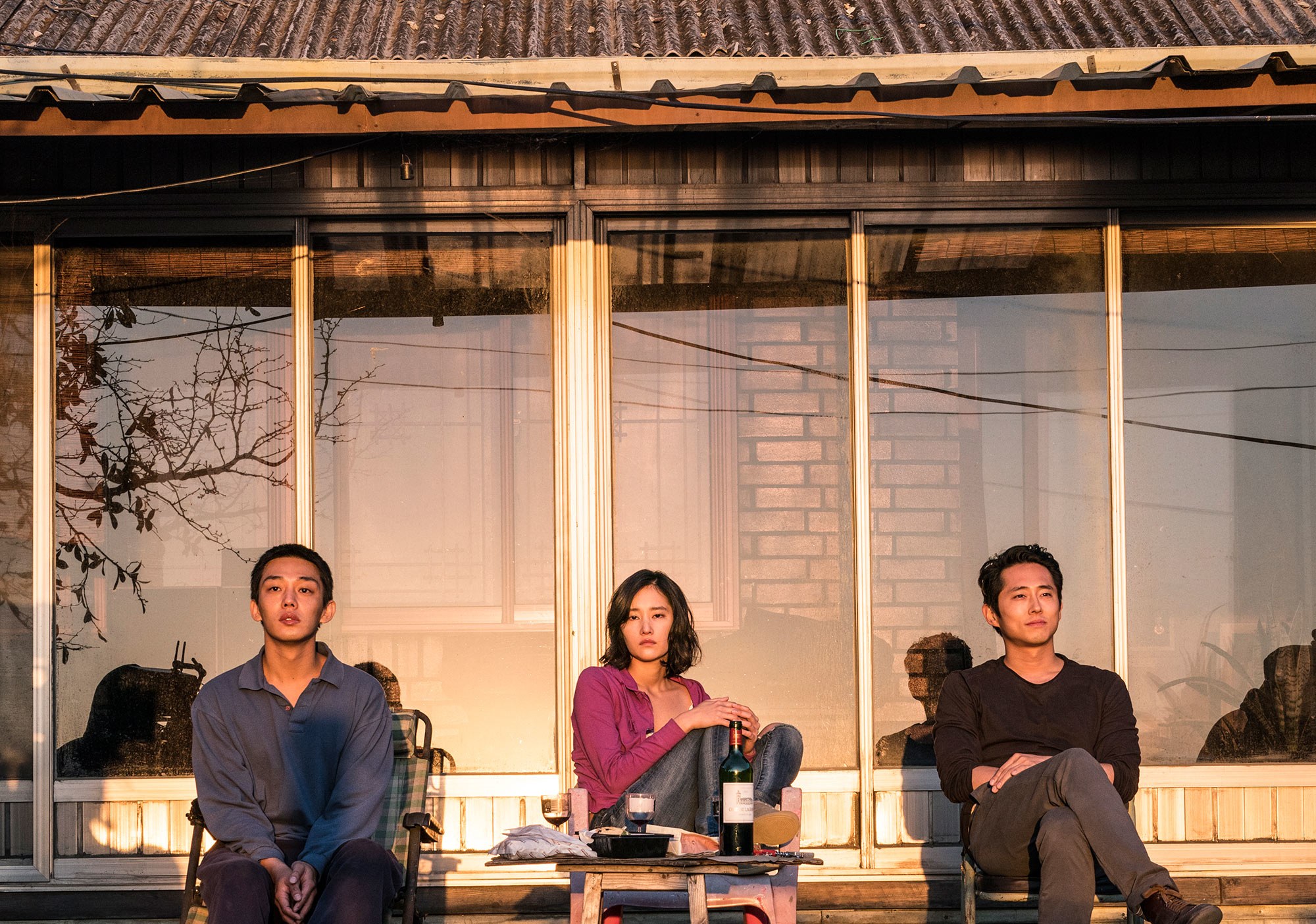
Films like M, Vertigo and Chinatown have spent decades taking audiences on twisty narrative rides. These classic mysteries raise thrilling questions, and payoff with satisfying answers. But what if a great mystery wasn’t at all concerned with answering the questions it raised? Chang-dong Lee’s Burning is more interested in the journey than it is the destination.

Jong-Su (Ah-In Yoo) spends his days doing odd jobs and taking care of his family’s dilapidated farm on the outskirts of town. A chance encounter brings Hae-mi (Jong-seo Jeon), a childhood neighbor, back into his life. Through Hae-mi, Jong-Su also meets Ben (Steven Yeun of The Walking Dead), a wealthy, good-looking and mysterious young man. While having drinks one evening, Ben confides to Jong-Su that he occasionally enjoys burning abandoned greenhouses. Jong-Su begins to think that burning greenhouses isn’t Ben’s only secret.

Burning unravels slowly. Two and a half hours seems daunting at first glance, but the twinge of unease hanging over the film keeps you involved the entire time. There’s a sense of dread that is hard to pinpoint, but is also intoxicating.

The film comes alive through the character work. Jong-Su is an open book. He’s miserable, lonely, disappointed and bored. And we get to see it all. He tells Hae-mi and Ben that he’s a writer, but he’s never actually shown writing. He spends hours working his monotonous jobs and pretending to be invested in taking care of the family farm. Jong-Su is a phony, and Ben sees that immediately.

Hae-mi and Ben, on the other hand, are complete enigmas to Jong-Su and the audience. Hae-mi tells Jong-Su stories from their childhood that he doesn’t remember, and eventually finds out aren’t true. Ben’s wealth, job and true motivation are complete mysteries. Knowing next to nothing about these two people that he so admires frustrates Jong-Su to the point of obsession.

For nearly 20 years, South Korean cinema has cemented itself as the industry to beat, creatively. Burning is absolutely no exception. The film owes more to Memories of Murder than it does Oldboy, slowly oozing into your psyche with its methodical and unconventional approach.

It’s easy to be frustrated by Burning as the credits start to role. It offers zero easy answers, and even refuses to acknowledge Jong-Su as an unreliable narrator. By defying genre conventions and expectations, Burning provides an alternative mystery that pops with just as much excitement.

Burning burns ever so bright.

Beauty in the Beast

The Dark

by Hope Madden

There are a lot of ways to approach a zombie film, few of them fresh. Zombie flick as YA (young adult) melodrama isn’t even a new idea anymore—2015 saw a surprisingly nuanced Arnold Schwarzenegger nurse his reanimated teen (Abigail Breslin) in Maggie, the best of the batch until now.

Still, writer/director Justin P. Lange has something on his mind with his debut feature The Dark, and he has found a compelling way to tell not-just-another zombie story.

We open on a twist to a familiar scene. A man in a rush, likely a fugitive of some kind, grabs some supplies at an out-of-the way gas station. He opens a map. The lone, wizened clerk points him toward an assumed destination: Devil’s Den.

As familiar as even the twist feels, the truth is that Lange gets more mileage from that old warhorse than you immediately realize. And he will continue to wield our assumptions and biases against us to better direct his story.

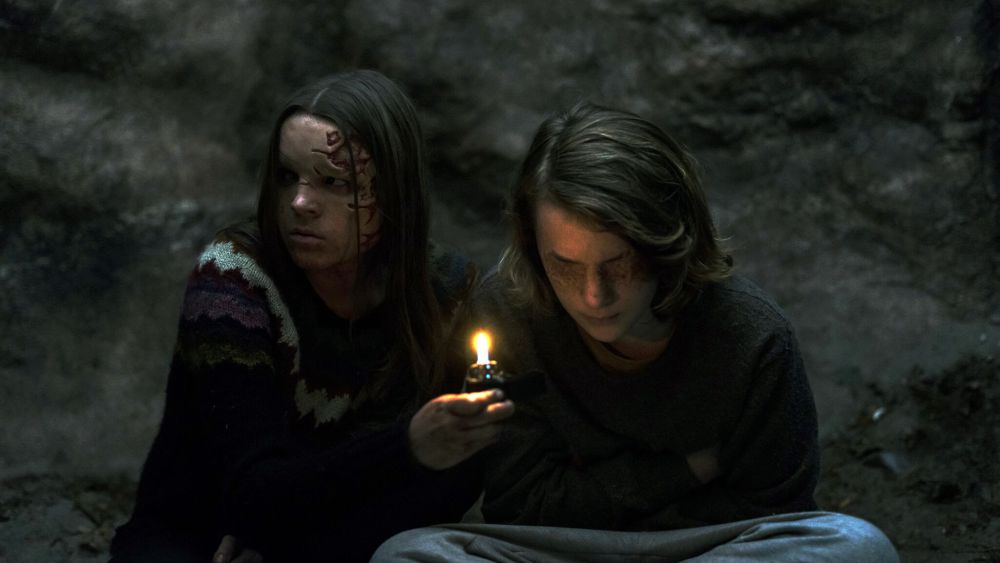
The blandly titled The Dark is, at its heart, a guide to overcoming trauma. Nadia Alexander is Mina, the creature that haunts Devil’s Den—a merciless, relentless, thoughtless killer. Until, that is, she comes across Alex, a blind young man (Toby Nichols) who reminds her of what she once was and what could have saved her.

Lange makes a series of clever narrative choices besides simply using our preconceived notions to surprise us. The Dark is, in part, a vengeance fable far less preoccupied by punishing those who do damage than those who should have been there for protection.

Alexander impresses as the beast unhappily and involuntarily rediscovering her humanity. Her silences, particularly in later scenes, are haunting.

As her mirror image and polar opposite, Nichols embodies vulnerability and resilience. There’s an optimism alongside a brokenness in his performance that is both necessary and heartbreaking.

The Dark occasionally skirts mawkishness, but what YA film doesn’t? In truth, Lange doesn’t run from the baggage associated with his chosen genres. He embraces it, forgives it, makes something powerful out of it.

Drive Safely

Green Book

by Hope Madden

What have the Farrelly brothers been up to?

Well, one of them (Peter) just updated Driving Miss Daisy. Nope, it is not a provocative but good natured spoof. It is Oscar bait.

The director and co-writer penned Green Book, a road picture telling the true tale of 1960s musician Dr. Don Shirley (Mahershala Ali) and Tony Vallelonga (Viggo Mortensen), the New York City nightclub bouncer Shirley hired to drive him throughout his tour of the deep South.

It’s a nice story, buoyantly directed. It’s another odd couple, two people with nothing in common who learn a lot from each other. And it’s hard to pick apart a true story for being so achingly convenient.

The film, co-written by Vallelonga’s son Nick, owes what artistic success it offers to two strong central performances.

Ali and Mortensen are veteran actors who just do not ever give an inferior performance. They are both excellent, always, and Green Book is no different. Their rapport and chemistry are the stuff of movie magic, and it is a joy to ride along with them.

Credit Mortensen for making more of Tony than a working class cliché, and to Ali for finding so many layers in what could have been a one-dimensional character. In his hands, Don Shirley is not simply the high class genius Tony first sees. Ali finds more in the character even than the lonely outsider Tony comes to understand. In Ali’s hands, there is a level of otherness, isolation and loneliness that borders on masochism, and it makes for a far more fascinating and far less knowable character.

Little else onscreen suggests layers.

Green Book is a film that tries very hard and wants so badly not to offend. Yes, the unlikely duo faces some challenges on their journey, but honestly, their struggle—indeed, everything about the movie—feels easy. Neutered.

Equally problematic is the point of view, which is, of course, the white male lead’s. It’s his lessons we’re really interested in, right? And he learns to have deep sympathy for Dr. Shirley.

But that is the primary problem with Green Book. It sympathizes greatly, but has absolutely no idea how to empathize.

Merry, Indeed

Robin Hood

by Hope Madden

Hey, do you guys remember Guy Ritchie’s King Arthur? I mean, of course you don’t. It made like $9.

Had it been anything other than a global box office disaster, a likeminded retooling of the British legend of Robin Hood might have made sense. And yet, here we have it: a poor man’s Guy Ritchie (Otto Bathurst) trying to anachronism his way through the old bandit’s tale.

Taron Egerton stars as the Hood, billed by imdb as “a war-hardened Crusader” but coming off more as a precocious 12-year-old. He’s joined by battlefield adversary and post-war comrade John (Jamie Foxx), who insists on calling him English regardless of the fact that they are in England and, you know, every single person is English. (Let’s not even talk about his accent.)

Eve Hewson and Tim Minchin round out the merry band as the politically liberal/inappropriately dressed Marian and the only actor who doesn’t embarrass himself, respectively.

Ben Mendelsohn shoulders the evil Sheriff of Nottingham duties this go-round. If you only know Mendelsohn from Ready Player One, Rogue One or Dark Knight Rises, please believe me when I say that he needs to stop playing scenery-chewing baddies. He is one of the most versatile and talented character actors in film today. Please go watch literally anything else he’s ever made. (Give yourself the gift of the Aussie film Animal Kingdom.)

Writers Ben Chandler and David James Kelly blandly reimagine Robin of Loxley’s origin story, casting aside any historical authenticity in favor of hip fun. Tragically, the result is never hip and rarely fun.

The film details some ludicrously debauched ties with the church and a global plot to bilk a few hundred peasants of more money than the whole of England would possess. Where do all those golden bowls and goblets come from? How many peasants are dining so flamboyantly?

They also reach to give the sheriff some Trumpian moments, though that backfires as well. As fine an actor as Mendelsohn is, it is tough for him to come off as a dumb ass.

The score feels cribbed, the action is video-game superficial and the costuming came directly from Forever 21.

Why did they make this movie again?

Fright Club: Best Mutant Animal Horror

It would not surprise us if we saw a new wave of ecological horror in which our own mistreatment of the environment and our irresponsible handling of pharmaceutical progress creates flesh hungry critters, pissed off two-headed bears, opioid addicted tapeworms, whatever. Let’s prepare by looking over history’s forewarnings, shall we?

Here are our favorite mutant animal films—cautionary tales about big pharma, careless planet keeping and sex.

5. Shivers (They Came from Within) (1975)

In an upscale Montreal high rise, an epidemic is breaking out. A scientist has created an aphrodisiac in the form of a big, nasty slug. That slug, though, spreads wantonness throughout the high rise and threatens to overrun the city with its lusty ways.

Not Cronenberg’s best film, but this is his first feature length horror and it announces not only his arrival on the genre scene, but it predicts so many of the films to come. The film obsesses over human sexuality, social mores, the physical form, physical violation and infestation, medical science, conspiracy, and free will. He’d revisit all of these preoccupations throughout his career, most obviously in his very next feature film, 1978’s Rabid, which is weirdly similar in every way.

Shivers takes a zombie concept and uses it to pervert expectations. (See what we did there?) They’re not here to eat your brains, after all. It’s the first film where Cronenberg marries ideas of the repugnant with the pleasurable, medical monstrosity with human body. It would be several years before his skill with performances (or maybe casting) matched his other directorial talents, but Shivers is still a worthwhile, utterly bizarre pleasure.

https://www.youtube.com/watch?v=eK9Wal9Dvic

4. Isolation (2005)

In 2016, writer/director/Irishman Billy O’Brien made an effective and lovely – yes, lovely – creature feature called I Am Not a Serial Killer. But about a decade earlier, he started down that path along a muddy, ruddy Irish roadside that wound ‘round to an out-of-the-way farm.

It’s the kind of a depressing, run-down spot that would catch nobody’s eye – which is exactly why it drew the attention of runaway lovers Jamie (Sean Harris) and Mary (a young Ruth Negga – wonderful as always). The solitude and remoteness also got noticed by a bio-genetics firm.

Down-on-his-luck Farmer Dan (John Lynch, melancholy perfection) has little choice but to allow some experimentation on his cows. He doesn’t really mind the required visits by veterinarian Orla (Essie Davis – hooray!).

But when one cow needs help delivering – genetic mutations, fetuses inside fetuses and teeth where no teeth belong. Nasty.

O’Brien and his truly outstanding cast create an oppressive, creepy, squeamish nightmare worth seeking out.

3. Black Sheep (2006)

Graphic and gory horror comedy seems to be the Kiwi trademark, no doubt a product of the popularity of native Lord of the Gastro-Intestinal-Splatter-Fest-Laugh-Riot, Peter Jackson.

First-time writer/director Jonathan King uses the isolation of a New Zealand sheep farm and the greedy evil of pharmaceutical research to create horror. He does it with a lot of humor and buckets full of blood. It works pretty well.

Evil brother Angus (Peter Feeney) has bred some genetically superior sheep while smart but sheep-phobic brother Harry (Nathan Meister) has been away. But the new sheep bite (a recurring problem with bio-genetically altered farm animals). Victims turn into, well, were-sheep. Of course they do.

The result is an endearing, often genuinely funny film. Cleverly written with performances strong enough to elevate it further, Black Sheep offers an enjoyable way to watch a would-be lamb chop get its revenge.

2. The Host (2006)
Visionary director Joon-ho Bong’s film opens in a military lab hospital in 2000. A clearly insane American doctor, repulsed by the dust coating formaldehyde bottles, orders a Korean subordinate to empty it all into the sink. Soon the contents of hundreds of bottles of formaldehyde find its way through the Korean sewer system and into the Han River. This event – allegedly based on fact – eventually leads, not surprisingly, to some pretty gamey drinking water. And also a 25 foot cross between Alien and a giant squid.

Said monster – let’s call him Steve Buscemi (the beast’s actual on-set nickname) – exits the river one bright afternoon in 2006 to run amuck in a very impressive outdoor-chaos-and-bloodshed scene. A dimwitted foodstand clerk witnesses his daughter’s abduction by the beast, and the stage is set.

What follows, rather than a military attack on a marauding Steve Buscemi, is actually one small, unhappy, bickering family’s quest to find and save the little girl. Their journey takes them to poorly organized quarantines, botched security check points, misguided military/Red Cross posts, and through Seoul’s sewer system, all leading to a climactic battle even more impressive than the earlier scene of afternoon chaos.

1. The Fly (1986)

After a couple of interesting, if un-medical films, the great David Cronenberg made a triumphant return to the laboratory of the mad scientist in his most popular film to date.

But it’s not just Cronenberg’s disturbed genius for images and ideas that makes The Fly fly; it’s the performance he draws from Jeff Goldblum.

Goldblum is an absolute gift to this film, so endearing in his pre-Brundlefly nerdiness. He’s the picture’s heartbeat, and it’s more than the fact that we like his character so much. The actor also performs heroically under all those prosthetics.

He and Geena Davis make the perfect pair, with their matching height and mullets, and their onscreen chemistry does give the film a level of human drama traditionally lacking from the Cronenberg canon. Atop that, there’s the transformation scene in the bathroom – the fingernails, the pustules – all classic Cronenberg grotesquerie, and still difficult to watch.

https://www.youtube.com/watch?v=7BzwxJ-M_M0