Tag Archives: Peter Farrelly

Wrapper’s Plight

Balls Up

by George Wolf

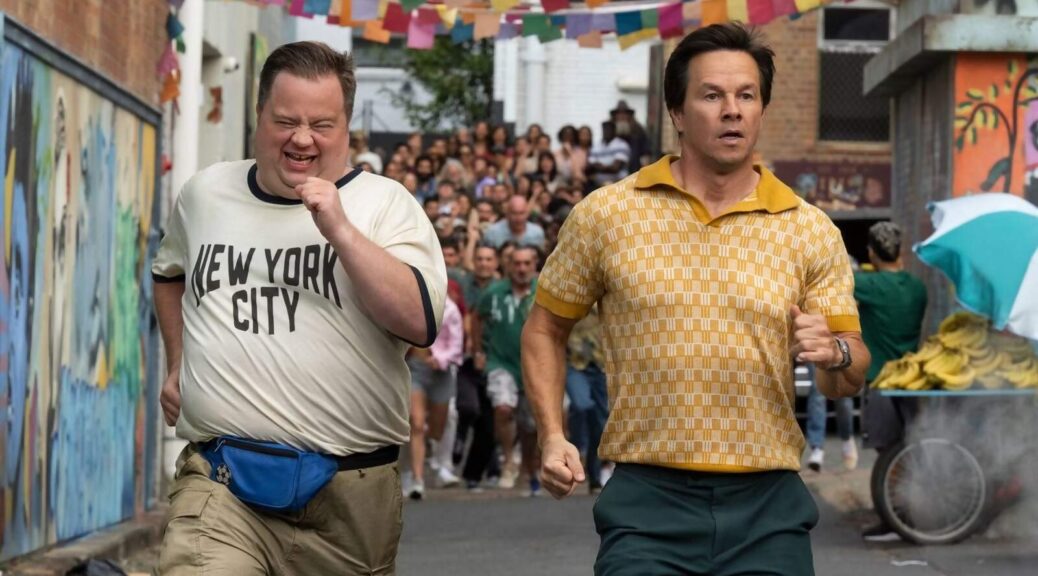
Is it funny to see Mark Wahlberg and Paul Walter Hauser bust out a lightly choreographed karaoke version of Goyte’s “Someone That I Used to Know?”

It is. But are there enough solid laughs in the rest of the film to make Balls Up a thumbs up?

Not quite.

Wahlberg is Brad from sales, and Hauser is Elijah from design, both reporting to boss lady Burgess (welcome delight Molly Shannon) at the Regal Blue condom company.

Elijah has designed a revolutionary condom that extends far enough to wrap the testicles, and Brad just landed the pitch to make “Balls Up” the official condom of the 2025 World Cup in Brazil!

“Raw Dog? Nah Dawg!”

The..ahem… head of the World Cup committee (Benjamin Bratt) is impressed enough to set the guys up with VIP treatment at the tournament. But things go so wrong so fast that Brad and Elijah become branded as “The Stupids,” two American villains on the run from a drug cartel kingpin (Sacha Baron Cohen) and any number of Brazilians who’d love to see them dead.

Speaking of drugs, this entire premise sounds like something two guys thought was freaking hilarious while they were high.

I don’t know if that’s true, but I do know writers Paul Wernick and Rhett Reese have scripted funnier movies. Like Zombieland, or Deadpool, or Deadpool & Wolverine. In comparison this one feels like something that could have been abandoned when they sobered up.

Hauser has the dim-witted schlub act down cold, but as talented as he is, he’s not enough of a comic presence to offset Wahlberg’s struggles with timing and delivery. The Other Guys worked because Wahlberg’s contrast with the effortlessly funny Will Ferrell was instantly engaging. This pairing is constantly in search of real chemistry, and director Peter Farrelly seems helpless to uncover it.

Farrelly has certainly had success with below-the-belt comedy (Kingpin, Dumb and Dumber, There’s Something About Mary), but Balls Up becomes just the latest streaming effort to string together inane antics and hope for the best.

This one just gets worse as it is goes, and after an hour and forty minutes of unfunny, you give up that hope.

Drive Safely

Green Book

by Hope Madden

What have the Farrelly brothers been up to?

Well, one of them (Peter) just updated Driving Miss Daisy. Nope, it is not a provocative but good natured spoof. It is Oscar bait.

The director and co-writer penned Green Book, a road picture telling the true tale of 1960s musician Dr. Don Shirley (Mahershala Ali) and Tony Vallelonga (Viggo Mortensen), the New York City nightclub bouncer Shirley hired to drive him throughout his tour of the deep South.

It’s a nice story, buoyantly directed. It’s another odd couple, two people with nothing in common who learn a lot from each other. And it’s hard to pick apart a true story for being so achingly convenient.

The film, co-written by Vallelonga’s son Nick, owes what artistic success it offers to two strong central performances.

Ali and Mortensen are veteran actors who just do not ever give an inferior performance. They are both excellent, always, and Green Book is no different. Their rapport and chemistry are the stuff of movie magic, and it is a joy to ride along with them.

Credit Mortensen for making more of Tony than a working class cliché, and to Ali for finding so many layers in what could have been a one-dimensional character. In his hands, Don Shirley is not simply the high class genius Tony first sees. Ali finds more in the character even than the lonely outsider Tony comes to understand. In Ali’s hands, there is a level of otherness, isolation and loneliness that borders on masochism, and it makes for a far more fascinating and far less knowable character.

Little else onscreen suggests layers.

Green Book is a film that tries very hard and wants so badly not to offend. Yes, the unlikely duo faces some challenges on their journey, but honestly, their struggle—indeed, everything about the movie—feels easy. Neutered.

Equally problematic is the point of view, which is, of course, the white male lead’s. It’s his lessons we’re really interested in, right? And he learns to have deep sympathy for Dr. Shirley.

But that is the primary problem with Green Book. It sympathizes greatly, but has absolutely no idea how to empathize.
