Tag Archives: movies

Pace that Kills

Running with the Devil

by Hope Madden

A tale told in bathrooms, Running with the Devil travels with The Cook (Nicolas Cage), a high ranking jefe in an international cocaine cartel.

He’s a jefe, but he’s not El Jefe. That’s Barry Pepper, as The Boss, and he has other pressing concerns. El Jefe needs The Cook to travel with his product from the farm where it’s produced through the forests, mountains, backstreets, highways and checkpoints to the hands of the dealers who sell it, so he can determine just where the other problem lies.

So while The Agent in Charge (Leslie Bibb) and Number One (Peter Facinelli) investigate suspicious OD’s stateside, The Cook heads south for his own form of investigation.

A word about character names. Writer/director Jason Cabell offers labels as opposed to your traditional Paul or Paulas. That would be interesting if the labels were fun or even on-the-nose, but The Cook? This isn’t meth. He actually just owns a restaurant on the side, which has nothing to do with anything, but I guess Cartel Middle Manager didn’t have the right zing.

Another word about Number One (Facinelli). This guy. He’s the trusted back up to The Agent in Charge. He’s the guy who gets stuck heading to the border to wait for the shipment. And he is the single most conspicuous person on earth. He’s like a Tom of Finland illustration come to life and dressed in JC Penney’s best.

Anyway, Cabell structures his film to draw tension and excitement from the inevitable collision between The Cook (Cage) and The Man (Lawrence Fishburne).

OK.

They may be borderline-geriatric badasses, but both have certainly cut interesting cinematic figures. What can they do together?

Well, in this case, they can disappoint. You can’t lay this on Fishburne’s portrayal. His commitment to the pursuit of cocaine and prostitutes impresses.

Unfortunately, this is one of those Nic Cage movies where he doesn’t cut loose—doesn’t go all Nic Cage on you. This means he has to act, but he more or less chooses not to. You get a flash here, a flutter there, but the naked truth is that Nicolas Cage has no idea how to behave like a regular person. The Cook is too ordinary a man for Nicolas Cage to properly portray.

And without the needed distraction of a Full On Cage, it’s tough not to notice the narrative inconsistencies, trite dialog, stupid character names.

I mean, Facinelli does what he can with that mustache to keep your attention, but when it comes to the school of Glorious Explosive Train Wreck Acting, he’s no Nic Cage.

A Series of Infuriating Events

Official Secrets

by Christie Robb

Director Gavin Hood grounds the shitshow that was the 2003 Iraq invasion in the intimate true story of the British Intelligence whistleblower, Katherine Gun (Keira Knightley).

Gun comes across an NSA email directing the British government to spy on smaller nations in the UN Security Council in order to blackmail them into voting for war. Attempting to avert an unjust war and save lives, Gun leaks the document to the press. But in doing so, she’s in violation of the Official Secrets Act.

The Observer’s front-page story, based on the email, makes international headlines. Unfortunately, it’s almost immediately delegitimized when an office drone tragically runs the article through spell check, changing the Americanized spelling of “favorite” to the British “favourite”—causing speculation that the entire email was a fake planted by the then-popular antiwar movement.

Gun confesses to the leak and is arrested, throwing her life into chaos. Knightley spends most of the film believably portraying a woman constantly on the edge of throwing up as she is bullied relentlessly by the state.

The film is praiseworthy in the way it covers a civilian taking a moral stand against a corrupt state.

Unfortunately, it’s also a bit unfocused, splitting attention between Gun,
her lawyer (Ralph Fiennes), and reporter Martin Bright (Matt Smith). Director Hood (Eye in the Sky, Ender’s Game) never manages to create a single narrative out of his multiple threads, making it tough to remain invested with any one particular storyline.

Urban Jungle

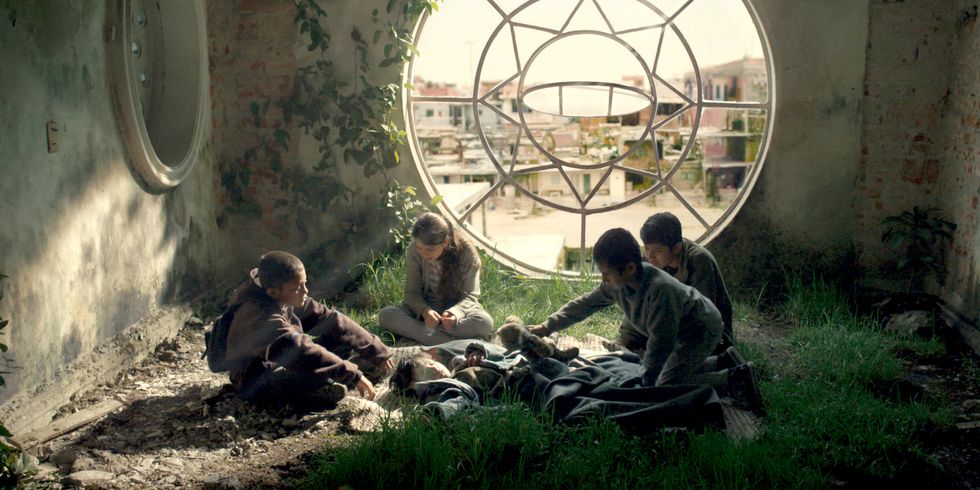
Tigers Are Not Afraid

by Hope Madden

Comparing most films to Pan’s Labyrinth would be setting a bar too high. Guillermo del Toro’s macabre fable of war and childhood delivers more magic, humanity and tragedy than any one film should be allowed.

And yet, it’s hard to watch Issa Lopez’s Tigers Are Not Afraid without thinking about little Ofelia, the fairies and the Pale Man.

Lopez’s fable of children and war brandishes the same themes as del Toro’s masterpiece, but grounds the magic with a rugged street style.

Tigers follows Estrella, a child studying fairy tales—or, she was until her school is temporarily closed due to the stray bullets that make it unsafe for students. As Estrella and her classmates hide beneath desks to avoid gunfire, her teacher hands her three broken pieces of chalk and tells her these are her three wishes.

But wishes never turn out the way you want them to.

There is an echo through Latin American horror that speaks to the idea of a disposable population. You find it in Jorge Michel Grau’s brilliant 2010 cannibal horror We Are What We Are and again in Emiliano Rocha Minter’s 2016 taboo-buster, We Are the Flesh.

Lopez amplifies that voice with a film that feels horrifying in its currency and devastating in the way it travels with the most vulnerable of those discarded people.

Estrella is befriended by other orphans in her city, each aching with the loss of parents and each on the move to escape the dangers facing the powerless.

Though Tigers bears the mark of a del Toro – Labyrinth as well as The Devi’s Backbone – it can’t quite reach his level of sorrowful lyricism. It makes up for that with the gut punch of modernity. Though this ghost story with tiny dragons and stuffed tigers is darkly fanciful, it’s also surprisingly clear-eyed in its view of the toll the drug war takes on the innocent.

It’s Latin American horror at its best.

Born Again

Depraved

by Hope Madden

It is tough to find a fresh direction to take fiction published 201 years ago, let alone a tale already made into countless films. Is there a new way—or reason—to look at the Frankenstein fable?

Writer/director/horror favorite Larry Fessenden thinks so. He tackles the myth, as well as a culture of greed and toxic masculinity, with his latest, Depraved.

Adam (a deeply sympathetic Alex Breaux) is kind of an act of catharsis for Henry (David Call). A PTSD-suffering combat medic, Henry is so interested in finding a way to bring battlefield fatalities back to life that he doesn’t even question where his Big Pharma partner Polidori (Joshua Leonard, in another excellent genre turn) gets his pieces and parts.

Here’s a question that’s plagued me since I read Shelley’s text in 8th grade. Why take parts of cadavers? Why not bring one whole dude back and save all that time and stitching effort? Frank  Henenlotter (Frankenhooker) and Lucky McKee (May) found answers to that question. Fessenden isn’t worried about it.

He’s more interested in illuminating the way a culture is represented in its offspring. Pour all your own ugly tendencies, insecurities and selfish behaviors into your creation and see what that gets you.

Fessenden isn’t subtle about the problems he sees in society, nor vague about their causes. Depraved is the latest in a host of genre films pointing fingers at the specific folks who have had the power to cause all the problems that are now coming back to bite us in the ass.

It’s the white guys with money because, well, because it is.

Along with Leonard’s oily approach and Breaux’s tenderness, the film boasts solid supporting work from Chloe Levine (The Transfiguration, Ranger) and especially Addison Timlin, who is great in a very small role.

There is a sloppy subtext here, charming in its refusal to be tidy, about the man Adam used to be (or one of them), the girl he didn’t really appreciate, and the way, deep down, a mildly douchy guy can learn a lesson about self-sacrifice.

In its own cynical way, Depraved does offer a glimmer of hope for mankind. Fessenden doesn’t revolutionize the genre or say anything new, though, but you won’t leave the film wishing Shelley’s beast would just stay dead.

I Don’t Want to Go Out—Week of September 9

What a good week to check out some pretty visionary, interesting filmmaking. And also Aladdin.

Oh, I’m kidding. Aladdin‘s fine.

Click the film title to link to the full review.

The Dead Don’t Die

John Wick 3 – Parabellum

Echo in the Canyon

Aladdin

https://www.youtube.com/watch?v=foyufD52aog

Tale of Two Mothers

The Wrath

by Hope Madden

This week, Shudder premieres a Korean ghost story, and there is always reason to be optimistic about a Korean ghost story.

Young-sun Yoo’s The Wrath revisits Hyeok-su Lee’s somewhat obscure 1986 period thriller, Woman’s Wail. A young woman of humble birth is brought to the ancient home of a high ranking Korean official, ostensibly to marry his youngest son. In truth, she’s been brought here to trick a vengeful spirit.

What unspools is a historically set spectral tale of family dysfunction, classism, sexism, and women who hate other women—or, in a single label, the horrors of patriarchy. All of which has been done before, and better. (Please see Jee-woon Kim’s masterpiece A Tale of two Sisters. Seriously, please see it.) But The Wrath is a very pretty film that delivers a fairy tale quality and solid performances.

The Wrath is more of a spook show than Two Sisters, with lots of wraiths and jump scares, lots of blood spitting and black ooze spitting and blood spatter and arterial spray, plus gorgeous costumes and a well-designed and well-used set.

The film drops us into a story in progress. A young girl (Na-eun Son) traveling to the secluded property is intercepted by a well to do son returning home. His step-mother (Young Hee Seo, wonderful), who appears to be head of the household, offers a chilly reception to both travelers.

Soon the girl is pregnant, the son is dead, and there’s something suspicious out in the storage shed.

Yoo’s film works best when he doesn’t try to explain too much. Heavy-handed flashbacks to the events that led to the family’s curse feel perfunctory and uninspired, while the hinted at spookiness generates more atmosphere.

For a period film, Yoo contains the environment to create something both believable and economical, the image of a very pretty yet desolate trap.

Na-eun Son, whose role offers the most layers, particularly impresses, but the whole cast embraces these somewhat slightly written characters. Each performer draws on period appropriate attitudes and, more importantly, finds a way to generate chemistry with the others trapped in the same confined quarters.

If you’ve seen much from Korea’s deep cinematic closetful of wronged-women-turned-vengeful-spirit options, there are few real surprises to be found in The Wrath. It’s a capably made film that wastes little time, boasts strong performances and offers familiar but creepy fun.

So Much Drama in the NYC

After the Wedding

by Brandon Thomas

The adult drama has all but vanished from American multiplexes. Sure, the occasional Oscar-baity title sneaks through around the holidays, but those mom-pleasing, bring your hanky dramas of yesteryear are pretty much a thing of the past. 

Despite the presence of A+ talent and an overall intriguing story, After the Wedding isn’t the shot in the arm the genre was looking for.

A retread of Susanne Bier’s 2006 Oscar nominee for foreign language film, After the Wedding follows Isabel (Michelle Williams), who is living a fulfilling, productive life running a small orphanage in Kolkata.

After an extremely generous donation offer is made to the orphanage, Isabel travels to New York to meet Theresa (Julianne Moore), the benefactor. Unexpectedly invited to the wedding of Theresa’s daughter, Isabel finds herself face-to-face with a man from her past (Billy Crudup), and a 20-year-old decision that will shake her to her core.

After the Wedding trips up right out of the gate by leaning so heavily into melodrama. Instead of an emotionally weighty dramatic piece anchored by an amazing cast, this film latches on to genre cliches and doesn’t let go.

Deep, dark family secrets? Check. Mystery illness? Check. Sneaky motivations? Double check. The movie is one evil twin away from being a bad episode of General Hospital.

Did I mention the amount of teary-eyed yelling? There is plenty.

The only real sense of urgency comes from the movie being in a rush to get to that next dramatic reveal. The characters, and likewise the audience, are never given the chance to dwell on what just happened. The experience feels cheap and anticlimactic.

Moore and Williams continue to show that they’re national treasures, but even they can only do so much with the material afforded them. The two actresses share multiple scenes together, but any emotional weight is often deflated by the scattershot script—co-written by director Bart Freundlich (Moore’s husband)— jumping from one unearned character beat to the next. These people feel like a blended mix of every character seen in indie dramas instead of being fully-formed individuals.

Despite reeling in a Who’s Who of a cast, After the Wedding never becomes anything more than a Who Cares.