Tag Archives: movie reviews

American Gothic

The Eyes of My Mother

by Hope Madden

The Eyes of My Mother will remind you of many other films, and yet there truly is no film quite like this one.

First time feature writer/director Nicolas Pesce, with a hell of an assist from cinematographer Zach Kuperstein, casts an eerie spell of lonesome bucolic horror.

Shot in ideal-for-the-project black and white, an Act 1 event could come from any number of horror films. A mother looks out her window to see her young daughter, playing alone in the front lawn, talking with a stranger. There is something clearly wrong with the stranger, and things take a bad turn. But for Pesce, this simple, well-worn set-up offers endless unexplored possibilities. Because this bad man doesn’t realize that the isolated farm family he’s come to harm is very comfortable with dissection.

His film is told in three parts. Part 1, with the stranger, sees the young Francisca (Olivia Bond) finding her role in her family. It changes after the stranger’s visit.

Parts 2 and 3 catch up with the family quite a few years later. The now-grown Francisca (Kika Magalhaes) takes some extreme measures to end her loneliness.

There is much power in dropping an audience into a lived-in world – the less we know, the better. Pesce understands this in the same way Tobe Hooper did with The Texas Chainsaw Massacre, and though The Eyes of My Mother lacks the cynicism, satire and power tools of Hooper’s farmhouse classic, it treads some similar ground.

Where Eyes differs most dramatically from other films is in its restraint. The action is mostly off-screen, leaving us with the sounds of horror and the quiet clean-up of its aftermath to tell us more than we really want to know.

As retrained as it is, The Eyes of My Mother hardly lacks in sensual experience. Stunning, gorgeously lit frames are matched with garish sound editing.

Kuperstein’s cinematography is sometimes almost Malick-like. Pesce focuses that camera on nearly silent moments full of traumatic images. He creates dissonance between the peaceful, idyllic scenes and the pinpoint imagery, the horrifying sounds.

The quiet amplifies Francisca’s isolation. The sounds amplify something else entirely.

Though Eyes of My Mother is reminiscent of several Seventies horrors, its muted telling exposes a patience rarely found in the genre. Pesce repays you for your patience.

Verdict-4-0-Stars

Come Out at Night

Nocturnal Animals

by Hope Madden

Style, elegance and crippling loneliness – though Tom Ford’s two films seem to be wildly different beasts, the same solitude and heartbreak inform both.

Like George (Colin Firth) in Ford’s incandescent 2009 feature debut A Single Man, Susan (Amy Adams) is at a crossroads in life with a future that looks unbearably grim.

Nocturnal Animals follows present-day Susan, a successful gallery owner struggling to keep up appearances in her marriage and finances, who’s surprised to receive a manuscript written by her first husband, Edward. Alone in her austere LA home, she reads through the night.

We flash occasionally to the Susan of 20 years ago (also played by Adams), just settling into a nurturing romance with Edward (Jake Gyllenhaal) – the sensitive writer dubbed “too weak” by Susan’s mother (played with bitter relish by Laura Linney).

But most of the film is dedicated to Edward’s novel, Nocturnal Animals.

Unlike the over-the-top style of the film’s “real world,” the novel-come-to-life has its own aesthetic – dusty, sunburnt and chaotic. As the novel’s hero Tony – also played by Gyllenhaal – drives through West Texas with his wife and daughter, he runs afoul of three not-so-good-old-boys.

Adams-lookalike Isla Fisher plays Tony’s wife, which hints at the themes driving the ex-husband’s work. The internal narrative plays like an arthouse twist on a traditional testosterone-laden revenge fable – and the film itself is about revenge, to a degree, just not the kind you might find in Charles Bronson’s Death Wish.

The world Ford creates inside the novel is its own surprising destination, playing with preconceived notions and haunting us with one startling image after another. The always wonderful Michael Shannon, along with a freakishly believable Aaron Taylor-Johnson, give the novel’s screen time a current of authenticity and terror.

Gyllenhaal and Adams – two of the strongest actors in film today – work wonders. Playing the same character caught twenty years apart, Adams reflects both the change the decades have left on Susan, as well as those elements of her personality that remain with her.

Gyllenhaal is likewise nuanced and powerful. While his two characters are separate entities, they are, in many respects, the same person. The strength across the film – and also its weakness – is the way the internal narrative informs and is informed by the real world of the characters.

The structure, the style, the sound – every aesthetic choice – is meticulous, but there’s a tidiness in the manufacturing of the movie that makes the way themes play out feel too orderly.

It’s a minor flaw, but it’s enough to keep Nocturnal Animals from reaching noir/pulp/arthouse mash-up heights of Blue Velvet or Drive. It’s not enough to keep it – particularly its many award-worthy performances – from being remembered at the end of the year, though.

Verdict-4-0-Stars

Beltway Badass

Miss Sloane

by Hope Madden

I’m curious. Is every film going to take on sharper, darker political meaning post-election? Because Miss Sloane definitely does.

First time screenwriter Jonathan Perera’s much-lauded screenplay documents Elizabeth Sloane, DC super-lobbyist. Driven and single-minded to a nearly sociopathic degree, Sloane finally finds a line she’s unwilling to cross when the gun lobby wants to hire her to make guns more appealing to women.

She abandons the big time firm that demands she rethink her gun-control stance and goes to work instead for the liberal opposition.

Though far from flawless, Miss Sloane has a lot to offer. Mainly, Jessica Chastain.

Her fierce performance and comfort with ambiguity come together in a turn that mesmerizes. This is an anti-hero, and Chastain gives her enough savvy, contempt, drive, self-loathing and vulnerability to make her fascinating. Not knowable, but forever provocative.

Though no other character in the film is nearly so fleshed out, a game supporting cast – including the welcome Michael Stuhlbarg and a pitch-perfect Mark Strong – help balance Chastain’s blistering presence.

Director John Madden – whose work tends toward the safer and tamer (Shakespeare in Love, Best Exotic Marigold Hotel) – here amplifies Chastain’s fiery delivery with frenetic camera movement and sudden close ups. He creates a pace that keeps attention, even when the screenplay begins to slog.

What’s exceptional about the film, aside from Chastain, is the way its core plotline and its greater themes work together. The us-versus-them battle, with each lobbyist one-upping the other in the most unconscionable (yet clever) ways, commands attention. But beneath all that Miss Sloane clarifies the way in which the American public is never privy to true information.

What we get, in its stead, is the narrative being pushed in increasingly obfuscated ways by different stakeholders.

The film builds to speechifying and heavy moralizing, often feeling too clever for its own good. It settles, while its titular firebrand would not. But before all the self-righteous Aaron Sorkinisms, Madden, Perera and Chastain get an awful lot right.

They push envelopes when it comes to a female anti-hero, answering only as many questions as necessary and leaving room for Chastain’s performance to fill in some gaps.

Together they also unleash an appropriately cynical view of a political system that is rotten.

Verdict-3-0-Stars


Apologize

Incarnate

by Hope Madden

Aaron Eckhart is a conundrum, isn’t he? He’s talented enough to land any indie gem, granite-jawed and handsome enough to elevate it to mass market appeal. Think Thank You for Smoking.

And yet, for every Rabbit Hole there’s an I, Frankenstein; for every In the Company of Men, an Incarnate.

His latest – his fourth of this calendar year – sees Eckhart as the wheelchair-bound, unshaven, grimacing Dr. Seth Ember. He’s damaged, damn it!

Don’t call him an exorcist. He doesn’t exorcise demons; he evicts supernatural parasites. He has an ability. You see, when he was young, he realized, “When I was asleep I could go into the minds of the possessed.”

How did he figure this out? How often did he get drowsy in the proximity of a possessed person?

No matter – can’t you see he’s damaged?!

When a liaison to the Vatican (Catalina Sandino Moreno) – don’t even get Dr. Seth started on the church! – lures him to a case of a possessed 11-year-old, it isn’t to save the boy. Oh no.

No?

No. It must have something to do with his damage. I’ll bet director Brad Peyton (that genius behind San Andreas) will soap-opera direct some weirdly stilted, flat and extreme-close-up-laden bit of ponderousness explaining the whole thing, but you will have lost the will to live before it’s all clarified.

There is one moment – not a scene, but a single moment – in this film where I believed Peyton might, maybe, possibly do something interesting.

Nope.

Worst thing about Incarnate? It’s not the made-for-SyFy-CGI. Not the superficial storyline, not the flatly uninspired direction. (Honestly, if Peyton had directed from inside a coma the film couldn’t have looked or felt more lifeless.)

It’s not the tedious ensemble performances, not the wildly predictable series of twists. It’s Eckhart. It’s as if he’s angry at us that he took this dog.

We didn’t make you do it, Aaron. We only sat through this festering corpse of a movie because you were in it.

I believe we’re owed an apology.

Verdict-1-0-Star

https://www.youtube.com/watch?v=LUVwbhc0j18

Unfair and Unbalanced

Christine

by Hope Madden

There’s a moment in Christine – Antonio Campos’s clinical character study of ‘70s on-air reporter Christine Chubbuck – when a violently depressed Christine chastises her mother’s parenting. Had she been a better parent, maybe Christine would understand how the world worked.

There is such honest, bewildered frustration in that moment. With that single thought, a career-best Rebecca Hall exposes Chubbuck’s isolated, lonely, crippled soul.

We’re invited to join the stormy decline of Chubbuck’s life. An awkward, severe professional at odds with the era’s sensationalistic news trends, Chubbuck clashes with her Sarasota station’s news manager (Tracy Letts) and pines for its handsome anchor (Michael C. Hall).

Chubbuck’s professional frustrations and personal isolation come to a head simultaneously. Thanks to Hall’s meticulous performance, what we can see is that the emotionally brittle, deeply depressed Chubbuck hasn’t the resilience to contend with it.

Hall’s body language, her gait, her facial expressions and her speech amplify her character’s growing turmoil. It’s a creeping darkness that grows to be almost unbearable before bursting into an eye-of-the-storm calm that’s even eerier for its realism.

Though Craig Shilowich’s screenplay leans too heavily on frustrated spinsterisms as a handy excuse for Chubbuck’s behavior, and Campos’s direction intentionally keeps Christine at arm’s length, Hall’s harrowing turn guarantees that Christine Chubbuck makes an impression.

Campos’s disturbing 2012 horror Simon Killer remained intentionally distant as well – a provocative approach that suited the mystery of the titular sociopath. Here, though, it feels too chilly, almost heartless.

That seems inappropriate, because neither Chubbuck nor those she left behind were heartless. In fact, one of the great successes in Hall’s performance is her ability to personify Chubbuck’s amazingly off-putting, alienating behavior while simultaneously pointing out that most of us are only a few social misjudgments away from pariah status ourselves.

Inevitably, the film feels like a 110-minute prelude to Chubbuck’s infamous on-air suicide, and that’s where Campos and Shilowich’s weaknesses show. What was at the heart of Chubbuck’s final display – institutional sexism, unending loneliness, mental illness, professional integrity, irony?

The filmmakers showed a great deal while exploring very little, but thanks to a performance likely to be remembered come awards season, Rebecca Hall makes sure Chubbuck’s struggle resonates.

Verdict-3-5-Stars

When They Go Low, We Fly High

The Eagle Huntress

by Cat McAlpine

The documentary opens on a man standing on a snowy ridge. With him are three animals: a horse, a goat, and an eagle. The man sacrifices the goat, sets the eagle free, and then slowly trots into the distance on the back of his horse. Cut to a school classroom, where we find 13 year old Aisholpan in braids.

Director Otto Bell deftly handles his Mongolian setting with equal care to the rich history, steeped in tradition and the modern life that the people now lead. He never patronizes the culture – a nasty habit of film makers delving into a new setting. Nomads, how quaint! Traditional regalia, how mystic! Instead, Bell simply shows life as it is today, a culmination of everything that came before.

Aisholpan is a young girl who boards at school during the week, and goes home on the weekends. She likes giggling with her friends, helping her dad with the family livestock, and wants to be an eagle hunter. A woman has never been an eagle hunter before, let alone a girl, but this doesn’t seem to phase Aisholpan.

There are, however, many old men who have quite a few grievances with a woman becoming an eagle hunter. “Who would make the tea?” “Women are too weak,” and “She’ll have to get married eventually.”

It’s a great use of the “talking heads” trope of documentaries. A series of men sitting in a tent, talking about how women can’t and shouldn’t hunt. Meanwhile, Aisholpan is doing just that.

Bell produces a film with a clear narrative and story arc, but the tale never stops feeling organic. The style of the film seems to shift seemlessly with need. Distant contemplative shots are evenly mixed with tight close-ups. Sometimes an eagle’s eye view shows off the vast landscapes. Sometimes the camera is literally strapped to an eagle. This ever-changing style, fluid to capture each moment at its best, suits the world Aisholpan lives in.

One of the best shots of the film is not a beautiful snowy mountain or a dramatic slow motion shot of an eagle in flight. It’s Aisholpan herself, having just fed her eaglet bloody, raw meat, now painting her sister’s nails a shade of purple. The eaglet sits beside them, on a stump, while the two girls chatter away. Aisholpan’s world is not just about dualities, but multitudes. Her desire to become an eagle huntress is not just an affront to the men who uphold the noble sport today, but all the generations that came before them.

Aisholpan never seems too threatened by the grumblings of old men, though. In fact she hardly raises the matter. She simply wants to be an eagle hunter like her father, and her father’s father. Because her father and grandfather support her, she imagines few other obstacles. The most inspiring bit is, becoming an eagle hunter is not Aisholpan’s highest aspiration, it’s just what she wants to do right now. When she grows up, she wants to be a doctor.

And I’m sure she’ll be a great one.

Verdict-4-0-Stars

Spy Versus Spy

Allied

by Hope Madden

In turns grand and intimate, Allied blends pulp and melodrama with old Hollywood glamour.

We open on a dashing Max Vatan (Brad Pitt), landing in a North African desert where he’ll be met by a mysterious driver delivering his new identity. Vatan will join French Resistance fighter Marianne Beausejour (Marion Cotillard) in Casablanca on a mission to assassinate a Nazi official.

Director Robert Zemeckis’s vintage spy thriller begins with a bang. Stylish and gorgeous, the first act embraces an old-fashioned dazzle that suits both Pitt and Cotillard.

Problems arise – for Vatan and Beausejour, as well as the film – once the couple relocates to London. Vatan takes a desk job with the Royal Air Force while his new wife and child wait lovingly at home. But when command turns up evidence that Marianne could be a German spy, this ideal life begins to crack.

Both Cotillard and Pitt perform respectably with a script involving tensions that reach toward the ludicrous. Pitt carries himself with a weird stiffness, but his face wears joy, weariness and emotional tumult in a way that the actor has rarely managed.

Cotillard is characteristically excellent, her own demeanor turning the edge of every expression with a hint of something sour. She is effortlessly mysterious, a characteristic required for the part.

Steven Knight’s screenplay loses momentum once the couple settles into their homey London life, and for all Zemeckis’s visual wizardry, the balance of the film never recaptures the thrill of their early adventures.

Instead, we settle for several gloriously shot sequences – a love scene inside a car beset by a sandstorm, a party interrupted by an air raid. But even the tensest late-film moments feel staged, even borrowed.

Knight’s writing tends to play better with grittier, more street-savvy direction (think Eastern Promises or Dirty Pretty Things), but Zemeckis likes a big stage. The result, though often entertaining because of solid performances, is too much of a mishmash to really work.

Verdict-3-0-Stars

What’s In a Name?

Loving

by Hope Madden

Like Barry Jenkins’s miraculous Moonlight, the new film from Jeff Nichols offers a needed, optimistic reminder that progress is not dead and the ugliness of hatred need not win – even when it looks like it has already won.

Like so many of Nichols’s films – his 2012 Huck Finn-esque Mud, in particular – Loving boasts an intimate, Southern storyteller’s lilt. Here the writer/director quietly shares the triumphant story of the couple whose Supreme Court case made interracial marriage legal in the US.

In 1958, Mildred (Ruth Negga) and Richard Loving (Joel Edgerton) married. Richard was savvy enough to have the ceremony conducted in D.C., but upon returning to their rural Virginia home, the two were arrested for breaking the state’s anti-miscegenation laws.

What follows, with admirable restraint, is a look at the couple’s struggle to live as they want, where they want.

Nichols conducts the effort with an understatement that gives certain small moments and images true power. Never splashy and far from preachy, Loving sits with an otherwise ordinary family and lets their very normalcy speak volumes about the misguided hate that would separate them.

His is a beautiful film anchored by Negga’s graceful, modest turn. Though legalizing the union was Richard’s idea – formally marrying and hanging the framed license in their home – it’s Mildred who is unbending, and in Negga’s hands, this will spills over with compassion and hope.

Edgerton’s Richard is a tougher nut. A man of few words, Richard would just as soon avoid the flashy lawyers and press that draws attention to his life. He just wants everyone to leave his family alone and, in return, his family won’t bother anyone.

Nichols may dial the drama down a bit too much, truth be told. Though the outcome of the court case hangs over the last reel like a dark cloud, the true, national impact of this victory and the potentially dire consequences of a defeat are barely whispered.

The approach does give the film a lovely intimacy, though. And it reminds us that progress, though hard-won and often ugly in its pursuit, can be won.

Verdict-4-0-Stars

Polynesian Princess

Moana

by Hope Madden

Disney’s no Pixar, but in 2016 that doesn’t seem to matter. In an ocean of excellent animation this year, Disney’s Zootopia stands out as quite possibly the best – certainly the most relevant. While their holiday release, Moana, returns to some tried-and-true-and-tired tropes, it frees itself often enough from Disneyisms to become yet another strong ‘toon from the studio.

The animation behemoth never strays for too long from its merch-encrusted path. Yes, Moana (Auli’i Cravahlo) is a Disney princess. She’s the daughter of a Polynesian chief, but as demigod Maui (Dwayne Johnson) points out, “You’re wearing a dress, you have an animal sidekick – you’re a princess.”

Yes, she’s a princess who yearns for more than the responsibilities life affords her. (Mercifully, that dream never does involve a beau.) There are songs of self-actualization and the thrill of adventure. There’s a lot that’s familiar.

Set generations ago in the Polynesian islands, the film tells of the ancient demigod Maui – a shapeshifter who used his magical fishhook to steal the heart of the earth goddess, dooming the islands to eventual peril. Moana is called by the sea to find Maui, retrieve his hook and return the heart to save her people.

Moana draws comparisons to The Little Mermaid, Aladdin, Pixar’s Brave – hell, there’s even a bit of Mad Max on the high seas (nice!). But the film ultimately carves out its own presence, partly due to a refreshing cultural change.

From music to art to tattooing, the film offers more than a patronizing nod to Polynesian historical context. Also refreshing: sturdier looking characters, a lack of (creepy, pre-adolescent) love story, quiet mockery of standard Disney motifs, one fantastically jewel-encrusted crab.

Jemaine! The always welcome Jemaine Clement voices one of the many dastardly creatures Moana and Maui encounter on their trek, and he’s almost Tim Curry glorious. (He also has the best song in the film.)

He’s just one baddie in a film littered with fascinating menaces – from the coconut pirates (no, they don’t steal coconuts – they are coconuts) to various undersea dangers to the lava demon the heroic duo must defeat to save the world.

Johnson steals most of the film. With broad humor to match Maui’s enormous, ornately tattooed body, his chemistry with the teen voyager is nearly as entertaining as his struggles to shape shift.

The film has its troubles, including a slog of a first act, but Moana contains more than enough freshness to offset its weaknesses and guarantee holiday family fun.

Verdict-3-5-Stars

Bizarre Billionaire Love Triangle

Rules Don’t Apply

by Matt Weiner

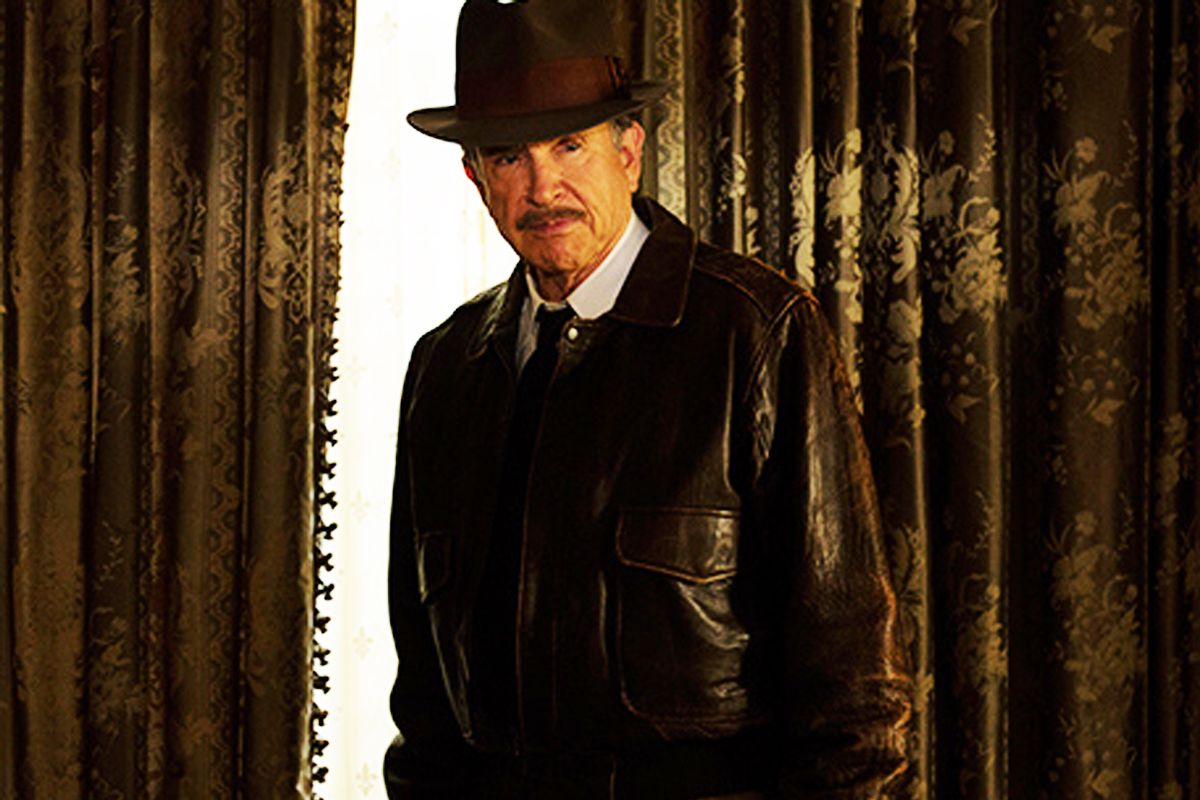
Warren Beatty is back behind the camera for his fifth feature film in almost as many decades. Rules Don’t Apply, also co-written and co-produced by Beatty, follows the lives of Hollywood newcomers Frank Forbes (Alden Ehrenreich) and Marla Mabrey (Lily Collins), each depending on the graces of billionaire Howard Hughes (Beatty) for their big breaks—Marla as an aspiring actress, Frank as a budding businessman.

When Frank gets assigned as Marla’s designated driver for the film studio, the two quickly bond over their shared determination to make it in a world where they both feel like outsiders stifled by tradition.

Hughes looms large over Frank and Marla’s courtship, although he doesn’t make an entrance until midway through the movie. Instead, his admired (and feared) presence hangs over everything with a Godot-like intensity that leaves Frank, Marla and everyone else in Hughes’s orbit to make what lives they can for themselves while longing for greater meaning.

The eventual appearance of Hughes complicates Frank and Marla’s awkward romance. And it certainly complicates our impression of the mogul. If the Hughes in Martin Scorsese’s The Aviator is one of tragedy, Beatty’s take leans closer to farce.

Beatty is still fascinating onscreen, and he grounds the tics and insecurities of the mentally deteriorating Hughes in warmth rather than gimmickry. But he never fully commits to whether Hughes—and by extension, his effect on the characters around him—is a kooky uncle or something more sinister.

Frank and Marla are the would-be heroes of a lush Old Hollywood comedy, but Hughes is always there to stalk their happily ever after. Contemporary filmmakers have mined the underbelly of the 1950s and ‘60s for Gothic horror that lies beneath, but it’s disconcerting to see stray flashes of this breaking into an otherwise straightforward homage to the period. (Cue off-camera singing of the on-the-nose title song, “The Rules Don’t Apply.”)

Like the elusive Hughes, Rules Don’t Apply is a maddening film to pin down. It’s not a biopic, but there’s plenty of historical nostalgia for a bygone Hollywood that Beatty himself helped revolutionize in the late 1960s. And while there’s plenty to loathe about the old system—as Hughes flunky Levar Mathis (Matthew Broderick) is there to remind us—it all feels more like an elegy than a satire.

Beatty includes the Spruce Goose as part of an impressionistic, ahistorical timeline, seemingly as a dare to invite the comparison. All the moving pieces of Rules Don’t Apply manage to achieve liftoff, if barely. The film should have collapsed under the weight of its own eccentricity… and yet. There’s also a sweetness there, a lightness that propels the romantic leads toward a satisfying ending that would make Old Hollywood heavyweights like Sturges or Lubitsch proud.

Verdict-2-5-Stars