Tag Archives: movie reviews

Death by a Thousand Papercuts

The Assistant

by Christie Robb

One of the more depressing aspects of maturity is the realization that evil is somewhat banal. Rarely does the antagonist sport a handlebar mustache that he twirls while ogling the victim he’s tied to the railroad tracks. The heinous are more ubiquitous and their misdeeds are cliched. The soul is crushed, not under a train, but under the repetition of many predictable, everyday disappointments.

Kitty Green’s The Assistant is a day-long coming-of-age story. Jane (Julia Garner), the titular assistant, has held her job for five weeks. We follow her from her bleary pre-dawn commute till she shuffles away from the office hours after sunset. She’s entry level at a New York production company, one of many assistants to an entertainment bigwig with a well-used casting couch.

Her day is filled with mundane tasks: organizing travel, making copies, stocking the fridge with bottled water, cleaning cum stains off her boss’s furniture, taking messages, fielding phone calls, ordering lunch…

Concerned about a young and potentially vulnerable new-hire, Jane tries to alert folks at Human Resources. But there are no heroes at corporate.

Garner carries the film with a nuanced performance that illustrates the exhaustion of a woman who represses much of herself in order to navigate a culture that normalizes predatory behavior and rewards complicity.

Informed by Green’s research and interviews with women post-Weinstein at technology and engineering companies as well as those in entertainment, The Assistant explores the machinery involved that works to normalize toxic work environments, that exchanges tolerance of bad behavior for a modicum of opportunity.

Green’s background in documentary (Ukraine Is not a Brothel, Casting JonBenet) serves her well here. She’s got an eye for the tiny but not so insignificant details that give an office its character—whether people decide to talk or to stay silent when a co-worker enters the breakroom, who gets off the elevator first, the aggression not so subtly hinted at by sliding a box of tissues across a desk.

It’s a hard film to watch that explores what, besides our time and labor, we are trading in exchange for a paycheck. 

Winter Wonderland

The Lodge

by Hope Madden

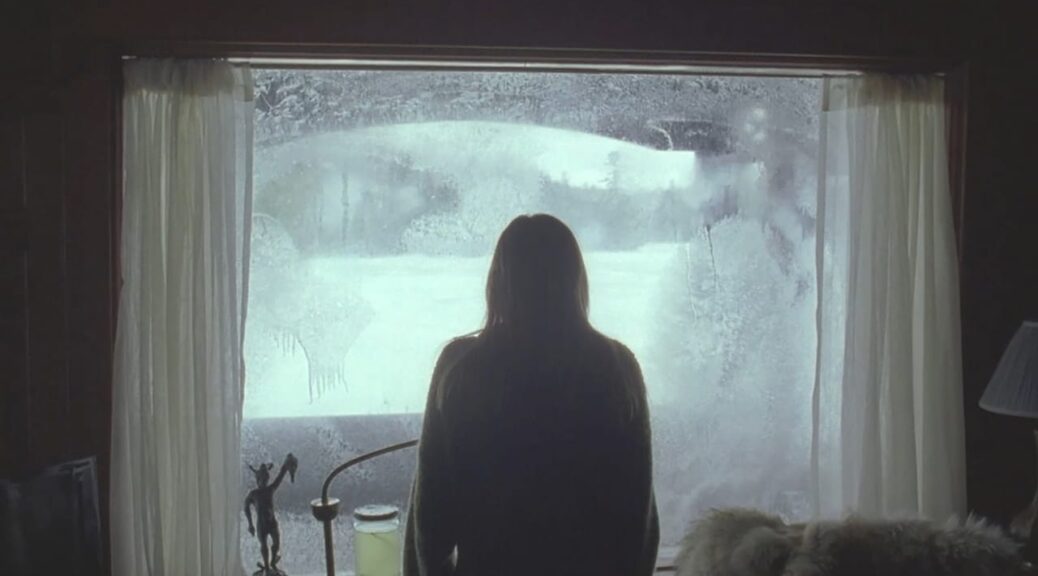
It’s Christmas, and regardless of a profound, almost insurmountable family tragedy, one irredeemably oblivious father (Richard Armitage) decides his kids (Jaeden Martell and Lia McHugh) should get to know the woman (Riley Keough) he left their mother for. A week in an isolated mountain cabin during a blizzard should do it.

Dad stays just long enough to make things really uncomfortable, then heads back to town for a few days to work. Surely everybody will be caroling and toasting marshmallows by the time he returns.

Though everything about The Lodge brings to mind A24 horror—for a number of reasons, Hereditary in particular—the film is actually a Hammer effort. No longer the corset-and-bloodletting studio, Hammer’s millennial output has been sparse but often quite good.

Choosing to back filmmakers Severin Fiala and Veronika Franz making their follow up to the supremely creepy Goodnight Mommy should be a solid risk to take. Here the pair does not shy away from the body of “white death” horror that came before The Lodge, with eerie and sometimes humorous nods to The Thing and The Shining, among others, haunting the piece.

The film also brings to mind A24’s It Comes at Night, another quiet film that saw Riley Keough trapped in an isolated abode with unsettling family dynamics. Keough is riding an impressive run of performances and her work here is slippery and wonderful. As the unwanted new member in the family, she’s sympathetic but also brittle.

Jaeden Martell, a kid who has yet to deliver a less than impressive turn, is the human heartbeat at the center of the mystery in the cabin. His tenderness gives the film a quiet, pleading tragedy. Whether he’s comforting his grieving little sister or begging Grace (Keough) to come in from the snow, his performance aches and you ache with him.

A healthy ability to suspend disbelief will aid in the experience The Lodge has to offer, but there’s no denying the mounting dread the filmmakers create, and the three central performances are uniquely effective. Thanks to the actors’ commitment and the filmmakers’ skill in atmospheric horror, the movie grips you, makes you cold and uncomfortable, and ends with a memorable slap.

I Don’t Want to Go Out – Week of February 17

It’s a beautiful day in the living room, what with all these excellent movie choices! Well, not every single one is a winner, but that’s what we’re here for. We’ll help you get it sorted.

Click the film title to link to the full review.

Jojo Rabbit

A Beautiful Day in the Neighborhood

21 Bridges

Frankie

Midway

Blue Streak

Sonic the Hedgehog

by George Wolf

Even before the masses were recoiling in horror at the people/feline hybrids of Cats, the early look of Sonic the Hedgehog caused such a fan uproar that the little blue speedster got a full CGI makeover.

Well, he’s here now for his (otherwise) live action debut, he looks fine, and while his film doesn’t follow in Cats memorably bad paw prints, it never finds a way to be memorable at all.

Anyone who’s followed the Sega video games of the 1990s will feel right at home, as the world-hopping Sonic (voiced by Ben Schwartz) does battle with mad scientist Dr. Robotnik aka “Eggman” (Jim Carrey).

Sonic’s been quite lonely during his uneventful time on Earth, but a helping hand from an aw-shucks small town sheriff (James Marsden) sends them both on a convoluted road trip. Sheriff Tom wants to prove himself a hero, while Sonic just wants a friend.

Cue the strings – no wait! Dr. Eggman and his robot drones are closing in! Muuuahahahaha!

Carrey sets his mugging level on stun, but really, with director Jeff Fowler keeping each actor exaggerated and a script-by-committee committed to over-explanation, it doesn’t seem as comical as it should.

Still, Sonic is harmless enough to land somewhere near the top of the dung heap that is video game film adaptations. It’s got a pop culture gag or two that lands, a mid-credits stinger that shows promise for the next chapter, and a pace that never becomes overly laborious.

So after its rough start with the fanboys, you might say Sonic avoids becoming a real…..CATS-tastrophy.

I won’t, but you might.

Poles Apart

Downhill

by George Wolf

If you’re a pair of American filmmakers out to remake an exceptional foreign film from the last decade, you gotta pick a side.

Are you gonna put some bankable U.S. stars up front and just add your name to someone else’s originality, or do you have a vision that can make the story your own?

To their credit, co-writers/directors Nat Faxon and Jim Rash choose the latter path for Downhill, their take on Ruben Ostlund’s 2014 stunner, Force Majeure (Turist). Faxon and Rash won an Oscar for their The Descendants screenplay – so the boys can write – but this makeover ultimately lands as a pleasant exercise stripped of the insightful bite.

The catalyst remains the same: a traumatic event changes the way a couple sees each other. Pete (Will Ferrell) and Billie Stanton (Julia Louis-Dreyfus) are on a lavish ski vacation in Austria with their two sons. Eating lunch on the resort’s outdoor porch, the family is terrified when an avalanche appears to be heading right for them.

Bille clutches her children in fear, while Pete grabs his phone and runs.

Turns out it was a planned snow release and everyone’s fine, but the Stanton marriage has been shaken to its core, no matter how hard Pete tries to revise history with another couple (Zach Woods and Zoe Chao).

Faxon and Rash do Americanize the story well, as Billie first looks to blame the resort (“I’m an attorney!”), and Pete, continually wallowing in the loss of his father eight months prior, becomes a personification of rationalized selfishness.

But while Ostlund used the secondary couple as a device to invite us into a near clinical deconstruction of societal assumptions, Faxon and Rash introduce a new “B” story involving an aggressive resort concierge (Amanda Otto) who lives on the wild side. It’s an uneven trade of insight for zany, and can’t move the film from an uneven headspace that’s too serious for comedy but too light for drama.

Downhill does give us the chance to see Will and Julia go head to head, and that is no small treat. Ferrell is a natural as the big awkward goof trying to come to terms with himself, but make no mistake, Julia Louis-Dreyfus is the reason to see this movie.

Billie is confused, hurt and angry, and Louis-Dreyfus sells it all with total authenticity, often with little to no dialog. She finds real depth in terrain that’s often shallow (such as Billie’s flirtations with a younger ski instructor), ultimately offering more proof that, in case you’ve missed the last few decades, JLD is a flat-out treasure.

And much like Billy Ray’s updated Secret in Their Eyes five years ago, Downhill has a humdinger of an ending to deal with. In the original film, Ostlund gave us an organic twist that managed to re-frame all that came before. Faxon and Rash’s take feels a bit like hitting the Ohio slopes after a trip to Vermont.

There are similarities, but the thrill is gone.

If you’ve haven’t seen Force Majeure, Downhill is a perfectly acceptable vehicle for two well-loved stars. If you have, well, see it again.

Buffalo (Dollar) Bills

Buffaloed

by Brandon Thomas

Phone solicitors are a menace. Political campaigns? Blech. Offers to buy your home “as is” for cash? Get out of here. Timeshare schemes? Block that number.

Oh, and debt collectors? The absolute worst. 

What’s that? Debt collectors are the heroes in Buffaloed? Tell me more.

From an early age, Peg Dahl (Zoey Deutch) had money on her mind. After a bad ticket scalping endeavor lands her in the joint, Peg racks up some massive legal fees. With career opportunities slim and her optimism fading, Peg discovers the lucrative world of debt collection. Accompanied by a flimsy moral code and a ragtag group of associates, she sets out to eliminate her debt and make a small fortune along the way.

Within its first few frames, Buffaloed announces that it’s not about to be your standard rags-to-riches tale. There’s a sense of whimsy apparent as director Tanya Wexler (Hysteria) introduces us to this heightened version of Buffalo, New York. Whimsy with an edge, that is. 

Buffaloed threatens many times to veer into the familiar. A down-on-their- luck group trying to defy the odds? Yeah, we’ve seen that before!

Not so fast.

A clever script by Brian Sacca doesn’t let these characters off the hook easily. They make mistakes, learn from them, then make even worse ones. The nimbleness of Buffaloed’s kinetic story is one of its greatest assets. Peg is always zigging when she should be zagging.

Deutch has been building a solid resume over the last few years. Her recent turn in Zombieland: Doubletap stole the show from long working veterans like Woody Harrelson, Jesse Eisenberg, and Emma Stone. There’s a crackling energy to her performance as Peg that’s a perfect fit for the character’s chaotic actions.

Equally good is Jai Courtney (Suicide Squad, Terminator Genysis) as Peg’s sleazy and dangerous competitor. Courtney has become an online punching bag over the years for appearing in bad sequels and/or comic book movies. Here, he’s allowed to flex some pretty incredible comedic muscles that don’t involve him interacting with a green screen.

With an offbeat story, and memorably eccentric cast of characters, Buffaloed charms and impresses with the miraculous feat of making debt collectors sympathetic. 


Paradise Found

Come As You Are

by Cat McAlpine

Come As You Are follows three men on a quest to get laid at a Canadian brothel, La Chateau Paradis, that caters to people like them. Scotty (Grant Rosenmeyer) is a paraplegic who was “born this way, baby.” Matt (Hayden Szeto) is an ex-boxer fighting a degenerative disease. Mo (Ravi Patel) is visually impaired. Collectively, their biggest hindrance is that they all still live with their mothers.

After one hilarious caper, a cop stops Scotty, Matt, and Mo as they slowly make their way along the shoulder of the highway. He looks at the three men and says:

“My cousin’s brother-in-law has Down syndrome so…I know.”

Sometimes, this film is about life as a person with disabilities. Mostly, though,Come As You Are is just about life as a person. The natural flow between these perspectives takes a raunchy boy’s trip and turns it into a heartwarming slice of life film about making friends, believing in yourself, and defining exactly what your life is supposed to be.

Come As You Are is the English remake of 2011’s Belgian Hasta la Vista (dir. Geoffrey Enthoven), and while I haven’t seen Enthoven’s original, it’s worth the effort to bring this film to American audiences. Sorry, Bong Joon-ho, I guess we’re still warming up to subtitles.

This 2019 edition is directed by Richard Wong, who has more cinematography credits than directorial. That experience shows in the film’s easy movement between steady and handheld shots. Wong’s vision expertly highlights how monumentally huge small inconveniences can be. At times, Scotty’s confinement to his chair leads to hilarious antics. Other times, it’s a horrific prison. Wong looks at both sides of every coin in a valiant effort to show the bigger picture.

Come As You Are boasts a diverse cast, a good script, and great performances. The best performance is from Rosenmeyer, whose unflinching cynicism and peeks at vulnerability are masterfully done. The other stand-out performance comes from Janeane Garofalo as Scotty’s mother who, for better or worse, cannot shut up.

Szeto and Patel both deliver quieter performances that gracefully grow with their character’s arcs. Patel particularly does a fantastic job of revealing the complexities behind his Coke-bottle glasses.

Some may find the final awkwardly funny scene misplaced after the narrative has moved to deeper material. I found it tonally perfect and more human than abandoning the characters and circumstances we started with.

Come As You Are is bitter, funny, tender, and worth the watch.

Extra Special K

Citizen K

by Rachel Willis

Inspired by Russia’s involvement in the 2016 U.S. presidential election, Oscar-winning documentarian Alex Gibney turns his focus to a tangled Russian web with his latest film, Citizen K.

And “K” is the crux of his film: one Mikhail Khordokovsky. Once known as perhaps the richest man in Russia, Khordokovsky spent ten years in a Siberian prison as a political prisoner.

To understand the situation, it helps to understand modern Russian history. Cramming thirty years of that history, from the fall of the Soviet Union to the present, into one two-hour documentary is no easy feat. Many times, it’s hard to keep track of the people and names who appear on screen. Gibney does his best to help us keep up, but he isn’t unnecessarily focused on it.

If you’re not already well-versed in Russian history and politics, trying to follow everything may at times be distracting, but Gibney (Taxi to the Dark Side, Enron: the Smartest Guys in the Room) always manages to keep the film engaging. It moves at a brisk pace, covering the thirty plus years of history and Khordokovsky’s rise as one of Russia’s oligarchs, in the first hour.

Though “Citizen K” is the film’s core, it’s impossible to tell Russia’s story, and Khordokovsky’s story, without taking a hard look at Vladimir Putin.

Putin’s rise was meteoric, a virtual unknown when an ailing Boris Yeltsin resigned and Putin succeeded him as president. Detailing Khordokovsky’s role in that succession is one of the film’s greatest strengths.

Gibney portrays the many grey areas when talking about individual involvement in black and white historical events. Is Khordokovsky a “real-life gangster” as many claim? Or is he a “hero for the cause of human rights?” Perhaps a bit of both.

Wisely, Gibney never absolves Khordokovsky of his past. Though many of the crimes for which he was accused and convicted were possibly exaggerated or even fabricated, his hands are not clean. His involvement in Russia’s economy, and in its history, is a mixed bag. Were his business decisions in the best interest of the country or did they serve his own greed?

Though there are questions left unanswered, the documentary shows Khordokovsky trying to make amends. His focus on transparency, and on an open Russia, is commendable. His attempts to bring to light the layers of conspiracy and violence surrounding Putin is dangerous, and he knows it.

Will Khordokovsky succeed? Only time will tell, but with the 2020 vote fast approaching, Gibney hopes his audience is paying attention.


Good Beat, You Can Dance To It

The Rhythm Section

by George Wolf

The sexy assassin. The beautiful killing machine.

The Rhythm Section plays a tune that’s lately been as popular as Taylor Swift at the high school talent show. But hey, there’s still a ways to go before it catches up to the macho men, so have at it ladies, the right arrangement can always find some swing in the mustiest of standards.

Blake Lively is Stephanie, a top student at Oxford who falls hard after losing her family to an airplane bomber. How hard? She’s an addict and a prostitute, but her destructive spiral finds a new avenue when an investigative reporter seeks her out.

He’s on the trail of the terrorist responsible for the bombing, and Stephanie’s cooperation sets a chain of events in motion that quickly lead to an ex MI-6 operative (Jude Law) training her to be a killer.

And why would he do that, exactly?

Keep that question at bay and you’ll find a serviceable thriller that hits plenty of familiar beats, but is always kept watchable through Lively’s committed performance.

Screenwriter Mark Burnell adapts his own novel as a globe-trotting exercise in exorcising your demons. And while multiple character motivations can get murky, the relationship between Stephanie and her mysterious mentor is always engaging.

Director Reed Morano (I Think We’re Alone Now, TV projects such as The Handmaid’s Tale and Halt and Catch Fire) can stage a nifty fight scene and breathless car chase, but she too often seems desperately in search of a definitive style that never finds a groove.

While soundtrack choices and soft focus flashbacks feel forced, Morano’s detached treatment of Lively’s physical appearance may be the most original pillar in the film. Though her role is plenty physical and Lively never shrinks from it, even the obligatory “red sparrow” sequence offers an overdue counterpoint to the usual leering camera served up by Morano’s male counterparts.

Expect the usual questions of “who can I trust” and the usual fine performance from Sterling K. Brown (that guy’s busy), who shows up as an ex-CIA agent with valuable contacts.

But most of all, expect Lively to keep The Rhythm Section humming, even when it’s set on repeat.

Glass Houses

The Edge of Democracy

by George Wolf

Documentaries can often be judged by how successful they are at showing us unfamiliar worlds.

But for the Oscar-nominated The Edge of Democracy, it is the familiarity of the story it tells that makes it so heartbreakingly urgent, as it wraps a personal memoir around a first hand account of Brazil’s fragile hold on democracy.

Veteran documentarian Petra Costa (Omar & the Seagull, Undertow Eyes), whose own parents risked their lives protesting Brazil’s military dictatorship, narrates the film with much personal insight, starting with her feeling that she and Brazilian democracy “have grown up together.”

Taking power through a U.S.-backed coup in 1964, a succession of generals ruled Brazil until 1985, when the Workers Party began to take hold, thanks in large part to union leader Luiz Inácio “Lula” da Silva, who was finally elected president in 2002.

Costa, backed up by a string of working class Brazilians, speaks in glowing terms of the economic progress made under Lula, and we see no less than Barack Obama dub him “the most popular politician on Earth.”

Indeed, Lula left office in 2010 with an 87 percent approval rating, when his hand-picked successor, former militant Dilma Rousseff, won the presidency. Three years later the economy stumbled, Dilma announced a crackdown on corruption, and the knives came out.

Even then, not many would have thought it possible for the democracy Brazilians long fought for to succumb so easily to primal populism, or for Jair Bolsonaro, a bigoted, hostile, “fake news” decrying candidate who began as a joke, to be elected president in 2018.

But here we are.

Costa’s passion for her cause is weary but evident, and her earnest narration often asks us to assume much without pausing to consider any contrasting evaluations of what she dubs “the coup of 2016.”

That’s not to say Dilma’s ouster doesn’t stink to high Heaven – it does – but it also isn’t hard to find accusations against the Workers Party that don’t seem that flimsy, and while the one-sided approach is in line with the film’s personal journey, it leaves the documentary side wanting.

But Costa’s ultimate success comes from weaving her family’s story into the political tumult of her homeland, and in turn mirroring a more global struggle. We get a stark illustration of the rising tides of authoritarianism, leaving the Edge of Democracy a film that should be pretty damn personal to all of us.