Tag Archives: movie reviews

Game Night

Dangerous Game: The Legacy Murders

by Hope Madden

Welcome to the murder castle!

That’s the bland first line in the exceptionally derivative Dangerous Game: The Legacy Murders, a mash of up Saw, Ready or Not and And Then There Were None with little of the associated mystery, thrills or gore and none of the humor. Plus the title sounds like a Lifetime flick.

Things begin predictably enough as a wealthy but dysfunctional family arrives on the patriarch’s (Jon Voight) secluded island to celebrate his 80th birthday. He and his manservant (Bradley Stryker) greet the guests in a Mr. Rourke/Tattoo kind of way before ushing them into his sprawling new mansion.

More frustrating than thrilling, the film still entertains in a B-movie way for a time. Rich people on an island who hate each other play a board game called Dangerous Game to pass the time. Why not?

Jonathan Rhys Meyers stars as the son who’s taken over the business from his bitter old man. Remember when Jonathan Rhys Meyers was a whole thing? Velvet Goldmine, Bend It Like Beckham, Match Point – he had a nice roll going there. He got a lot of attention for his TV gigs in Elvis and Tudors about a decade ago.

I’m worried about him. He’s made eight movies in the last two years, with another six in various stages of production. So far, not one of them is worth watching. Indeed, many are unwatchable.

Dangerous Game: Really Tedious Subtitle isn’t unwatchable. It’s just dumb and lazy, at least until this scene on an operating room. Things turn irreversibly stupid on the operating table.

Cardboard performances and silly writing veer toward the ludicrous and the film is never able to recover. Or capitalize.

Here’s the line, “I’m sorry baby, I can’t find it. Can you tell me where it is?”

At this moment, I began to hope that Sean McNamara’s film would surprise me, go full Malignant, or at least Orphan: First Kill. Alas, turns out this was just a ludicrous highlight in an otherwise unremarkable rehash of superior films.

So close, though!

Chaos Reigns

Thrust!

Brandon Thomas

It’s impressive when a film is able to tap into genuine chaos. Director Victor Bonacore’s Thrust! is a punk-rock, spit-soaked, guffaw-inducing ode to don’t give-a-shit cinema. Thrust! isn’t the kind of film concerned with narrative cohesion or deeper themes. No, this movie simply wants to take the audience on the kind of ride you’d only get if your brakes failed.

Thrust! follows lovers Aloe (Erin Brown) and Vera (Allison Egan) as they cross a female-ruled dystopian world to confront and kill the vile Dirtbag Mike (Michael Shershenovich). In their quest to vanquish the elusive Dirtbag, Aloe and Vera encounter various girl-gangs that feature the likes of Linnea Quigley (Return of the Living Dead, Night of the Demons) and Ellie Church (Headless, Space Babes From Outer Space).

Thrust! is the kind of movie you want to see in a packed theater with some close friends and probably a beer or two. The risque nature of the movie feels very reminiscent of early John Waters with equal amounts of Mad Max and Switchblade Sisters thrown in for flavor. While the gross-out gags are inventive and plentiful, they never become repetitious or lose their ability to shock or make you cover your mouth with your fist.

Bonacore infuses the entire movie with an energy other features might have in a scene or two. From a rousing rock & roll opening to blood-spattered fights and gratuitous sex scenes, Thrust! produces one cackle-inducing scene after another. This impressive level of chaotic momentum should make an audience feel over-stimulated, but Thrust! throws just enough twists and surprises to keep the movie from feeling monotonous. 

The cast is more than game for the mayhem. As the audience’s entry point to this world of debauchery, Brown and Egan do a good job with two of the less flashy roles. Shershenovich makes a mean impression as the vicious Dirtbag Mike – a role where scenery chewing was probably encouraged on a daily basis. 

Thrust! certainly isn’t for the squeamish, and it might even test the limits of exploitation cinema veterans. Vulgarity aside though, Thrust! is one heck of a fun time at the movies.

Thrust! screens Sunday, October 23rd as part of the Nightmares Film Festival at Gateway Film Center in Columbus, Ohio.

Deadpan on Arrival

The Loneliest Boy in the World

by Daniel Baldwin

Oliver has had a rough go of it. He’s lived in isolation for the bulk of his life. His father has long since passed away and his mother died recently in a freak accident. If that weren’t enough, he just got out of a stint in an asylum and is likely to be headed back there if he cannot prove to his caseworkers that he can function properly on his own. In short, Oliver needs to make new human connections. He needs a friend.

So he digs a few up. Literally. Against all odds, his newfound, freshly-deceased pals come to life and attempt to help the poor boy get his life in order. If there is an answer to the question “What do you get when you throw Tim Burton, Wes Anderson, and a pinch of John Waters into a blender?”, the answer is The Loneliest Boy in the World.

An intriguing list of ingredients, no? Unfortunately, the parts are far greater than their sum. The cast is largely comprised of British characters actors, and they do their darnedest to (pardon the pun) liven things up, but the premise is stretched too thin, even at 90 minutes. Gags that might have been funny in smaller doses often become interminable and there’s an unfortunate amount of repetition at play. In the end, it feels like a script for a 30-minute short that’s been padded to triple that length.

There are some positives, however. Max Harwood is charming as our quirky lead and Tallulah Haddon is adorable as his would-be first living friend. Alex Murphy and Hammed Animashaun make for a fun pair of oddball cemetery caretakers.

Of course, the film’s greatest feature is the flashback sequence revealing the accidental death of Oliver’s mother. The event is so sweetly dark in its humor that it makes one wish the rest of the film had kept to a similar tone.

Kudos to director Martin Owen and writer Piers Ashworth for trying a new recipe. The flavor profile didn’t quite come together, but that’s always the risk when one takes wild swings. If you like quirky genre-bending comedies where undead folks watch ALF together and have heart-to-hearts with their human pal, this might still do it for you. Otherwise, you might not want to exhume this one.

Unjustified

Halloween Ends

by Hope Madden and George Wolf

In 2018, director David Gordon Green and writer Danny McBride did the almost unthinkable, something often tried but rarely accomplished. They made a good Halloween movie. Three years later they did what a lot of people have done. They made a bad sequel.

But the second film in a trilogy is tricky business. The origin story is out of the way and you can’t kill the villain – everyone already knows a third installment is coming. Some filmmakers thrive in that middle space, but most tread water until the big climax.

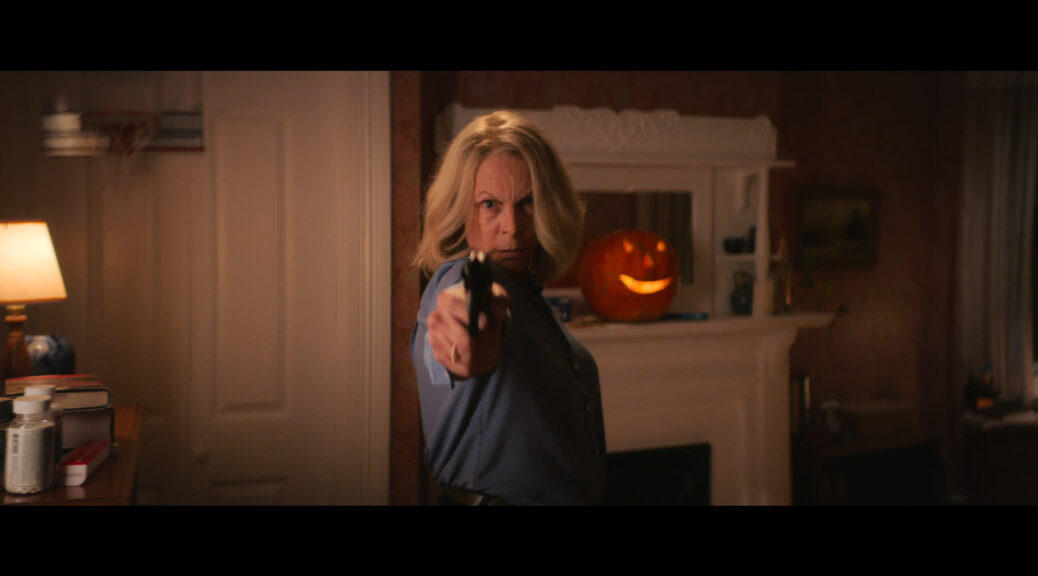
Well, that big climax is here. Laurie Strode (Jamie Lee Curtis) and Michael Myers (James Jude Courtney) face off in the final piece of Greene’s trilogy, Halloween Ends.

The bad second installment was better.

Rohan Campbell is Corey, a misunderstood outcast with tousled hair, bee stung lips and a motorcycle. The Strode women take a shine to him, Laure introducing him to granddaughter Allyson (Andi Matichak). But Haddonfield is pretty tough on Autumn romance, and this story is too rushed to resonate, too dull to be truly angsty.

Green has made some really good movies: George Washington, All the Real Girls, Undertow, Snow Angels, Pineapple Express, Joe, Halloween. One of the most impressive things about that list is the way it crosses genres like there is no border from one to the next. His first episode in the series was a mash note to the original. He wisely ignored all the other sequels and reboots and just brought us a clear vision for an Act 2.

Then, in lieu of a cohesive story, Green caves to some desire to pepper a sequel with odes and easter eggs in honor of all the franchise installments. He and co-writers McBride, Chris Bernier and Paul Brad Logan pick up an idea hinted at in two earlier episodes across the full constellation of films. An honest to god original thought would have been better.

It’s a sidetrack that some longtime fans might embrace, but the execution is littered with missteps. The new relationships do not feel authentic, much of the internal logic is questionable, and forget about scary, the film is too tired to even develop effective tension. There aren’t even any good kills.

We do get the final Laurie v Michael showdown that the title promises, which is a welcome return to giving the legendary Curtis some opportunity for badassery. But while Green & company manage a couple late-stage surprises, this is ultimately a disappointing end, with the highest of hopes limping to the finish for only lukewarm satisfaction.

R+R4E

Rosaline

by Hope Madden

Sometimes it’s fun to reconsider a Shakespearean story from the perspective of a side character. Rosencrantz and Guildenstern got their own play. Juliet’s nurse got her own book. So why not Romeo’s first love, Rosaline?

Director Karen Maine takes Rebecca Serle’s YA novel When You Were Mine back to Verona for a savvy, fun if slight reimagining of the Bard’s tragic love story. Kaitlyn Dever (who also produces) stars in a comedy that pokes holes in old-fashioned concepts of romance.

Devers is Rosaline, beloved of Romeo (Kyle Allen, your future He-Man, here sporting an eerily Heath Ledger look). He climbs her balcony at night, brings her roses, speaks such poetry – so when he finally tells her he loves her, why does she freeze?

It doesn’t matter. She’ll make it up to him at the masquerade ball, where Montagues and Capulets can dance together without anyone ever knowing. Brilliant! But she’s held up by one of her dad’s stupid suitors, Dario (Sean Teale, of the strong jawline and perfect teeth). By the time she gets to the ball, everyone’s gone. Romeo is long, long gone.

But soon enough she realizes it’s her young cousin Juliet (Isabela Merced) he’s fallen for. So, Rosaline takes Juliet under her wing in an attempt to undermine the new romance, to comedic ends.

The best bits come by way of Rosaline’s nurse, played with droll perfection by Minnie Driver, but the entire supporting cast is rock solid. Bradley Whitford is a charmingly befuddled father, Nico Hiraga gives good reason that Steve the Courier never seems to deliver packages properly, and Spencer Stevenson gets off a couple of chuckles as Paris. Anachronistic dialog fits the fun.

Maine’s film, written for the screen by Scott Neustradter and Michael H. Weber (who together penned The Spectacular Now, 500 Days of Summer, The Fault in Our Stars), is intentional in the way it dismantles damaging tropes of romance. Classic romantic stories pit women against women. And the best-known romance of all time ends with two youngsters making the dumbest decisions ever put to paper.

Rosaline recognizes this and makes light entertainment of it all. Dever is more than strong enough to carry the comedy. Her heroine offers stubbornly wrong-headed reasons for resilience and it’s hard to root against her. There’s nothing profound here, but it’s a breezy bit of fun.

Worn Retread

The Visitor

by Hope Madden

Four years ago, filmmaker Justin P. Lange used our preconceived notions against us to carve out a fresh horror with something meaningful on its mind. He followed his impressive feature debut The Dark with the subpar 2021 exorcism flick The Seventh Day.

This third outing, The Visitor, falls somewhere between the two.

 A young married couple moves back to the wife’s hometown when her father dies and leaves her his big, old gothic house. So far, so garden variety.

The pair’s not even unpacked yet when the husband starts hearing noises, then he’s having nightmares, and then he discovers a painting in the attic bearing his own unmistakable likeness.

Still pretty familiar. The truth is, not a single beat in The Visitor feels truly fresh. The film looks great and performances – especially from the supporting cast that includes veterans Dane Rhodes, Thomas Francis Murphy and Donna Biscoe – keep it lively.

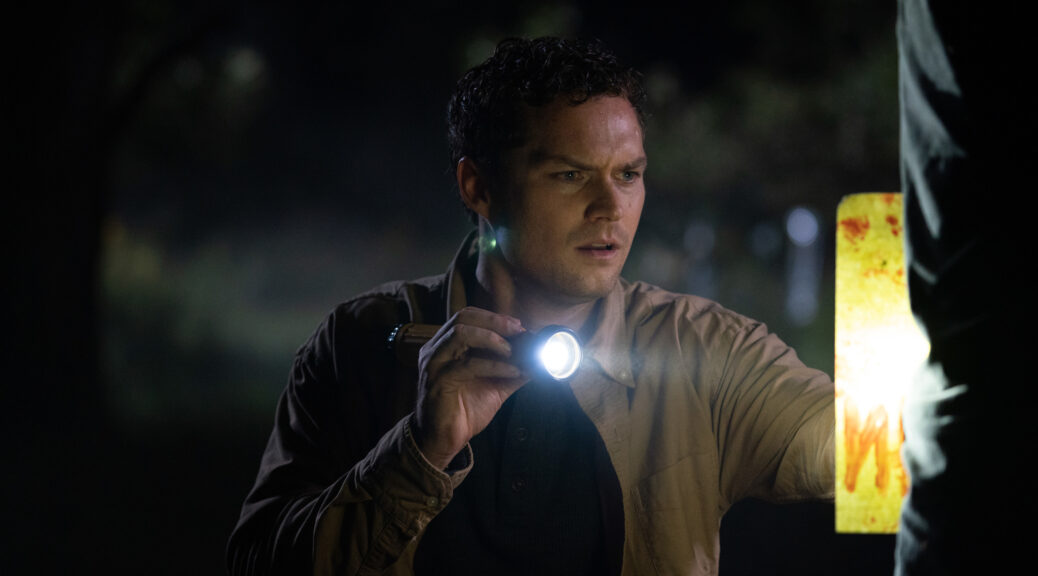
Leads Finn Jones and Jessica McNamee benefit from a genre gender reversal. In nearly every film of this ilk, it’s the female who senses that something in this house and this town is amiss while her husband’s too stoic and dismissive to buy in. Here it’s Londoner Robert (Jones) who sees menace in the overly friendly townsfolk, who dreams of cackling old women. His wife Maya (McNamee) grows more and more hostile to his nonsense, especially now that she’s pregnant and they’re ready to start fresh.

Lange does a serviceable job of mashing together solid elements from better films and packing them in gorgeous autumnal shades. His set designer deserves applause for understated Gothic elegance. But it’s not enough.

Lange’s film boasts no real scares, not a single surprise, little dread. It’s a bland if attractive facsimile of other films we’re already kind of tired of.

Fire Walk with Me

She Will

by Hope Madden

There is nothing quite like an excellent set of cheekbones.

The effortlessly elegant and formidable Alice Krige and her fine cheekbones deliver another quietly powerful performance in director Charlotte Colbert’s bewitching horror, She Will.

Krige is Veronica, an actress seeking some time away from prying eyes. She and healthcare aid Desi (Kota Eberhardt) will seclude themselves in the Scottish Highlands so Veronica can convalesce from a double mastectomy. She’ll also be able to escape the media frenzy around a proposed remake of the controversial film that made her a star back when she was only 14.

It’s hard to say which of the two traumas haunts her more.

The traveling pair find, thanks to a self-help guru (Rupert Everett) leading his own little squad of guests, that the rustic getaway inhabits a spot used to burn witches in older, more barbaric times. Witty feminism doesn’t overwhelm but enlightens a tale with vengeance on its mind.

Colbert, who co-wrote the script with Kitty Percy, crafts a moody shapeshifter of a film, allowing atmosphere and images to drive the narrative. The result is hypnotic. Clint Mansell’s transfixing score spills into Jamie Ramsay’s dreamy cinematography and suddenly you can’t tell whether you’re in the woods or in Veronica’s headspace or neither or both.

Eberhardt’s thoughtful turn creates a lovely opposite to the brittle Veronica, their growth offering an enduring image of the strength in companionship and sisterhood.

Colbert peppers the film with unexpected humor that serves it well. She seamlessly blends styles and ideas into a singular vision – no minor feat for a first-time director.

On top of the controversy surrounding the Hocus Pocus sequel, it is nice to be reminded, however artfully, of the legacy of witchcraft: the powerful tormenting and in many cases torching the powerless. Colbert shows us how lovely revenge can look when those women have a little power.

Sunglasses at Night

Dark Glasses

by Hope Madden

Giallo is the soap opera of horror, and you have to embrace that to appreciate it. Emotion and drama, tension, fear and sexuality are amped up to a ludicrous degree, with sense and sensibility tossed out the window.

Few have ever done this as well as Dario Argento. I’d argue Mario Bava, but many consider Argento the king of giallo, and with good reason – his landmark 1977 film Suspiria may be the high-water mark for the entire genre. After a decade away from filmmaking in general and longer still since his last giallo, Argento returns to form with Dark Glasses.

Passions run high and bad decisions are rampant as Diana (Ilenia Pastorelli) attempts to evade a serial killer. But wait, it’s more complicated than that! You see, she’s also blind and has sort of kidnapped this kid. It’s better if you don’t ask.

Though the score is not from Goblin, composer Arnaud Rebotini’s electronic soundtrack conjures classic giallo. Indeed, between those recognizable chimes and an early throat severing, you’d think you were watching Argento of old. But the filmmaker does have a couple new ideas in store, and marginally less misogyny onscreen.

Diana’s a harder-edged protagonist than what you find in other films from the Italian maestro. A high-end sex worker, she’s nonplussed about her line of work and disinterested in anyone else’s opinion of it. She’s a peculiar central character and Argento, who co-wrote the script with frequent collaborator Franco Ferrini (Opera, Phenomena), gives her more to do than elude victimization. She develops skills and bonds in the second act that feel reasonable and realistic, sometimes even tender. It helps ground the film in character before those characters step into a den of watersnakes and remind you that you are essentially watching a soap opera.

There are some inventive kills, gore aplenty, and loads of reminders of why Argento has developed such a boisterous following. This is by no means his best film, but it’s by no means his worst, either.

Everyone yells when they shouldn’t yell, everyone pauses when they shouldn’t pause, everyone talks when they shouldn’t talk, but who cares when the blood is this red and free-flowing?

Unchained Melody, Unpaid Rent

Phantom Project

by Daniel Baldwin

Pablo (Juan Cano) is a struggling actor who makes his money working as a training actor for a medical program where personnel get to practice their bedside manner in a classroom setting. He had been making ends meet, but now that his roommate has bounced – still owing him a couple of months’ rent – Pablo needs to find a replacement roommate fast. In addition to this, he’s still dealing with his feelings for his ex-boyfriend, contending with a ghost(!) in his apartment, and worrying about his downstairs neighbor’s abusive relationship with her partner.

If you haven’t guessed it already, Phantom Project is a quirky slice-of-life dramedy about a 20-something living in the city who is just trying to get by while chasing his dreams of becoming a movie star. Ghost aside (we’ll get to that in a moment), this is very much your typical “walk in a young person’s troubled shoes” indie comedic drama. Even with it being a Chilean spin on the subgenre, this is pretty standard stuff. Thankfully the core performances are all charming enough to help smooth over the samey-ness of the plot.

Samey except for the ghost, that is.

There are two big bright spots in this film: Susan and the ghost. Who is Susan? She’s Pablo’s adorable dog, who knows what’s up with the haunting and seems perpetually annoyed not only by said spirit, but also by how long it takes Pablo to catch on to what is happening. The ghost itself is delivered in an intriguing way. Instead of modern FX work, we have what is an ever-morphing (even in terms of gender) hand-drawn apparition that is often up to hijinks, but occasionally wants to get frisky as well. Alas, said spirit is but one of many subplots. It would have made a better focal point, instead of an intriguing, but also jarring side story.

Phantom Project is a well-crafted slice of indie dramedy cinema that has a good cast, a great animal performer (you deserve better, Susan!), and a really cool-looking ghost in it, after all! What ultimately holds it back is an over-reliance on slice-of-life tropes and too broad a focus, along with an uneven tone. There’s an imaginative spark at its core, however. One that points toward writer/director Roberto Doveris as someone to keep your eye on going forward.