Screening Room: Knock at the Cabin, 80 for Brady, Remember This, Little Dixie, Blood, Baby Ruby
by Hope Madden
Back in 2001, Brad Anderson scared the living shit out of us with the ingenious institutional horror, Session 9. He followed this up with the utterly remarkable The Machinist, and a few years later, the mind-bending thriller, Transsiberian.
Things began to peter out for Anderson as a filmmaker by 2010’s Vanishing on 7th Street, and as he found more success with episodic programming, he more or less stayed there, popping over to film every few years with routinely middling results.
Such is the case with his latest, the supernatural family drama, Blood.
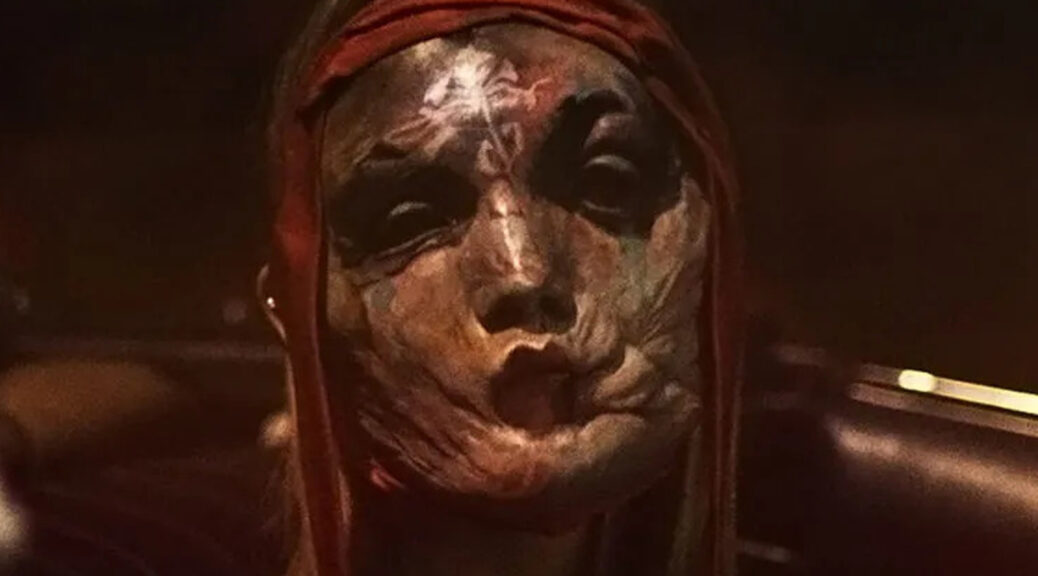
Michelle Monaghan is Jess, a recently sober, recently divorced, harried nurse settling her pre-teen children into their new home, an isolated farmhouse owned by her aunt before she passed. But Pippin, the golden lab, knows something’s wrong out in them woods.
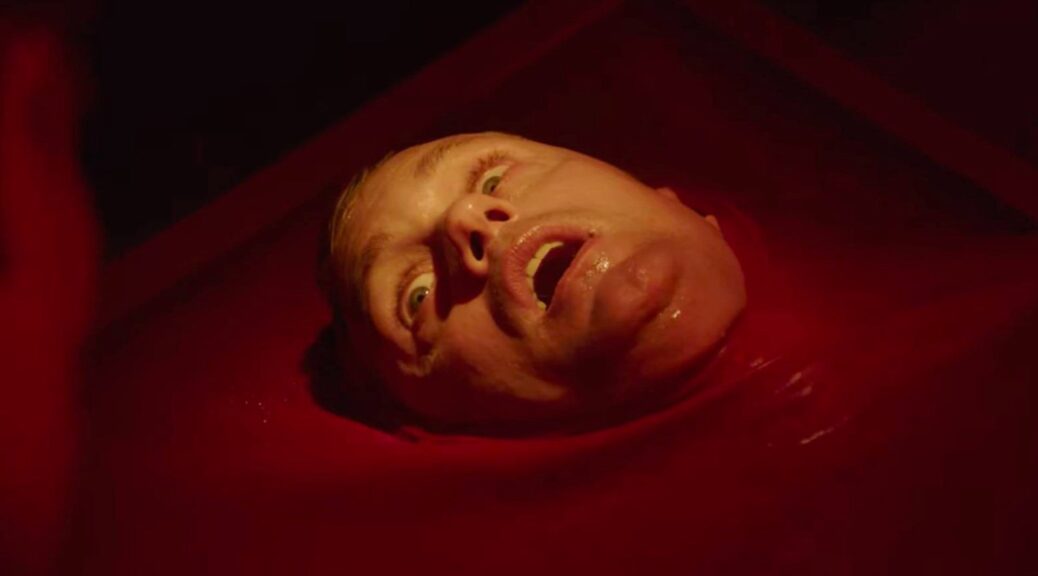
Whatever’s out there ends up in Pippin and then, shortly, in Jess’s 8-year-old, Owen (Finlay Wojtak-Hissong). The obvious tension is amplified by the fact that Jess is desperately afraid to lose custody of her children, so she is loath to admit there’s anything seriously wrong. But things are seriously, seriously wrong with Owen.
Writer Will Honley hits on a topic that was really popular in the genre maybe five years ago (The Hole, The Prodigy, Brahms: The Boy 2, Z, Brightburn ). His updates actually recall slightly older films – Grace (2009), It’s Alive (the 2009 remake), even 1990’s nutty Baby Blood to a degree. What Blood is saying is not original at all, so to make it relevant, Anderson will need to mine Honley’s script for some real relevance.
The family dysfunction and addiction angle could be it. There’s an undercooked metaphor here concerning addiction and heredity. Owen’s bratty behavior buoys the film’s darker qualities, and that business down the basement is especially gruesome (as “down the basement business” so often is). But none of it pans out. In fact, some of it – the least forgettable bits – are forgotten entirely as the film delivers a kind of final grace that is wildly unearned.
Had that moral ambiguity felt intentional the film would have been at least provocative. The fact that it does not is alarming, but not in a way that makes the film more enjoyable.
All the performances are solid. Monaghan and June B. Wilde spar beautifully with each other. Meanwhile, Skeet Ulrich (nice to see you!) and young Skylar Morgan Jones fill out the problematic family well. They just won’t help you remember the movie.

You check in. You assume the best. You’d never think, as you doze off in total helplessness, that maybe the last guest is still lingering in spirit, or was fed to gators, or that the hotel itself may be the doorway to hell.
In all likelihood the worst thing you’ll bring home with you is bedbugs, but I’ll take the gators.
For this episode we’re joined by our dear friend Jamie Ray from the Fave Five from Fans podcast and, at his behest, we will run through horror cinema’s best – or worst? – hotels.
Listed below are our five favorites, but honorable mentions go to Eaten Alive‘s Starlite Hotel, Basket Case‘s Hotel Broslin, Hotel Quickie from Killer Condoms and Slausen’s Oasis from Tourist Trap.
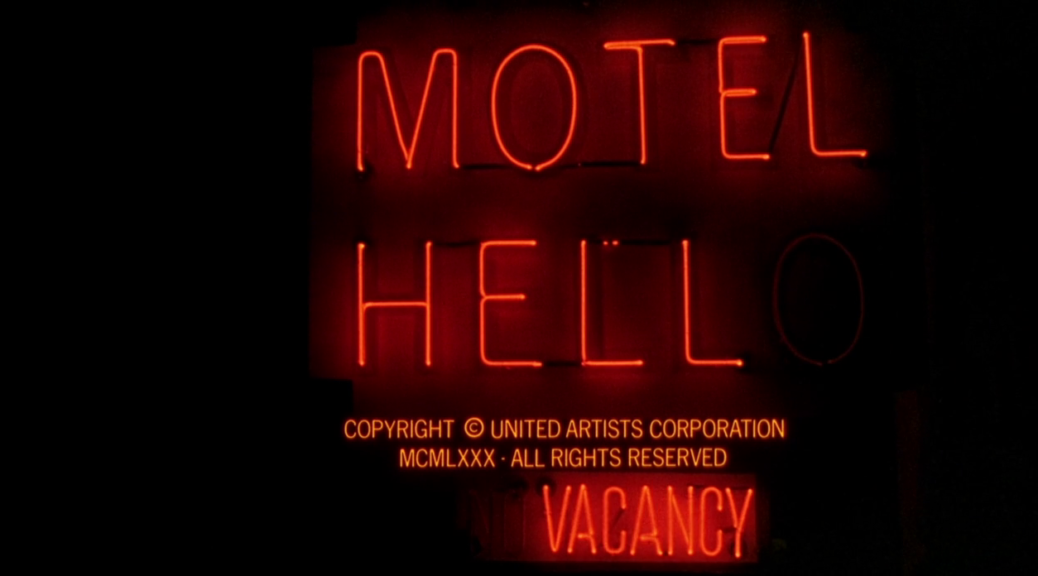
It takes all kinds of critters to make Farmer Vincent’s fritters, so swingers looking for a cheap motel in which to swing – be warned! Fifties heartthrob Rory Calhoun plays Farmer Vincent, who, along with his sister Ida (a super creepy Nancy Parsons) rid the world of human filth while serving the righteous some tasty viddles. Just don’t look under those wiggling, gurgling sacks out behind the butcherin’ barn!
Motel Hell is a deeply disturbed, inspired little low budget jewel. A dark comedy, the film nonetheless offers some unsettling images, not to mention sounds. Sure, less admiring eyes may see only that super-cheese director Kevin Connor teamed up with Parsons and Calhoun – as well as Elaine Joyce and John Ratzenberger – for a quick buck. But in reality, they teamed up to create one of the best bad horror films ever made.
Guests rarely come and a strange fate awaits them.
Takashi Miike is an extremely prolific director. He makes a lot of musical films, a lot of kids’ movies, a lot of horror movies, and then this – a mashup of all of those things. Like Sound of Music with a tremendous body count.
The Katakuris just want to run a rustic mountain inn. They’re not murderers. They’re lovely – well, they’re losers, but they’re not bad people. Buying this piece of property did nothing to correct their luck, either because, my God, their guests do die.
You might call this a dark comedy if it weren’t so very brightly lit. It’s absurd, farcical, gruesome but sweet. There’s a lot of singing, some animation, a volcano, a bit of mystery, more singing, one death by sumo smothering, and love.
Seduction, homoeroticism, drowsy lustfulness – this one has it all.
Countess Bathory – history’s female version of Dracula – checks into an all-but-abandoned seaside hotel. The only other guests, besides the Countess’s lover, Ilona, is a honeymooning couple.
Effortlessly aristocratic, Delphine Seyrig brings a tender coyness, a sadness to the infamous role of Bathory. Seyrig’s performance lends the villain a tragic loveliness that makes her the most endearing figure in the film. Everybody else feels mildly unpleasant, a sinister bunch who seem to be hiding things. The husband, in particular, is a suspicious figure, and a bit peculiar. Kind of a dick, really – and Bathory, for one, has no time for dicks.
Caring less for the victims than for the predator – not because she’s innocent or good, but because her weary elegance makes her seem vulnerable – gives the film a nice added dimension.
The accents are absurd. The outfits are glorious. The performances are compellingly, perversely good, and the shots are gorgeous. Indulge yourself.
It doesn’t look like much, but the old Bates place used to be something before the new highway. Now it’s really just Norman, some dusty bungalows, that ice machine, swamp out back, some stuffed birds and, of course, Mother.
Anthony Perkins was the picture of vulnerability in Hitchcock’s horror classic, but the motel itself is also about as benign as a spot can be. Hardly the downcast, shadowy, menacing lodging you think of today when you think of low-rent motels. It’s bright, clean and empty. Lonesome, but hardly frightening. Just like Norman.
You know who you probably shouldn’t hire to look after your hotel?
Jack Nicholson.
A study in atmospheric tension, Kubrick’s vision of the Torrance family collapse at the Overlook Hotel is both visually and aurally meticulous. It opens with that stunning helicopter shot, following Jack Torrance’s little yellow Beetle up the mountainside, the ominous score announcing a foreboding that the film never shakes.
The hypnotic, innocent sound of Danny Torrance’s Big Wheel against the weirdly phallic patterns of the hotel carpet tells so much – about the size of the place, about the monotony of the existence, about hidden perversity. The sound is so lulling that its abrupt ceasing becomes a signal of spookiness afoot.
Nicholson outdoes himself. His early, veiled contempt blossoms into pure homicidal mania, and there’s something so wonderful about watching Nicholson slowly lose his mind. Between writer’s block, isolation, ghosts, alcohol withdrawal, midlife crisis, and “a momentary loss of muscular coordination,” the playfully sadistic creature lurking inside this husband and father emerges.
by Hope Madden
Brandon Cronenberg + Mia Goth + Alexander Skarsgård … for a very specific set of people, the sum there is hell yes.
Riding my favorite wave in horror – that rich people are unspeakably diabolical – writer/director Cronenberg takes us on a strange journey through privilege, debauchery, entitlement, boredom, narcissism, psychotropic drugs and more in his trippy new flick, Infinity Pool.
Skarsgård is James Foster, a writer of very little renown who’s vacationing on a fictional island nation with his wealthy wife (Cleopatra Coleman). They’re bored, but as luck would have it, James’s number one fan Gabi (Goth) and her husband have vowed to show them a good time.
Cronenberg’s ultimate concept is clearly, wildly his own, but moments sometimes call to mind ideas from last year’s Speak No Evil, as well as Society, Kill List, Hour of the Wolf, and A Serbian Film (no, not that part). Still, the film never feels borrowed. Uncomfortable, yes. Borrowed? No.
James represents the regular Joe – yes, a very good-looking version, but regular, nonetheless. And no matter how long he plays the part, he’s an outsider. The truly wealthy are alien. Beyond the sci-fi insanity, beyond the outright body horror, this is the most horrific element of the film because feels honest. It touches a nerve.
In 2020, Jeff Bezos racked up more than 16k in parking tickets. Because, why not? He wanted to park there. Once you reach a certain tax bracket – which is the one where you pay no taxes at all – no rules apply. And that does not create better people.
It’s fascinating and refreshing, this particular approach to the story. These particular villains. And Goth proves once again to be a seductive menace and a force to be reckoned with.
There are certain scenes in this – one in a group holding cell at the island prison, for instance – that are as insightful, impressive and memorably horrific as anything any Cronenberg has filmed.
It’s hard to believe this is only Brandon Cronenberg’s third feature. It does not pack the visceral punch of 2020’s Possessor, but it is a satisfyingly surreal piece of class warfare and an outstanding way for the genre to kick off 2023.

by Hope Madden
Writer/director Michael Jacobs is best known for producing TV shows that speak to teens: My Two Dads, Boy Meets World, and Girl Meets World. But just seconds after what feels like the longest pre-film credits in the history of cinema, his feature film Maybe I Do makes certain we know this is not that.
The romantic dramedy enlists four truly great veteran talents to take a peek at romance, love, and existential angst in your sixties.
Grace (Diane Keaton, who executive produces) can’t help but notice Sam (William H. Macy), who’s sobbing at a foreign film as he dumps M&Ms into his popcorn tub. She reaches out to him because he “seems distressed.” He assumes that, as she is also alone at a movie, she, too, is distressed.
She admits she is, but honestly, there’s nothing wrong with going alone to the movies. I’m saying that, not Diane.
Anyway, they bond. Meanwhile, Richard Gere and Susan Sarandon quietly out-hot each other. And across town, young Michelle (Emma Roberts) questions an uncertain future with Allen (Luke Bracey).
So, the film offers three different vignettes of couples talking, arguing, and ruminating about love until worlds collide in the most obvious and contrived way possible. The sheer volume of cliches at work here could drown out almost anything of value, but how do you dismiss a film starring Macy, Keaton, Sarandon and Gere? Even the tritest dollops of wisdom sound charming and/or wizened coming from one of these four.
Gere and Macy together are a particularly tender treat, and while I applaud the actors and the opportunity the film allows, this scene best articulates the movie’s most nagging weakness. The whole film is sad for successful men who are dissatisfied with how their lives turned out. No one on earth is less pitiable than a successful middle-aged white man and his angst over what he hasn’t accomplished. But Gere and Macy almost make it work.
The second biggest problem is that the film hits traditional romance so hard. The act that has Michelle rethinking her relationship with Allen should be a red flag, an end to the relationship. Instead, it becomes a “marry me or it’s over” ultimatum. No. No! And then the whole film, one brimming with wildly unhappy marrieds, intends to prove to us all that you just have to go ahead and take the leap with someone who publically humiliated you to make sure they didn’t have to commit to you.
No.
Maybe I Do is unabashedly romantic, deeply traditional, well-meaning and tired. So tired. But at least you get to see four tremendous actors riff off each other for 90 minutes.
Well, they’re here, and the 2023 Oscar nominations are a reminder that we actually had some hits this year. Blockbusters are all over this lineup, as are indies, returning favorites, first-time veterans, newcomers, surprises and – say it with us – snubs.
Here are our thoughts on this year’s Academy Award nominations:
Best Film
Sure, people will cheer and/or complain about the love of Avatar: The Way of Water and Top Gun: Maverick. Purists will point out that many, many smaller films boasted better acting and writing (Aftersun? The Woman King? Nope?), while others will be happy that, for once, they’ve seen a Best Picture nominee. Our issue is with Triangle of Sadness, which has too many nominations altogether. For our money, The Menu’s nuance succeeded where the obviousness of Triangle failed, and it did it in half the time.
Nominees:
All Quiet on the Western Front
Avatar: The Way of Water
The Banshees of Inisherin
Elvis
Everything Everywhere All at Once
The Fabelmans
Tár
Top Gun: Maverick
Triangle of Sadness
Women Talking
Best Director
Östlund took a spot that could have more deservedly gone to Sarah Polley (Women Talking) or the criminally unappreciated Park Chan-Wook, whose sublime Decision to Leave was entirely ignored.
Nominees:
Martin McDonagh, The Banshees of Inisherin
Daniel Kwan and Daniel Schenhert, Everything Everywhere All at Once
Steven Spielberg, The Fabelmans
Todd Field, Tár
Ruben Östlund, Triangle of Sadness
Best Lead Actress
Where is Danielle Deadwyler? Easily the biggest snub of the day, Deadwyler deserves to be on this list forher turn in Till without question. And while de Armas was the one saving grace in the 3+ hour dumpster fire that was Blonde, Oscar-worthy she was not.
We’re happy to see the surprise nomination for Riseborough, but we do also miss Emma Thompson for Good Luck to You, Leo Grande, and Viola Davis for The Woman King.
Nominees:
Cate Blanchett, Tár
Ana de Armas, Blonde
Andrea Riseborough, To Leslie
Michelle Williams, The Fabelmans
Michelle Yeoh, Everything Everywhere All at Once
Best Lead Actor
This card looked about as expected, but we couldn’t be more thrilled that Paul Mescal is being recognized for his beautiful turn in Aftersun.
Nominees:
Austin Butler, Elvis
Colin Farrell, The Banshees of Inisherin
Brendan Fraser, The Whale
Paul Mescal, Aftersun
Bill Nighy, Living
Best Supporting Actor
Brian Tyree Henry?! Yes, please! One of the biggest surprises this year is also one of the most welcome. Thrilled as well to see Keogan join Gleeson and, like everyone else, overjoyed that the undeniable Ke Huy Quan will be at the Oscars – even if he doesn’t win, although things are looking good for him.
Nominees:
Brendan Gleeson, The Banshees of Inisherin
Brian Tyree Henry, Causeway
Judd Hirsch, The Fabelmans
Barry Keogan, The Banshees of Inisherin
Ke Huy Quan, Everything Everywhere All at Once
Best Supporting Actress
We would have loved to see literally anyone from Women Talking get acknowledged here, but honestly, we don’t have a lot of nits to pick. Exceedingly happy for every single person who made this list.
Nominees:
Angela Bassett, Black Panther: Wakanda Forever
Hong Chau, The Whale
Kerry Condon, The Banshees of Inisherin
Jamie Lee Curtis, Everything Everywhere All at Once
Stephanie Hsu, Everything Everywhere All at Once
Best Original Screenplay
Oh how we hoped we’d see Nope on this list. Jordan Peele’s genre-bending treasure deserves the Triangle of Sadness spot, and if not him, Charlotte Wells for Aftersun.
Frontrunners have to be Banshees and EEAAO, but honestly, that seems to be the case in almost every single race.
Nominees:
The Banshees of Inisherin
Everything Everywhere All at Once
The Fabelmans
Tár
Triangle of Sadness
Best Adapted Screenplay
All Quiet on the Western Front earned a lot of nominations. It’s clearly frontrunner for Best International Picture, and a worthy screenplay for this ticket. We’d love to see it go to Women Talking, most deserving of all the nominees. But where is Guillermo del Toro’s Pinocchio? It’s a far superior adaptation in narrative and vision than Glass Onion or Top Gun: Maverick.
Nominees:
All Quiet on the Western Front
Glass Onion: A Knives Out Mystery
Living
Top Gun: Maverick
Women Talking
Best Animated Feature
Very quietly, 2022 was the best year for animated features in decades. Every last film on this list deserves an Oscar. So happy to see Puss In Boots and The Sea Beast make the list. Marcel the Shell was maybe the most charming film of 2022. Pixar released what may have been the most personal, accessible and needed film of its catalog with Turning Red. But del Toro out del Toroed himself with one of the best films, animated or not, of the year.
Nominees:
Guillermo del Toro’s Pinocchio
Marcel the Shell with Shoes On
Puss In Boots: The Last Wish
The Sea Beast
Turning Red
Best International Film
Where is Decision to Leave? Because it shouldn’t just have been nominated, it should have won. Not to take anything away from these films, each of which is truly wonderful. (Smart money’s on All Quiet on the Western Front in what is the surest lock of the show.)
Nominees:
All Quiet on the Western Front
Argentina,1985
Close
EO
The Quiet Girl
Best Documentary
We saw a lot of documentaries in 2022, none of which was a brilliant and moving use of the medium as Moonage Daydream. How it managed to go unsung by the Academy is a crime.
Nominees:
All That Breathes
All the Beauty and the Bloodshed
Fire of Love
A House Made of Splinters
Nevalny
Best Cinematography
Good choices, and nice that Bardo is getting a deserved nod here.
Nominees:
All Quiet on the Western Front
Bardo, False Chronicles of a Handful of Truths
Elvis
Empire of Light
Tár
Best Score
Sad to see no nods for GdT’s Pinocchio or Nope.
Nominees:
All Quiet on the Western Front
Babylon
The Banshees of Inisherin
Everything Everywhere All at Once
The Fabelmans
Best Song
We admit it, we were rooting for “Good Afternoon” from Spirited. And we thought TSwift had a shot with “Carolina” from Where the Crawdads Sing. But nominating RRR’s “Natu Natu” makes up for everything.
Nominees
“Applause” from Tell It Like a Woman
“Hold My Hand” from Top Gun: Maverick
“Lift Me Up” from Black Panther: Wakanda Forever
“Naatu Naatu” from RRR
“This Is a Life” from Everything Everywhere All at Once
The 95th annual Academy Awards will air on Sunday, March 12 on ABC.
by Hope Madden
Two years ago, Florian Zeller reimagined how film could represent perspective, turning his play The Father into a devastating meditation on helplessness, loss and love. Once again Zeller works with Christopher Hampton, this time to adapt the third in his trilogy of stage plays to examine family conflict, The Son.
Hugh Jackman stars as Peter, a dashing and successful lawyer with a lovely young wife (Vanessa Kirby) and a cherubic infant son. He also has a harried ex-wife named Kate (Laura Dern) and a teenage son named Nicholas (Zen McGrath), both of whom feel abandoned by him.
We meet Kate at Peter’s high-high-end doorway. He’s clearly not thrilled to see her – “You can’t just show up here unannounced like this!” – but she’s at her wit’s end. There’s something wrong with Nicholas.
Well, here’s Peter to the rescue. And in the ensuing two hours we learn that, even though appearances suggest that ol’ Pete has it all under control, he does not. No one does.
The dynamic between Kirby and McGrath becomes the most intriguing pairing as neither character is positioned to be fully villain or hero. Both are at odds – with each other, with Peter, with Kate – and yet both make genuine, if thwarted, attempts to bond.
As is her way, Kirby digs to find richness and complexity in a character with limited screen time. Dern is likewise excellent – as is her way. But the film lives and dies with Jackman and McGrath.
Zeller and Hampton’s script does McGrath no favors and he struggles mightily to find a balance between whining entitlement and genuine suffering.
Jackman’s a little bit by the numbers here. Zeller allows the clean, slick surfaces of his home and office and his elegant, never-mussed wardrobe to speak more loudly than they should, stifling a nuanced characterization. Jackman tries, and moments where Peter’s vanity seeps through his “perfect father” demeanor are welcome. But Zeller’s direction is obvious, and the writing wallows more than it enlightens.
Where The Father was a transcendent experience that dared to ask viewers to see as a man with Alzheimer’s sees, The Son takes no such daring leap. Its insights are stale, its twists manipulative. The film delivers a classy melodrama, but nothing more.
by Hope Madden
There are things about There’s Something Wrong with the Children that feel familiar. It’s a cabin-in-the-woods horror film, sure, but director Roxanne Benjamin complicates those tiresome tropes because the forest partiers are a little older than your typical co-eds.
The film drops us somewhere near the end of the first night of vacation. Ben (Zach Gilford) and Margo (Alisha Wainwright) are spending the weekend in adjoining cabins with Margo’s best friend, Ellie (Amanda Crew), and her husband and two kids.
There’s a camaraderie as well as a distance among all partiers that feels authentic. Ellie drinks a great deal for a parent whose kids are on-hand. Ben seems more comfortable playing nerdy forest games with the kids than he does hanging out with the adults. Ellie’s husband Thomas (Carlos Santos) is clearly upset with his wife about something.
The kids seem fine.
And then Ben drags everyone on a forest hike that requires a machete to complete. They stumble upon a ruin with a deep, deep well. Everybody gets a little weird, the children’s noses spontaneously bleed, and the campers decide to retire to their cabins.
The kids – as you might predict from the title – are no longer fine.
The entire cast is solid. Even when the film wades into too-familiar territory, the actors elevate the material with realistic and reasonable performances. Both David Mattie and Briella Guiza as the children in question evolve beautifully from precocious youngsters to something terrifying yet still playful.
I appreciate the way Benjamin dwells in that fun-and-games space where adults do childish things, where dangerous behavior can masquerade as playfulness. She draws you into a supernatural world that feels whisper close to reality.
The most intriguing thing about this film is its stance on motherhood. As much as I enjoyed M3GAN, its mom-shaming got to me. Horror (and not only horror) has a terrible habit of developing storylines meant to prove to women that they do, indeed, have a maternal instinct. And woe be to those women who simply do not.
Benjamin, focusing a script by T.J. Cimfel and David White, instead explores the tension involved in simply owning your own decision not to become a mother. Indeed, There’s Something Wrong with the Children wholly approves of this choice. Makes a great case for it, even.