Tag Archives: Madd at the Movies

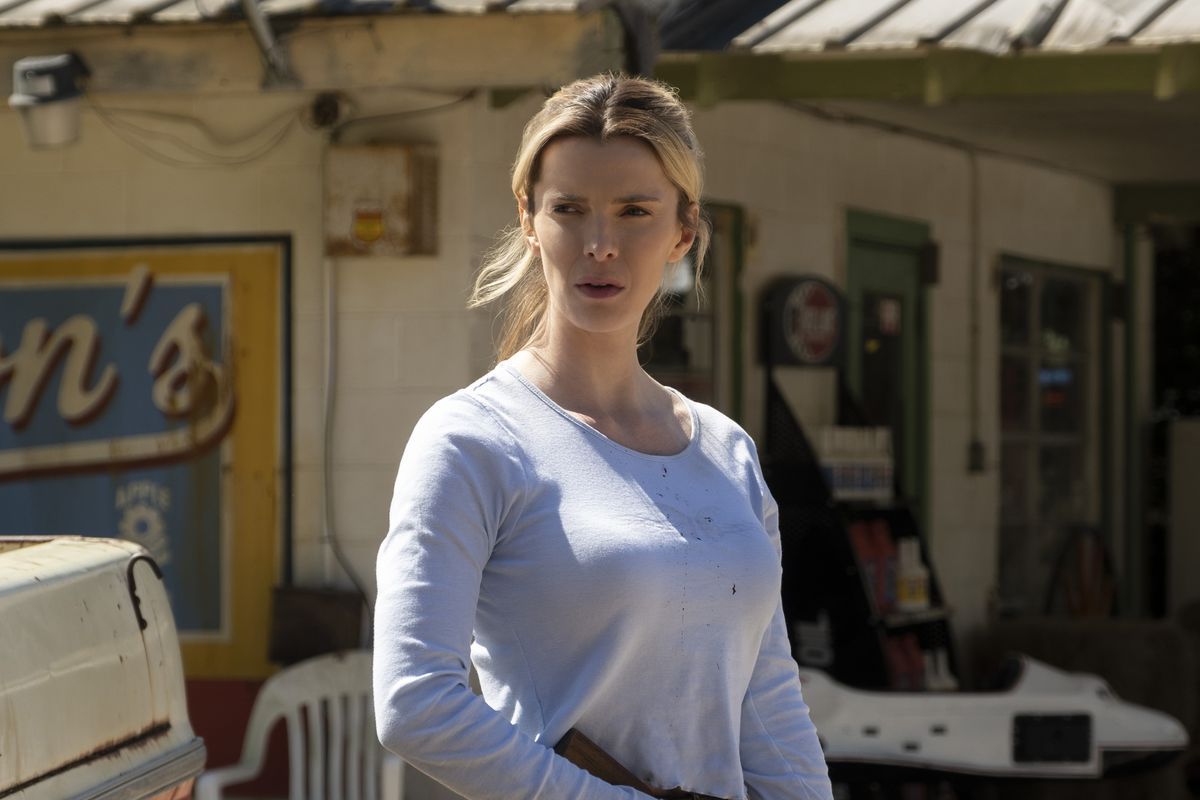
Atomic Blondes

Bombshell

by Hope Madden

Bombshell, Jay Roach’s depiction of the unrepentant sexual harassment that poisoned the work atmosphere at Fox News, is equal parts cathartic and depressing.

Buoyed by strong lead performances in a trio of unerring talent—Charlize Theron, Nicole Kidman and Margot Robbie—the film also leans on an incredible and sizable ensemble to deliver a surprisingly nuanced look at the shades of grey, of complicity and responsibility when it comes to sexual harassment.

“It’s no one’s job to protect you,” Theron’s Megyn Kelly tells newbie Kayla (Robbie).

“It’s all of our jobs,” she disagrees.

No surprise the script comes from The Big Short scribe Charles Randolph. Roach’s film benefits from the same kind of thoughtful, informative, funny and “can you believe this?” approach, but Bombshell lacks much of the rage and outright comedy of an Adam McKay film.

Like McKay, Roach left comedies behind in favor of headier, sharper, more political material. Also like McKay, his comedic sensibilities breathe some life into the efforts, helping this film serve the dual purpose of entertaining and informing. And, like McKay, Roach knows how helpful a well-placed comedian can be.

Kate McKinnon actually does a lot of the film’s narrative heavy lifting. (Is it wrong I wanted her to play Rudy Giuliani as well?) As a Bill O’Reilly producer who befriends Kayla and helps her better understand the Fox New world, she allows Roach to make salient points about the network and the way it’s run, but because McKinnon is naturally funny and incredibly talented, it feels organic.

Her character’s position when it comes to rocking the boat also offers a clear-eyed take on why toxic work environments can go unchecked for so long. Since McKinnon’s character is in many ways the one the audience will most relate to, this is a sly and successful maneuver to keep us from feeling too superior and enabling us to better empathize with characters we may not like as well.

Enough cannot be said for the work of Roach’s makeup department, especially that of prosthetic make up designer Kazu Hiro. Theron’s imperceptible prosthetic—along with her own posture and voice work—turn her into an alarming replica of Kelly. Ditto Nicole Kidman, and John Lithgow, whose performance as Roger Ailes also delivers a wallop.

Not that any of this matters if the three central performances lacks in any department. They don’t. Characteristically, Theron, Kidman and Robbie deliver exceptional work, each willing (as they always are) to depict a woman who is not always (or, in some cases, is rarely) likable but who deserves respect and empathy for her suffering and courage.

Wisely, Roach and team don’t get swept away by the bracing change and empowerment of victory. Indeed, Bombshell’s final act is a smack I still feel. But its power is its honesty.

Fright Club: Future Oscar Winners in Horror

One of the most fun facts in acting is that most of the greats, even the truly greats, started off in horror. And, apparently, they all co-starred at one point or another with Keanu Reeves, whose Oscar is apparently still forthcoming. Today we look at some horror films with casts dripping with future gold.

5. Constantine (2005)

Two Oscars plus three nominations. Not for Constantine, obviously, but that’s the hardware and would-be hardware shared among the cast of this one.

We have no explanation for this, but Keanu Reeves shows up three times in this countdown, regardless of the fact that he’s never been nominated for an Oscar.

No!

Francis Lawrence (of the many Hunger Games fame) made his directorial debut with this big screen take on the comic Hellblazer. Reeves mumbles his way through the lead role of John Constantine. Destined to hell because of an early-life suicide attempt and cursed with the ability to see demons and angels in their true form, Constantine battles on behalf of the light in the hopes of regaining favor and avoiding his eternal fate.

Tilda Swinton plays the angel Gabriel! Peter Storemare plays Satan! I don’t know what else you need to convince you to waste two hours, but Rachel Weisz also plays twins, Pruitt Taylor Vince plays a priest, Djimon Hounsou plays a witch doctor, and there’s absolutely no reason any one of these people said yes to this job. Glorious!

4. Bram Stoker’s Dracula (1992)

OK, well Coppola alone has five outright Oscars and one Thalberg Memorial Award, as well as nine additional nominations. Add to that Oldman’s win and nomination, Hopkins’s win and three nominations, Ryder’s two nominations and Richard E. Grant’s nom and you have to just wonder why this movie doesn’t work better.

Overheated, overperformed and somehow undeniably watchable, Francis Ford Coppola’s take on Stoker’s classic vampire tale is a train wreck.

Keanu Reeves is awful. Winona Ryder is awful. Anthony Hopkins is so over the top as to be borderline hilarious. And yet, Coppola somehow matches that ridiculous volume and pitch with a writhing, carnal atmosphere – almost an oversaturated Hammer horror, all heaving breasts and slippery satin.

At the heart of the film is a glorious Gary Oldman, who is particularly memorable as the almost goofily macabre pre-London Dracula. Tom Waits makes an impression as Renfield, Richard E. Grant offers a nicely wearied turn as the asylum’s keeper, Dr. Seward, and the lovely Sadie Frost joins a slew of nubile vampire women to keep the film simmering. It’s a sloppy stew, but it is just so tasty.

3. The Gift (2000)

Blanchett has two, Swank has two, Simmons has one, writer Billy Bob Thornton has one plus, including Danny Elfman and Greg Kinnear, there’s another 11 Oscar nominations for this cast and crew. And yet…

Thornton co-writes this supernatural backwoods thriller, allegedly about experiences his mother had as a clairvoyant. Sam Raimi, who’d just directed Thornton to an Oscar nomination with A Simple Plan, directs a star-heavy cast: Cate Blanchette, Keanu Reeves, JK Simmons, Gary Cole,  Hilary Swank, Giovanni Ribisi, Katie Holmes and Greg Kinnear.

Blanchette is a small town Georgia fortune teller (though she doesn’t like that label). Recently widowed and raising three young boys, she’s the picture of vulnerability and Blanchette is, of course, excellent. This is one of Reeves’s stronger performances, too, as the violent rube suspected of murdering a lovely young missing person (Holmes).

Ribisi does the best by the film, which is a fun if predictable little spook show. Raimi can’t quite find his tone, and humorless horror is definitely not the filmmaker’s strong suit. Still, the cast is just about enough to make the film really shine.

2. Zombieland (2009)

Emma Stone, Woody Harrelson, Jesse Eisenberg, Abigail Breslin and Bill Murray each have at least one Oscar nomination; Stone’s also won one. And in a lovely change of pace, the movie they made together kicks all manner of ass.

Hilarious, scary, action-packed, clever and, when necessary, touching, Zombieland ranks as one of the most fun zombie movies ever made. How much of that is due to Rhett Reese and Paul Wernick’s spot-on screenplay? Loads. How much credit goes to director Ruben Fleischer? Well, he did stage that utterly fantastic theme park kiosk shootout of death, didn’t he?

But let’s be honest, the chemistry among the four leads, their comic timing and simple, undeniable talent is what raises this film to the highest of genre heights.

https://www.youtube.com/watch?v=p9gNJpJyYiA

1. American Psycho (2000)

Truth be told, Christian Bale should have won the Oscar for this iconic slice of perfection. He did not, but he did win for The Fighter, with three nominations in quick succession after that. Reese Witherspoon has one win, one nom and Jared Leto has one win. Meanwhile, Chloe Sevigny has one nomination to Willem Dafoe’s four.

It this film better than all of those? Hell yes. These fantastic actors mingle in a giddy hatchet to the head of the abiding culture of the Eighties. American Psycho represents the sleekest, most confident black comedy – perhaps ever. Writer/director Mary Harron’s send up of the soulless Reagan era is breathtakingly handled, from the set decoration to the soundtrack, but the film works as well as a horror picture as it does a comedy. 

As solid as this cast is, and top to bottom it is perfect, every performance is eclipsed by the lunatic genius of Bale’s work. Volatile, soulless, misogynistic and insane, yet somehow he also draws some empathy. It is wild, brilliant work that marked a talent preparing for big things.

Bro Down

Black Christmas

by Hope Madden

In the history of cinema, the number of bad, misogynistic horror movies is too high to count. I literally cannot count that high. So, even though Black Christmas is not a good horror movie, it’s somehow comforting to know there is now at least one bad feminist horror flick.

Co-writer/director Sophia Takal (writing alongside April Wolfe) puts a new spin on Bob Clark’s seasonal classic. (Well, Clark also directed A Christmas Story, but I’m talking about his 1974 original Black Christmas.)

Christmas break is upon the Hawthorn College campus and students are slowly trickling home. Any sorority sisters left at school will wish they’d made other plans.

Clark’s bloodier yuletide gem remains relevant because it’s a pre-slasher slasher, meaning that it doesn’t entirely follow the formula because there was no formula for slashers in 1974. Many consider Black Christmas to be the first of that sub-genre, so it subverts expectations because, when it was made, there were none. Fun!

The second reason people return to it annually is the creepy ass phone calls that still somehow manage to be chilling.

Takal definitely frustrates with phones, although not to nearly the same chilling effect. But she does manage to give the formula a switch-up.

Imogen Poots leads the cast as Riley, and we know Riley is the film’s hero because she has the most to overcome. Poots is a reliable performer, though she struggles to give Riley much character. Still, you see flashes of her talent, especially in an infuriating conversation with campus police.

Aleyse Shannon leaves a more interesting impression as activist/bestie Kris, and Cary Elwes makes a welcome, oily visit as the professor you really, really hate.

Unlike the ’74 original or the unwatchable 2006 reboot, Takal’s Black Christmas is PG13, so don’t expect any real scares or envelope-pushing violence. Where Takal takes chances is with the message that rape culture has to be burned to the ground.

The film is a blunt instrument, but there are moments in the dialog that are both cathartic and funny. Female characters are treated with sincere scrutiny and empathy (except in the film’s prologue, which is just disappointing).

And yet, the leap in logic between “let’s go to the cops” and “here’s my supernatural theory” is so grand, so bold, so ludicrous that you almost have to admire it. It absolutely sinks the movie, but there’s something applause worthy in the wrong-headedness of it.

The plot ends up killing Black Christmas, which is too bad. Takal threads some audacious take downs of bro culture throughout a film with a lot of insight. It’s just not a very good movie.

Diamonds in the Soles

The Kingmaker

by Hope Madden

Is there anything more dangerous than a sense of entitlement? This belief in being owed something unearned—a theme that’s played in a number of filmmaker Lauren Greenfield’s documentaries about the absurdly wealthy—takes on a more sinister stench in her latest, The Kingmaker.

With surprising access and intimacy, Greenfield delivers a behind-the-scenes look at the Marcos family’s return to power in the Philippines. It’s a dark, almost surreal image of what passes for reality in this post-truth world and it is depressing A.F.

We spend most of our time with Imelda Marcos, best known for being the first lady of the Philippines during Ferdinand Marcos’s dictatorship, and for owning thousands of pairs of shoes.

“Martial law, that was the best years of Marcos because that’s the time he was able to give the Philippines sovereignty, freedom, justice, human rights,” Imelda wistfully remembers of the period during which 14 of 15 newspapers closed, 70,000 people were incarcerated—half of them tortured—and 3200 people were killed.

But according to Imelda, “There are so many things in the past that we should forget. In fact, it’s no longer there.”

These days, Marcos devotes herself to supporting her son Ferdinand “Bongbong” Marcos’s political aspirations. As Greenfield follows along on Bongbong’s vice presidential campaign, she frequently pauses to reiterate some salient points from the last time a Marcos ran that country.

Two journalists and a teacher share their stories of torture, including rape, under the regime. In an almost surreal yet bracingly telling piece of filmmaking, Greenfield also spends time with the islanders most effected by Imelda’s fondness for exotic animals.

Marcos reframes her capacity to loot her nation to serve her own pathological spending habits as mothering, love. Indulgence is love. Grotesque, criminal self-indulgence at the expense of her nation’s citizens? Well, she claims that never happened, but if that Monet painting that she definitely did not purchase with ill-gotten money has been found, can she get it back?

The corruption hangs from this family like a mink stole, and The Kingmaker doesn’t deliver the same empathetic shock value to be found in Greenfield’s 2012 doc The Queen of Versailles. Instead, we watch as a nation forgets its horrifying history and, swept up in the “everybody loves a bully” philosophy that seems to have overtaken the entire world, sits complicit as a family of criminals and looters takes its seat again at the head of the nation’s table.

https://www.youtube.com/watch?v=Udbf4xQwWag

Just the Two of Us

The Two Popes

by Hope Madden

How funny is it that Hannibal Lecter is playing Pope Benedict XVI?

That’s not the only sly jab Brazilian director Fernando Meirelles (City of God) takes at the pomp and scandal of the papacy in his latest, but the punches come early and make way quickly for a tone of reconciliation.

Indeed, The Two Popes may be more forgiving than many people will appreciate. Or accept.

But it’s hard to fault the casting.

Anthony Hopkins is better here than he’s been since his Oscar turn as the flesh eater. Frail and humorless (but trying!), Pope Benedict becomes a recognizable figure, one whose solitude and study have isolated him from the people he’s meant to protect and lead.

Jonathan Pryce is perhaps better than he has ever been. An ever reliable “that guy,” Pryce has built a career on versatility, never so showy he outshines the lead, never so unfussy as to be easily ignored. That facility with chemistry elevates his performance here, and as the “everyman’s” pope, Pryce becomes the vehicle for the audience.

Together the two banter back and forth, easily turning Anthony McCarten’s lofty theological and spiritual dialog into passionate conversations between two peers.

The Two Popes offers considerably more nuance than The Theory of Everything, Darkest Hour or Bohemian Rhapsody, although McCarten will never be chastened for writing an unforgiving screenplay.

What he’s done with this script is imagine what the dialog between these two men might have been like as Catholicism moved headlong toward a pivotal event unseen for 600ish years. A bit like The Two of Us, Michael Lindsay-Hogg’s 2000 fictional conversation between Lennon and McCartney (a pair the popes mention more than once), this film is a smartly crafted fantasy of the behind closed stained glass meetings that might have led to the changeover.

The humor is undoubtedly the brightest surprise the film has in store, but Meirelles keeps the film quick and interesting, his filmmaking simultaneously intimate and elegant. The missteps come as he refocuses attention on the future Pope Francis’s rocky past. These sequences drag, boasting neither the visual flair nor the vibrancy of the modern footage.

It’s hard not to also mark as a weakness the way the film simultaneously admonishes and reflects the Church’s tendency to be too forgiving of clergy.

Still, The Two Popes is hard to resist. In the end – especially at the end – the film is almost criminally charming.

I Don’t Want to Go Out – Week of December 9

Holy cow, will you look at all those stars? I don’t think we’ve ever seen a week with such an amazing bounty. Stars, stars, stars – they’re everywhere. If you can’t find something to love this week, you, friend, have troubles.

Click the film title to link to the full review.

Hustlers (DVD)

Once Upon a Time…In Hollywood

Monos

Knives and Skin

Linda Ronstadt: The Sound of My Voice

Daniel Isn’t Real

It Chapter 2

Lady in Red

In Fabric

by Hope Madden

My last note after watching In Fabric: “Well, that was weird.”

Weird in a good way.

Nobody blends giallo’s surrealistic seduction with dry British wit (two elements that, to be honest, should not fit together at all) like Peter Strickland. Subversive and playful while boasting a meticulous obsession with the exploitation films of the Seventies, Strickland creates vintage-futuristic fantasies that live outside of time and evoke both nostalgia and wonder.

His latest follows a red Ambassadorial Function Dress and the havoc it wreaks on its wearers.

This sounds like Yong-gyun Kim’s 2005 Japanese horror The Red Shoes, but Strickland has something far less sensible, less predictable, and more memorable in store for you.  (Quick PSA: If you can be less sensible than a Japanese ghost story horror and still make a watchable, even fascinating, film, you are at the top of your game.)

We meet Sheila (Marianne Jean-Baptiste), lonely fiftysomething bank teller just finding her way back into the dating pool and in need of a new dress. She heads, during sales season, to Dentley & Soper, where a coven of sales women led by Strickland favorite Fatma Mohamed (she owns this movie) will do what they can to usher clients toward a “transaction of ecstasy.”

The dress, a “a double dream, diamond wrapped,” says the catalog, is “body sensual, captivating, candlelight glances, canape conversations.”

This heightened perfume-ad speak also spills from the department store sales women—each a cross between a Victorian witch and a mannequin—hinting at the fetishistic nature of the entire film.

Strickland, apparently, is about as fond of consumerism as Romero or Cronenberg. He’s also as fond of the color red as Argento. Unlike the giallo films that clearly inform Strickland’s aesthetic, here commerce, not violence itself, is the seductive, sexualized element.

Sheila is a good egg waiting to crack played with working class grace by Jean-Baptiste (Secrets and Lies). In the tradition of the genre, we root that good egg Sheila will somehow outwit the killer dress her saleswitch conned her into purchasing.

Sheila’s story represents the first half of In Fabric, a peculiar but somewhat straightforward horror film. At the film’s halfway mark, Strickland makes a quick left turn into full blown absurdity, which awaits you in the second half.

Not a frame, not a glance, not a bizarre line of dialog is wasted or misplaced in a bold vision that’s stylized nearly to death. In a good way. Strickland’s audacious anti-consumerism fantasy must be seen to be believed.

Time and Tide

Waves

by Hope Madden

“Seize the day,” Tyler’s (Kelvin Harrison, Jr.) literature teacher reminds each student as they leave her classroom.

In a constant loop during weight training, Tyler’s wrestling coach barks,
“There are no second chances and there is no fucking second place!”

Even at home, Tyler’s relaxing moment alone with his loving stepmother Catharine (Renee Elise Golsberry) is interrupted by a very stern father (Sterling K. Brown, remarkable as always) reminding him that if he expects to achieve all that has been set out for him – wrestling at state championship level, securing a scholarship – he’d better get back to work.

Trey Edward Schults’s Waves is quick to show us that Tyler has it all: a loving and financially comfortable family, grades, talent, friends, and a gorgeous girlfriend (Alexa Demie). If there is time to enjoy it, there’s certainly no time to live it, to give into it, or to give anything without the clear expectation that it is forwarding something for himself. High expectations, high demands, high rewards, everything focused on Tyler, everyone focused on Tyler, Tyler focused on Tyler.

Waves sometimes feels like a less contrived, more Floridian view of Julius Onah’s Luce, the scab-picking indie in which Harrison proved himself a blistering and commanding lead. Are the demands put upon the brightest and most talented African American high school males too high? Are those supporting these young men deriving too much from their success to actually offer clear-eyed guidance?

Says Dad to an increasingly desperate Tyler, “We are not afforded the luxury of being average.”

While much of the drama leading to this moment could be generalized to most any adolescent male buckling under high expectations, this moment between father and son separates the narrative as one dealing specifically with the black American experience.

In 1968, George Romero famously cast Duane Jones as the lead in his groundbreaking zombie film Night of the Living Dead only, according to the filmmaker, because Jones was the best actor to audition for the part. The film’s enduring success has less to do with Jones’s talent (though that is evident in every frame) and more to do with the political power the film derives from seeing a black hero in this particular effort.

Schultz cast Harrison Jr. as the male lead in Waves because of his work with the remarkable talent in his previous effort, It Comes at Night. The white filmmaker’s script itself is semi-autobiographical, and there’s a superficial tidiness to Schultz’s cultural shift that Romero’s film didn’t suffer.

It’s not enough to topple the film by any means, but the shorthand and stylized moments that remark on the cultural shift from the story of a white adolescent male on a collision course with destiny and the story of a black young man on that same course feel specifically introduced and placed, while much of the rest of the film offers an uneasy authenticity that keeps your attention.

From Schults’s dizzying opening sequence, Tyler’s breathless youth in sunny south Florida is simultaneously exhilarating and reckless, a reality underscored throughout the film by Drew Daniels’s whirligig camera and Trent Reznor and Atticus Ross’s furious score.

What separates Waves from other chronicles of the frenzied fall of an idealized adolescent is his follow-up act, one in which the fallout of Tyler’s destruction implicates everyone who loves him, including his quiet sister Emily (Taylor Russell).

The point of her narrative is the redemptive nature of forgiveness. Here Schults uses the same camera movement and score to note again the hand-in-hand nature of freedom and danger in adolescence. But here, we sense things may not end up as dire.

Like Schults’s first film Krisha, Waves is embroiled in family issues as well as addiction, though this time the issues and the sociological context concern American blackness—questionable territory for a white filmmaker, even one as irrefutably talented as Schults. Perhaps thanks mainly to remarkable performances by Brown, Russell and especially Harrison, Waves rings mainly true.