Tag Archives: Madd at the Movies

Fright Club: Broadcast Horror

Broadcasting—TV, radio, podcasts—offer plentiful opportunities for horror. You have the good broadcasts, where an important message is being delivered to the right people: The Fog, I Am Legend, A Quiet Place Part II, Texas Chainsaw Massacre 2. And, of course, there are the evil broadcasts: Lords of Salem, Trick or Treat, The Cleansing Hour.

There are also two (well, three really)N utterly brilliant films with very particular broadcasts that are difficult to come by. We narrowed the list to broadcasts aimed at as many people as can be affected, and for that reason alone we’ve left off Poltergeist and Ring/Ringu.

So here are the five best ways horror filmmakers found to wreak havoc over the airwaves.

5. They Live (1988)

More SciFi and action than horror, still John Carpenter’s vision of an elite class using tech to mollify and control the population of the US was eerily prescient. And horrifying.

At the time, though, it was just plain entertaining in a way that married Carpenter’s own iconic Escape from New York vibe with the SciFi horror miniseries of the day, V.

But mainly, it’s Rowdy Roddy Piper chewing bubble gum, and the 6 1/2 minute fight scene between Piper and undeniable badass Keith David that make this film as fun to watch today as it was when it was released.

4. Halloween III: Season of the Witch (1982)

Man, people did not like this movie when it came out. After two massive blockbusters kicking off the franchise, somebody decided to make a Halloween movie without Michael Myers. It would go on to be one of the most beloved cult movies of all time.

Is the storyline confused? Well, its mythology—Celts and Stonehenge and shamrocks and Halloween masks and blah blah blah—but the point is Tom Atkins, isn’t it? Plus the main plot points: kids wear the masks, they watch the commercial, they hear that creepy jingle, and their heads effing melt.

Now that’s showbusiness.

3. The Signal (2007)

A transmission – a hypnotic frequency – broadcasting over TV, cell and landline telephones has driven the good folks of the city of Terminus crazy. David Bruckner, Dan Bush and Jacob Gentry created a film in three segments, or transmissions.

Transmission 1 introduces our lover heroes as well as the chaos. Can Mya (Anessa Ramsey) and Ben (Justin Welborn) remain sane, reunite and outrun the insanity?

Transmission 2 takes a deeply, darkly funny turn as we pick up on the illogical logic of a houseful of folks believing themselves not to have “the crazy.” The final transmission brings us full circle.

The movie capitalizes on the audience’s inability to know for certain who’s OK and who’s dangerous. Here’s what we do know, thanks to The Signal: duct tape is a powerful tool, bug spray is lethal, and crazy people can sure take a beating.

2. Pontypool (2008)

Canadian director Bruce McDonald’s shock jock horror film is best appreciated as a metaphor on journalistic responsibility and the damage that words can do. Radio air personality and general pot-stirrer Grant Mazzy (Stephen McHattie) finds himself kicked out of yet another large market and licking his wounds in the small time – Pontypool, Ontario, to be exact. But he’s about to find himself at the epicenter of a national emergency.

McDonald uses sound design and the cramped, claustrophobic space of the radio studio to wondrous effect as Mazzy and his producers broadcast through some kind of zombie epidemic, with Mazzy goosing on the mayhem in the name of good radio. As he listens to callers describe the action, and then be eaten up within it, the veteran McHattie compels attention while McDonald tweaks tensions.

Shut up or die is the tagline for the film. Fitting, as it turns out that what’s poisoning the throng, turning them into mindless, violent zombies, are the very words spewing at them. It’s a clever premise effectively executed, and while McDonald owes debts all around to previous efforts, his vision is unique enough to stand out and relevant enough to leave an impression.

1. Videodrome (1983)

Videodrome was the last true horror and truly Canadian film in David Conenberg’s arsenal, and it shows an evolution in his preoccupations with body horror, media, and technology as well as his progress as a filmmaker.

James Woods plays sleazy TV programmer Max Renn, who pirates a program he believes is being taped in Malaysia – a snuff show, where people are slowly tortured to death in front of viewers’ eyes. But it turns out to be more than he’d bargained for. Corporate greed, zealot conspiracy, medical manipulation all come together in this hallucinatory insanity that could only make sense with Cronenberg at the wheel.

Deborah Harry co-stars, and Woods shoulders his abundant screen time quite well. What? James Woods plays a sleaze ball? Get out! Still, he does a great job with it. But the real star is Cronenberg, who explores his own personal obsessions, dragging us willingly down the rabbit hole with him. Long live the new flesh!


That’ll Do

Pig

by Hope Madden

A quick plot synopsis of co-writer/director Michael Sarnoski’s Pig suggests a very specific image. Nicolas Cage plays a hermetic truffle hunter whose beloved pig is kidnapped. He uses his particular set of skills to find her.

You are almost undoubtedly thinking this is John Wick, swapping Cage for Keanu and a pig for a puppy.

Nope.

This touching film—a tale of love, loss, authenticity and a good meal— is essentially the anti-John Wick. And we are better for it.

Cage’s legacy will rightfully be of an unhinged and singular talent—and also an actor who never turns down a gig. But every decade or so the stars align and Cage gets to stretch, he gets to underact. He hasn’t delivered as nuanced or thoughtful a performance since David Gordon Green’s 2013 film Joe.

Lurking, silent and disheveled, his character hitches a ride with the only soul who contacts him regularly, Amir (Alex Wolff, Hereditary), the slick wholesaler who takes his truffles off his hands each Wednesday.

As the two climb the ladder of potential kidnappers, from other outdoorsy truffle hunters to middlemen to chefs and higher still, Sarnoski mimics the beats of a vengeance thriller like John Wick or Taken, but he does this only to subvert expectations. It turns out, when your only real goal is to retrieve something beloved and lost to you, bloodshed doesn’t rank high in your thoughts.

A uniformly strong supporting cast and their priceless reactions to Cage’s vagabond presence not only illuminate the pretension Sarnoski hopes to call attention to in Portland’s high-end restaurant culture. They give the actor the chance to react.

Cage is almost always the center of attention in every film. It’s tough to look away from him because you’re afraid you’ll miss some insane grimace or wild gesture, but also because filmmakers love him and never pull away. Sarnoski asks you to wait for it. He gives Cage time to pause, breathe, and deliver his most authentic performance in ages.

I guarantee the folks to my left at this screening were here for Cage Uncaged! ™ Hopefully they appreciated the fact that they didn’t get it.

https://www.youtube.com/watch?v=c-hFLl7mYlw&t=3s

Straddling Borders

I Carry You with Me

by Hope Madden

If the final act of I Carry You with Me has a documentary feel about it, that makes good sense. Director/co-writer Heidi Ewing—known primarily for docs including Jesus Camp and The Boys of Baraka—takes on her first narrative feature by spinning a love story based in fact.

Ewing’s subjects, Iván Garcia and Gerardo Zabaleta, are NYC restauranteurs who fell in love in Mexico in the 1990s. Though Ewing grounds her fable in their present day, the bulk of the film waxes youthful and romantic back in Mexico.

Young, closeted Iván (Armando Espitia) dreams of putting his culinary skills to use so he can provide for his young son, whose mother rarely allows him to visit. He meets Gerardo (Christian Vazquez) and they fall in love, but dreams of the success that evades him at home propel Iván north.

And though the film’s title aptly captures the longing between separated lovers, it carries with it a great deal more. Ewing conjures the phantom ache that follows Iván the rest of his life without his son, his family and the home he knew.

Yes, the film, co-written with Alan Page, leads inevitably to the couple’s modern-day dilemma. They’ve worked their way up from nothing, lived and achieved the American dream, but are essentially caged. Iván’s son has grown up without him. He will never be allowed to come here, and if Iván returns to Mexico to see him he risks losing Gerardo and his American dream forever.

I Carry You with Me never feels like a blunt instrument. In much the way Ewing did with her documentaries, she weaves true tales with humanity and honesty so they resonate. A documentary’s best chance of affecting change is by helping an audience see themselves in the lives on the screen. Ewing did that with her many docs. She does it again here.

Ready Player Bron

Space Jam: A New Legacy

by George Wolf and Hope Madden

You think the GOAT debate about hoop gets heated? Just wait ’til your twitter thread blows up with hot takes on the thespian greatness of Jordan vs. LeBron!

Yeah, that’s not likely to happen.

I can tell you Don Cheadle is a great actor, and he’s clearly having a ball as the high-tech heavy in Space Jam: A New Legacy.

Cheadle is Al G. Rhythm, a (what else?) algorithm inside the Warner 3000 computer system that has designed a can’t miss WB idea for LeBron James. But LeBron is not impressed, so Al decides to get even by pitting LBJ against his own 12 year-old son, Dom (Cedric Joe).

Dom is actually more interested in video game design than basketball, but feels pressured by his superstar Dad to follow in the family business. Al seizes on this rift, pulling father and son into the virtual world, stealing Dom’s design for a basketball video game, and offering a deal.

You guessed it: classic Tunes (featuring Zendaya voicing Lola Bunny) vs. some brand new Goons (basketball superstars including Anthony Davis, Damian Lillard and Diana Turasi). A win for the Tune Squad puts the James family back to normal, but a loss means they’ll stay in the “server-verse” forever.

Adding WNBA stars and a new look for Lola are just two of the ways director Malcolm D. Lee (Girls Trip, The Best Man franchise) and the writing team succeed with an updated premise required for new sensibilities. Sure, the resolution of the father-son tension is predictable, but it manages a schmaltzy level of resonance amid the cartoon nuttiness that we’re really here for.

The antics of your favorite Looney Tunes characters (aside from an ill-advised, rapping Porky Pig) are classically looney, but the script also scores with some topical, self-aware humor aimed at the digital age, a classic Dave Chappelle bit, and LeBron himself (Dom: “Did my Dad leave?” Al: “That’s what he does, isn’t it?”)

And while the original ’96 Space Jam always smacked of product placement marketing, A New Legacy ups that ante, dropping LBJ and friends into any number of Warner properties, from Casablanca to Rick & Morty. Shameless, yes. Fun? Also yes.

As for King James, he follows that standout cameo in Trainwreck with a lead performance that alternates between awkward and decent. He does bring more natural onscreen charisma than Jordan (there’s a reason MJ barely speaks in his TV ads), but I’m guessing the task of acting opposite cartoons didn’t help with James finding a comfort zone in his first lead role.

But LeBron sure looks at home on the court, and once everybody joins him (and I mean everybody – have fun scanning the crowd), Lee rolls out some frantically fun game action with plenty of visual pop. This Space Jam may follow some of the original’s playbook, but there’s enough “new” here to justify the title, and by the time the buckets and anvils start dropping, A New Legacy finds its own fun and satisfying groove.

This Looks Familiar

Dachra

by Hope Madden

Any break from Judeo Christian supernatural horror is always welcome. That’s not to say that your traditional Western religious zealotry can’t make for a fine scare, but it has certainly been done. From The Exorcist to The Omen to the entire Conjuring universe to the best horror of 2021 so far, St. Maud, cinema is forever teeming with the biblical unholy.

Why not try something else?

Tunisian filmmaker Abdelhamid Bouchnak does what he can with a tale of North African witchcraft in Dachra.

The grim story follows three journalism students trailing the origins of a wild urban legend about a witch found on the highway decades ago. They track the source of the legend to Dachra, a tiny, backward village unlocatable via Google.

Yassmine Dimassi plays Yassmine, headstrong and clearly the leader of the trio of investigators. Still, once they find the village, Yassmine and her bickering sidekicks Walid (Aziz Jebali) and Bilel (Bilel Slatnia) are hard-pressed to find their way back out.

Dimassi’s angry, unyielding performance drives the film, giving it a blind urgency that can’t help but push things onward. Jebali and Slatnia counterbalance, their dunderheaded sibling-esque rivalry creating sweet but organic opportunities for Bouchnak to get in the way of that forward momentum.

This is how filmmaker and crew generate tension, but it’s always upended by contrivance. Like so many films that rely on characters’ inability to leave someplace, unexplained lapses in time and delays that strain believability puncture whatever dread the film has built.

Perhaps what’s most disappointing about Dachra—Tunisia’s first official horror movie—is how uninspired it is. Unlike Baskin, for example—one of the very few horror films to ever come out of Turkey. Can Evrenol’s meat-loving mindbender positively reeks of originality. Bouchnak, on the other hand, pieces together every cliché he can think of, winding up with a film both clumsily familiar and unpleasant.

Assassins Assemble

Black Widow

by Hope Madden and George Wolf

Avenger Natasha Romanoff had to wait a while to get the green light on her own standalone origin story, and then even longer for the big screens to carry it. Now Black Widow is finally here, and Natasha’s not even the most interesting character in her own show.

And the film is better for it.

Director Cate Shortland and writer Eric Pearson surround Natasha with uniquely compelling personalities that become important parts of a whole, while surrounding star Scarlett Johansson with a supporting ensemble skilled enough to make this one of the MCU’s most character-driven successes.

Oh, there’s action, too, but we start with a prologue set in 1995 Ohio, when Natasha’s family is trying to flee the country at a moment’s notice. Father Alexei (David Harbour), and mother Melina (Rachel Weiss) were prepared for this day, so they scoop up young Natasha (Ever Anderson) and sister Yelena (Violet McGraw) and put the escape plan into action.

An overlong, Watchmen-style montage mixing music and news headlines brings us up to 2006, when the family is long estranged. Natasha is on the run since the Avengers “divorce” (between Civil War and Infinity War), Yelena (Florence Pugh) is taking names in Norway, Alexei is in prison and Melina’s loyalties seem tied to some talented pigs. Meanwhile the villainous Dreykov (Ray Winstone – nice! His accent – not so much) has plans to build an army of mind-controlled “Black Widow” assassins.

That means females only, but while the reveal lands as a clear metaphor for sex trafficking, Shortland (Berlin Syndrome, the underseen gem Lore) and Pearson (Godzilla vs. Kong, Thor: Ragnarok) never belabor any well-taken points. Even better, they fill the entire adventure with enough organic, self-aware humor about posing, too tight supersuits and the need for pockets that very few of the 133 minutes seem laborious at all.

The core foursome is uniformly terrific, as you would expect from actors of this caliber. Performances blossom and surprise, their chemistry buoying the familial longing required of every superhero backstory while anchoring action in characters you can care about.

Pugh—sympathetic, comedic and badass—is the standout, but Johansson shines, especially in a climactic bout with Winstone that lands satisfying jabs about weak men.

Shortland never forgets the point of a superhero film, though. The breathless action in Black Widow impresses as much as it entertains, whether hand-to-hand or aerial.

And it is a Marvel film, so be sure to stick around post-credits for an intriguing stinger and a welcome addition to the universe.

In His Name

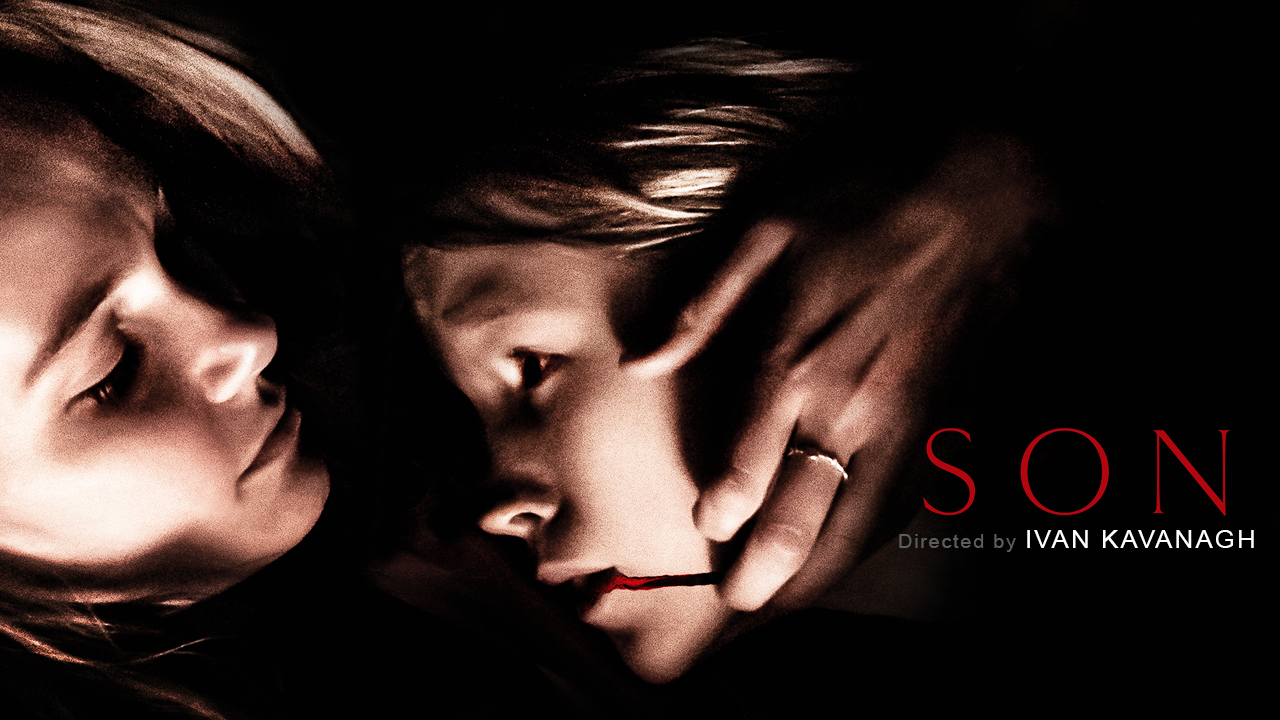
Son

by Hope Madden

Back in 2014, Irish filmmaker Ivan Kavanagh wondered what to do about a dad who may be his son’s only salvation, or may be his one true danger. Canal had a lot going for it—it looked creepy, performances were solid, and it wasn’t afraid to bang up its cast.

It just couldn’t quite make the leap from good to great.

Same goes for the filmmaker’s latest, Son.

We open on a filthy, barefoot, rain-soaked young pregnant woman (Andi Matichak, Halloween) hoping to warm up with a coffee in a roadside diner. Two men walk in, she exits in a hurry.

Cut to eight years later. Same woman, clean and wholesome now, buckles in precocious little David (Luke David Blumm) to drop him off at school. They’re adorable. They’re happy, hard-working, loving, and about to face some ugly stuff once Kavanagh establishes the paradise to be lost.

An awful lot of movies want to know how far a mother is willing to go to protect the son who may or may not be the real villain. This has been especially true in the last five years. (See The Hole, The Prodigy, Brahms: The Boy 2, Z, Brightburn it’s a long list.) Does anything set Son apart?

Kavanaugh roots the story in hysteria and conspiracy, sketchy memories of a cult versus police reports of sex trafficking. All of it feels mildly of-the-moment, but the real purpose is to throw skepticism toward the seemingly lucid mother and her claims.

Which is another common horror trope (is she crazy or is she right?), especially in the subgenre where a mother is trying to figure something out that may or may not be supernatural.

So, no, Kavanaugh does not bring much that’s new to the table.

Son does boast solid performances, and the filmmaker once again flexes his strong instincts for unsettling locations and atmospheres. The writing, pacing, and imagery all work together as they should to generate anxiety and dread. Son gets gory now and again, too.

It just doesn’t do anything you don’t expect it to do.

What Might Have Been

The Forever Purge

by Hope Madden

Now, I’m not suggesting any of the Purge films were subtle. Creator James DeMonaco wielded a blunt political instrument from the start.

Quick recap: In the near future, a far-right government, the New Founding Fathers, establishes a single night of lawlessness to encourage Americans to purge themselves of all their hate and anger. And, you know, take their frustrations out on the homeless, the poor, and the otherwise generally oppressed.

So, a pretty easy metaphor to figure out, although most installments contained an interesting idea here, some memorable imagery there. Gerard McMurray’s 2018 The First Purge was impressively topical and prescient, and genuinely angry. In it, the filmmakers essentially looked at Trump’s America and asked: How did we get here?

In a way, all of these films have led organically to The Forever Purge, a film with a premonition of what would have happened if Trump’s America had been allowed to – or would ever again – continue on its natural course.

It’s hard to blame filmmakers for losing optimism in the face of the national shame of January 6. In this installment, entitled, angry white people have decided that one night is not enough, so they organize online and just take over the country.

DaMonaco returns as writer, while Everardo Gout directs. Gout’s sensibilities lean heavily toward action. The Forever Purge is essentially an action thriller with a social conscience (and about as much subtlety as you’ve come to expect from the franchise).

There is no forgiveness in this installment, and maybe there shouldn’t be. But The Forever Purge loses the humanity of the better episodes in the series. At its worst, it’s a political outcry by way of a predictable horror film that’s pretty light on horror. At its best, it’s a poignant upending of this country’s fundamental, foundational racism.  

Floating in a Most Peculiar Way

I Like Tomorrow

by Hope Madden

Need one more reason to be thrilled that the Wexner Center for the Arts is reopening to the public? A new collaboration between filmmakers Jennifer Reeder and Nancy Andrews—the delightfully spacy I Like Tomorrow—plays through July and August in The Box.

The 11-minute short showcases Andrews’s animation prowess, as well as the versatility of performer Michole Briana White, who delivers three roles in one.

White plays Captain Regina Lamb, a lone astronaut who’s been in orbit a while. Maybe a really long while. And at the moment, she’s working through some relationship issues. With herself. Specifically, she’s navigating her commitments to her past self (White again, as Reggie) and her future self (White as Rae).

The I Like Tomorrow aesthetic is MST3K meets Bowie, and who wouldn’t be wild about that? White’s performance is lonesome, slyly insightful and very funny. She makes excellent use of Reeder and Andrews’s nimble dialog, using space exploration to mirror relationship communication, then focusing everything inward.

Captain Lamb’s journey toward appreciating who she is today, this moment, is as charming as it can be. White gives each of the three versions of Lamb age-appropriate personalities and the interplay among the three is priceless.

As layered and insightful as the film is, Andrews and Reeder never abandon their playful attitude. In fact, the comic in this cosmic episode only increases as Captain Lamb’s journey wears on.

Musical interludes and animation, set design and costumes all work together to create a mood that’s simultaneously lonely, hopeful, and weirdly funny.