Tag Archives: independent film

Cornish Comfort Food

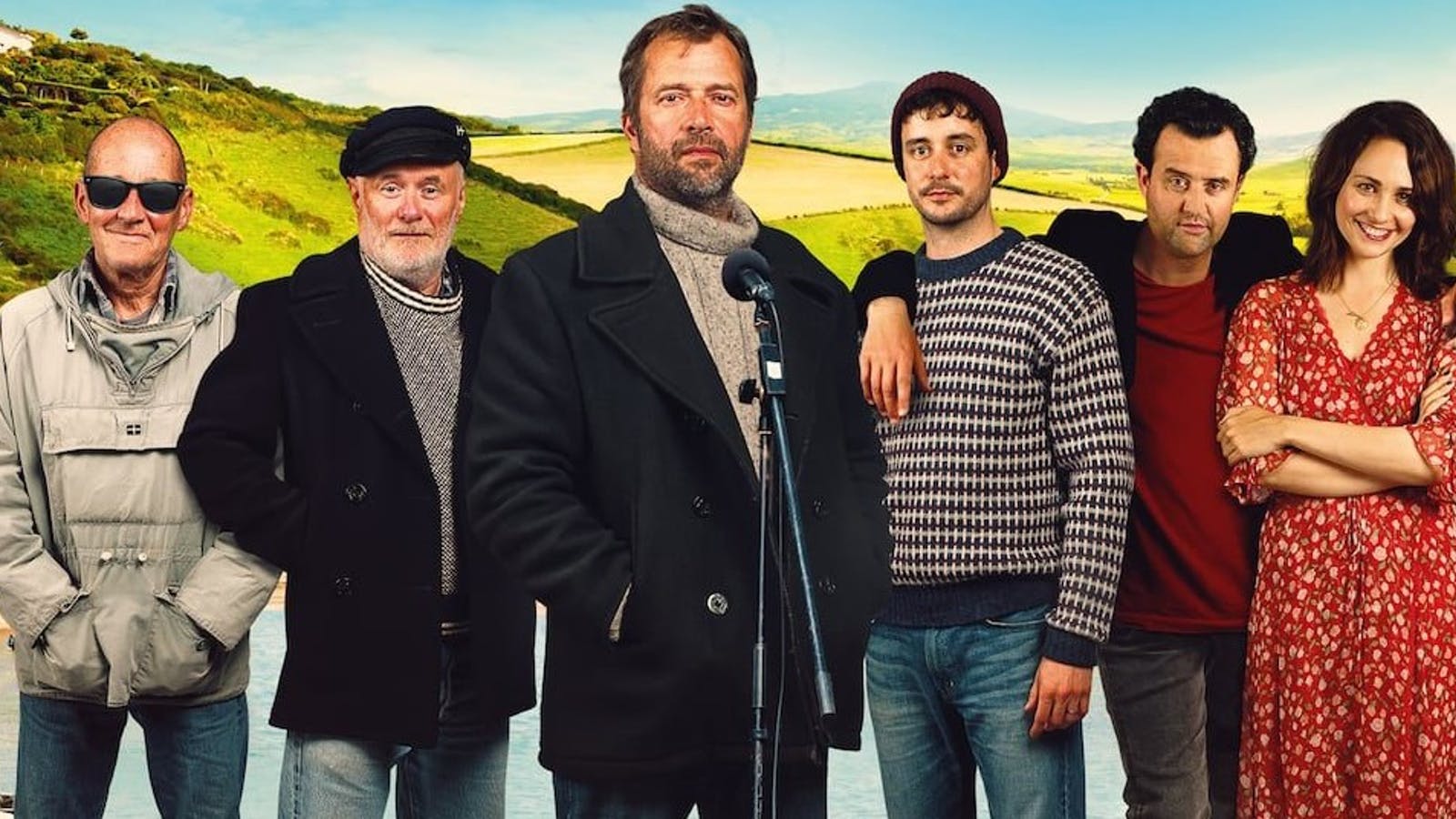
Fisherman’s Friends

by Seth Troyer

If you’re looking for a low stakes, feel good film to watch with your family, you could do a lot worse than Fisherman’s Friends.

The film is loosely based on the true story of a men’s a capella group consisting of tough-as-nails men of the sea who were eventually signed to Island Records and became a surprising success.

Witnessing the transformation of a group of old men who like to sing traditional music while drunk at a pub on a Friday night into performers with sold out shows is undeniably interesting. The a cappella performances in the film mix the voices of original members and the actors portraying them, and the results are surprising. Even if it’s not your thing, Fisherman’s Friends will remind you that a cappella music can send shivers down anyone’s spine.

Names have been changed and the story is clearly expanded and fictionalized to better suit the arc of a feel good movie. One of the real events left out is the 2013 stage collapse that resulted in the deaths of member Trevor Grills and promotor Paul McMullen. The film is respectfully dedicated to these men and seems to be an attempt to celebrate the good times before the tragedy rather than letting it define the band.

I can’t help thinking that a more honest and candid portrayal may have made for a more engaging film, but the choice to avoid the tricky task of translating such a painful event into cinematic drama is understandable.

In the end, director Chris Foggin succeeds in doing what he sets out to do. The film is a charming story of friendship and ambition—nothing more, nothing less. It follows all the familiar narrative beats, with a sweet but predictable love story thrown in, and plenty of montages that will make more cynical viewers roll their eyes. But honestly, this simply isn’t the film for a cynical viewer.

If you want Ingmar Bergman, go watch The Seventh Seal (it, of course, rules). But if you want to watch something with your extended family and maybe smile a bit, what you have here is some Cornish cinematic comfort food that will do the trick just fine. 

Unforgiven

Retaliation

by Seth Troyer

Written by Geoff Thompson, a survivor of sexual abuse, Retaliation is a loosely autobiographical descent into the pain and violence that can come in the aftermath of trauma. Orlando Bloom steps up to this challenging material with surprising ease.

Any Lord of the Rings jokes you may want to make will be silenced within the first few minutes as you see Bloom fully embody the character of Malky. He has been tormented all his life by the memory of being molested as a child by a local priest.

Malky is a powder keg ready to blow, attempting to channel this energy into his construction job, demolishing dilapidated churches with vengeful satisfaction. Where the film truly amps up is when he realizes his abuser has returned to preaching in Malky’s hometown.

What follows almost feels like Ingmar Bergman making a John Wick film (in a good way, for the most part). Bloom and the film itself may not perfectly execute every complex maneuver they attempt, but they often reach heights that are undeniably moving.

Brothers Ludwig and Paul Shammasian are a competent directing duo, though they make some choices that threaten to turn the film into an exploitive, bass pulsing thriller that doesn’t suit the material. In addition, several characters—Malky’s girlfriend Emma (Jane Montgomery) among them—often feel less like characters and more like plot tools despite the actors’ best efforts. 

In the end, what does shine through is the writer’s personal story, offering a brooding character study rather than a simple revenge thriller.

Thompson has stated on his website that, like Malky, he struggled with a thirst for violence and revenge. His demons are clearly being exorcised here.

The film’s intense conclusion, where Malky and his old priest finally cross paths, has been understandably divisive for audiences. Regardless, the questions this showdown raises are well worth discussing.

While you will probably never find a Retaliation DVD for sale at a Christian book store, the film’s sentiment seems far from atheistic. It unflinchingly condemns the corruption that can come from organized religion, but also appears to have a strange sort of reverence for the idea of God and biblical teachings. It’s a brutal concoction that makes for a fascinating and unique experience.

Living Deliciously

First Cow

by Hope Madden

Kelly Reichardt films tell a story, but not in the traditional Hollywood sense. She draws you into an alien environment, unveils universal humanity and shows you something about yourself, about us. There’s usually a story buried in there somewhere. In this case, it’s about two outsiders in 19th Century Oregon who find friendship.

And a cow.

Cookie (John Magaro) is a gentle soul, not properly built for the fur trade. (You saw The Revenant, right?) He’s a baker at heart, not that he gets to do much baking on a trapping expedition with hungry, volatile, hunt-weary men.

He holds no value for these men, and has nothing in common with them. But somehow he sees a kinship with the naked Chinese man he stumbles upon as he forages for mushrooms in the woods.

It’s sweet and sad the way Cookie and King-Lu (Orion Lee) fall into a relationship. King-Lu has ambitions. He opens Cookie’s eyes to opportunities he’d never had the courage to consider. Through these characters Reichardt demonstrates how fragile, lovely and heartbreaking hope can be.

Working again with regular collaborator Jonathan Raymond, whose novel the two adapted, Reichardt keeps you pulling for her heroes. The narrative lulls you with understated conversations and observations while the meticulously captured natural beauty onscreen beguiles. Within that, we see the potential of a young country through the eyes of Americans determining the dream.

Reichardt explores loneliness in all her films, the sense that we are each simply and inevitably alone, though we struggle against it regardless. This exploration isn’t hurried. It breathes. She emphasizes the longing for connection in every quiet moment with her characteristic use of lighting, the way she frames nature and the naturalistic performances she draws from Lee and Magaro.

William Tyler’s lonesome score offers something both mournful and tender, which is fitting. Although these men’s very existence in this place testifies to hardy ambition, Reichardt lingers on moments of gentle camaraderie.

When Kelly Reichardt tells a story, she breaks your heart. She does it slowly and quietly, but it’s broken nonetheless.

Belle of the Ball

The Truth

by Matt Weiner

Actors getting lost in a role can become the stuff of legends, or the butt of jokes—as Olivier’s advice allegedly went to Dustin Hoffman, “Why don’t you just try acting?” In The Truth, director Hirokazu Kore-eda takes one of film’s most iconic actresses and sets to demolishing the notion that an artist could ever separate who they are from what they have to say.

The film is Kore-eda’s first foray outside of Japan, and a worthy follow-up to his masterful 2018 drama Shoplifters. The drama, also written by Kore-eda, has a lighter touch in The Truth, but it’s no less arresting thanks to a brilliant self-referential performance from Catherine Deneuve.

Deneuve plays Fabienne, an idol of French cinema now at a point in her life when she’s ready to look back on her storied career. Fabienne’s daughter Lumir (Juliette Binoche) has brought along her family from America to pay Fabienne a visit. When Lumir gets an early look at Fabienne’s memoir, she lashes out at the wide gulf between Fabienne the myth and Fabienne the mother, the one who pursued her art to the detriment of everything else in her life.

One family’s drama becomes a delightful interrogation of memory and art. And as if the unreliable memoir weren’t enough to drive the point home, Fabienne is also currently filming a new movie against an up-and-coming actress playing her younger version.

The film’s quirky sci-fi twist forces Fabienne to face her younger self, and the grande dame of French cinema isn’t quite ready to relinquish her fading star power to what she sees as a poor imitation of her own youthful rise to celebrity.

Kore-eda blurs the lines even further by referencing Deneuve’s breakout years, specifically Belle de Jour, with posters and costumes dotting Fabienne’s house and still exerting a powerful hold on her sense of self-worth. (Ethan Hawke’s understated turn as Lumir’s bohemian husband Hank also feels like an alternate universe version of Jesse from the Before trilogy… but that might also just be Hawke’s natural “these are my ‘just chilling in France’ vibes.” Either way, the man is living his best life.)

The result is a family drama that manages to humanize the dysfunction without fully absolving anyone. Fabienne might be a legend, but she’s still only human. Living an entire life unmoored, unable to process anything in the moment without layers of artifice to mediate any real emotion, seems like it should be punishment enough.

You’ve Got a Friend in Me

Jack & Yaya

by Brandon Thomas

LGBTQ youth often find themselves at the receiving end of family and friend abandonment. The people who are supposed to support them through the coming out simply walk away. The story at the heart of Jack & Yaya is about what happens when two childhood friends go through the same life-changing events, and how those closest to them stick around to champion their lives.

Jack and Yaya grew up as next-door neighbors in south New Jersey. From early on, they both saw who the other truly was, a girl and a boy, even if the rest of their family and friends did not. 

In her directorial debut, Jennifer Bagley wisely lets the film’s two subjects be front and center. Jack and Yaya share a genuine openness about their lives. Absent is any kind of hubris when the two of them talk about their struggles or their successes. This honest, matter-of-fact nature feels immediately welcoming.

The focus on day-to-day struggles for transgender people is real and evident even in this sunnier-than-normal documentary. Jack struggles with running into discrimination even in a city as large as Boston. Yaya worries about the constant financial stress around obtaining hormones. It’s a needed dash of reality. 

As the colorful cast of characters who revolve around Jack and Yaya are introduced, it’s not hard to see how these two became the people they are. Bagley naturally captures the warmth and love that flows between all of them. Amidst the alcohol and ‘70s rock, Yaya’s uncle Eddie spills to the camera how much love he has for both Yaya and Jack. “All you need is frickin’ love!” bellows Eddie. 

Jack & Yaya works exceptionally well at being a celebration of these two people as they figure out their ever-changing lives. This isn’t a film interested in making a grand social statement. Bagley lets these two tell their story, and show us who they really are through their own words and actions.

Jack & Yaya beautifully shows how good we all can be when we prop each other up. Jack and Yaya’s lives could’ve gone so much differently. But they had each other and a support system that evolved into a deep friendship of genuine acceptance and caring. 

“All you need is frickin’ love!” indeed.

Flailing in the Dark

Darkness Falls

by Brandon Thomas

Going into Darkness Falls, I felt upbeat and positive. Gary Cole is the heavy of the film? Sign me up! His track record as a villain (namely A Simple Plan and Pineapple Express) is pretty spotless in my book. 

Then I watched Darkness Falls

Cue sound of deflating balloon.

Detective Jeff Anderson (Shawn Ashmore) has become obsessed with his wife’s suicide, convinced that it was actually a murder. As Anderson delves deeper into other similar suicide cases, he finds that a father and son serial killer duo (Gary Cole and Richard Harmon) are stalking his city. 

From the opening scene, Darkness Falls leans heavily into cliche, and, if I’m being painfully honest, laziness. The filmmaking lacks any real type of energy or urgency. Director Julien Seri’s artistic choices come across as inept and amateurish, never really settling on a specific style. Seri tends to stage many shots to look cool instead of helping to tell an engaging story.

Giles Daoist’s script isn’t up to the challenge either. Rather than try something new with the genre, Darkness Falls relies on the same tired detective movie tropes. Anderson is the loose canon detective that the brass just can’t handle. And I’d be ashamed to forget mentioning just how often he slams his palms on counters and/or tables and shouts things like, “Tell me where he is?!” Truly riveting screenwriting.

The “twists” in the film are ones we’ve seen countless times before in much better films. The climax itself was probably done at least three dozen times before 1990. A few genuine “oohs” and “aahs” could’ve helped Darkness Falls be something more than a feature-length Criminal Minds episode.

Performance wise, things don’t improve. Ashmore, who’s notable for playing more squeaky-clean roles, awkwardly tries to embody the tough-as- nails detective. When he’s not chewing up scenes with over-acting, Ashmore’s performance barely registers above bored. Cole, who I usually adore, doesn’t fare much better. His papa bear serial killer lacks any kind of menace. The character is more of a homicidal used car salesman than threatening maniac. 

With its pedestrian writing, cruise control direction, and phoned-in performances, Darkness Falls spectacularly falls on its face. 

Killer Tween

Becky

by Hope Madden

Finally, someone truly understands what it’s like to be an incredibly angry adolescent girl.

At the very least, Jonathan Milott and Cary Murnion’s film Becky understands enough to be afraid of her.

The titular 13-year-old, played with convincing charisma by Lulu Wilson, is a handful for her widowed father (Joel McHale). Still, dad has decided this is the weekend to take Becky for a getaway with his girlfriend (Amanda Brugel), and her 5-year-old (Isaiah Rockcliffe). They head to the old vacation cabin for a big talk.

He soon finds that his 13-year-old may not be the scariest thing on earth.

Or, you know what? Maybe she is.

Kevin James plays against type as a swastika-tatted up inmate, leader of a band of escapees. James may be hoping to catch the same mid-career fire Vince Vaughn has been fanning, mainly portraying the heavy in various indie thrillers. Early scenes play well, James cutting a solemnly menacing figure as he quietly organizes and orchestrates. But as the film wears on it becomes clear the actor can’t manage the sinister energy needed to really make an impression.

I’ll take this over Paul Blart, though.

Robert Maillet’s a lot of fun, though. At 6’10”, the one-time wrestler dwarfs even the gangly McHale. He’s no master thespian, but his arc creates a spectacular punctuation for Becky’s own transformation and his sheer immensity brings a little needed anxiety to the film.

The writing team, which includes Lane and Ruckus Skye of the brilliant and as-of-yet undistributed Devil to Pay (originally titled Reckoning), cheats a little with this script. Backstories, motivations and mysteries—particularly as they articulate the villainous characters—feel less undefined than lazily obscured. Between that and James’s inability to truly sell the viciousness in his character, the family’s jeopardy lacks the intensity it needs for this film to truly impress.

Wilson does not. In her hands, Becky is a fascinating character, and it is with this character that the writing team and directors score the most points. The film is bloody, angry and, even for its fairly formulaic premise, unpredictable.

Backdoor Progression

Dreamland

by Hope Madden

“You don’t want to suck me.”

There are moments in Bruce McDonald’s head trip Dreamland that are just bizarre fun, like that self-aware line delivered by Henry Rollins. A lowlife gangster kingpin, his statement is as much a moment of self-defense as it is a warning.

Rollins’s Hercules is one of many unseemly characters orbiting each other in this surreal, jazzy noir. Veteran character actor and welcome sight Stephen McHattie (Pontypool) plays dual roles: jazzman junkie and conflicted hitman.

One needs to exact retribution on the other, you see, but maybe redemption of sorts could be arranged for both of them?

From one flesh-peddling nightclub to the highfalutin debauchery of a palace, McDonald’s fever dream offers consistently weird moments, each loosely connected to the next, all meandering toward a wild climax. Dreamland is a nutty drug trip of an underbelly film.

McHattie’s fun, especially as the anesthetized trumpet player. The other McHattie is having a tough time learning that you can’t rely on a junkie.

Both Rollins and Juliette Lewis are clearly enjoying themselves—Lewis, in particular, relishing every moment of over-the-top decadence and weirdness. Belgian character actress Stéphane Bissot impresses most as the sole voice of reason in the entire film. She’s deadpan hilarious.

Not that Dreamland is a comedy. Not that it isn’t, either. It’s a tough film to characterize.

McDonald hit his artistic high water mark in 2008 with the inspired lunacy of Pontypool. For Dreamland he teams again with writer Tony Burgess, and together they dive back into themes of sanity, reality and jazz. But Dreamland lacks the fidelity of vision and the internal logic that made Pontypool simultaneously hilarious and terrifying.

Dreamland occasionally feels like a cheat. Worse still, it too often feels predictable when its every breath is meant to be just the opposite.

Still, there’s more than enough carnage and madness packed into this 90 minutes to keep you gawking.

All In

Lucky Grandma

by Hope Madden

It’s hard to watch Lucky Grandma without giving at least a passing thought to Lulu Wang’s 2019 gem The Farewell. This story could not be more different, honestly, but at the heart of both movies is the undeniable force of a nai nai.

In writer/director Sasie Sealy’s tale, Tsai Chin portrays Nai Nai Wong as a dead-eyed hoot. Cigarette dangling, disgusted expression, Nai Nai doesn’t play. Her dismissive stare is priceless. Her confrontational giggle even better.

One routine trip to see her fortune teller/doctor/friend (Yan Xi) convinces her that her luck is changing. She boards a bus, hits a casino and lets it roll.

But luck is not always what you hoped for and the next thing Nai Nai knows, some homely gangsters are after her.

What makes this film the savvy, funny adventure it is results from Sealy’s manipulation of the familiar. The basic story follows many an Underdog Runs Afoul of the Mob stories (Hard 8, Jackie Brown, Millions, True Romance, etc.)

The difference here, obviously, is the underdog.

Like the movie on the whole, the elderly and beloved old grandmother at the center of this mess is simultaneously familiar and alien. Her aches, pains, poverty and the clear patterns of her behaviors suggest something authentic and recognizable. She’s just not a movie grandma—not like any in the movies we’re used to. Her will is as strong as steel, whether her body keeps up or not.

Sealy’s careful not to mock Nai Nai Wong (a good thing, as she would clearly kick a person’s ass). But Chin makes certain this character is not only formidable, but hilarious.

She’s aided by her odd couple sidekick Big Pong (Hsiao-Yuan Ha), a gentle giant of a bodyguard hired in the savviest, old-ladiest of ways. (You know who can spot a bargain? Grandma can.)

Michael Tow also lends a fascinating, unseemly quality to his scenes as creepy gangster henchman Little Handsome.

The emotional grounding for the film never feels forced, which allows the Lucky Grandma to run its course without the predictable sentimentality that crushes most “look how funny this old person is” films. It’s there—the weighty pull of family over self-reliance, of dependence over loneliness—but, like everything else in the film, it respects the character Chin has so meticulously developed.

https://www.youtube.com/watch?v=7XRn6VswMro