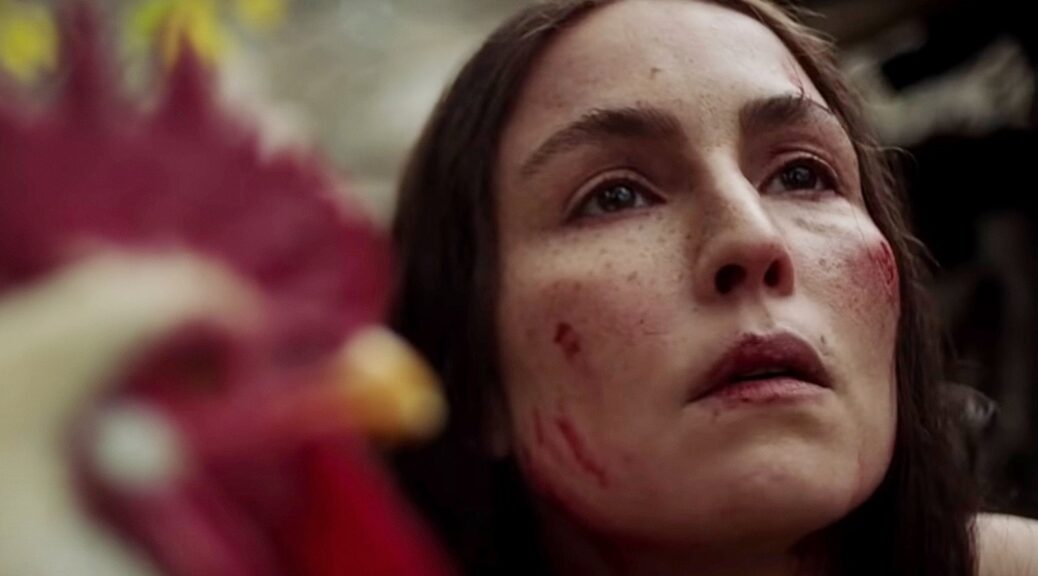
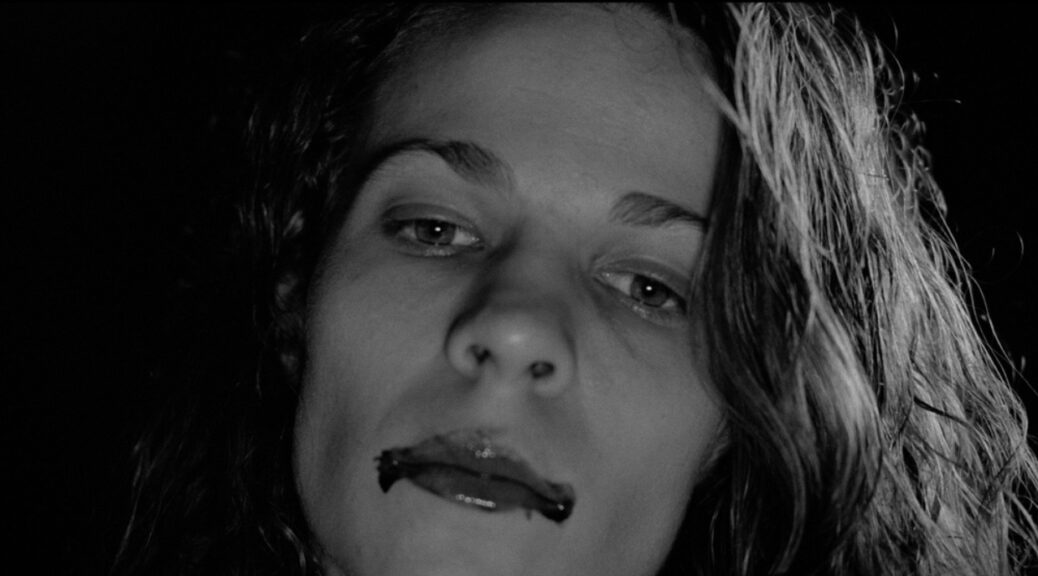
To suppose that filmmaker Goran Stolevski is a fan of Terrence Malick seems fair. His tale of 19th century Macedonian witchery offers the same type of visual aesthetic, whispery voiceover and absence of dialog in much of Malick’s work, especially 2018’s A Hidden Life.
You Won’t Be Alone follows Neneva (Sara Klimoska), a teenager raised in isolation, hidden from the Wolf-eatress (Anamaria Marinca) who’s claimed her. Freed from hiding, the teen shapeshifter takes on different forms (Noomi Rapace, Felix Maritaud, Alice Englert) and learns of life.
The vast majority of the film’s spoken language comes in the form of Neneva’s thoughts via voiceover. Having grown up alone and unable to speak, Neneva’s language is disjointed and poetic, her musings untouched by traditional socialization.
These reflections are periodically punctuated by the bitter logic of her lifelong tormentor, the Wolf-eatress, whose own upbringing among the human race has left her horribly scarred, literally and metaphorically.
Sections of the film are quite lovely. Admirable performances all around help to keep you engaged. Klimoska’s physical performance reflects the primal beginnings of Neneva’s explorations. Rapace brings an awkward adolescence feel to the character’s early interpretations of normal human behavior. Englert carries the character into adulthood with quiet curiosity, never losing that animalistic inquisitiveness carried throughout the earlier performances.
Stolevski’s cast gives him all he could have hoped. Unfortunately, he doesn’t entirely deliver on his end. The story free floats, its style often overwhelming its substance. You feel every minute of its running time.
That’s not to say Stolevski’s approach is a failure, only that it’s taken too far. His fractured storytelling suits his purposes of exploring gender identity and the nature of humanity. He builds dread well and his fluid camera allows his tale to cast a spell.
The result is mainly entrancing, but too often frustrating.
Working from a screenplay by Robert Dean Klein, director Craig Singer brings us the time loop horror film, 6:45.
Bobby (Michael Reed) and Jules (Augie Duke) are trying to work through some issues, so they visit the quaint island of Bog Grove for a relaxing vacation. What the couple doesn’t know is that their visit to the island falls on the anniversary of a traumatic, unsolved murder. Because of this, the ferry service doesn’t run, and they’re stuck – or so they’re informed by the nosy, odd proprietor for the inn where they’re staying.
A slow opening that follows the couple exploring Bog Grove, its tourist shops and oddball residents, doesn’t take advantage of the opportunity to build tension. When the tragedy occurs, it comes as a relief rather than a shock.
Soon, Bobby descends into a nightmare he must relive over and over. Being forced to relive the day alongside Bobby is a horror in itself.
No one else experiences the loop, so we get to see Duke in a range of roles: some days she wishes could last forever, others see her trying to rein in an increasingly unstable boyfriend. Reed, on the other hand, is stuck playing a man who doesn’t seem to know how to handle himself each day. Every time the crucial event occurs, he seems constantly taken by surprise.
The cast of locals has little to do, often repeating lines from previous loops. They fill mostly stereotypical roles: small-town friendly and welcoming or weirdly creepy. There isn’t middle ground, and it makes for uninteresting characters.
Rather than differentiate itself from similar time loop films through storytelling, 6:45 instead focuses on camerawork and distracting split screens. Anywhere from four to six screens will litter the frame, some focusing on banal details, others on more interesting visuals. Days are relegated to montages,
Flashbacks detailing the couple’s history sometimes punctuate the flashbacks. It’s here that Singer cleverly injects moments that help us understand why the couple has been fighting. It’s clear that the fight revolves around infidelity, but these fleeting moments offer hints of violence, which reveals something more sinister.
The film does take an interesting turn, but it comes too little, too late. It also fumbles any message it’s trying to get across. Instead of offering a strong look at a troublesome relationship, it embraces shock over commentary. In the end, we’re not shown anything new or astute.
Filmmaker Mariama Diallo’s episodic and short film work has explored — in comedic and dramatic form — the impact of living within a culture of micro- and not-so-micro-aggression. Her feature debut Master dives deeper, taking themes in more horrific directions.
Regina Hall plays Gail Bishop, the first Black residence hall “master” in the long and storied history of New England’s Ancaster College. In her first year on campus, she’ll meet another newcomer, freshman Jasmine (Zoe Renee), the only Black student in her dorm.
Jasmine has the bad luck of being assigned to the dorm’s spookiest room, where a student haunted by campus’s legendary witch once killed herself. As freshman year progresses, both Jasmine and Gail begin seeing menace around every corner.
Diallo sets up shop at the intersection of racism and misogyny. While her story tells of a history of racism that’s clearly alive and well, the filmmaker’s comment on institutional and historical contempt for women is more sly but ever-present.
The result for this particular position in the crosshairs is a palpable, inescapable sense of loneliness. If there’s one thing Master communicates it’s the isolation and aloneness both Gail and Jasmine face at this institution and, more broadly, in this world. The effect is poignant and sincerely scary.
It’s always great to see Hall at the center of a film. The veteran has provided reliable support, both comedic and dramatic, in films for ages. Her frustrating but sympathetic lead offers the perfect balance to Renee’s vulnerability.
Amber Grey’s turn as confidant Liv Beckman is superbly brittle and narcissistic. Likewise, a sea of white faces (Talia Balsam, Will Hochman, Bruce Altman, D.C. Anderson) hit varying degrees of condescension and hostility to create a drowning pool with little chance of escape.
Diallo struggles at times balancing allegory and horror story. On occasion, genre tropes become too obvious. At other times, the obviousness of political points overtakes cinematic narrative. But the underlying horror of reality ably depicted by Hall and a game cast make sure these minor issues remain minor.
You’ve only had to pay half attention to the entertainment world during the past few years to know that a lot of high-profile comedians have been outed as scumbags. It’s probably the worst kept secret in the industry. From Louis C.K. to Bill Cosby, a lot of comedy titans came under fire for their bad – or even criminal – behavior.
This landscape seems ripe for a darkly comedic horror flick. Unfortunately, Heckle lacks the laughs or the scares to do this topic justice.
Stand-up comedian Joe Johnson (Guy Combes) is riding a wave of success. His tours are popular and he’s about to star in a major film playing tragically murdered comedy icon, Ray Kelly (a supremely foul-mouthed Steve Guttenberg of Police Academy and Cocoon fame). All of that starts to crash as a particularly nasty heckler worms his way into Joe’s psyche. As his mental state begins deteriorating, Joe starts to believe that his physical well-being is also in danger from the obsessive heckler.
Heckle spends a lot of time easing the audience into Joe’s world and his inner circle. Joe’s supposed to be this “big deal” comedian, yet the character is never really shown to be funny. The same process is used for Guttenberg’s character. The abrasiveness of the characters becomes the focal point to the detriment of everything else. It’s hard to buy this grand world of comedy legends if none of them are actually that funny.
The horror aspect suffers in the same regard. Nothing much happens for the first two-thirds of the film. There are some weak attempts to show Joe’s psychological decline, but none of it is particularly scary or thrilling. Mostly, these scenes come across as wheel-spinning to pad out an already short running time. By the time the actual carnage begins in the last act, it’s too little, too late.
Heckle is full of starts and stops. The movie never quite knows if it wants to be a full-on horror film, a biting satire of the stand-up world or a comedy. Unfortunately for the audience, Heckle never truly succeeds at doing any of the three.
It’s got a little Brian Yuzna, definitely some Larry Cohen, a touch of Eraserhead, and the exact set of Revenge. Plus, sci-fi/horror flick The Seed maintains maybe the single most used premise of the last few years: three friends rent a place to stay and bad things happen.
There’s nothing necessarily wrong with that. A small cast and limited locations are just smart plays for an independent filmmaker working with budget confinements, and there are moments when writer/director Sam Walker transcends such trappings.
Just not many.
Vampy social influencer Diedre (Lucy Martin), her somewhat vapid bestie Heather (Sophie Vavasseur), and their down-to-earth pal Charlotte (Chelsea Edge) head to a luxurious, isolated spot in the Mojave desert and witness a meteor shower.
It’s gorgeous, but now their phones are on the fritz, which means they can’t call an uber or get in touch with civilization at all. Worst of all, there’s some stinky dead armadillo bear thing oozing all over their pool deck.
There’s no question Walker is a fan of late 80s horror. The social media angle is the only element of The Seed that feels like it wasn’t hatched in 1985, actually. Walker goes for a sharpness in the color that does call Yuzna to mind, and attempts at social satire by way of body horror link Cohen as well.
Walker just doesn’t seem to know where to go with it all.
Martin does. She elevates tired mean girl dialog and cuts an exceptional narcissistic presence. Both she and Vavasseur find the comedy in the script, and their bickering buddies often entertain.
Edge is the weak link, which is unfortunate because – given the 1980s roots and the wholesome character – she’s telegraphed early to be the film’s hero.
The fact that The Seed is set in the exact house Coralie Fargeat used to gorgeous, bloody extremes in her 2017 treasure Revenge only makes you want to see Walker do more with his location.
So little about this film feels fresh and that retro vibe only carries it so far. The beast itself is sometimes laughable, but not often enough to be fun, which is par for the course with the film. Walker wades into dark comedy/satire territory for the first two acts, then abandons it entirely for a dusty, predictable, humorless finale.
It’s the most wonderful time of the year! Yes, each spring we get to dig around Oscar nominees’ closets to find the bad horror lurking behind those glittery ball gowns. And this year it’s a fine season!
Here are five of our favorite bones from Oscar nominee skeletons.
5. Aunjanue Ellis (Best Supporting Actress, King Richard): The Resident (2011)
Ellis alone is reason to see King Richard. She’s breathtaking. But she hasn’t always had such luck with roles. In Antti Jokinen’s lifeless voyeur horror The Resident, she gets little to do but be the supportive bestie while a slumming Hilary Swank struggles with her new landlord.
Christopher Lee makes an appearance in what might be the only interesting thing about the film – not his performance as much as his presence. This was one of Hammer Studios modern releases, reuniting Lee with the studio that made him (or was it Lee who made the studio?).
Other than that, Jeffrey Dean Morgan misses the mark, Swank degrades herself and Ellis goes underutilized.
4. Ciarán Hinds (Best Supporting Actor, Belfast): The Rite (2011)
Veteran character actor Ciarán Hinds gets his first Oscar nomination this year for Belfast. No stranger to horror, Hinds has starred in the good (The Woman in Black), the bad (Mary Reilly) and the underseen (The Eclipse).
He does what he can to class up Mikael Hafstrom’s pedestrian 2011 possession flick The Rite.
Hoping to help a seminarian find his faith, Hinds’s Father Xavier sends him to learn exorcism from the best: Hanibal Lecter. No, it’s Anthony Hopkins as Father Lucas Trevant, but they know what you’re thinking.
Hopkins hams it up, trying to resuscitate Michael Petroni’s script with as much bombast as he can muster. It doesn’t work. Hinds is wasted, but so too are Rutger Hauer, Alice Braga and Toby Jones.
3. JK Simmons (Best Supporting Actor, Being the Ricardos): The Snowman (2017)
If we were weighing by disappointment, The Snowmanwould be #1. Tomas Alfredson followed up Let the Right One In and Tinker Tailor Soldier Spy with this Norwegian crime thriller and he packed his cast with heavy hitters: Michael Fassbender, Rebecca Ferguson, Charlotte Gainsbourg, Val Kilmer, Toby Jones, Chloe Sevigny, and 2022 nominee for Best Supporting Actor in Being the Ricardos, JK Simmons.
Why does it feel like there are gaping holes in the plot? Because the film was released, but they didn’t shoot the entire script. Who needs all the pieces to a mystery, anyway?
The actors do what they can, but the source material trades in darkness for misogyny and nonsense. Gainsbourg, Sevigny and Ferguson all play thankless roles while Simmons’s character appears, seems like a bad guy, disappears and never makes a dent in the storyline.
Nonsense.
2. Kirsten Dunst (Best Supporting Actress, The Power of the Dog): The Crow: Salvation (2000)
Sure, we could have gone with fan-favorite Interivew with the Vampire because, after all, it was not very good. Kirsten Dunst, Oscar-nominated this year for The Power of the Dog, was great in it, though.
She’s the best thing bout The Crow: Salvation, too, but that’s not saying a lot.
The third installment sees a surprisingly stacked cast (including Walton Goggins and Fred Ward) conspire to let a scapegoat die for their sins. He comes back as the single blandest Crow ever.
Dunst is the victim’s sister and she does what she can, but the writing is god-awful, the makeup is laughable, the staging, action, set design and direction are all just sad. It made us sad she took the role.
1. Kristen Stewart (Best Actress, Spencer): Twilight: Breaking Dawn – Part 2 (2012)
Before we start, we want to point out that, like her Twilight co-star Robert Pattinson, Kriten Stewart has proven to be a dependable, remarkable talent. She’s shown adaptability and range across a ton of great indie films, some of them very solid genre efforts. We were thrilled to see her nab her first nomination for Spencer.
But before all that, there was Twilight. This series could be the whole podcast. Do you know why? They SUCK. Shiny vegetarian vampires? Mopey, special teens? YA fodder with the most profoundly backwards, disempowering message? Yes to all four films, so which is the worst?
The last one is the worst one because of 1) that creepy baby, 2) the imprinting. The CGI on that fast-growing Renesme is diabolically bad, but not nearly as heinous as the plotline where a grown man chooses an infant for his future spouse and that infant’s parents are good with it. So wrong.
Unusual family dynamics tend to be at the heart of movies made by Adams Family Films, a collective that shares writing, directing, and acting duties.
They’re also a family: co-writer/co-director/co-star/mom Toby Poser, co-writer/co-director/dad John Adams, co-writer/co-director/co-star/daughter Zelda Adams, co-star/daughter Lulu Adams. No word on Cousin It.
The clan’s 2019 horror The Deeper You Digcentered on the bond between mother and daughter, both outsiders in a rural mountain town. The Family’s latest, Hellbender, orbits similar territory.
Poser — again cutting an impressive cinematic figure — is a mother who keeps her teenage girl Izzy (Zelda Adams) far, far from prying eyes. The two enjoy each other’s company, even playing in a 2-person punk band (bass & drums, hell yeah!) called Hellbender.
But Izzy is lonely, and she’s beginning to distrust her mother’s claims that illness prevents socialization. Izzy doesn’t feel sick.
It turns out, Mom isn’t trying to protect Izzy. She’s trying to protect everybody else.
A soundtrack full of the band’s music creates an effective atmosphere of rebellion, anger and evil. Zelda Adams haunts the film, a central figure of awkwardness and naivete blossoming with power.
There’s barely another face onscreen and even fewer behind the camera. Aside from Trey and Samantha Lindsay, who pull crew duties, every role from costume design to sound, editing to cinematography to music is handled by a member of the family.
They are impressive. Hellbender looks great. It sounds great. The story is fluid and creepy, punctuated with psychedelic carnage and informed by lived-in relationships.
A muddy backstory and slight anticlimax keep the film from utterly beguiling, but the coming-of-age center impresses. Hellbender delivers a moral ambiguity that questions society’s fear of female power.
The Adams Family doesn’t represent a gimmick or a “good for you for trying” brand of filmmaking. These people are the real deal and I look forward to their next effort.
From its unsettling opening moments, Ruth Paxton’s A Banquet sets a tone that never eases. Holly’s (Sienna Guillory) life is certainly never the same.
The event that kicks off the film puts a generational horror in motion that flirts with the supernatural, bringing allegorical focus to the rippling effects of trauma in a family. As a caregiver, Holly likely blames herself for what happened, which makes it harder for her to focus properly on mothering her two teenage daughters, Isabelle (Ruby Stokes) and Betsey (Jessica Alexander).
At first blush, it seems Betsey has the worst of things. Having witnessed the trauma, she’s been particularly needy of her mother’s affection. Or is she hoping to prove to her mother that, indeed, Mom’s love is the cure she’d hoped it might be? Is Betsey trying to prove that to herself?
Or is there some larger force at play, as Betsey claims when she stops eating?
Justin Bull’s screenplay braids ideas associated with this theme of trauma, from anorexia to neglect to guilt and grief and isolation. Details unfold slowly, uncovering lived-in resentments and traumas that heighten tensions.
Paxon sets these ideas loose among an exquisite cast. A brittle Guillory carries the unforgiving emotional complexity scene to scene with appropriate weariness. Alexander brings an enigmatic quality to the role, while Stokes mixes heartbreak with anger to surprising effect.
The great Lindsay Duncan, whose grandmother character haunts the first act and delivers a bracing presence throughout the second, is magnificent.
Paxon’s camera ogles food, which is a trigger in the film, both a tool for caregiving and for Betsey’s rebellion. There’s so much to like about A Banquet — which is why it’s such a frustrating film to watch.
Paxon can’t decide where to take things. She’s filled the screen with exceptional performances, each character exploring fascinating, dark emotional corners. The filmmaker flirts early with body horror, diverts quickly to something more psychological, dips deeply into family drama and never lands on a tone.
This same lack of clarity or commitment begins with Bull’s script, which builds slowly to an energetic if fizzling climax. For all it has going for it, A Banquet answers none of the questions it asks and leaves you wanting.
A surreal meditation on emotionally abusive relationships, Emily Bennett and Justin Brooks’s Alone with You brings eerie new meaning to lockdown.
Co-writer/co-director Bennett also stars as Charlie, a woman eagerly waiting for her lover Simone (Emma Myles) to return from a trip. It’s their first anniversary and Charlie would like it to be special.
What transpires never has two people in the same room, is set almost exclusively in one apartment, utilizes multiple device screens, and somehow pulls it off as not a Covid necessity but an effective way to create tension.
As Simone is later and later, Charlie finds herself stuck in the apartment. Literally stuck – the door is jammed. And though she’s able to raise her mother (Barbara Crampton) and her best friend (Dora Madison), neither will really follow the conversation and help her out.
Bizarre noises, missing objects, and creepy goings on all build a potent sense of foreboding. The allure of the film is this tension and the way Brooks and Bennett weave in surreal flourishes to give the piece a macabre quality.
But the reason it works as well as it does is because Alone with You becomes a cagey allegory. The film taps the horror of unhealthy relationships, but it also works that nerve of being trapped in the damn house—as we all have been.
In much the same way Sean King O’Grady’s We Need to Do Something picked that Covid scab with a family stuck in a bathroom together, Alone with You recalls the almost desperate desire to get out.
Each actor on screen does a credible job of interacting with tech. This can be a tough sell, but Bennett and the small cast all make it work. Crampton is a particular joy as Charlie’s judgy mom. She veers from nitpicky to loving to critical to nightmarish in the span of a single, beautifully crafted scene.
Even at a slight 83 minutes, though, Alone with You feels a little bloated. But the mystery at work binds with a horrifying sense of familiarity to manufacture enough scares to keep you guessing.
Addiction is its own horror story, which may explain why so many filmmakers use monstrous imagery as metaphor for addiction. We count down the best horror films that use addiction to freak you out.
5. Enter the Void (2009)
Gaspar Noe films from the point of view of Oscar, an American who deals drugs in Tokyo. When Oscar is shot in a police raid, the camera follows his subconscious as Noe tries to illustrate a nightmarish link between drugs and death.
Noe’s trademarks – jarring opening credits, roller coaster camerawork, extended takes – are all here, and the result is a nearly two-and-a-half hour barrage of extreme violence, graphic sex, drug-fueled hallucinations and an often hypnotizing gloom that may leave you feeling physically beaten. It’s an experience. But like most of Noe’s work, it’s also hard to turn away from, even if you want to.
4. Habit (1995)
Writer/director/star Larry Fessenden explores alcoholism via vampire symbolism in this NY indie. Fessenden plays Sam, a longtime drunk bohemian type in the city. He’s recently lost his father, his longtime girlfriend finally cut bait, and he runs into a woman who is undoubtedly out of his league at a party.
And then he wakes up naked and bleeding in a park.
The whole film works beautifully as an analogy for alcoholism without crumbling under the weight of metaphor. Fessenden crafts a wise, sad vampiric tale here and also shines as its lead.
3. The Addiction (1995)
Like most of director Abel Ferrara’s work, the film is an overtly stylish, rhythmically urban tale of brutal violence, sin and redemption (maybe). Expect drug use, weighty speeches and blood in this tale of a doctoral candidate in philosophy (Lili Taylor) over-thinking her transformation from student to predator.
Taylor cuts an interesting figure as Kathleen, a very grunge-era vampire in her jeans, Doc Martens and oversized, thrift store blazer. She’s joined by an altogether awesome cast—Annabella Sciorra, Edie Falco and Christopher Walken among them.
Ferrara parallels Kathleen’s need for blood to drug addiction, but uses her philosophy jibberish to plumb humanity’s historical bloodlust.
2. Evil Dead (2013)
With the helpful pen of Oscar winner Diablo Cody (uncredited), Fede Alvarez turns all the particulars of the Evil Dead franchise on end. You can tick off so many familiar characters, moments and bits of dialog, but you can’t predict what will happen.
One of the best revisions is the character of Mia: the first to go and yet the sole survivor. An addict secluded in this cabin in the woods with her brother and friend specifically to detox, she’s the damaged one, and the female who’s there without a male counterpart, which means (by horror standards), she’s the one most likely to be a number in the body count, but because of what she has endured in her life she’s able to make seriously tough decisions to survive – like tearing off her own damn arm. Nice!
Plus, it rains blood! How awesome is that?!
1. Resolution (2012)
Michael (Chris Cilella) is lured to a remote cabin, hoping to save his friend Chris (Vinny Curan) from himself. Chris will detox whether he wants to or not, then Michael will wash his hands of this situation and start again with his wife and unborn baby.
But Michael is in for more than he bargained, and not only because Chris has no interest in detoxing. Directors Aaron Moorhead and Justin Benson (working from Benson’s screenplay) begin with a fascinating and bizarre group of characters and a solid story, layering on bizarre notions of time, horror and storytelling in ways that are simultaneously familiar and wildly unique. The result is funny, tense, and terrifying.