Tag Archives: Hope Madden

The Whole World Is Watching

The Trial of the Chicago 7

by Hope Madden

Oscar winning, much beloved and frequently frustrating writer Aaron Sorkin first ducked behind the camera for the clever if overwritten 2017 indulgence Molly’s Game.

A courtroom drama (very Sorkin) about celebrity tabloid fodder (less Sorkin-like), the film seemed an odd match for the filmmaker. He’s found a much more comfortable focus in his follow up, the tale of eight defendants, their counsel, prosecution, and a corrupt establishment: The Trial of the Chicago 7.

Chicago 7 artfully and urgently recreates the scene of the federal court hearing against eight defendants alleged to have conspired to incite the infamous riot at the 1968 Democratic National Convention in Chicago.

The film rings with historical significance as well as disheartening immediacy. It is another courtroom drama, this one benefitting from surprising restraint, as well as Sorkin’s deep well of passion for the subjects of legal processes and liberalism. Like Ave DuVernay’s 2014 masterpiece Selma, Sorkin’s new film details the past to show us the present.

He’s assembled a remarkable ensemble, each actor leaving an impression though none gets an abundance of screen time. Yahya Abdul-Mateen II is a blistering Bobby Seale while Frank Langella is infuriatingly believable as Judge Julius Hoffman. Eddie Redmayne, Joseph Gordon-Levitt and Mark Rylance are all also excellent, as you might expect.

Jeremy Strong and Sacha Baron Cohen share a comfortable, enjoyable chemistry as Jerry Rubin and Abbie Hoffman, respectively. Both appear in the film, as they did in life, as the wise-cracking comic relief in the room, but Cohen’s turn is thoughtful, wise, and slightly tragic. He’s obviously a talent, but this may be the first time we’ve seen the magnitude of his acting prowess.

An alarmingly relevant look at the power of due process, free speech, and justice, Chicago 7 is catapulted by more than the self-righteousness that sometimes weights down Sorkin’s writing. This is outrage, even anger, as well as an urgent optimism about the possibilities in human nature and democracy.

If I may quote my own review of Molly’s Game and my take on Sorkin as a filmmaker:

His are dialogue-driven character pieces where brilliant people throw intellectual and moral challenges at one another while the audience wonders whether the damaged protagonist’s moral compass can still find true north.

Still the case. But with Chicago 7, Sorkin’s struck a balance. He’s found a story and convened a cast that demand and receive his very best, because The Trial of the Chicago 7 is a story about today, this minute.

Funeral for a Friend

The Mortuary Collection

by Hope Madden

“Have you any experience in the mortuary arts?”

So begins a conversation between Raven’s End’s mysterious mortician and a young woman who’s come to answer the help wanted sign out front in writer/director Ryan Spindell’s fun and stylish horror anthology, The Mortuary Collection.

Mortician Montgomery Dark (Clancy Brown) has tales to tell of the lives and deaths in Raven’s End. His new assistant Sam (Caitlin Custer) is an eager listener, but also tough to please.

Such is the framing device for the anthology of short horrors, much like the one from Rusty Cundieff’s 1995 collection, Tales from the Hood (and just a bit like Jeff Burr’s 1987 anthology with Vincent Price, From a Whisper to a Scream).

The framing device is so often the best part.

Brown conjures a bit of Angus Scrimm (Phantasm’s Tall Man), channeling a little Tom Noonan as well, to create a spooky but somehow vulnerable master of ceremonies. Custer’s is an intriguing character, challenging her host, never squeamish or spooked. It makes for an interesting dynamic that turns more into a conversation on storytelling than you might expect.

The tales themselves are all set in and around a town where newspaper headlines speak of beasts, asylums, and missing persons. Raven’s End and its stories possess an unidentifiably vintage quality, something fictional and fanciful, modern and yet of an indeterminate past.

Characters sometimes pop up in multiple tales, each story boasting that patented twist ending you’d expect from a Tales from the Crypt episode. Some of the shorts are stronger than others (as Sam likes to point out to Mr. Dark), but the performances are all very solid, and Spindell peppers every story with fun bits of dialog.

“They won’t let me near a scalpel, and for good reason.”

There isn’t a weak short in the bunch, and though certainly some of the twists are not surprising, the execution is slick, the shorts are gorgeous and moody, and Clancy Brown is an absolute treat.

Pennies From Heaven

Faith Ba$ed

by Hope Madden and George Wolf

I have seen Faith Ba$ed and I am outraged.

People that haven’t seen it are outraged, and you know what that is?

Outrageous, but not surprising.

According to writer and co-star Luke Barnett, people are upset at just “the idea of it.” And that’s an ironic protest that actually speaks more negatively about the Christian film industry than anything in this actual movie.

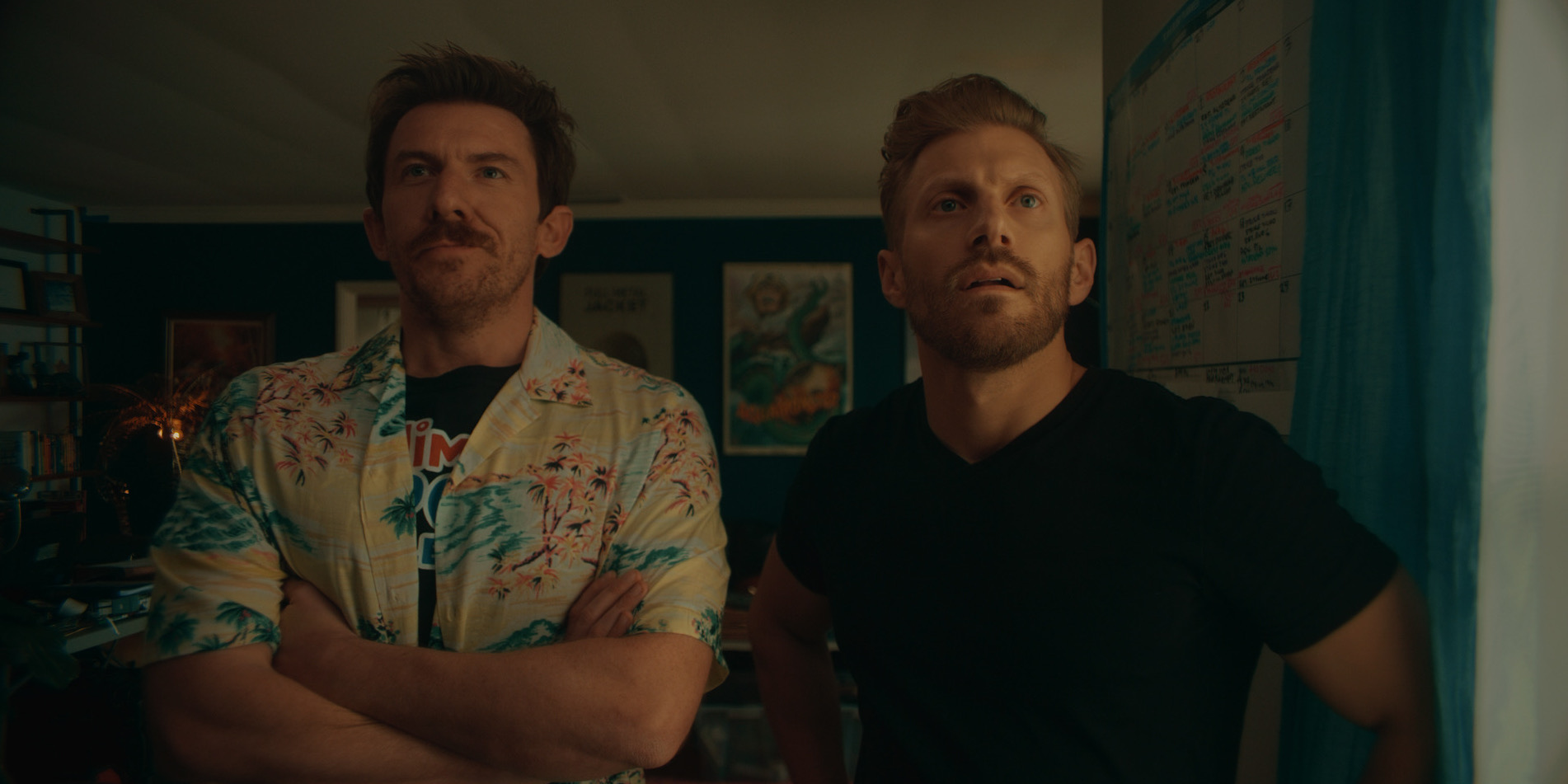
Barnett and director Vincent Masciale, both Funny or Die veterans, are more interested in the goofy exploits of two lifelong friends in California who are having trouble adjusting to adulthood.

Tanner (Tanner Thomason) is a ladies man bartender whose life goals don’t extend beyond drinking and hanging out with friends. Luke (Barnett) cleans pools while peddling the weight loss tea pyramid scheme of his entrepreneurial idol Nicky Steele (Jason Alexander in a bonkers cameo).

Luke and Tanner are big movie fans, and when they discover just how profitable the faith-based market is, a plan emerges. If they can make their own “Jesus” film and sell it to ChristFlix pictures, there should be more than enough profit to stuff their pockets and help out the local Elevate Church where Luke’s father (Lance Reddick) is the pastor.

The big question: can the boys snag Butch Savage (David Koechner, bonkers himself), the action hero from their youth, for the pivotal role?

Masciale, helming his second feature, brings an irresistibly absurdist vibe to the shenanigans that practically begs you not to overthink any of it. Sometimes we get character interviews as per a mockumentary, sometimes we don’t. The continuity and internal logic gets shaky at times, all of which falls perfectly in line with the movie within this movie.

Good-natured fun is certainly had at the expense of the faith-based industry. Margaret Cho’s appearance as a ChristFlix executive running down the rules of Christian films is every bit the bullseye of the horror rules in Scream, and the big Christian yacht rock concert (pay attention to those lyrics!) is subtle perfection.

But it’s the continued success of the Christian entertainment industry that makes it ripe for satire. And while Faith Ba$ed uses the setting to great advantage, its knives are never out for the believers themselves.

Because you know what else Barnett’s script gives us? A church community that is welcoming to all, one where people missing something in their lives can and do find real fulfillment.

And it gives us plenty of laughs, memorable quotes and overall nuttiness at a time when we could use it.

Oh, the outrage.

See How High She Flies

The Curse of Audrey Earnshaw

by Hope Madden

Who’s the villain?

A vampire didn’t choose that destiny, nor the zombie, nor even the werewolf. All three are victims of fate.

The witch, however, comes to her dark powers by choice. And maybe – as Robert Eggers pointed out in his 2015 masterpiece The VVitch—that choice might even make some sense.

Since Eggers’s beguiling horror show, a number of filmmakers have joined him in his ruminations. Lukas Fiegelfeld’s mesmerizing 2017 debut Hagazussa and Luca Guadagnino’s 2018 feminist reprise of Suspiria represent the strongest among the resulting films.

Few if any will ever tell the tale so powerfully or so well as Eggers, but writer/director Thomas Robert Lee has a go with The Curse of Audrey Earnshaw. His film is interested in women’s agency, their oddness, what they owe, what they should and shouldn’t be deciding for themselves, and what they are willing to sacrifice.

It’s August of 1973, but it could just as easily be the 1950s or the 1880s. (So why 1973? It was a big year in women’s rights, after all.) A rugged woman, isolated from the nearby religious community, stands silhouetted against her barn, ax and woodpile.

She is Agatha Earnshaw (Catherine Walker), and she has a secret.

Things haven’t been right in the village since the eclipse 17 years back, but things have been especially troubling lately. Agatha has the only farm that’s producing, the only animals that haven’t taken sick.

Performances are wonderful in a film that looks rustic and spooky, creating a time out of time. Walker, who was so effective in the wonderful little Irish horror Dark Song, cuts an impressive figure of maternal ferocity. She’s orbited by consistently impressive turns, whether the sincere pastor (Sean McGinley), entitled patriarch (Tom Carey), distraught husband (Jared Abrahamson), or young woman finding her voice (Jessica Reynolds).

Each man, however sympathetic or compassionate, represents danger. Like a lot of horror films, The  Curse of Audrey Earnshaw is a coming-of-age cautionary tale: fear the power of womanhood. But Lee is careful to keep asking who, exactly, is the villain here?

The direction is too often obvious: a cough, a handkerchief, blood. At other times, cinematic choices betray the film’s low budget. The Curse of Audrey Earnshaw will never reach the ranks of classic, but it makes a lot of bold choices and leaves an impression.

Liar, Liar

The Lie

by Hope Madden

Kids are stupid.

There may be no more universally accurate sentence. But parents? Dumb and dumber.

Writer/director Veena Sud retools the 2015 German film Wir Monster with a great cast, compelling complications, and that same awful truth.

Kayla (Joey King) is not very popular, not very happy about her parents’ separation, and not at all excited for this weekend-long ballet retreat. When she sees her bestie Brittany (Devery Jacobs) at the bus stop and convinces Dad (Peter Sarsgaard) to pick her up, things turn ugly.

There are any number of “how far would you go to protect your potentially evil kid?” movies—some great (Luce), some less so (Prodigy). What sets this one apart is mainly the cast, plus a somewhat sly delivery.

Sarsgaard is wonderful, as always. He’s one of the most reliable actors working today, and he finds a way to humanize every character, add a bit of depth and some curious moral complexity. He certainly does that here, and with Mireille Enos (playing Kayla’s mom) as sparring partner, a great deal of backstory is communicated without being overtly detailed.

King, a veteran weepy horror protagonist, delivers a clever performance as someone you’re honestly never certain about. Unlike trainwrecks such as Brahms: The Boy II, The Lie knows why the character should be so hard to pin down, and that reason is not a gimmick. It’s integral to the story.

That story is sharply told, even if there are moments that leave you scratching your head. The police presence is something out of a TV drama, and not a very good one. But when all eyes are on this family dynamic, The Lie is often riveting stuff.

The film is far more family drama/thriller than horror, but Blumhouse could do worse than introduce its Welcome to Blumhouse program on Amazon with this solidly crafted, impressively acted film.

Workin’ for a Livin’

12 Hour Shift

by Hope Madden

“My mama always said, never trust a skinny woman. While we are eating, they are plotting.”

Amen, sister.

The skinny woman in question is Mandy (Angela Bettis, glorious as always). And she’s skinny for a reason.

It’s the tail end of 1999 somewhere in Texas and Mandy’s just starting a 12 Hour Shift. She’s a nurse (on probation) in a hospital that’s not well staffed, not well run, and losing more patients and organs than it has a right to.

Writer/director Brea Grant strikes an intriguing tone. Her film’s humor is simultaneously deadpan, macabre and very silly. It’s an unusual spot to hit because you don’t root against any of the bad guys, even though they’re doing horrible and often needless things to perfectly likable people. Mainly out of stupidity.

Bettis is dead-eyed perfection, her unflappable nature a front for reluctant tenderness. She’s orbited by a wild assortment of hicks, Karens, low-rent crime lords, criminals, hypochondriacs, bumbling cops, and drugs. So, so many drugs.

Boldly colorful and strikingly stupid, Chloe Farnworth’s Regina is a wonderful counterpoint to Mandy. Together the two generate laughs with the kind of frustrating bond you only have with kin.

Nikea Gamby-Turner’s comfortable presence creates a great energy, while producer David Arquette essentially plays David Arquette (but he does it so well!).

Grant’s film is ghoulish and tense, with a genuinely unexpected musical number. It’s a hard film to nail down, and though it plays out like a long and especially bloody sitcom, the utter lunacy of the plot feels grounded in an authentic exhaustion and insanity known only to those who work in hospitals.

Repo Woman

Possessor

by Hope Madden

It’s been eight years since Brandon Cronenberg swam familiar family waters with his feature debut, Antiviral. He is back with another cerebral, body-conscious fantasy thriller and my first thought is dayyuuuummmmn…

Son of the master of corporeal scifi horror David Cronenberg, Brandon appears to come by his fixations naturally. With Possessor, he travels along with a high end assassin (Andrea Riseborough) who uses a piece of tech (inserted directly into the squishy brain, naturally) to body hop from one mark to the next. She enters one body, takes it over, executes the hit and moves on.

That last part has started to cause some issues, though.

As it was with Antival, much of the world building here is left to our imagination and the film is stronger for it. Possessor’s internal logic is solid enough to be the entire plot. The context is impeccably rendered, providing the most disturbing landscape for Riseborough and her primary avatar, played by the nicely understated Christopher Abbott.

All of it proves an incredible piece of misdirection for what the film is actually accomplishing.

For much of the running time, the chameleonic and underappreciated Riseborough’s Tasya Vos plays an observant interloper—exactly what we are in this weirdly meticulous and recognizable future world. Showy jabs about privacy, appropriation, gender definition and capitalism are simultaneously clever and intentionally distracting.

Cronenberg’s created a gorgeous techno world, its lulling disorientation punctuated by some of the most visceral horror to make it to the screen this year. There is something admirably confident about showing your influences this brazenly.

Credit Cronenberg, too, for the forethought to cast the two leads as females (Jennifer Jason Leigh playing Riseborough’s boss). The theme of the film, if driven by males, would have been passe and obvious. With females, though, it’s not only more relevant and vital, but more of a gut punch when the time comes to cash the check.

Possessor is a meditation on identity, sometimes very obviously so, but the underlying message takes that concept and stabs you in your still-beating heart with it.

Gonna Shout It Everyday

The Glorias

by Hope Madden

“The path up is always a jagged line.”

Gloria Steinem always could articulate the struggle toward progress. Filmmaker Julie Taymor certainly understands that sometimes the best way forward is not straight ahead. The daring filmmaker (Across the Universe, Frida, Titus) puts four Glorias on a bus heading nowhere and everywhere to help us see Gloria Steinem, backward and forward.

The Steinem we best recognize—trailblazing feminist and human rights advocate of the 60s, 70s and onward—is played by the always excellent Julianne Moore. Wise and just a little weary, Moore’s version brings Steinem’s warm soul to the screen.

She’s joined in the role by Alicia Vikander, who plays Steinem in her 20s and 30s; Lulu Wilson as teenaged Gloria; and Ryan Kiera Armstrong, portraying Steinem as a child. Though Vikander stumbles with the flat Ohio accent, each performance establishes something that grows from one era to the next: resolve, openness, vulnerability, courage.

Timothy Hutton shines as Steinem’s father, Leo, and Bette Midler commits outright larceny in her scenes as Bella Abzug. A host of minor roles—Dorothy Pitman Hughes (Janelle Monae), Flo Kennedy (Lorraine Toussaint), Wilma Mankiller (Kimberly Guerrero), Dolores Huerta (Monica Sanchez) and more—fill out a picture of early feminism far more vibrant than history sometimes remembers.

Taymor’s characteristic flourishes sometimes work well to enrich a tale fit for a legend. At other times, they seem like filler in a film that’s far broader than it is deep.

It is exhilarating to watch these pioneering advocates spar and support, dodge and demand, and most of all, speak up. It’s heartbreaking, too. There’s exhausting tragedy in all that promise left unfulfilled, and real terror in the face of what we now stand to actually lose.

But a cameo from the legend herself may be enough to reaffirm anyone’s resolve. As she says, “The constitution does not begin with ‘I the President.’ It begins with ‘We the people.’”

Mr. Lonely

Kajillionaire

by Hope Madden

Can a film be absurd without really being cynical? That might be the miracle of Miranda July, who mixes heartbreak and humor like no one else.

Fifteen years since her groundbreaking Me and You and Everyone We Know and nine years since The Future, the writer/director returns to the screen with a film every bit as ambitious but perhaps more contained and intimate.

In Kajillionaire, a miraculous Evan Rachel Wood is Old Dolio Dyne, 26-year-old woman-child who knows no existence other than that of the low-rent cons she runs day in, day out with her disheveled but wily parents (Richard Jenkins and Debra Winger).

Like Hirokazu Koreeda’s delicate 2018 film Shoplifters and Bong Joon Ho’s 2019 masterpiece Parasite, Kajillionaire disregards the idea of the glamorous con and settles fully into the concept of scam as a daily grind. And, like Koreeda and Ho, July uses this workaday world to examine family. Although July’s vision is more decidedly comedic and highly stylized, she hits the same notes.

The Dynes make their home in an abandoned office space that shares a wall with a car wash. Every day—twice on Wednesdays—pink bubbles descend that wall and it’s up to the Dynes to collect, discard, and dry, lest the foundation of the building become besot with dampness and mold. The precision clockwork (their digital watches are timed to go off) and the pink ooze become ideal identifiers of Old Dolio’s rigid yet surreal existence.

Things get unpredictable when Mom and Dad take a shine to Melanie (an effervescent Gina Rodriguez). She loves their oddball qualities and wants to join the team, but Old Dolio is immediately put off by the disruption, and more than that, by her parents’ doting affection for Melanie.

July is a sharp, witty and incisive filmmaker, but Kajillionaire benefits more from the performances than any of her other films. Wood is like an alien visiting human life, then imitating and observing it, and the performance is oddly heartbreaking.

Jenkins and Winger are reliably magnificent, and Rodriguez’s bright charm is the needed light in an otherwise gloomy tale.

The film hits July’s sweet spot: gawky introverts struggling to find, accept and maintain human connections. The humor works as well as it does because the whimsy and eccentricity in the film is grounded in compassion rather than mockery.