The fence is meant to separate the proud and the privileged from the lawless and desperate. So the opening in it serves as a warning about who might try to come in, and a reminder about how important it is to protect your place on the “good” side.
The Hole in the Fence (El hoyo en la cerca) isn’t exactly subtle, or especially profound, but it does serve up a well constructed lesson in the roots of toxic masculinity, the twisted tenets of religious hypocrisy, and the casual cruelty that often accompanies both.
A group of rich Catholic kids is bused into Mexico’s Los Pinos integration camp for boys. The lessons they receive will continue their grooming as the next wave of the Mexican “elite,” and lesson one is a speech that reinforces how unworthy the “outside” people are.
And right on cue, ringleader Jordi (Valeria Lamm) and the rest of the boys begin singling out any sign of weakness in the ranks. Diego (Eric David Walker) is hampered by casts and a neck brace, Eduardo (Yubah Ortega) is a scholarship kid, and Joaquincito (Lucciano Kurti) might be gay.
This will not do.
We’ve seen these themes and metaphors before, but director and co-writer Joaquin del Paso does score some compelling moments by narrowing the focus to the teachers and students interacting in one confined space. And the pupils learn quickly about how well cruelty can work for them, especially as a means to decrease your own suffering at the expense of someone else’s.
Slowly, the priests and instructors begin moving from the periphery to the center of the narrative. One camper goes missing, hints are dropped about the history of the camp, and del Paso engineers a truly unsettling extended take sequence set by the side of a highway.
Who is more dangerous here, those outside the fence, or those inside? The Hole in the Fence has answers that are not soft-pedalled, but still too hard to be ignored.
Welcome to Asteroid City, a grief comedy that may be the most Wes Anderson-y movie Wes Anderson has ever made. Or, welcome to “Asteroid City” – the stage play from famous writer Conrad Earp (Edward Norton) upon which Asteroid City, the film (TV show?) is based. Actively. Brian Cranston will explain as he, the narrator of “Asteroid City”, deconstructs the meticulous framing device Anderson crafts to keep us just one layer further from chaos.
“We are all just characters in a play that we don’t understand.”
As is so often the case, writer/director Anderson painstakingly creates a world – colorful, peculiar, emotionally tight lipped – brimming with characters (equally colorful, peculiar and emotionally tight-lipped). Brimming. About 50 speaking characters stand or sit precisely on their mark, perfectly framed, each one doing their all to keep chaos at bay.
Like Augie Steenbeck (Jason Schwartzman), a widowed war photographer stranded with his teenaged son (scene-stealer Jake Ryan from Eighth Grade) and three daughters in the clean desert nowhereville of Asteroid City, where a “stargazing event” will soon commence. Cinematographer Robert D. Yeoman’s 360-degree swivel shows all you need to see: diner, roadway cabins, onramp to nowhere, and the garage where the town mechanic (Matt Dillon) has found that Augie’s wagon is now deceased.
Augie’s father-in-law Stanley Zak (Tom Hanks, in the usual Bill Murray role) fires ups his Cadillac and arrives for a rescue, only to find no one can leave Asteroid City on account of the alien.
Yep, an alien! He just came down sure as you please and made off with the city’s prized meteorite! Everybody saw it – including famous actress Midge Campbell (Scarlett Johansson) and all the visiting school kids in Miss June’s (Maya Hawke) class!
So the whole city’s on lockdown, while General Gibson (Jeffery Wright) and Dr. Hickenlooper (Tilda Swinton) assess the situation and Augie realizes he just may have snapped the only photo of an honest to goodness alien.
All the unique and wonderful trademarks of Anderson’s craftsmanship are on display. Both the city itself, and the surrounding stage area where the play is performed, are given distinct aesthetics that benefit equally from Anderson’s commitment to symmetry, palette and depth-of-field.
The wordplay is succinct and witty per usual, dancing through themes of science, art, and Cold War paranoia. But while Anderson’s last film, The French Dispatch, left its procession of indelibly offbeat characters to fend for themselves, this time they’re connected with the sterile humanity that buoys the best of his work.
“You can’t wake up if you don’t fall asleep!”
You’ll hear that several times in Asteroid City, enough to know that Anderson hopes we’re paying attention. Leave yourself open – to what art, and science, is saying – and your world might seem a little more colorful.
Maggie Moore(s) is nestled in a quiet little neighborhood between the Coen Brothers, Taylor Sheridan, and any mid-lfe rom-com. Expect engaging characters getting caught in dangerous games and possible romances, and reacting with clever witticisms, charming flirtatiousness and occasional bursts of violence.
And though the film doesn’t rise to the best of any genre, it patches together enough winning moments for a worthwhile caper-com.
With an opening declaration that “some” of the events actually happened, Paul Bernbaum’s first script since 2007’s Next takes us to a small desert town in Arizona that’s suddenly rocked by two murders in one week.
And both victims are named Maggie Moore. WTF?
Is there a connection between Maggie 1 (Louisa Krause) and Maggie 2 (Mary Holland)?
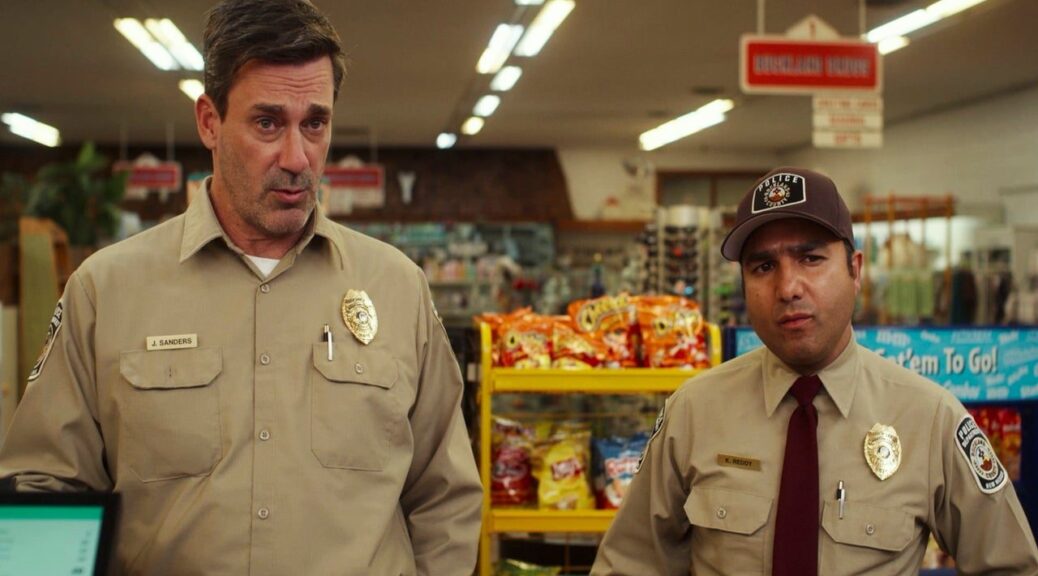
That’s what Police Chief Sanders (Jon Hamm) and deputy Reddy (Nick Mohammed) aim to find out. And pretty soon they’re finding out that Maggie 2’s husband (Christopher Denham) has a girlfriend (Bobbi Kitten) and a life insurance payout coming, while Maggie 1’s man (Micah Stock) has been passing photos for a pedophile food supplier (Derek Basco) in exchange for cheap and moldy cold cuts for his sub shop.
Oh, and Maggie 1’s neighbor Rita (Tina Fey) says the couple’s fights had recently been escalating.
Director John Slattery (God’s Pocket) exhibits fine juggling skills, giving his Mad Men pal Hamm plenty of room to craft Chief Sanders as the easy-to-root-for heart of the film. He’s a widower who takes a creative writing class at night, and his rebuff of a classmate’s overtures only makes us more hopeful when he and the divorced Rita find reasons to meet.
Of course, it helps that Hamm and Fey are real life buddies, with enough natural chemistry and snappy barbs (Him: “Wash your car.” Her: “Wash your ass!”) to make their time together a treat to watch.
Yes, putting a wannabe romance in the middle of Hell or High Fargo can bring a disjointed feel, but the orbit of distinct characters and cutting dialogue around it never lets the crime-solving grow tiresome.
Don’t look to Maggie Moore(s) for trail blazing or ground breaking, it will come up short. But for an hour-and-a-half of breezy, sometimes messy entertainment, it’s plenty capable.
How many kids does Nick Cannon have? Think on it, because your answer could say a lot about you.
It might even keep you alive.
Several friends from college (including Jay Pharaoh, Yvonne Orji, Sinqua Walls, Antoinette Robertson, and the film’s co-writer Dewayne Perkins) are reuniting at a remote cabin for a Juneteenth celebration. It isn’t long before they discover a talking blackface at the center of a board game called The Blackening (“probably runs on racism!”) and fall into a sadistic killer’s plan to pick them off one by one.
The game will test their knowledge of Black history and culture, and demand they sacrifice the friend they deem “the Blackest.” It’s a clever device that Perkins, co-writer Tracy Oliver and director Tim Story use to skewer both well-known horror tropes and well-worn identity politicking.
The old joke about Black people being the first to die in horror films is pretty well-worn, too, but don’t let that poster tagline convince you that the film has nothing new to say. The less “Blacker” these characters seem, the greater chance they have of surviving. That’s some fertile ground for social commentary, and what began as a viral comedy sketch lands on the screen as a refreshing new angle for a horror comedy.
The winning ensemble crafts unique, identifiable characters, and Story (Barbershop, Ride Along) keeps the homages coming, from Scream to Saw to Set It Off and more. But while the film’s brand of fun can be silly and/or bloody, there’s plenty of smart woven into the takes on scary movies, race, and sexual identity (Perkins’s character is openly gay and has some rules of his own).
But seeing that I’m a white man in his fifties, every joke in the film didn’t land for me. And I can respect that. This is a film from Black creators, with a Black cast, that speaks very knowingly to a Black audience while keeping the cabin door open for anyone to join the fun.
Thinking that only a certain type of audience could enjoy The Blackening is exactly the kind of stereotyping the film is eager to put in the crosshairs. And that assumption would be more than wrong.
Remember the utility belt on the Adam West version of Batman? Whatever the situation, there was always something on that belt that was perfect for bailing him out of it.
Decades later, it’s starting to look like “the multi-verse” may be the new Get Out of Jail Free card for superhero adventures. It certainly is for The Flash, a movie that scatters impressive moments across a landscape of fan service that’s searching for a truly compelling story.
Ezra Miller returns as Barry Allen/The Flash, who discovers this time out that he can hit speeds fast enough for time travel. Bruce Wayne/Batman (Ben Affleck) warns him against messing with the past, but Barry is convinced that simply putting one can of tomatoes in a shopping cart can bring back his murdered mother (Maribel Verdú ) and in turn, free his father (Ron Livingston) from a murder charge.
Of course, that can of tomatoes carries plenty of butterfly effects. The changes are enough to put Barry face-to-face with a non-super version of himself, in a universe where Bruce Wayne (Michael Keaton) has hung up his cape, Eric Stoltz never got canned from Back to the Future, and General Zod (Michael Shannon) is still an imminent threat to destroy the planet.
That Stoltz name drop (along with Affleck’s priceless line about the size of his ego) are just two of the moments where screenwriters Christina Hodson and Joby Harold inject some lighthearted fun that never seems forced. Ironic, though, that the Stoltz backstory just reminds you that the controversial Miller didn’t get dropped from this franchise.
But beyond the many offscreen troubles, Miller is impressive here, effectively crafting two distinct Barry Allens who play off each other quite well. Keaton’s return is a nostalgic kick, and as much as he’s clearly enjoying getting back in the Batsuit, Keaton steers clear of scenery-chewing. His Batman is a perfectly weary version of the one he left in the 90s, a disillusioned hero ready for one more ride.
And as the Barrys and Bruce search for an imprisoned Superman, we get our first look at Sasha Calle as Kara/Supergirl, who provides an intriguing glimpse of what we might expect from the character’s upcoming standalone film.
Director Andy Muschietti (It, It Chapter Two) hooks us with an exciting and visually impressive – except for the computer-generated babies – opening sequence, but the pace begins to drag almost immediately after. Threads of other time travel films from Timecrimes to Looper are bandied about, leading to the puzzling centerpiece that is the Chrono-ball.
Inside the ball, any past version of a superhero can be trotted out for a fan service bow, often with GCI that’s less-than-super enough to recall DC’s embarrassing experiment with Superman’s mustache. You would think that after that debacle, the effects bar would be higher. Apparently not, which only exacerbates the feeling that the point here is not The Flash, it’s how many flashes of the past can be manufactured – before and after the credits.
Both the animated and live action Spider-Man films have shown us how delightful the multi-verse can be. The Flash never gets there, but it shows us enough of Barry Allen to wonder what might be possible if the DCEU can trust him enough to carry his own weight.
When a human being just doesn’t have enough meaningful ways to invest their time, they can go a little nuts. Here’s to the horror of life as the underappreciated, boxed-in, cast off and/or misused housewife. May they all draw blood.
5. Jakob’s Wife (2021)
Director/co-writer Travis Stevens (Girl on the Third Floor) wraps this bloodlusty tale of the pastor’s wife (Barbara Crampton) and the vampire in a fun, retro vibe of ’80s low-budget, practical, blood-spurting gore.
To see a female character of this age experiencing a spiritual, philosophical and sexual awakening is alone refreshing, and Crampton (looking fantastic, by the way) makes the character’s cautious embrace of her new ageless wonder an empowering – and even touching – journey.
With Crampton so completely in her element, Jakob’s Wife is an irresistibly fun take on the bite of eternity. Here, it’s not about taking souls, it’s about empowering them. And once this lady is a vamp, we’re the lucky ones.
4. The Stepford Wives (1975)
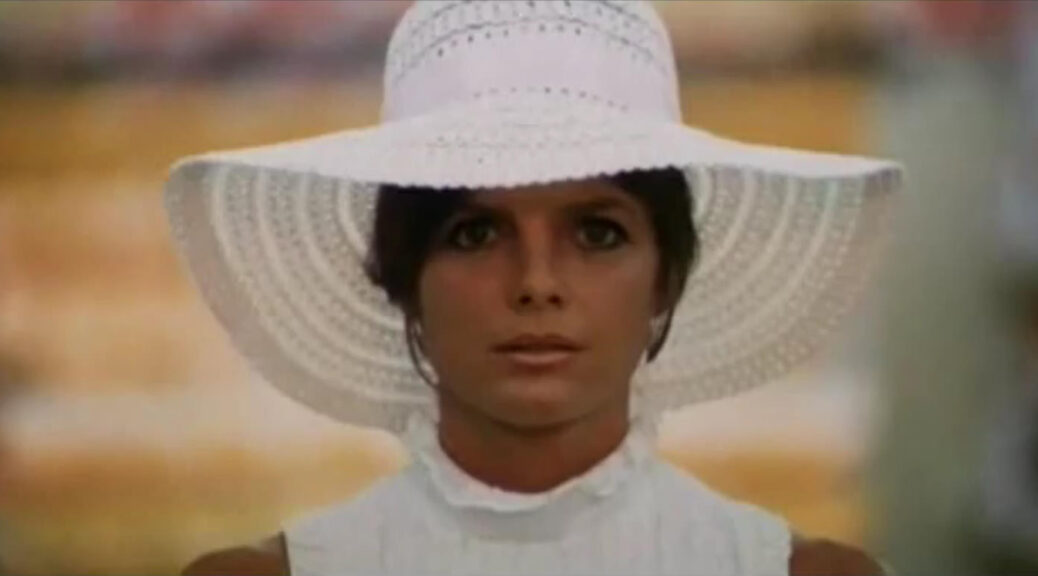
Ira Levin’s novel left a scar and filmmaker Bryan Forbes and star Katherine Ross pick that scab to deliver a satirical thriller that is still surprisingly unsettling. What both the novel and the film understand is a genuine fear that the person you love, whose faults you accept and who you plan to age and die with, has no interest in what’s inside you at all. You – the actual you – mean nothing at all.
It’s the idea of trophy wife taken to a diabolical extreme (as even the outright trophy wife isn’t long to last, what with the inevitability of aging and all). The term Stepford Wife worked its way into the lexicon, and there’s a clear pot boiler, B-movie feel to this film, but it still leaves a mark.
3. Dumplings (2004)
Fruit Chan’s Dumplings satirizes the global obsession with youth and beauty in taboo-shattering ways.
Gorgeous if off-putting Aunt Mei (Bai Ling) balances her time between performing black market medical functions and selling youth-rejuvenating dumplings. She’s found a customer for the dumplings in Mrs. Li (Miriam Yeung ChinWah), the discarded wife of a wealthy man.
With darkest humor and sharp insight, Chan situates the horror in a specifically Chinese history but skewers a youth-obsessed culture that circles the globe.
The secret ingredient is Bai Ling, whose performance is a sly work of genius. There are layers to this character that are only slowly revealed, but Ling clearly knows them inside and out, hinting at them all the while and flatly surprised at everything Mrs. Li (and you and everyone else) hasn’t guessed.
Gross and intimate, uncomfortable and wise, mean, well-acted and really nicely photographed, Dumplings will likely not be for everyone. But it’s certainly a change of pace from your day-to-day horror diet.
2. Swallow (2019)
Putting a relevant twist on the classic “horrific mother” trope, writer/director Carlo Mirabella-Davis uses the rare eating disorder pica to anchor his exploration of gender dynamics and, in particular, control.
Where Mirabella-Davis’s talent for building tension and framing scenes drive the narrative, it’s Bennett’s performance that elevates the film. Serving as executive producer as well as star, Haley Bennett transforms over the course of the film.
When things finally burst, director and star shake off the traditional storytelling, the Yellow Wallpaper or Awakening or even Safe. The filmmaker’s vision and imagery come full circle with a bold conclusion worthy of Bennett’s performance.
1. Watcher (2022)
If you’re a fan at all of genre films, chances are good Watcher will look plenty familiar. But in her feature debut, writer/director Chloe Okuno wields that familiarity with a cunning that leaves you feeling unnerved in urgent and important ways.
Maika Monroe is sensational as Julia, an actress who has left New York behind to follow husband Francis (Karl Glusman) and begin a new life in Bucharest.
Monroe emits an effectively fragile resolve. The absence of subtitles helps us relate to Julia immediately, and Monroe never squanders that sympathy, grounding the film at even the most questionably formulaic moments.
Mounting indignities create a subtle yet unmistakable nod to a culture that expects women to ignore their better judgment for the sake of being polite. Okuno envelopes Julia in male gazes that carry threats of varying degrees, all building to a bloody and damn satisfying crescendo.
Sir Ben Kingsley as Salvador Dali? That is perfect casting, and an offer that would be hard to resist even if the rest of Daliland was an uninspired bore.
It’s not, although it could use a bit more of the legendary surrealist’s zest for the unconventional.
Director Mary Harron and writer John Walsh (married since 1998) anchor the film in 1974, when Dali’s outlandish antics, eclectic entourage and wild parties (“I need four dwarves and a suit of armor”) have caused the art critics to lose interest in him.
But such a lifestyle costs money.
As Dali’s longtime wife and muse Gala (Barbara Sukowa) presses his gallery for cash, the curator’s young assistant James Linton (Christopher Briney from TV’s The Summer I Turned Pretty) is tasked with “spying” on the master. Dali’s big show opens in 3 days, and the gallery wants to make sure they will have plenty of new works to unveil.
Using a young neophyte as an audience’s window into an icon’s world is a fairly standard narrative device, but Harron and Walsh make sure this world is a fascinating one. Kingsley is as delightful as you expect, Sukowa digs deep into the persona of an aging beauty clinging desperately to power and sex appeal, and Briney makes for the perfect wide-eyed fan on a spiral toward disillusion.
Some of Dali’s more famous friends (Alice Cooper, Jeff Fenholdt, Amada Lear) are represented, creating a Warhol-esque community of celebrities and hangers-on that seems disinterested in the demands of tomorrow.
But while Harron does well showcasing the excess and activity, Dali’s actual artwork is MIA, leaving a few well-placed flashbacks to provide anything close to surreal. As we see the younger Dali (Ezra Miller) pursuing the then-married Gala (Avital Love) and receiving inspiration for what will be his signature style, Kinglsey’s Dali watches with us, inviting us into the conversation. These are not only compelling moments, they are the times when the film seems most in step with the legend that drives it.
It may be young James that carries the film’s biggest arc, but it is the orbit around planet Dali that changes him. Harron and Walsh seem too content to merely document that world on the way to a larger comment on disposable fame, crass classism, and the simple fear of death.
As the title would suggest, don’t come to Daliland for a psychological profile of a legend. Come for a peek inside his carefully curated shelter from the real world, and for the e-ticket ride performance from Kingsley.
Mending the Line certainly has its heart in the right place. It gives us wounded warriors and grieving souls, all finding some peace for battered psyches through the Zen of fly fishing.
There are some beautiful and serene Montana landscapes, and a message of caring respect that’s easy to get behind.
It’s also smart to get behind it, because anything in front of that message is in the path of some dramatic box-checking with little thought of subtlety.
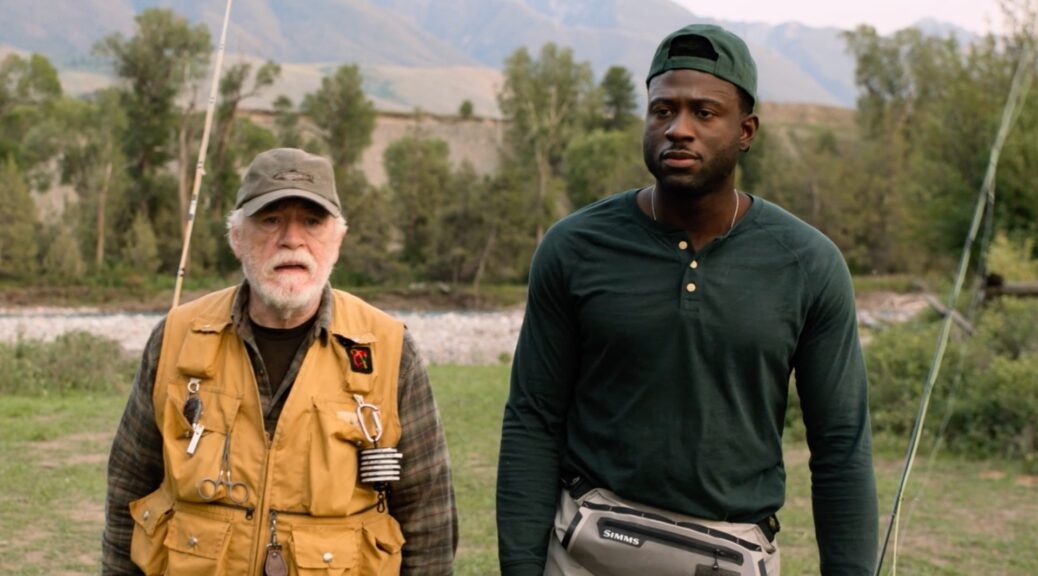
Marine Sgt. John Colter (Sinqua Walls from the recent White Men Can’t Jump remake and next week’s The Blackening) is making good progress on recovering physically from a deadly firefight in Afghanistan. “Colt”‘s mental state is more fragile, as he’s plagued by memories of losing good men on their final tour before coming home.
Their final tour. And Colt’s best friend in the Corps was about to be married. And Colt was to be the Best Man.
Colt wants to get back to the front lines asap, but his V.A. Dr. (Patricia Heaton) isn’t sure his head is right, so she sends him to see old Ike Fletcher for fly fishing lessons.
Ike (Bryan Cox) is a battle-scarred Vet himself, and begrudgingly puts Colt through some Mr. Miyagi-approved training while Colt gets to know the locals. There’s Lucy (Perry Mattfeld), who’ still mourning the loss of her fiancé, while Harrison (Wes Studi) is the requisite best friend who needles Ike about what an old coot he is before imparting a nugget of wisdom and walking off.
The cast is fine, and director Joshua Caldwell follows up the in-your-face cliche fest of his Infamous with a appropriately gentler hand, but Stephen Camelio’s debut screenplay offers more good intention than authentic emotion.
Pivotal changes of heart land suddenly without being earned, while the heavy-handed plot turns walk hand in hand with Bill Brown’s paint-by-melodramatic-numbers score.
Veterans care, survivor’s guilt and life after trauma are worthy issues, and Mending the Line wants badly to respect those involved and provide enlightenment for the conversation.
The respect is never in doubt, but the conversation ends up treading water.