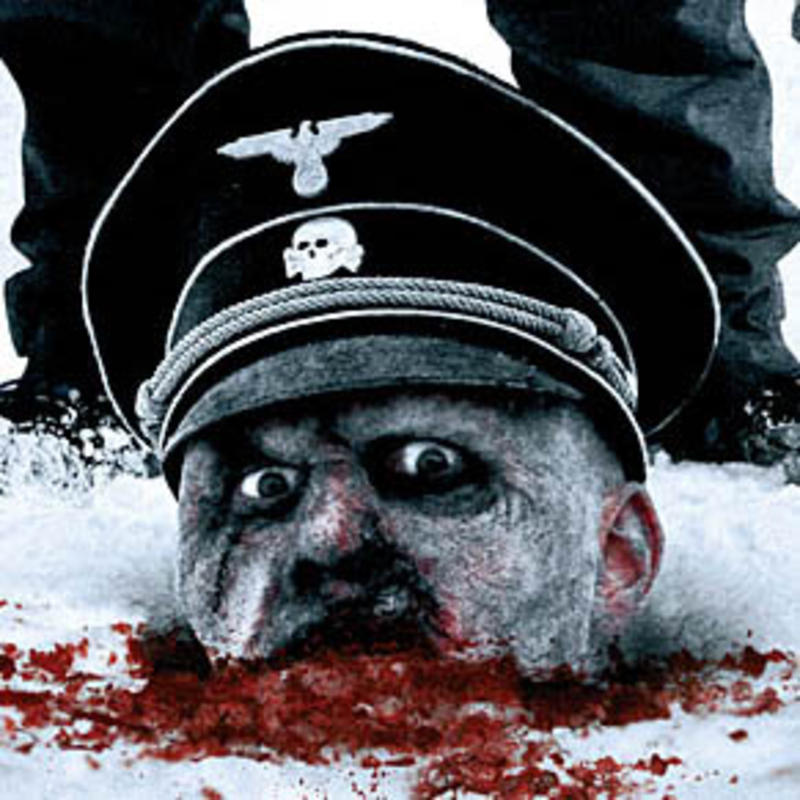
Rated R for “an abundance of outrageous gore,” Dead Alive is everything the early Peter Jackson did well. It’s a bright, silly, outrageously gory bloodbath.
Lionel Cosgrove (Timothy Balme) secretly loves shopkeeper Paquita Maria Sanchez (Diana Penalver), but she has eyes for someone less milquetoast. Until, that is, she’s convinced by psychic forces that Lionel is her destiny. Unfortunately, Lionel’s milquetoast-iness comes by way of decades of oppression via his overbearing sadist of a mother, who does not take well to her son’s new outside-the-home interests. Mum follows the lovebirds to a date at the zoo, where she’s bitten (pretty hilariously) by a Sumatran rat-monkey (do not mistake this dangerous creature for a rabid Muppet or misshapen lump of clay).
The bite kills her, but not before she can squeeze pus into some soup and wreak general havoc, which is nothing compared to the hell she raises once she comes back from the dead.
Mama’s boy that he is, Lionel can’t bring himself to do what he must until it is spectacularly too late. He chains up an entirely unwholesome family down the basement, which works out well enough as long as he keeps from being bitten, and keeps conniving Uncle Les (Ian Watkin) out of there.
Braindead is so gloriously over-the-top that nearly anything can be forgiven it. Jackson includes truly memorable images, takes zombies in fresh directions, and crafts characters you can root for. But more than anything, he knows where to point his hoseful of gore, and he has a keen imagination when it comes to just how much damage a lawnmower can do.
Listen weekly to MaddWolf’s horror podcast FRIGHT CLUB. Do it!
A lurid Korean fairy tale of sorts – replete with dreamy cottage and evil stepmother – Kim Jee-Woon‘s A Tale of Two Sisters is saturated with bold colors and family troubles.
Kim would go on to direct the also outstanding, although entirely different, I Saw the Devil, but where Devil breathes masculinity, Tale of Two Sisters is a deep, murky, and intensely female horror.
A tight-lipped father returns home with his daughter after her prolonged hospital stay. Her sister has missed her; her stepmother has not. Or so it all would seem, although jealousy, dream sequences, ghosts, a nonlinear timeframe, and confused identity keep you from ever fully articulating what is going on. The film takes on an unreliable point of view, subverting expectations and keeping the audience off balance. But that’s just one of the reasons it works.
The director’s use of space, the composition of his frame, the set decoration, and the disturbing and constant anxiety he creates about what’s just beyond the edge of the frame wrings tensions and heightens chills. The composite effect disturbs more then it horrifies, but it stays with you either way.
Tale masters the slow reveal in large and small ways. Whether you’ve begun to unravel the big mystery or not, Tale always has something else up its sleeve. Or, under its table.
Listen weekly to MaddWolf’s horror podcast FRIGHT CLUB. Do it!
Horror cinema’s most common and terrifying villain may not be the vampire or even the zombie, but the hillbilly. The Hills Have Eyes, Texas Chainsaw Massacre, Deliverance and hundreds of others both play upon and solidify urban dwellers’ paranoia about good country folk. The generous, giddy Tucker and Dale vs. Evil lampoons that dread with good natured humor and a couple of rubes you can root for.
In the tradition of Shaun of the Dead, T&DVE lovingly sends up a familiar subgenre with insightful, self-referential humor, upending expectations by taking the point of view of the presumably villainous hicks. And it happens to be hilarious.
Two backwoods buddies (an endearing Tyler Labine and Alan Tudyk) head to their mountain cabin for a weekend of fishing. En route they meet some college kids on their own camping adventure. A comedy of errors, misunderstandings and subsequent, escalating violence follows as the kids misinterpret every move Tucker and Dale make.
Director Eli Craig’s clever role reversal screenplay, co-written with Morgan Jurgenson, recreates the tension-building scenes that have become horror shorthand for “the hillbillies are coming.” From the bait and tackle/convenience store encounter with bib overall clad townies, to the campfire retelling of likeminded teens lost forever in the wooded abyss, the set up is perfect.
Each punchline offers the would-be killers’ innocent point of view – expressing their increasingly baffled take on what appears to them to be a suicide pact among the coeds.
T&DVE offers enough spirit and charm to overcome most weaknesses. Inspired performances and sharp writing make it certainly the most fun participant in the You Got a Purty Mouth class of film.
Listen weekly to MaddWolf’s horror podcast FRIGHT CLUB. Do it!
Psycho may have asked us to look at the weird relationships possible with mothers and sons, but fathers and daughters can develop dangerously close bonds, as well. For proof, just gander at this Aussie freakshow.
Writer/director/Tasmanian Sean Byrne upends high school clichés and deftly maneuvers between angsty, gritty drama and neon-colored, glittery carnage in a story that borrows from other horror flicks but absolutely tells its own tale.
Brent (Xavier Samuel) is dealing with guilt and tragedy in his own way, and his girlfriend Holly tries to be patient with him. Oblivious to all this, Lola (a gloriously wrong-minded Robin McLeavy) asks Brent to the school dance. He politely declines, which proves to be probably a poor decision.
Byrne quietly crafts an atmosphere of loss and depression in and around the school without painting the troubles cleanly. This slow reveal pulls the tale together and elevates it above a simple work of outrageous violence.
Inside Lola’s house, the mood is decidedly different. Here, we’re privy to the weirdest, darkest image of a spoiled princess and her daddy. The daddy/daughter bonding over power tool related tasks is – well – I’m not sure touching is the right word for it.
The Loved Ones is a cleverly written, unique piece of filmmaking that benefits from McLeavy’s inspired performance as much as it does its filmmaker’s sly handling of subject matter. It’s a wild, violent, depraved way to spend 84 minutes. You should do so now.
Listen weekly to MaddWolf’s horror podcast FRIGHT CLUB. Do it!
Two gamblers – one a smooth talking charmer and the other a desperate loser – team up for a high stakes road trip to New Orleans, taking all the action they can along the way.
It may sound like a cliche waiting to happen, but if you think you know where Mississippi Grind is heading, think again. Filmmakers Anna Boden and Ryan Fleck (Half Nelson, Sugar) don’t do same old same old. The writing/directing team is more interested in slowly immersing you in a new environment, letting simple truths drip from the intimate details of their characters.
Gerry (Ben Mendelsohn) has a growing list of gambling debts and a daughter he never sees, but things might be looking up. The high-rolling, confident Curtis (Ryan Reynolds) sits down at Gerry’s card game, buys him a drink (“not the cheap stuff, either”) and suddenly Gerry thinks he’s found a lucky charm.
Curtis agrees to Gerry’s idea for the road trip, but questions linger. Sure, Curtis can work a room with the best of them, but is it all just to find his next hapless mark? The film wouldn’t work without two sublime performances to drive it, and there’s no question it works.
Reynolds has never been better, keeping just enough of his usual smirking smart ass persona to give Curtis an extra layer that makes him hard to pin down. Mendelsohn is less of a surprise, as he might be the most consistently great actor that nobody knows. He keeps Gerry a constantly evolving work, equal parts thieving liar and gold-hearted schlub who just needs a break.
Sienna Miller and Analeigh Tipton both make effective use of their limited screen time as working girls who get a visit from the southbound duo. They not only give us added glimpses into the souls of Gerry and Curtis, but they’re also real characters unto themselves.
Boden and Fleck introduce each new locale with postcard perfect shots free of almost all life, another reminder our interest is Gerry and Curtis and where they are going, both literally and figuratively.
With enthralling characters, mesmerizing performances and filmmakers confident enough to stay their own course, it’s a hugely satisfying trip.
You’re exhausted – just bone-deep tired – and for the umpteenth night in a row your son refuses to sleep. He’s terrified, inconsolable. You check under the bed, you check in the closet, you read a book together – no luck. You let him choose the next book to read, and he hands you a pop-up you don’t recognize: The Babadook. Pretty soon, your son isn’t the only one afraid of what’s in the shadows.
It’s a simple premise, and writer/director Jennifer Kent spins her tale with straightforward efficiency. There is no need for cheap theatrics, camera tricks, or convoluted backstories, because Kent is drilling down into something deeply, frighteningly human.
Like a fairy tale or nursery rhyme, simplicity and a child’s logic can be all you need for terror.
Kent’s film is expertly written and beautifully acted, boasting unnerving performances from not only a stellar lead in Essie Davis, but also the alarmingly spot-on young Noah Wiseman. Davis’s lovely, loving Amelia is so recognizably wearied by her only child’s erratic, sometimes violent behavior that you cannot help but pity her, and sometimes fear for her, and other times fear her.
Likewise, Wiseman delivers as a tender, confused, dear little boy you sometimes just want to throttle. Their naturalistic performances genuinely showcase the baggage that can exist between a parent and a child.
Radek Ladczuk’s vivid cinematography gives scenes a properly macabre sense, the exaggerated colors, sizes, angles, and shadows evoking the living terror of a child’s imagination.
Much of what catapults The Babadook beyond similar “presence in my house” flicks is the allegorical nature of the story. There’s an almost subversive relevance to the familial tensions because of their naked honesty, and the fight with the shadowy monster as well as the film’s unusual resolution heighten tensions.
The film’s subtext sits so close to the surface that it threatens to burst through. Though that does at times weaken the fantasy, it gives the film a terrifying urgency. In the subtext there is a primal horror, a taboo rarely visited in film and certainly never examined with such sympathy. Indeed, the compassion in the film may be the element that makes it so very unsettling.
Eerily familiar yet peculiar and unique, The Babadook immediately ranks among the freshest and more memorable films the genre has to offer. It also marks a filmmaker to keep an eye on.
Listen weekly to MaddWolf’s horror podcast FRIGHT CLUB. Do it!
If you’ve seen Man on Wire, the Oscar-winning documentary from 2008, you may wonder if The Walk is even necessary (as if Hollywood cares). James Marsh’s look inside the legendary wire walk across the Twin Towers was as poetic as it was thrilling, and it left any other film on the subject a skyscraper-high hill to climb.
The Walk brings together director Robert Zemeckis, star Joseph Gordon-Levitt and some vertigo-inducing wizardry to give the story an newly polished sheen.
Gordon-Levitt is Philippe Petit, the effervescent Frenchman who pulled off the “artistic crime of the century.” In August of 1974, he successfully rigged a wire from the top of one tower to the other and walked across…and back..and back again.
The high whimsy count in the film’s first half could be expected from the director behind Forrest Gump, but it’s also a clear attempt to create a distinct identity for re-telling the tale. Zemeckis, who also co-wrote the script based on Petit’s book, has Gordon-Levitt in character atop the Statue of Liberty, scaling the “fourth wall” and narrating his journey from naive street performer to international sensation.
The overly fantastical narrative loses its charm pretty quickly, never approaching the emotional connection that drove Man on Wire. Gordon-Levitt, though, is a wonderful choice for Petit, with a performance good enough to make those unfamiliar with Petit’s tireless personality think the portrayal is over the top. No, that’s Petit.
The backstory does seems rushed, and when Petit’s team converges on the WTC to put the illegal scheme in motion, you’re not sure he’s earned the right to try it. But if Zemeckis is in a hurry to get Petit out on that wire, you quickly find out why, as questions about the film’s necessity are rebutted once the moment of truth arrives.
Man on Wire could only provide still photos from, as Petit calls it, “the coup,” but The Walk puts you there. Zemeckis and cinematographer Dariusz Wolski (Prometheus) unveil an array of truly wondrous visuals not for the faint of height. As with the recent Everest, this is a film meant to be seen in all its 3D IMAX eye-popping glory
Zemeckis saves any subtlety for where it counts the most, treating the memory of the WTC towers with a welcome, restrained dignity. That, coupled with the breathtaking recreation of a once-in-a-lifetime feat, makes The Walk a worthy trip.
For whatever reason, filmmakers and moviegoers alike seem to find twins inherently creepy. Would The Shining have been as menacing if it were just another child trying to lure Danny to his death? No – for some reason what’s particularly terrifying is the image of those two identical girls waving and beckoning, “Come play with us, Danny…”
It’s as if they’ve conspired. You’re outnumbered. There’s the idea that they’re doppelgangers able to fool the rest of us, that or they are two half beings unable to live without the other and yet perhaps quietly desperate to try.
We’ve enlisted the help of Senior Twin Correspondent Joy Madden (she’s Hope’s evil twin, FYI) to puzzle through the best in twin horror. Unlike The Shining, though, twins are the centerpiece of these films and it is their very twin-ness that drives the story.
5. Basket Case (1982)
This film is fed by a particularly twin-linked anxiety. Can anyone really be the love of one twin’s life, and if so, where does that leave the other twin? More than that, though, the idea of separating conjoined twins is just irresistible to dark fantasy. Rock bottom production values and ridiculous FX combine with the absurdist concept and poor acting to result in an entertaining splatter comedy a bit like Peter Jackson’s early work.
When super-wholesome teenage Duane moves into a cheap and dangerous New York flophouse, it’s easy to become anxious for him. But that’s not laundry in his basket, Belial is in the basket -Duane’s deformed, angry, bloodthirsty, jealous twin brother – but not just a twin, a formerly conjoined twin. What he really is, of course, is Duane’s id – his Hyde, his Hulk, his Danny DeVito. And together the brothers tear a bloody, vengeful rip in the fabric of family life.
https://www.youtube.com/watch?v=wtmLKrxR6H0
4. Sisters (1973)
We’re all probably familiar with director Brian De Palma’s long and sometimes tiresome journey through his own person obsessions with Alfred Hitchcock. He married Hitch’s high-tension score and murder mystery plotlines with Mario Bava’s sexualized violence to create his own hybrid, which began with this twin sister trauma.
French Canadian model Danielle (Margot Kidder) may or may not have a once-conjoined twin who may or may not be a diabolical killer in this “is she or isn’t she” mind bender. Separation anxiety and a general nervousness about twins as an alien concept fuel this murder mystery that takes some hard left turns – some novel, some now clichéd. Whatever the flaws, though, De Palma’s panache and Hitchcockisms are in full bloom in this stylish, often creepy thriller.
3. Dead Ringers (1988)
The film is about separation anxiety, with the effortlessly melancholy Jeremy Irons playing a set of gynecologist twins on a downward spiral. Cronenberg doesn’t consider this a horror film at all. Truth is, because the twin brothers facing emotional and mental collapse are gynecologists, Cronenberg is wrong.
Irons is brilliant as Elliot and Beverly Mantle, bringing such flair and, eventually, childlike charm to the performance you feel almost grateful. Like some of the greats, he manages to create two very distinct yet appropriately linked personalities, and Cronenberg’s interest is the deeply painful power shift as they try and fail to find independence from the other. The film’s pace is slow and its horror subtle, but the uncomfortable moments are peculiarly, artfully Cronenberg.
https://www.youtube.com/watch?v=_xmheE3L19c
2. Goodnight Mommy (2014)
During one languid summer, twin brothers Lukas and Elias await their mother’s return from the hospital. They spend their time bouncing on a trampoline, floating in a pond, or exploring the fields and woods around the house. But when their mom comes home, bandaged from the cosmetic surgery she underwent, the brothers fear more has changed than just her face.
Inside this elegantly filmed environment, where sun dappled fields lead to leafy forests, the filmmakers mine a kind of primal childhood fear. The filmmakers’ graceful storytelling leads you down one path before utterly upending everything you think you know. They never spoon feed you information, depending instead on your astute observation – a refreshing approach in this genre.
Performances by young brothers Lukas and Elias Schwarz compel interest, while Susanne Wuest’s cagey turn as the boys’ mother propels the mystery. It’s a hypnotic, bucolic adventure as visually arresting as it is utterly creepy. The film is going to go where you don’t expect it to go, even if you expect you’ve uncovered its secrets.
1. The Other (1972)
Director Robert Mulligan (To Kill a Mockingbird) is a master of slow reveal, feeding us information as we need it and pulling no punches in the meantime. It’s rural 1930s, and one hearty farm family has withstood a lot. Ever since Dad died last summer, seems like every time you turn around there’s some crazy mishap. And yet, the farm still goes on – there’s always a pie in the oven and a cow that needs milking. Still, Ada (Uta Hagen), the sturdy German matriarch, is troubled. Sweet, stout young Niles seems terribly confused about his twin, Holland.
Mulligan turns to that same nostalgic, heartland approach he used so beautifully with Mockingbird to inform a stunningly crafted, understated film that sneaks up on you. He creates what is likely the most effective and troubling film you’ll see about twins.
In honor of George Wolf’s birthday on “the 21st night of September” (thanks Earth, Wind & Fire!), we celebrate Wolf men today. Not the fuzzy abomination of the Twilight wolf boys – let’s skip them. In fact, in prepping for this one we noticed an awful lot of really bad werewolf movies, and even more decent efforts undone by the real curse of lycanthropy – the prosthetics and make up. There’s also one we leave off this list that will piss a lot of people off. It was a close call, but we gave goth poetry the nod over Eighties social commentary.
5. The Company of Wolves (1984)
Neil Jordan’s poetic tale of sexual awakening is saturated with metaphors and symbols – most of them a bit naughty. A young girl dreams a Little Red Riding Hood type fable. She was just a girl, after all, who’d strayed from the path in the forest.
Jordan looks at a lot of the same themes you’ll find in any coming of age horror – the hysteria surrounding the move into womanhood. It’s just that he does it with such a sly delivery.
Theatrical and atmospheric, it’s not a classic horror tale, but it is creepy and it builds genuine dread. It also takes some provocative turns, and it boasts a quick but outstanding cameo by Terence Stamp as the Prince of Darkness.
4. The Wolf Man (1941)
Obviously this classic needs to be remembered in any examination of the genre. Lon Chaney, Jr.’s incredibly sympathetic turn as the big American schlub who keeps accidentally killing people anchors a film that has aged surprisingly well. Just compare it to its heinous 2010 reboot and you, too, will long for the grace of the original.
Sure, the score, the sets, the fog and high drama can feel especially precious. And what self-respecting wolf man goes by the name Larry? But there’s something lovely and tragic about poor, old Larry that helps the film remain compelling after more than sixty years.
3. Ginger Snaps (2000)
Sisters Ginger and Bridget, outcasts in the wasteland of Canadian suburbia, cling to each other, and reject/loathe high school (a feeling that high school in general returns).
On the evening of Ginger’s first period, she’s bitten by a werewolf. Writer Karen Walton cares not for subtlety: the curse, get it? It turns out, lycanthropy makes for a pretty vivid metaphor for puberty. This turn of events proves especially provocative and appropriate for a film that upends many mainstay female cliches. Walton’s wickedly humorous script stays in your face with the metaphors, successfully building an entire film on clever turns of phrase, puns, and analogies, stirring up the kind of hysteria that surrounds puberty, sex, reputations, body hair, and one’s own helplessness to these very elements. It’s as insightful a high school horror film as you’ll find, peppered equally with dark humor and gore – kind of A Canadian Werewolf in High School, if you will.
https://www.youtube.com/watch?v=Zoa1A987A_k
2. Dog Soldiers (2002)
Before Neil Marshall freaked us all out with the excellent genre flick The Descent, he breathed new life into the werewolf tale by abandoning a group of soldiers in the Scottish highlands as bait.
Wry humor, impenetrable accents, and a true sense of being out in the middle of nowhere help separate this from legions of other wolf men tales. Marshall uses an army’s last stand approach beautifully. This is like any genre pic where a battalion is trapped behind enemy lines – just as vivid, bloody and tense. But the enemies this time are giant, hairy, hungry monsters. So the idea (fantastically realized here) of traitors takes on a little extra something-something.
1. An American Werewolf in London (1981)
We’ve mentioned John Landis’s groundbreaking horror comedy in the past. It is the best of the bunch for a number of reasons: a darkly funny script, sharp writing that propels the action, Oscar-winning effects, a cool looking wolf. But is there one scene that encapsulates it all?
A pasty, purse-lipped Brit businessman leaves the train in an otherwise empty, harshly lit subway station. He pumps a small vending machine with change and comes out with mints. A tiny smirk of satisfaction crosses his face as he begins to unwrap the item, but the look turns to a grimace of unpleasant surprise. Echoing through the empty, rounded corridor comes a far off growl.
“Hello? Is there someone there?”
Again the growl.
Stern voice: “I can assure you that this is not the least bit amusing. I shall report this.”
There now, those hooligans have ruined his happy mint moment.
The camera follows him up an escalator, around a turn, into a rounded tunnel-like corridor uninterrupted for a long stretch by doors or windows. It’s a claustrophobic nightmare.
The camera takes the beast’s eye view, rounding a nearby corner, eyeing the Englishman. We see the terror as he backs away.
First and foremost, the film account of a legendarily tragic Mt. Everest expedition has to look the part. By that measure, Everest is a masterpiece.
Director Baltasar Kormakur displays pristine craftsmanship and finely-tuned instincts in displaying both the awe-inspiring enormity of the mountain – and the folly of believing you are not at its mercy. Blessed with Salvatore Totino’s breathtaking cinematography, Kormakur (Contraband, 2 Guns) effectively translates the punishing nature of an Everest climb, using a gracefully fluid camera to build set pieces of wonder and true gut-wrenching tension.
You will feel cold, tired, and small.
Based on the deadly 1996 Everest trek chronicled in the best-seller Into Thin Air, the more intimate aspects of the story present some inherent disadvantages for acclaimed screenwriters Simon Beaufoy (127 Hours, Slumdog Millionaire) and William Nicholson (Les Miserables, Gladiator).
The sheer number of real people and unique personal angles involved makes it much more difficult to establish the deep connection of a more singular experience such as 127 Hours. Add in the hoods, hats and masks that cover many faces on the climb, and those not familiar with the book may find it hard to keep track of just who is who.
A mere 20 years seems too recent to siphon the events through fictional characters (a la Titanic), and Everest aims for as much humanity as each character’s screen time will allow.
These writers are more qualified than most to tackle it, and they are able to make some moments resonate, particularly with long-distance conversations between expedition leader Rob Hall (Jason Clarke) and his pregnant wife back home (Kiera Knightley). Their script also tackles the “why do you climb” question with welcome understatement, never elevating any one individual in the equalizing event that the group is marching into.
Ultimately, Everest feels like an earthbound bookend to Gravity. It’s a magnificent, grand scale achievement – the 3D IMAX version is a must – with a slightly less developed human side.