So, Elton John won’t be singing in the movie about Elton John?
Seems weird, until you see how well Rocketman incorporates decades of indelible music into one vastly entertaining portrait of the iconic rock star who stands second only to Elvis in career solo hits.
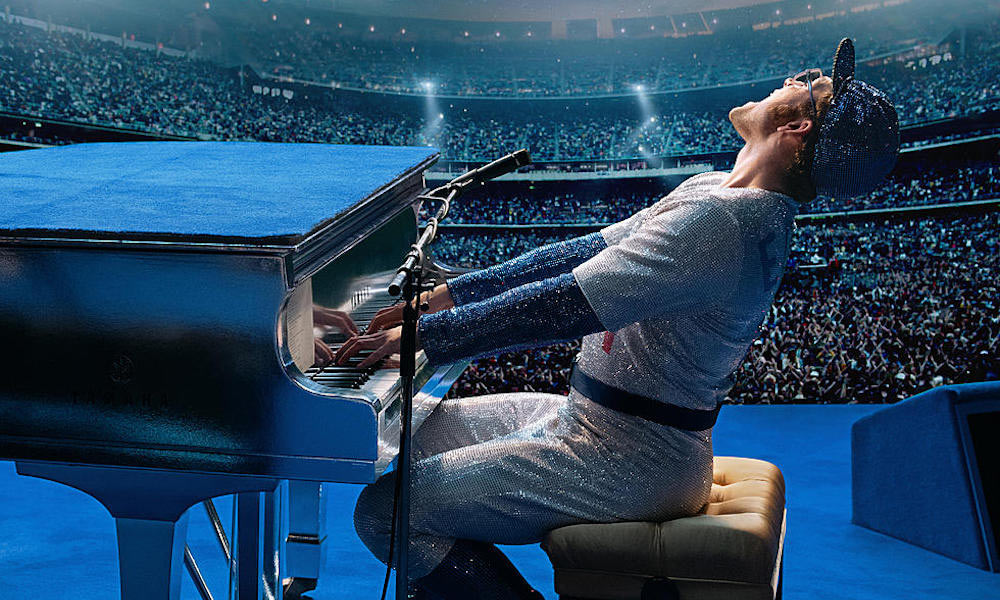
Driven by a wonderfully layered performance from Taron Egerton – who also handles his vocal duties just fine – the film eschews the standard biopic playbook for a splendid rock and roll fantasy.
Kudos to writer Lee Hall and director Dexter Fletcher for knowing we’ve seen this rise/drugs/fall arc before, and knowing how to pool their talents for an ambitious take.
Hall wrote Billy Elliot and Fletcher is fresh off co-directing Bohemian Rhapsody. Their vision draws from both to land somewhere between the enigmatic Dylan biopic I’m Not There and the effervescent ABBA glitter bomb Mamma Mia.
Narratively grounded in Elton’s first visit to rehab, Rocketman cherry-picks the hits for resplendent musical set pieces that accompany the blossoming of a shy English youngster named Reginald Kenneth Dwight into the flamboyant global superstar known as Elton Hercules John.
Wounded by an uninterested father (Steven Mackintosh) and an adversarial mother (Bryce Dallas Howard – never better) Reggie sought acceptance through his musical talent. A happenstance introduction to lyricist Bernie Taupin (a quietly effective Jamie Bell) brought unexpected success and then, the obligatory wretched excess.
Even without Fletcher’s involvement, comparisons to Bohemian Rhapsody (now the most successful music biopic to date) were inevitable, but Rocketman leaves the stage as a vastly superior film.
While the close-to-the-safety-vest nature of Queen’s trajectory rendered every artistic license ripe for scrutiny, Rocketman‘s R-rated frankness and fantastical tapestries leave ample room for crowd-pleasing maneuvers.
Of course the kickers-clad schoolboy didn’t pound out “The Bitch is Back” on his living room piano, the aspiring songwriter didn’t sing “Sad Songs” at a 1960s audition, and the overnight sensation didn’t “Crocodile Rock” at his legendary 1970 stint at The Troubadour.
But in the world of Rocketman, anything is possible. And even with all the eccentric flights of fancy, the film holds true to an ultimately touching honesty about the life story it’s telling.
And, oh yeah, the songs are still pretty great, too (no matter who’s singing them).
A veritable smorgasbord of films available this weekend – something for every appetite. We run through Aladdin, Booksmart, Brightburn, Shadow, Non-Fiction, The White Crow and all that’s new in home entertainment.
There was a brief interruption, but we now return to the usual mastery of Yimou Zhang.
While 2016’s The Great Wall (Zhang’s first English language film) stood less than tall, the return to his native tongue results in yet another rapturous wuxia wonder, one nearly bursting with visual amazements and endlessly engrossing storytelling.
Taking us to ancient China’s “Three Kingdoms” era, director/co-writer Zhang (Hero, House of Flying Daggers, Raise the Red Lantern) creates a tale of martial artistry, lethal umbrellas and political intrigue gloriously anchored in the philosophy of yin and yang.
After generations of warfare, the cities of Jing and Yang have been peacefully co-existing in an uneasy alliance. Now, thanks to a brilliantly devious plan for revenge that’s been years in the making, that fragile peace is threatened.
While the tragedies and backstabbings recall Shakespeare, Dickens and Dumas, Zhang rolls out hypnotic tapestries filled with lavish costumes, rich set pieces and thrilling sound design, all perfectly balanced to support the film’s dualistic anchor.
Working mainly in shades of charcoal grey with effectively deliberate splashes of color, Zhang creates visual storytelling of the grandest spectacle and most vivid style. There’s little doubt this film could be enjoyed even without benefit of subtitles, while the intricate writing and emotional performances combine for an experience that entertains and enthralls.
But seriously, you will never look at an umbrella the same way again.
Stepping in for Robin Williams as the Genie in Aladdin was always going to be a thankless task, but while everyone was busy debating the casting of Will Smith, the director’s chair went largely unnoticed.
Could Guy Ritchie, who’s evolved from rough and tumble British crime capers (Snatch) to both big budget hits (Sherlock Holmes) and disasters (King Arthur), capture the magic of Disney’s best live action remakes?
Well, how many wishes does he have left?
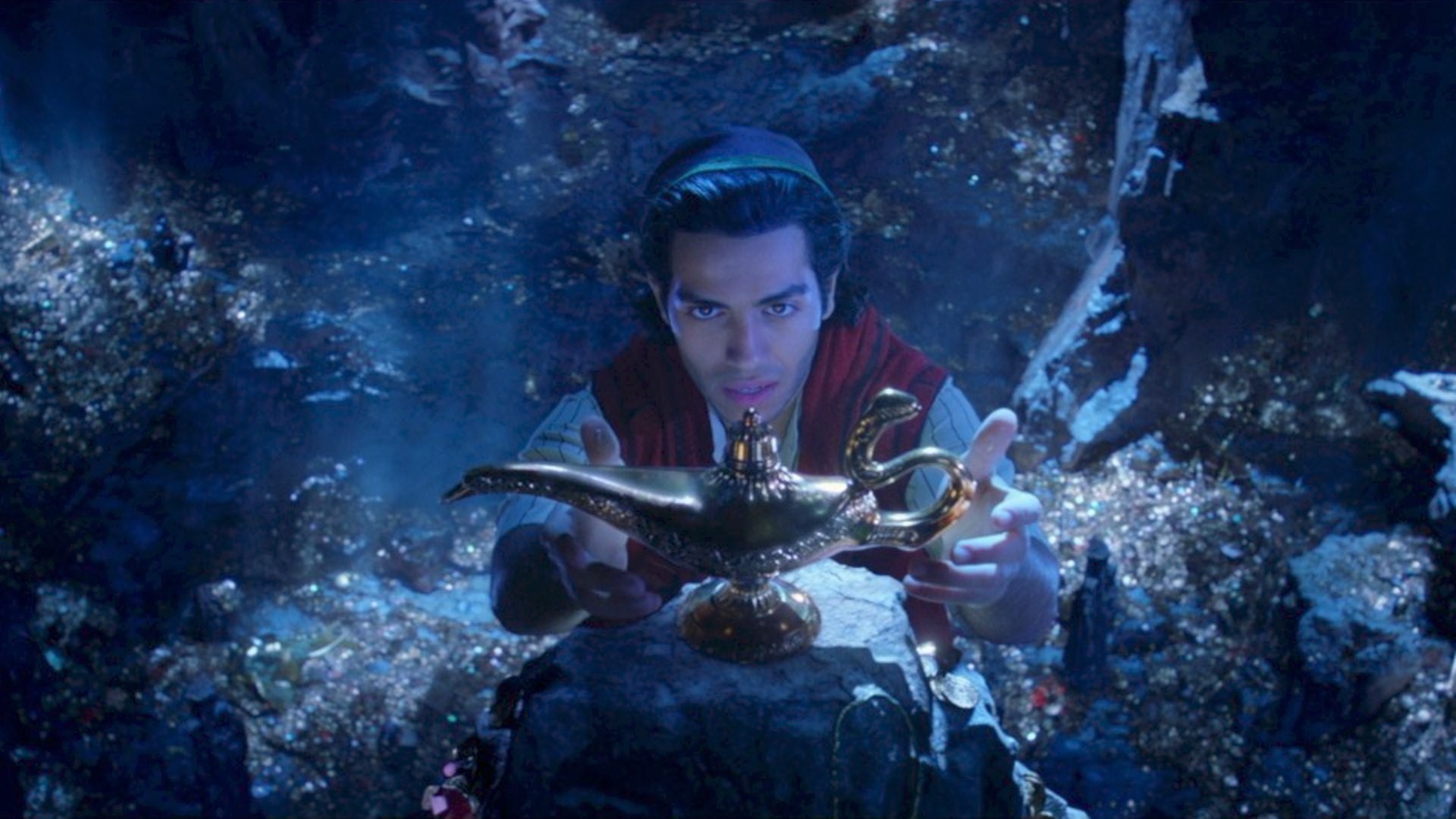
The tale of “street rat” Aladdin (Mena Massoud) using the Genie (Smith) to get him next to Princess Jasmine (Naomi Scott) ends up feeling too stiff and self-conscious to ever let some real wonder out of the bottle.
The story arc has been altered slightly, leading to an earlier meeting between Aladdin and the Princess, and a relationship where the stakes don’t feel as high or the changes of heart as well-earned.
Reaction shots and choppy dialog (from Ritchie and co-writer John August) carrying an overly staged, exaggerated odor, while the Genie is plagued less by casting than by the less-than-cutting edge CGI.
Re-imagining the Genie character would have been a risky (but ambitious) move, and though Smith won’t make anyone forget Williams, he is hardly the big problem here. His charm is abundant and a valuable asset for the film, especially when the Genie takes human form.
His singing voice, though, is not strong. And strangely, neither is Massoud’s, compounding the weaknesses in Ritchie’s bland vision for the musical numbers.
The Alan Menken/Howard Ashman tunes are still stellar, but the repeated addition of a new girl power anthem for Jasmine (“Speechless“) ranks as forgettable bait for an Original Song Oscar nod.
And while I’m ranting, maybe we could have an extra thirty second buffer to decompress before the ubiquitous cry of “DJ Khaled!” signals an oncoming pop mix for the closing credits?
Even the best directors have struggled with musicals (Attenborough’s misguided A Chorus Line and Eastwood’s limp Jersey Boys jump to mind), and though Aladdin didn’t originate on the stage, the music sequences demand a pizzazz that Ritchie is helpless to present.
He seems much more comfortable with film’s darker edges, and an intensely slimy turn from Marwan Kenzari as Jafar helps the villain’s quest for absolute power find some needed gravitas.
Look, the film still offers some perfectly fine moments of overly manufactured family entertainment that will make many parents nostalgic for the original. But after the live-action heights hit by The Jungle Book and Beauty and the Beast, this Aladdin is a carpet ride missing much of its magic.
Why fear the sea? The same reason to see menace in the deep, dark unknown of space or the dense and dizzying claustrophobia of the forest: because it’s really hard to see what’s in there.
That leaves us to our imagination, and when is that ever a good idea? Here, then, are some of the most imaginative ways horror filmmakers terrorized us with tales of what lies beneath.
5. Godzilla (Gojira) (1954)
Up from the depths, 30 stories high, breathing fire…you know the rest. Surely we had to have a Fifties science run amok beastie on this list, and while there was some stiff competition, nothing really bests Godzilla.
As Japan struggled to re-emerge from the 1945 bombings of Hiroshima and Nagasaki, director Ishiro Honda unleashed that dreaded kaiju—followed quickly by a tidal wave of creature features focused on scientists whose ungodly work creates global cataclysm.
Far more pointed and insightful than its American bastardization or any of the sequels or reboots to follow, the 1954 Japanese original mirrored the desperate, helpless impotence of a global population in the face of very real, apocalyptic danger. Sure, that danger breathed fire and came in a rubber suit, but history shows again and again how nature points out the folly of man.
4. Open Water (2003)
Jaws wasn’t cinema’s only powerful shark horror. In 2003, young filmmaker Chris Kentis’s first foray into terror is unerringly realistic and, therefore, deeply disturbing.
From the true events that inspired it to one unreasonably recognizable married couple, from superbly accurate dialog to actual sharks, Open Water’s greatest strength is its unsettling authenticity. Every element benefits from Chris Kentis’s control of the project. Writer, director, cinematographer and editor, Kentis clarifies his conception for this relentless film, and it is devastating.
A couple on vacation (Blanchard Ryan and Daniel Travis) books a trip on a crowded, touristy scuba boat. Once in the water, they swim off on their own – they’re really a little too accomplished to hang with the tourists. And then, when they emerge from the depths, they realize the boat is gone. It’s just empty water in every direction.
Now, sharks aren’t an immediate threat, right? I mean, tourist scuba boats don’t just drop you off in shark infested waters. But the longer you drift, the later it gets, who knows what will happen?
https://www.youtube.com/watch?v=F4fxtHQtt4Y
3. The Lure (2015)
Here’s a great Eastern European take on reimagined Eastern European fairy tales, like Norway’s Thale (2012) and Czech Republic’s Little Otik (2000).
Gold (Michalina Olszanska) and Silver (Marta Mazurek) are not your typical movie mermaids, and director Agnieszka Smoczynska’s feature debut The Lure is not your typical – well, anything.
The musical fable offers a vivid mix of fairy tale, socio-political commentary, whimsy and throat tearing. But it’s not as ill-fitting a combination as you might think.
The Little Mermaid is actually a heartbreaking story. Not Disney’s crustacean song-stravaganza, but Hans Christian Andersen’s bleak meditation on the catastrophic consequences of sacrificing who you are for someone undeserving. It’s a cautionary tale for young girls, really, and Lure writer Robert Bolesto remains true to that theme.
The biggest differences between Bolesto’s story and Andersen’s: 80s synth pop, striptease and teeth. At its heart, The Lure is a story about Poland – its self-determination and identity in the Eighties. That’s where Andersen’s work is so poignantly fitting.
https://www.youtube.com/watch?v=vxhi_3hDUPE
2. The Host (2006)
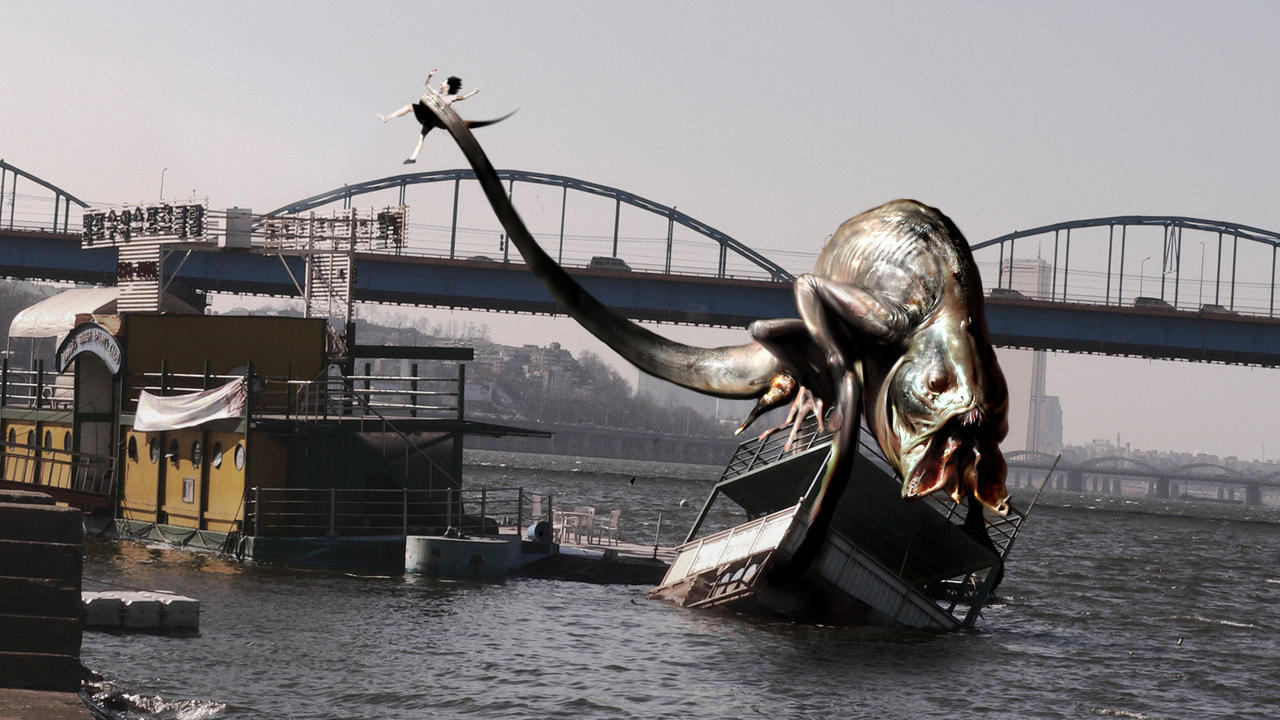
Visionary director Joon-ho Bong’s film opens in a military lab hospital in 2000. A clearly insane American doctor, repulsed by the dust coating formaldehyde bottles, orders a Korean subordinate to empty it all into the sink. Soon the contents of hundreds of bottles of formaldehyde find its way through the Korean sewer system and into the Han River. This event – allegedly based on fact – eventually leads, not surprisingly, to some pretty gamey drinking water. And also a 25 foot cross between Alien and a giant squid.
Said monster – let’s call him Steve Buscemi (the beast’s actual on-set nickname) – exits the river one bright afternoon in 2006 to run amuck in a very impressive outdoor-chaos-and-bloodshed scene. A dimwitted foodstand clerk witnesses his daughter’s abduction by the beast, and the stage is set.
What follows, rather than a military attack on a marauding Steve Buscemi, is actually one small, unhappy, bickering family’s quest to find and save the little girl. Their journey takes them to poorly organized quarantines, botched security check points, misguided military/Red Cross posts, and through Seoul’s sewer system, all leading to a climactic battle even more impressive than the earlier scene of afternoon chaos.
1. Jaws (1975)
What else – honestly?
Twentysomething Steven Spielberg’s game-changer boasts many things, among them one of the greatest threesomes in cinematic history. The interplay among the grizzled and possibly insane sea captain Quint (Robert Shaw), the wealthy young upstart marine biologist Hooper (Richard Dreyfuss) and the decent lawman/endearing everyman Brody (Roy Scheider) helps the film transcend horror to become simply a great movie.
Perhaps the first summer blockbuster, Jaws inspired the desire to be scared silly. And in doing so it outgrossed all other movies of its time. You couldn’t deny you were seeing something amazing – no clichés, all adventure and thrills and shocking confidence from a young director announcing himself as a presence.
Spielberg achieved one of those rare cinematic feats: he bettered the source material. Though Peter Benchley’s nautical novel attracted droves of fans, Spielberg streamlined the text and surpassed its climax to craft a sleek terror tale.
It’s John Williams’s iconic score; it’s Bill Butler’s camera, capturing all the majesty and the terror, but never too much of the shark; it’s Spielberg’s cinematic eye. The film’s second pivotal threesome works, together with very fine performances, to mine for a primal terror of the unknown, of the natural order of predator and prey.
Jaws is the high water mark for animal terror. Likely it always will be.
Every time I see the latest Young Adult romance fantasy on the big screen, I end up thinking about Barton Fink getting reprimanded for not sticking to the formula.
“Wallace Beery! Wrestling picture!”
Credit The Sun Is Also a Star for trying to stray outside the usual lines, even as it hits those same formulaic goalposts.
Natasha (Yara Shahidi) and Daniel (Charles Melton) are great-looking (and somehow, single) teens in New York City. Hers is a family of Jamaican immigrants facing deportation in 24 hours, while his Korean family runs a black hair care store in the neighborhood.
‘Tasha “doesn’t believe in love,” but meeting Daniel gives him the chance to win her over while she explores a last option to stay in the U.S.
Yes, there’s voiceover essay reading, yes he realizes her specialness after one faraway glimpse, and yes they both have to break free from the lives their parents have planned for them. Yes, in a city of millions they keep stumbling into idyllic situations where they’re all alone. Yes, it’s based on a YA novel and yes, some of the dialog is downright cringeworthy.
You knew much of that already (because “wrestling picture!”), but the film does mange to score some little victories.
Best of those is the assured direction from Ry Russo-Young (Nobody Walks, Before I Fall) , who keeps NYC’s melting pot as an ever-present supporting player. Paired with the diversity of the cast, the undercurrent of real lives upended by immigration policies comes in surprisingly deft waves.
But as Daniel waxes on about fate and the need for chemistry, it eventually becomes clear that Shahidi and Melton – both promising talents – don’t have enough of it.
That’s a problem, and it stands at the top of the list of things this film is selling that you just can’t buy.
Another death row drama with a clear agenda, probing one questionable conviction to build a righteously angry condemnation of our entire justice system?
Yes, Trail by Fire is certainly that, but the familiarity of its gripping narrative actually serves to strengthen the argument. How many dubious death sentences will it take to shake our comfortable faith in fair trials?
In 1992, Texan Cameron Todd Willingham (Jack O’Connell) was sent to death row for setting the house fire that killed his three young children.
After years in prison, concerned citizen Elizabeth Gilbert (Laura Dern) took an interest in the case. Along with lawyers from the Innocence Project, Gilbert worked to poke enough holes in the conviction to get Willingham a new trial.
Adapted from a New Yorker magazine article and Willingham’s own letters from prison, the committed script from Geoffrey Fletcher (Precious) suffers only in the rushed introduction of Gilbert’s character. But though any organic motivation for Liz’s commitment may be thin, it’s overcome by the sterling performances from the two leads.
O’Connell – a vastly underrated talent- is heartbreakingly effective as Willingham, a man happy to have a regular visitor but wary of the hope Liz brings with her.
His journey from slacker defiance to jailhouse wisdom is grounded in the authenticity of McConnell’s touching performance. This man was no altar boy, but our sympathy for him is well-earned.
The chemistry with Dern is evident from the start. While these plexiglass encounters are a necessary staple of this genre, Dern and McConnell make them simmer with an intensity that is often riveting.
Kudos, too, to Emily Meade as Willingham’s wife Stacy. The Willingham marriage was challenging, to say the least, and Meade (Nerve, Boardwalk Empire, The Deuce) is good enough to make the conflicted relationship recall the bare emotions of Manchester by the Sea.
Director Edward Zwick (Glory, Blood Diamond, Pawn Sacrifice) takes some narrative risks that ultimately pay off, keeping the pace vital through some effective visual storytelling that feeds the sense of a ticking clock.
Zwick also builds layers of indelible support characters (Willingham’s first jail cell neighbor, the lead prison guard, an independent arson investigator) that leave engaging marks, often at junctures critical to avoiding an overly rote structure.
Crushing in its familiarity, gut wrenching in its specifics, Trial by Fire is a tough but worthy reminder of the illusion of fairness.