
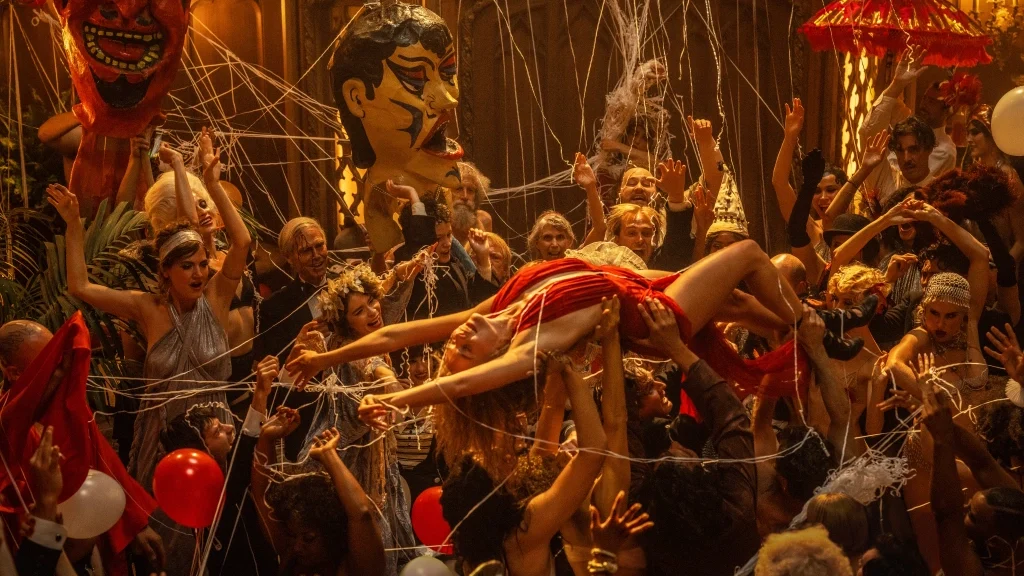
Hooray for Hollywood
Babylon
by George Wolf
Well first, let’s talk about the elephant in the room.
There’s an elephant in the room. A real one, delivered to a film exec’s insane party by the ambitious young Manuel (Diego Calva). Wannabe starlet Nellie LaRoy (Margot Robbie) has also found a way past security, and as writer/director Damien Chazelle’s extended take winds us through some impressively staged decadence, Babylon begins its frantically entertaining chronicle of intertwining fates in early Hollywood.
Manuel and Nellie meet that night, each launching a dream to break into the movie business, where Jack Conrad (Brad Pitt) reigns as the king of silent films. While Manual begins climbing the ladder on the production side and Nellie’s persona as the screen’s new “wild child” makes her an in-demand sensation, the jaded Jack pines for innovation and laments that “the most magical place in the world” has become stagnant.
And before anyone can warn Jack about being careful with his wishes, “motherfucking sound!” comes to the movies.
Chazelle’s vision here is more ambitious than ever. Babylon is always big and often wild, swinging in all directions as it proposes a drug-fueled toast to the movies, the people that make them, and to the often cruel way those people are used and abused.
It’s a mess of humor, spectacle and emotion, with all angles fighting the urge to run off on their own. There’s surprising humanity in the arc of Sidney (Jovan Adepo), an African American horn player whose success in musicals can’t protect his dignity, but curious excess revealed in the strange cameo from Tobey Maguire as a scary guy with an alligator in his dungeon, as well as a sudden montage of classic movie moments that pops up in act three.
All three leads are terrific. Pitt exudes charisma and hard-earned wisdom as a man forced to admit bitter truths, Calva provides the film’s sympathetic heart and Robbie is flat-out ferocious, delivering a constant challenge for you to just try and look somewhere else. The always welcome Jean Smart is also a treat, stealing scenes with an award-worthy supporting turn as an influential gossip columnist.
Babylon isn’t just big, it’s large, with a three-hour-plus running time that Chazelle packs with enough pizazz and amazing craftsmanship to keep it constantly compelling. This film may be many things, but boring is not one of them.
Like Jack, the silent film star struggling in talkies, Chazelle knows the movie business may be at an important crossroads. But both men still believe in the power of movie magic, and that despite shame from the past and uncertainty in the future, Hollywood deserves the big loud hooray that explodes from Babylon.


Sexy Boots
Puss in Boots: The Last Wish
by Hope Madden
Live like there’s no tomorrow. For some, that idea may be freeing. Not for Puss in Boots (Antonio Banderas).
Down to the last of his nine lives thanks to his devil-may-care, adventuring lifestyle, the legendary tabby knows fear for the first time. Indeed, it seems to him that death itself stalks his every move.
But just as he’s resigned himself to the life of a housecat, he learns of a wishing star and decides that this one wish is his key to becoming his fearless, legendary self again. Too bad his ex, Kitty Softpaws (Salma Hayek), is also after it. So is narcissistic psychopath and piemaker Jack Horner (John Mulaney), as well as Goldilocks (Florence Pugh) and the three bears (Olivia Colman, Ray Winstone and Samson Kayo).
That’s a killer cast right there. That’s five Academy Award nominations and one Oscar. Sure, most of that is Colman, but still, Puss in Boots: The Last Wish is loaded with talent.
That’s no real surprise from the Shrek franchise or the gang at Dreamworks. What is a surprise is the material these pros have to tear into. Directors Joel Crawford and Januel Mercado capitalize on the talent with a heartfelt, surprisingly mature script from Tommy Swerdlow, Tom Wheeler and Paul Fisher as well as animation that looks better than anything the studio’s put out to date.
Banderas has a blast, as he has since his first appearance as the booted feline in 2004. Not every actor is cut out for voice work, but Banderas excels.
Pugh’s scrappy Goldilocks is a stitch, as is Winstone’s Papa Bear. Colman characteristically delivers a performance that’s equal parts tender, hilarious and heartbreaking. And with just her voice!
The entire cast, including Harvey Guillén as the most resilient chihuahua ever animated, populates this imaginary world with decidedly memorable characters – characters with dimension, 2D be damned.
Puss’s existential crisis drives this imaginative, often hilarious adventure, but it does more than that. It anchors all the derring-do with earnest emotion and recognizable struggle. The film never feels as if it’s winking at its adult audience while dishing out frivolity to youngsters. Instead, somehow the filmmakers bridge that, engaging all ages with an emotionally complex but digestible tale, gorgeously rendered, beautifully acted and shockingly fun.


Carry That Weight
The Whale
by George Wolf
By now you’ve probably heard plenty of accolades about Brendan Fraser’s “comeback” performance in Darren Aronofsky’s The Whale. It’s all true.
And that emotional standing O at Cannes? He deserved it.
It’s a stupendous performance, in a movie that’s always struggling to keep up with him.
Fraser, under some pretty impressive prosthetics and makeup, is Charlie, who pretends his laptop camera is broken so his online writing students won’t glimpse his obesity.
Charlie spends almost every moment of the day in his Idaho apartment, resisting face-to-face contact with anyone except his caring nurse Liz (Hong Chau, Oscar-worthy herself). Liz and Charlie share a connection to the traumatic event that sent Charlie down the path of eating himself to death, and Liz’s frustrated admonishments about Charlie’s habits seem to have little effect.
What does stir Charlie from his destructive routine are two surprise visits. One is from Thomas (Ty Simpkins), a missionary from New Life Ministries. The other is from Ellie (Sadie Sink from Stranger Things and Fear Street), Charlie’s angry, spiteful and estranged teenage daughter.
Screenwriter Samuel D. Hunter adapts his own play, and while Aronofsky offsets the chamber piece roots with sufficient cinematic vision, not all of Hunter’s themes make an equally successful transition.
The Moby Dick metaphor is frequent and obvious, but woven as it is through the lens of a composition teacher, settles in as an organic and relatable device. Similarly, Hunter’s points about the often judgmental and unforgiving nature of religious groups aren’t exactly profound, but their character-driven delivery is welcome.
But the heavily dramatic relationship between Charlie and Ellie – and later, Ellie’s mother (Samantha Morton) – suffers from the stage-to-screen edit. Emotions often escalate from two to ten in an instant, straining authenticity and pushing the manipulative wave that threatens to consume the film.
It doesn’t help that Aronofsky’s camera flirts with fetishizing Charlie’s shame, though Fraser’s tenderness is always the film’s saving grace. His every expression is etched with a soul-deep pain that’s finally being pierced by a last hope for redemption. Far from the maudlin exercise this character could have been, Fraser’s is an endlessly compassionate performance that will not let you give up on Charlie, or the film.
And you may very well see the resolution coming by the second act, but regardless, don’t forget to have the tissues handy for the third. Every time The Whale needs saving, fear not, Fraser will keep it afloat.

An Odd Couple in an Even Odder World
Joy Ride
by Christie Robb
A cozy story of mutual self-discovery, director Emer Reynolds and writer Ailbhe Keogan’s Joyride delivers a series of poignant moments but unfortunately not enough of them to result in a believable conclusion.
The excellent Olivia Colman plays Joy, a solicitor that has recently given birth to a late-in-life baby that she wishes to give away to a childhood friend. The delightful Charlie Reid plays Mully, a teenager who has recently lost his mom to cancer and is left with a scumbag dad who wants him to steal money from a hospice fundraiser to clear his debts. Their lives intersect when the two try to use the same stolen taxi.
The transitional nature of a road trip during a transitional period in both of their lives provides the opportunity for each of the two to learn things they never knew about themselves and to grow and mature as individuals. They are doing this while rolling through the Irish countryside, which is quite a pleasurable backdrop.
The two leads are very talented and their banter is written naturally enough to be believable. However, the plot at times veers into the ridiculous, ignoring so much of the way the actual world works as to leave you wondering if you accidentally got the genre wrong and you are watching a fantasy.
It’s a world in which you can evade the police by simply turning into the first driveway on the side of the road and 13 year-old-boys can function as effective lactation consultants.
But, if you are looking for a movie to attempt to give you heart-expanding holiday feelings without the Hallmark tinsel explosion, Joyride might be the movie for you.


Rad Chad’s Metaverse
Scare Package II: Rad Chad’s Revenge
by Hope Madden
Three years ago, Aaron B. Koontz delighted die-hard horror fans with the squishy, oozy, gory mash note to the video store, Scare Package. It was an anthology of horror shorts, and those only tend to work if they have a compelling frame. In this case, each short represented a film on the shelf at Rad Chad’s Horror Emporium.
For the sequel, Scare Package II: Rad Chad’s Revenge, survivors from Part I regroup for Rad Chad’s funeral. But they find themselves trapped by a sinister mastermind with deadly games they must play if they hope to make it out alive.
Why do they watch the short films? That’s less clear this go-round, but the shorts they do watch are all pretty solid.
Both Alexandra Barreto’s Welcome to the Nineties and Anthony Cousins’s The Night He Came Back Again! Part VI: The Night She Came Back – like Koontz’s framing story – rely on your knowledge of horror tropes to generate laughs. Barreto’s film has some of the sharpest insights via dialog as it celebrates the changing of the “final girl” guard once the grunge-and-garage era took hold.
Rachele Wiggins’s We’re So Dead is a fun Aussie adventure, part Stand by Me part Re-Animator, with a wry delivery. Like all the other shorts in the program, We’re So Dead offers metacommentary without surrendering its standalone charm.
For Special Edition, director Jed Shepherd sets a handful of friends in a lighthouse for the night with a one-of-a-kind video. But what is the film, exactly? As one woman obsessively rewinds, fast forwards and pauses, her friends are the ones making the big discoveries.
Nods to Aliens, Black Christmas, Halloween, Friday the 13th Part 5, A Nightmare on Elm Street Part 3, Hellraiser, Saw and more flavor the product and mark its makers as bona fide fans. You may have to be a fan of Scare Package to appreciate Koontz’s framing story because it picks up not long after the first left off, without explanation. Being in on the joke, as always, makes the gag more satisfying. But that’s the basic premise of every story told in this collection.


Mommy Issues
They Wait in the Dark
by Hope Madden
Writer/director Patrick Rea’s latest opens on a little girl standing and staring at the foot of a bed, her expression blank. In the bed, a woman – the child’s mother, we’ll later learn – bleeds out.
It’s an effective way to open a horror film, but the following image is even more provocative. A woman, lean and hollow-eyed, wakes in a little-used corner of a convenience store, a nook where she and a young boy catch some sleep, hopefully unnoticed.
What exactly is happening in They Wait in the Dark?
Rea leaves you guessing for a long while, and even once you think you’ve pieced the plot together, you haven’t. His film is a supernatural psychological drama about the circular trauma of abuse. But the filmmaker toys with your preconceived notions of supernatural horror and domestic thriller tropes, and the sleight of hand is often compelling.
Sarah McGuire is Amy, the mother on the run, making her way with her son to the ramshackle house her father left her. McGuire gives Amy the believable, faraway look of someone haunted. She’s asked to shoulder a lot of internal and emotional shifts. Amy’s motivations are never a given, and McGuire must drive the film while keeping her character mainly a mystery. She succeeds, often because she allows the physical performance to carry the emotional weight of the character.
Though not ever performance in the film is as strong, Rea’s instinct for how and when to introduce creepier elements helps the film overcome most of its weaknesses. The filmmaker never rushes, so when we do see a hand where no hand should be, the impact is felt.
There are some lapses in logic – like why squatting teens would leave empty beer cans and a pentagram behind but would not help themselves to a shotgun. And scenes sometimes linger longer than necessary, the actors looking like they’re spinning their wheels while the film’s slight runtime begins to feel padded.
But thanks to sly maneuvering of genre expectations and a handful of uncomfortable scenes, They Wait in the Dark leaves an impression.

Screening Room: Avatar: The Way of Water, If These Walls Could Sing, Utama, Onoda, High Heat

Come and Sea
Avatar: The Way of Water
by George Wolf
Week after week, really good films telling solid, compelling stories have been debuting in movie theaters and sinking like streaming-bound stones. What’s it gonna take for movies not named Top Gun to move people off the couch and back into the cinema?
James Cameron thinks the answer is to provide a sensory experience you just cannot get anywhere else. And on that front, Avatar: The Way of Water is a resounding success. See it on the IMAX screen, with the 3D glasses on your face, the thumping Dolby in your earholes and the high frame rate injected in your eyeballs and you’ll be transported to a theme park-like world of technical wonder.
The storytelling, on the other hand, is all wet.
Since we last left Jake Sully (Sam Worthington) over ten years ago, he and Neytiri (Zoe Saldana) have formed a happy family among the forest people of Pandora.
Their peace is shattered by a new invasion from the sky people, with a Na’vi clone of Colonel Quaritch (Stephen Lang) out to settle an old score. To keep the Na’vi from the fight, Jake and family flee to a village of the water people (including Kate Winslet and CCH Pounder) that’s led by Tonowari (Cliff Curtis).
But just as the forest family is bonding with their new water world, Quaritch and his troops come calling for a showdown.
You know who realized they shouldn’t run, that war would follow them and put others at risk? Neytiri did, the latest in a long line of smart women in James Cameron movies who no one listens to. That’s not the only throwback to Cameron films you may notice. Aliens, The Abyss, and Titanic are all over this film, and why not? Everybody else steals from them, why not Cameron?
The problem is not that he borrows from himself, but that he repeats himself. Scenes replay the same beats again and again. There’s so much wasted narrative space in this three-plus-hour film, and yet voiceover narration explains what that space could have been used to show.
And that’s the ironic weakness that consistently keeps Avatar 2 from resonating beyond surface-level amazement. Cameron (who also co-wrote the script) shows us so many wonderful delights, but precious few of them advance any investment in character, theme or narrative. It’s not that the ideals hitching a ride with the wizardry aren’t worthy, it’s just that they’re slapped together with so much obviousness and redundancy.
As the long-promised follow-up to the all-time box office champ, and carrying a budget in the hundreds of millions with several more sequels in the pipeline, there was already plenty riding on Cameron’s new vision. But a big return for TWOW could fast track a bittersweet bargain. The days of a rising tide at the multiplex lifting all boats seem to be fading fast, and one more huge wave might not leave room for anything on the big screen that’s less than pure spectacle.

Truth and Consequences
Bardo: False Chronicle of a Handful of Truths
by Hope Madden and George Wolf
The latest from Oscar-winning director Alejandro G. Iñárritu may be uneven and frustrating at times, but do not be tardy. The first three minutes of the film, while showcasing only light, shadow and landscape, unveil the most mesmerizing opening we’ve seen in a damn long time.
And good news, it’s just an appetizer for the two and a half hours of visual delights that follow.
Crafting self-indulgence into sometimes breathtaking art, Iñárritu turns his characteristic cinematic style inward for the sorta-semi-autobiographical Bardo: False Chronicle of a Handful of Truths.
“If you don’t know how to fool around, you don’t deserve to be taken seriously.” So says the Iñárritu stand-in, Silverio Game (Daniel Giménez-Cacho, terrific), a journalist-turned-documentarian who yearns to show emotion rather than fact.
Silverio’s about to be presented with a big award in L.A., which only triggers a series of introspections that attempt to reconcile an imposter complex with a need for recognition, global fame with his Mexican identity, and a general distaste for the state of his profession.
Visually, Iñárritu pulls no punches, reminding us of the fluid wonder that characterized his films from Babel to Biutiful to Birdman and The Revenant. Here those tactics conjure a dreamlike reality, simultaneously playful and bitter, ideal to reflect the reminiscences and wallowing preoccupations of an artist brooding on his accomplishments and shortcomings.
The narrative is bloated and rambling, which Silverio freely acknowledges as Iñárritu (who also co-wrote the script with frequent collaborator Nicolás Giacobone) continues indulging his self-indulgence. Giménez-Cacho finds sympathy in Silverio’s identity crisis, and it’s fascinating to feel both the push and pull of Iñárritu‘s approach. We embrace it for the shot-making but resist it while the artist tries to tell us where his artistry takes root.
The metaphors, symbolism and contradictions pile on, along with enough jaw-dropping framing to make you realize this could be in an unknown language with zero subtitles and it would still be worth seeing.
“Life is a brief series of senseless events,” Silverio tells us. Maybe. And though Bardo may not be brief and its sense can be confounding, there’s no denying its beauty.
Indulge yourself. See it on the big screen.
