Tag Archives: Joko Anwar

Creepy Cellmate

Ghost in the Cell

by Hope Madden

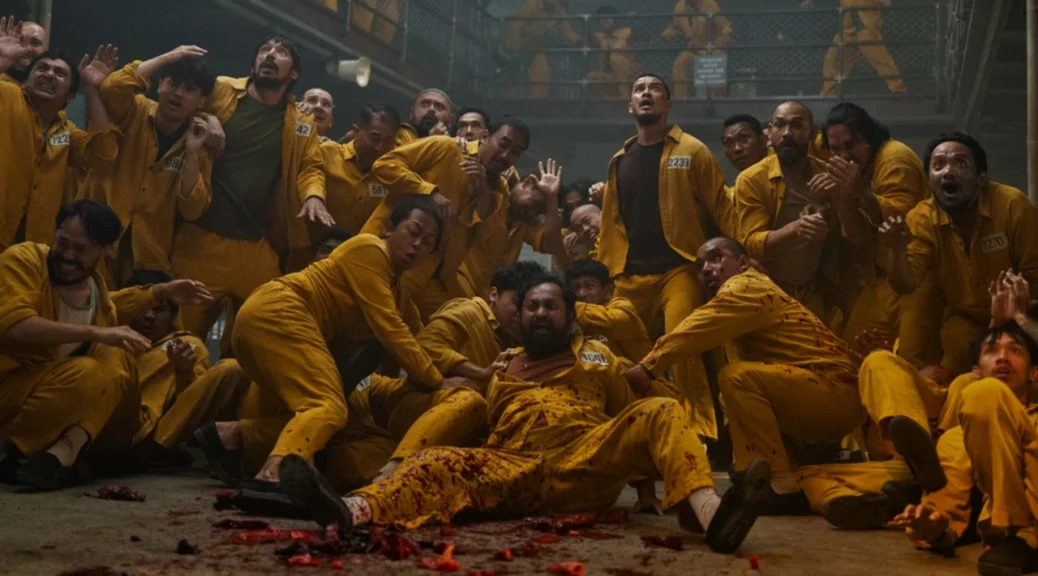
Joko Anwar makes a lot of movies. Not all of them are worth watching, but when he hits, you can expect grimy, bloody fun. Perhaps none more unexpectedly fun than his latest, Ghost in the Cell.

We open after midnight in a sweaty Indonesian newsroom, dedicated journalist Dimas (Endy Arfian) keying in the last sentences of his most perfect story. Capitalists are illegally mining a rainforest in Borneo where dozens of strange deaths occurred.

But the story never runs, and within a scene or two, Dimas is the new guy in an awfully unpleasant Indonesian prison.

Were it not for the gruesome opening (the reason that story didn’t run), you might not recognize Anwar’s latest as a horror film until after its midpoint. Instead, the filmmaker pits a rag tag group of not-so-badnicks (one telephone scammer, one small time robber, etc.) against more serious felons and a sadistic prison force. It’s somewhat traditional action with a bit of good-natured humor tossed around.

And then, meek little do-gooder Dimas arrives. Fresh meat. Or is he?

Though the most unhinged of the inmates, Tokek (Aming Sugandhi), has made his ill intentions clear, he meets a similarly grisly fate as that newspaper publisher. Is Dimas to blame? Or did he unwittingly bring something to the prison with him?

Ghost in the Cell showcases Anwar’s knack for truly ghastly body horror with a buoyant camaraderie, proletariat zeal, and well-placed bursts of comedy. His cast is up to the tonal challenge, each one carving out a memorable character, which can be tough to do in a sea of prison bars and orange jumpsuits.

There’s almost a sweetness and definitely a sense of optimism in the humor, characterizations, and storyline. The respect the inmates show the dance instructor, and Anwar’s earnest use of dancing in the film, can’t help but make you smile—even as massive chunks of inmate slide down the gore-slimed stone walls.  

Pick-me-up seems like the wrong way to describe Ghost in the Cell, but for a movie boasting the sheer volume of carnage, the film has a good heart.

Slum Lord

Satan’s Slaves: Communion

by Hope Madden

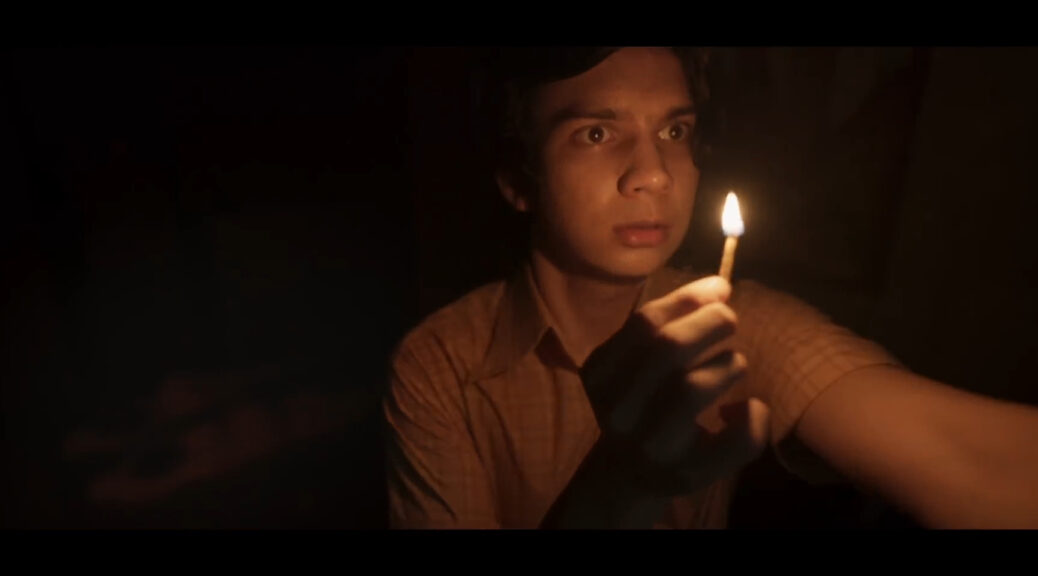
In what may be Joko Anwar’s most assured and consistently spooky effort, Satan’s Slaves: Communion evokes effective, building horror.

Building, like a towering apartment building. It’s not an image you expect to find in horror, but it has been used to fantastic effect a number of times. Obviously, Rosemary’s Baby and The Sentinel delivered urban terror via creepy architecture. More recently, Rec and the action classic The Raid took advantage of layer upon layer of floors and doors for bloody mayhem.

Anwar blends the supernatural of the earlier films and the pandemonium of the latter with the looming presence of the structure itself, a bit like what you’ll find in Eskil Vogt’s The Innocents and Ciaran Foy’s 2012 horror, Citadel.

The mish-mash works wonders to conjure a dark, dreary, dangerous trap with supernatural evil waiting down every hall. And don’t even look in the laundry chute.

A sequel to his 2017 Satan’s Slaves (itself a riff on Norman J. Warren’s ’76 cult horror Satan’s Slave), Communion picks up in 1985, just a few years since Rini (Anwar favorite Tara Basro) and her brothers Toni (Endy Arfian) and Bondi (Nasar Annuz) lost their mother and little brother to something very sinister. Their dad moved them to this building in Jakarta, and as long as they can survive the big storm that’s coming, Rini will finally leave the nest and pursue her education.

Sure. Just don’t take the elevator.

The first Indonesian film to be shot in IMAX, Satan’s Slaves: Communion looks as grimy and shadowy as any Anwar film – as it should. He uses shadows and distance, cramped spaces and lighting to set a stage that unnerves. Both sound design and practical FX complete that picture. Yes, the ideas and even some images are pulled from other films, but the final concoction is utterly Anwar.

Queen of Mean

The Queen of Black Magic

by Hope Madden

Filmmaker Kimo Stamboel resurrects 70s exploitation horror with The Queen of Black Magic. Not a remake or really a sequel or reboot of the Indonesian cult classic, Stamboel’s film is more inspired by its namesake.

Fun throwbacks to Liliek Sudjio’s original over the end credits do more to remind you how comparably tame this one is.

Not that it is without merit. Or gore.

Hanif (Ario Bayu) returns to the orphanage where he grew up. The man who raised him is dying, and now Hanif and his two childhood friends reunite, families in tow, having come home to pay their respects.

But bad things haunt the old orphanage.

Of course they do! What are you, new?!

Stamboel and writer Joko Anwar can’t come up with anything particularly new when deciding what, exactly, is the problem with this orphanage. But they populate their scenes of carnage with actors who generate some empathy, and put those actors into scenes that are pretty compelling. Especially if you have a thing about crawly creatures. Or a sensitive gag reflex.

Anwar is a master of conjuring nightmarish environments, complete with nightmare logic. His 2017 remake Satan’s Slave and his 2019 original Impetigore throw narrative logic aside in favor of a denseness of dread punctuated with unseemly carnage.

The Queen of Black Magic makes more narrative sense, but somehow that seems to flatten it out a little. It feels less magically horrific and unsettling as the films Anwar directs. But strong, dimensional performances elevate every scene.

And both filmmakers know gore. They know what sounds make you wince, what sights make you look away. Between that, the performances, and a tight enough screenplay to keep your interest, they’ve pieced together a tough little horror flick worth a genre fan’s time.  

Skin Trade

Impetigore

by George Wolf

In a remote Indonesian village, a garden of small headstones marks the effectiveness of a Shaman’s curse. Newborn after newborn dies, the one survivor growing to endure a mysterious, painful existence.

Creepy, right?

Shudder’s Impetigore scores some definite points there, which help to offset a narrative often hampered by convenience and confusion.

Maya (Tara Basro) and Dini (Marissa Anita) are best friends trying to make a go of it in the city. With no family to speak of, they scrape by with menial jobs while dreaming of a better future.

Though raised by her aunt, Maya learns of a spacious home left behind by her wealthy parents. Maya could very well lay claim to this valuable property through inheritance, so she and Dini make their way to the remote village, unaware of the curse and their place in it.

Writer/director Joko Anwar (Satan’s Slaves), an Indonesian genre veteran, seems to know he’s got some solid benchmarks here while not worrying too much about the strength of what binds them together.

Dialogue can range from awkward to WTF-worthy, amid a few convenient plot turns and one humdinger of extended curse explanation that strains coherence.

But when Anwar hits his creepy marks, Impetigore can leave one. The atmospheric isolation in the village feels authentic, and once blood begins letting, the tension is well-paced, bolstered with some satisfying visual payoffs.

There will be eyerolls, but if you’re keeping score, also enough frightful eyebrow-raising to make Impetigore a winning dive into twisted family values.

https://www.youtube.com/watch?v=2RfEwT2LI2M
