Tag Archives: Screen Wolf

Fright Club: Claustrophobic Horror

Claustrophobia is a common terror, which makes it a common theme in horror films. Whether the entire film generates a sense of entrapment (The Thing, Rec, Pontypool, Misery) or the filmmaker inserts moments of claustrophobic terror (Shadow in the Cloud, The Pit and the Pendulum), these movies hit a nerve. Today we spend some time in tight quarters counting down the most claustrophobic horror movies.


5. The Hole (2001)

Nick Hamm’s 2001 thriller finds a handful of spoiled boarding school teens sneaking away while the school’s on holiday. They want to see what kind of trouble they can get into with a couple of undetected days in the underground bomb shelter they discovered well behind the school.

It’s all fun and games until they can’t get out.

Thora Birch delivers a brilliant turn as the lead — vulnerable and yet entirely conniving and psychotic, her Liz is mesmerizing. Kiera Knightly shines as well, as does Embeth Davidtz as a detective who won’t be fooled by Liz’s psychosis.

Or will she?

https://www.youtube.com/watch?v=S79NgoLKvVs

4. Cube (1997)

Making his feature directing debut in 1997, Vincenzo Natali, working from a screenplay he co-wrote, shadows 7 involuntary inmates of a seemingly inescapable, booby-trapped mazelike structure. Those crazy Canucks!

Cube is the film Saw wanted to be. These people were chosen, and they must own up to their own weaknesses and work together as a team to survive and escape. It is a visually awe-inspiring, perversely fascinating tale of claustrophobic menace. It owes Kafka a nod, but honestly, stealing from the likes of Kafka is a crime we can get behind.

There is a level of nerdiness to the trap that makes it scary, in that you know you wouldn’t make it. You would die. We would certainly die. In fact, the minute they started talking about Prime Numbers, we knew we were screwed.

3. Buried (2010)

Almost did not make it past the trailer for this one. A tour de force meant to unveil Ryan Reynolds’s skill as an actor, Buried spends a breathless 95 minutes inside a coffin with the lanky Canadian, who’s left his quips on the surface.

A truck driver working in Iraq who wakes up after being hit on the head, Paul Conroy finds himself inside a coffin. He has a cell phone and a lighter, but not the skill of Uma Thurman, so he is pretty screwed.

The simple story and Reynolds’s raw delivery make this a gut-wrenching experience.

2. The Descent (2005)

A bunch of buddies get together for a spelunking adventure. One is still grieving a loss – actually, maybe more than one – but everybody’s ready for one of their outdoorsy group trip.
Writer/director Neil Marshall begins his film with an emotionally jolting shock, quickly followed by some awfully unsettling cave crawling and squeezing and generally hyperventilating, before turning dizzyingly panicky before snapping a bone right in two.

And then we find out there are monsters.

Long before the first drop of blood is drawn by the monsters – which are surprisingly well-conceived and tremendously creepy – the audience has already been wrung out emotionally.
The grislier the film gets, the more primal the tone becomes, eventually taking on a tenor as much like a war movie as a horror film. This is not surprising from the director that unleashed Dog Soldiers – a gory, fun werewolf adventure. But Marshall’s second attempt is far scarier.
For full-on horror, this is one hell of a monster movie.

1. The Vanishing (Spoorloos) (1988)

Back in ’88, filmmaker George Sluizer and novelist Tim Krabbe adapted his novel about curiosity killing a cat. The result is a spare, grim mystery that works the nerves.

An unnervingly convincing Bernard-Pierre Donnadieu takes us through the steps, the embarrassing trial and error, of executing his plan. His Raymond is a simple person, really, and one fully aware of who he is: a psychopath and a claustrophobe.

Three years ago, Raymond abducted Saskia (Johanna ter Steege) and her boyfriend Rex (Gene Bervoets) has gone a bit mad with the mystery of what happened to her. So mad, in fact, that when Raymond offers to clue him in as long as he’s willing to suffer the same fate, Rex bites. Do not make the mistake of watching Sluizer’s neutered 1993 American remake.


Love And Mercy

Brian Wilson: Long Promised Road

by George Wolf

“Genius” is a term often thrown around too casually, but about one third of the way through Long Promised Road, a moment drops that leaves little doubt Brian Wilson fits the bill.

Veteran producer Don Was sits in a recording studio with the original masters of God Only Knows, the classic pop symphony Wilson wrote and produced for The Beach Boys in 1966. As Was isolates track after track of those ethereal harmonies, he’s left to just shake his head in amazement.

“I’ve been making records for 40 years, and I have no idea what he’s doing.”

Credited with being an innovator of recording studio possibilities and the architect of the unmistakable Beach Boys sound, Brian has a long list of music business admirers, and director/co-writer Brent Wilson lines up an array of famous faces to sing Brian’s praises. From Elton to Springsteen, Foo Fighters to Nick Jonas and more, we hear nothing but well-earned respect and praise for a once-in-a-lifetime virtuoso. 

And that’s great, but it’s not exactly anything new.

What makes Long Promised Road resonate is the time we spend with the man himself, in rare moments when Brian feels safe enough to let his guard down and revisit people and places from his life and career.

Our guide is the film’s co writer Jason Fine, a longtime journalist who gained Brian’s trust over the course of several years and many conversations. Brian started hearing voices at age 21, and he is still troubled by mental health issues which can make formal, sit down interviews uncomfortable for him. So instead, Jason and Brian take to the road for some engaging carpool conversation.

They tool around Brian’s old California stomping grounds (some of which are now actual landmarks saluting him and The Beach Boys) as Jason asks about the past and Brian answers, while often calling out song requests for Jason to cue up in the car. Through it all, Brian comes across as a dear, sweet soul with minimal ego (he excitedly introduces himself to Vanna White in a diner), full of deep feeling and affection for those who’ve touched his life (even his father Murray and his longtime doctor Eugene Landy – whose relationships with Brian were at best volatile and at worst criminal).

Director Wilson (Streetlight Harmonies) intersperses the conversation with some terrific archival footage, at one point layering film of a young Brian directing the famous “Wrecking Crew” of studio musicians alongside more recent footage of him onstage and in studio. It’s a wonderful juxtaposition that brings the film full circle, giving us both a warm and often moving look back with a fragile genius and an illuminating glimpse of the maestro in his element.

I’m So Eggcited

Red Notice

by George Wolf

Heist Movie? Gal Gadot? I’m in.

Plus Dwayne Johnson and Ryan Reynolds.

I said I’m in! Sounds like a bunch of fun.

But somehow, it’s just not.

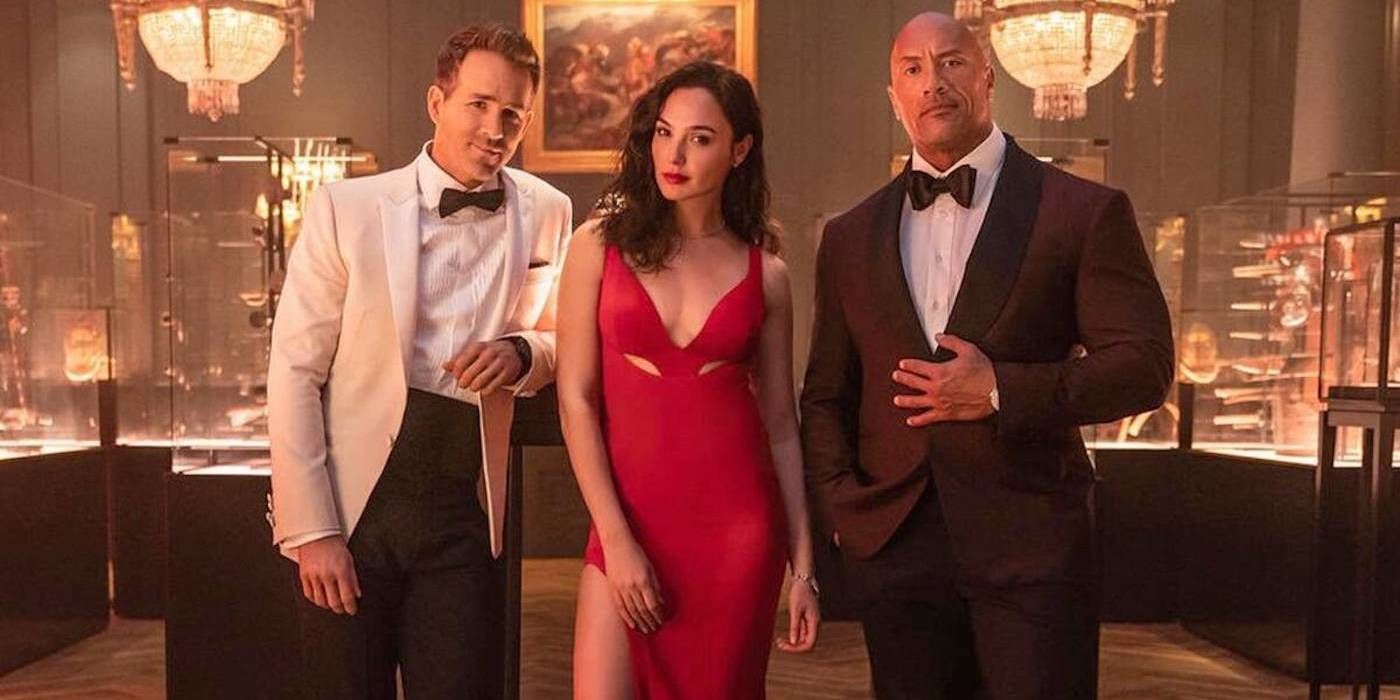
Johnson is FBI agent John Hartley, and he’s on the trail of Nolan Booth (Reynolds), the 2nd most wanted art thief in the world.

Who’s number 1? That would be The Bishop (Gadot), a mysterious criminal who always seems one step ahead of Booth in the quest to reunite three priceless jeweled eggs that Marc Antony once gave to Cleopatra. Yes, Cleopatra.

After a snappy, parkour-heavy chase to open the film, Hartley offers Booth the chance to move up to the top spot on Interpol’s Red Notice (highest level arrest warrant) list. All he has to do is help Hartley and the Feds nab The Bishop.

And the game is on!

Writer/director Rawson Marshall Thurber (Dodgeball, We’re the Millers, Central Intelligence, Skyscraper) has assembled three charismatic A-listers for a globe-trotting adventure with glamourous locales, double crosses and a script full of quippy banter. And it takes barely thirty minutes to begin wondering how it all went wrong.

You would think that watching Gadot, Reynolds and Johnson do anything together would be at least a marginal hoot, but nobody seems comfortable. What chemistry there is feels forced, at best, and none of the three stars bring much beyond the personas they’ve earned in better films. Reynolds carries most of the comedic weight, but with schtick that’s nearly interchangeable from his two Hitman’s Bodyguard films, a stale odor appears early and often.

There are a few LOL moments, most notably Hartley and Booth arguing about Jurassic Park and the real Ed Sheeran showing up to fight some federal agents. But with direct references that include Indiana Jones and Vin Diesel, plus multiple outlandish wardrobe changes (Johnson can’t exactly buy off the rack, so who had the tailor made safari outfit?), Thurber ends up navigating an awkward space that teeters on spoof.

Is Red Notice really trying to launch a new action/comedy franchise? Or is it just riffing on the genre? Either way, it ends up on the naughty list. Even those two Hitman‘s Bodyguard films embrace their own ridiculousness to deliver some dumb, forgettable fun. Red Notice manages two out of those three, and that ain’t good.

State of Shark

Great White

by George Wolf

Wait, no new scientific term mixing sharks and weather? No genetically modified sharks? Unearthed prehistoric giants? Sharks with lasers on their heads?

Geesh, do these guys even know how to Sharkmovie?

Don’t get me wrong, Shudder’s Great White gives you plenty of opportunity to suspend disbelief, but it’s built on a premise that now seems almost quaint.

People in the water. Sharks in the water. Big sharks.

Farewell and adieu to you fair Spanish ladies….

Actually these are Australian waters, with Charlie (Aaron Jakubenko) and Kaz (Katrina Bowden) running the Pearl Air charter service, where they debate getting married and fire up the seaplane to take tourists on excursions to Hell’s Reef.

The business needs some renewed cash flow, so Charlie is only too happy to book a last minute trip for superdouche investment analyst Joji (Tiim Kano) and his wife Michelle (Kimie Tsukakoshi), who wants to scatter her Grandfather’s ashes in the sea.

But even before cook Benny (Te Kohe Tuhaka) can whip them up a delicious lunch on the island, a ridiculous accident puts everyone in a life raft trying to evade some large, hungry predators that supposedly injured some bathers.

Yes, that’s another Jaws reference, which seems appropriate as director Martin Wilson doesn’t shy away from them either, even including a pretty shameless re-working of one of Spielberg’s classic scenes. But Wilson does craft one major jump scare of his own, and adds frequent shots framed right on the waterline to consistently simmer the tension through simultaneous looks at the castaways and what they fear.

Bowden and Jakubenko mine Michael Boughen’s script for enough authenticity to seem like real people who care for each other. Kano and Tsukakoshi aren’t as lucky, with the Joji character painted as such an over the top asshole that it’s clear he’ll be an entree, the only question is how bloody satisfying it will be to watch.

These man-eaters never do get lasers, but there’s still some pretty outlandish shark wrangling before the shoreline comes into view. So while Great White gets some props for not drowning in silliness from the start, that may have been the only way to make it memorable.

Couples Therapy

Mass

by George Wolf

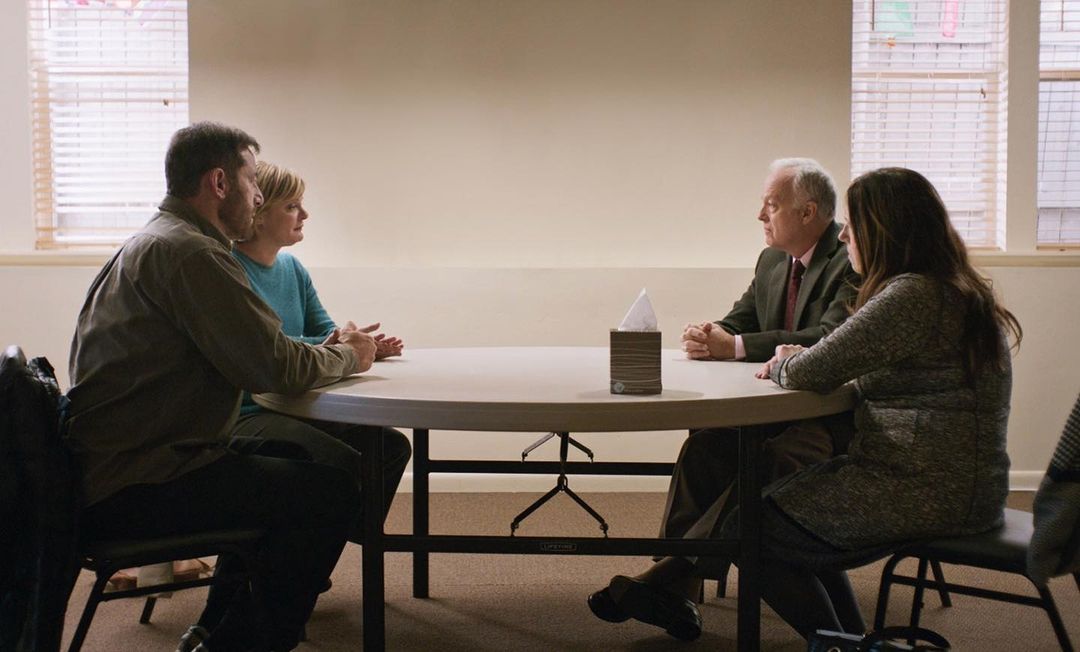
Jay and Gail (Jason Isaacs and Martha Plimpton) arrive at a local church, both uneasy about their planned meeting with Linda and Richard (Ann Dowd and Reed Birney). While the choir practices upstairs, a room has been reserved for the couples to talk.

There is a small table with four chairs. There is water. And there are tissues.

An unthinkable tragedy has connected these four people for life, and veteran actor Fran Kranz explores their journey of healing with a gently assured filmmaking debut full of shattering emotion.

Yes, you will need some of those tissues, too. But Kranz’s touch is so perfect, and the characterizations so real, that you never feel preached to, even with a large crucifix dominating the room.

The four actors are raw and touching, each exploring different levels of anger, blame, guilt and forgiveness. Writer/director Kranz gives Gail the most complete journey, and Plimpton realizes it with an award-worthy turn, while Dowd finds the subtle grace in a final confession that could have easily turned overwrought.

Mass is a spare chamber piece that makes sure nothing comes easy. You hang on every word, afraid to intrude on this intimate pain yet welcoming the invitation. With insightful writing, superb performances and unassuming direction, it’s a cathartic film that deconstructs an all too common tragedy with overdue honesty.

Bloody Well Write

The French Dispatch

by Hope Madden and George Wolf

Who’s ready for Wes Anderson’s most Wes Anderson-y movie to date?

It feels like we say that every time he releases a new film, but The French Dispatch is absolutely the inimitable auteur at his most Andersonesque.

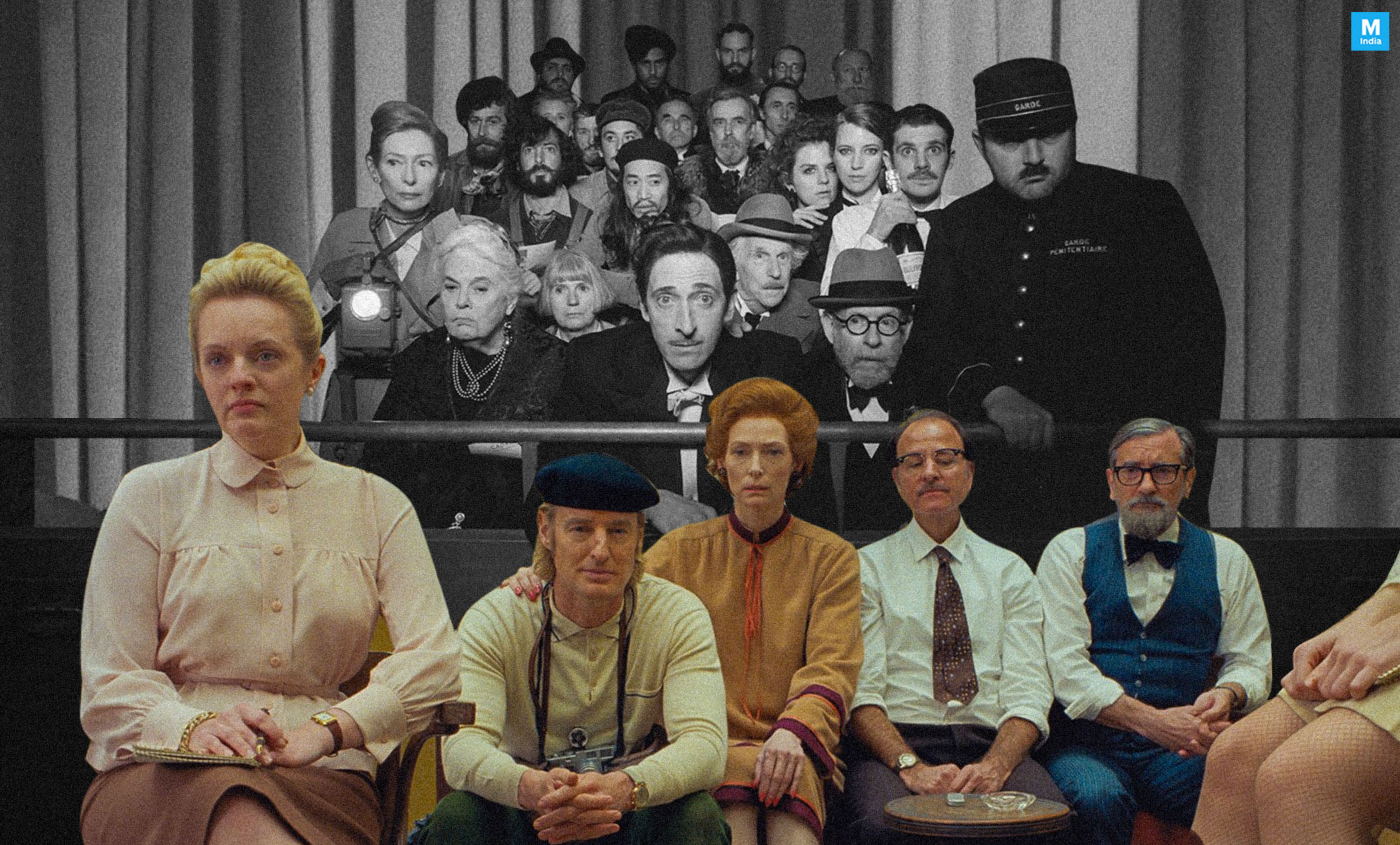
The French Dispatch is a magazine — a weekly addition to a Kansas newspaper covering the ins and outs of Ennui, France, the town where the periodical is based. The film itself is an anthology, four shorts (four of the stories published in the final edition) held together not by the one character each has in common, editor Arthur Howitzer, Jr. (Bill Murray), but by Anderson’s giddy admiration for France and The New Yorker.

Boasting everything you’ve come to expect from a Wes Anderson film — meticulous set design, vibrant color, symmetrical composition, elegance and artifice in equal measure, and a massive cast brimming with his own stock ensemble — the film is not one you might mistake for a Scorsese or a Spielberg.

Expect Anderson regulars Tilda Swinton, Mathieu Amalric, Lea Deydoux, Owen Wilson, Adrien Brody, Frances McDormand and newcomers Benicio Del Toro, Timothee Chalamet and Jeffrey Wright. And those are the big roles (although truth be told, no one is on screen all that long).

Blink and you might miss Saoirse Ronin, Willem Dafoe, Henry Winkler, Elisabeth Moss, Ed Norton, Christoph Waltz, Liev Schreiber and Jason Schwartzman.

In the segment filed under the “Taste and Smells” section, Dispatch writer Roebuck Wright (Wright) turns in a sprawling profile on master chef Nescaffier (Steve Park) that – to Howitzer’s chagrin – contains merely one quote from Nescaffier himself. As with the other pieces of the anthology, the many tangents of the piece are explained through Anjelica Huston’s narration, which can’t replace a truly emotional through line and holds the film back from resonating beyond its immaculate construction.

Anderson’s framing of symmetry and motion has never been more tightly controlled, and the film becomes a parade of wonderfully assembled visuals paired with intellectual wordplay and an appropriately spare score from Alexander Desplat.

As a tribute to a lost era of journalism and the indelible writers that drove it, Anderson delivers a fascinating and meticulous exercise boasting impeccable craftsmanship and scattershot moments of wry humor. But the layer of humanity that elevates the writer/director’s most complete films (Rushmore, Moonrise Kingdom, The Grand Budapest Hotel) never makes it from page to screen, and The French Dispatch ultimately earns more respect than feeling.

https://www.youtube.com/watch?v=z0_hwGWen-I

Downtown, Waiting For You Tonight

Last Night in Soho

by George Wolf and Hope Madden

A pair of Beats headphones is Last Night in Soho‘s first clue that you’re not where you think you are.

The sights and sounds of young Ellie’s (Thomasin McKenzie) bedroom scream 1960s London. And though that’s where and when she’d really like to be living, Ellie is a modern-day British country girl, brought up by her Grandparents after her mother’s suicide years earlier.

Ellie dreams of a career as a designer, so she’s thrilled by an acceptance letter from the London College of Fashion. But once in the big city, the shy “country mouse” has trouble adjusting to the pace and the pressures of city life.

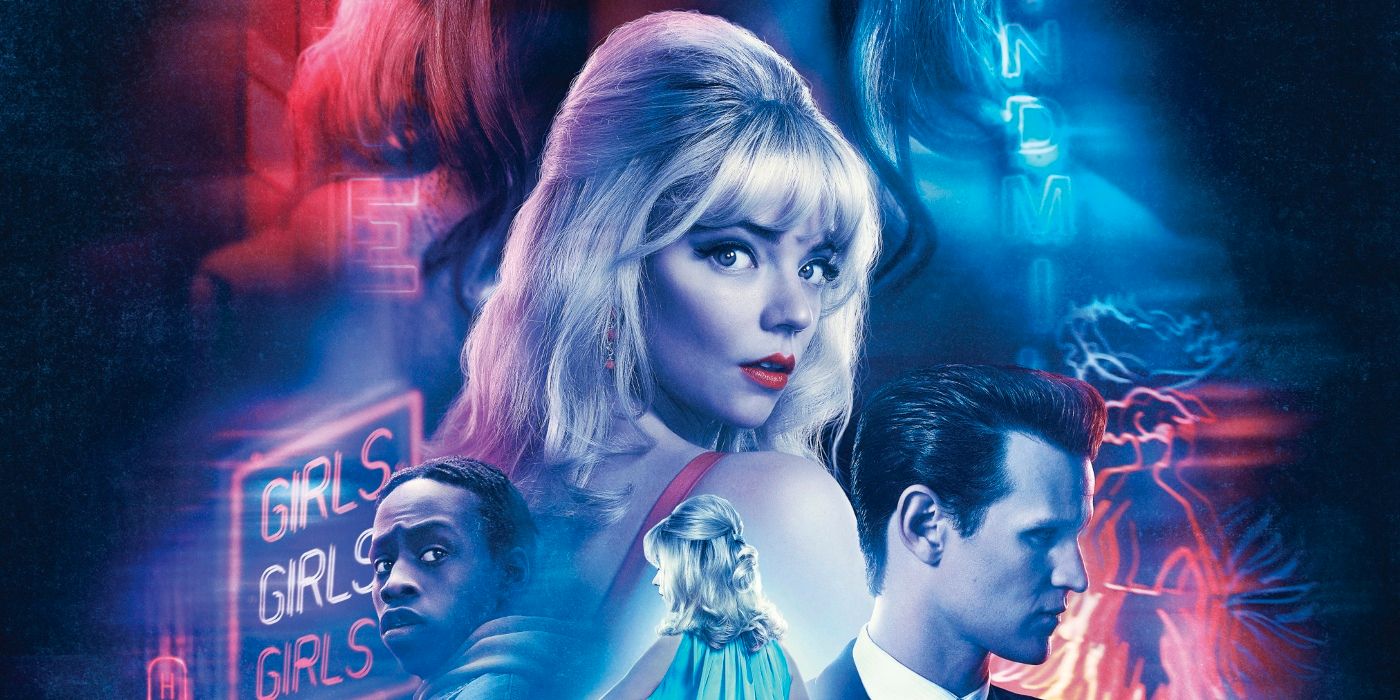
Her refuge becomes vivid dreams from the swinging 60s era she celebrates, detailed visions that put Ellie alongside Sandie (Anya Taylor-Joy), a young singer looking for fame and fortune among a sea of predatory men.

As Sandie’s trust in nightclub manager Jack (Doctor Who‘s Matt Smith) leads her down a dark and dangerous path, Ellie’s dreams turn truly terrifying. And the deeper Ellie is drawn into Sandie’s world, the more she believes a creepy old dude from her local pub (Terence Stamp) is really present-day Jack, who needs to pay for his past misdeeds with a succession of starstruck London girls.

Director and co-writer Edgar Wright slows his often frantic pace this time, trading those trademark edits for a more languid, appropriately dreamy vibe. His love of color is still front and center, and a giallo pastiche is just one in his Soho arsenal. There’s a time-hopping mystery here, sitting at the center of bloody thrills and a Black Swan-esque exploration of female trauma.

Wright hooks you early with delightful period details and – of course – some effortlessly hip throwback tunes for the soundtrack. His camera is nimble and his faming is precise, often using mirrors to exquisitely blend Ellie’s dreams with Sandie’s past.

McKenzie is doe-eyed perfection as the naive Ellie, an innocent somehow working out her own issues through the tragic past of a kindred spirit. Taylor-Joy is equally wonderful, bringing sad authenticity to Sandie’s quick descent from confident talent to broken soul. Stamp and Smith provide terrific support, eclipsed only by the bullseye casting of Diana Rigg (in her final role) as Ellie’s landlady.

Last Night in Soho is an often glorious mashup of settings and genres, and though you’ll recognize all of them, the package still carries a postmark that’s uniquely Wright’s. Maybe that’s why the resolution lands as curiously rote.

As was the case with the darling zom-rom-com Shaun of the Dead, it seems as if Wright doesn’t have the meanness to make a scary movie. He understands them, clearly, and bends their tropes to his will. Here he pulls apart Hitchcock and Argento to invert the genre’s fetishistic relationship with violence against women. Wright does this with such panache for 2/3 of the film that the final act feels abruptly tidy, too clear a reversal.

Does it spoil the Soho experience? Don’t be silly, baby! This film is a gas, but one that leaves you with with a little reminder that Wright’s most perfectly groovy film is still to come.