Tag Archives: Screen Wolf

Sheep’s Clothing

Wolf

by George Wolf

More metaphorical than Cuckoo’s Nest, more elusive than Girl, Interrupted, and with less satirical bite than The Lobster, Wolf brings a few other films to mind. But like many of her characters, writer/director Nathalie Biancheri is committed to her own different animal.

George MacKay is hypnotic as Jacob, a young man suffering from species dysphoria. He believes he is a wolf trapped in a human’s body, and when we first meet Jacob, his distraught parents are dropping him off for an extended stay at a treatment center promising a cure.

Once inside, Jacob meets others in similar circumstances: Parrot (Lola Petticrew), German Shepard (Fionn O’Shea), Duck (Senan Jennings), Horse (Elsa Fionuir) and Wildcat (Lily-Rose Depp) – all patients under the domineering thumb of The Zookeeper (Paddy Considine).

Though enemies in the wild, Wolf and Wildcat become drawn to each other within the confines of the treatment center. She’s mysterious, with privileges the other patients don’t enjoy, which comes in mighty handy when Wolf starts resisting The Zookeeper’s increasingly harsh methods.

Biancheri’s metaphor for conversion therapy certainly isn’t hard to pick out, but on a wider scale, her film speaks not only to ignorance toward the LBGTQ+ community, but to a universal push for conformity across all lanes of society. To The Zookeeper, a happy and productive life comes only when you accept what is expected of you, and while Biancheri often juggles different tones within this theme, she is able to craft several moments of powerful humanity, including a structured lesson on laughing that will just about break your heart.

MacKay (1917, The True History of the Kelly Gang) is such a wonderful actor, and it’s no surprise that he’s able to uncover Jacob’s inner conflict with a touching, understated depth. But even beyond that, his command of the role’s animal physicality is powerful and striking.

As Wolf and Wildcat grow closer, MacKay and Depp (also impressive in a comparatively underwritten role) often seemed locked in to an acting school exercise on primal instincts that left the rest of the class in the dust.

There’s more than enough here – from the narrative core to the stellar ensemble to the clinical production design and beyond – for a compelling and thought provoking parable. But while Biancheri’s ambitions are bold and worthy, her second feature (after 2019’s Nocturnal) can’t quite settle on a species.

Such commitment to a unique identity is certainly thematically consistent, but a more streamlined focus may have made the finale feel less abrupt, and brought more clarity to Wolf‘s high concept vision.

Fright Club: Best of Charles Band

Legendary indie horror filmmaker Charles Band joins Fright Club this week to talk about his new book Confessions of a Puppet Master, Marilyn Monroe, spotting talent, and VHS art. He even gives us some advice on our first feature film.

5. Trancers (1984)

Directed by Charles Band, the film follows a hard-boiled Blade Runner style mercenary into the past. Jack Death (Tim Thomerson) must stop a villain from killing off the ancestors of those who keep him from ruling the world. If they’re never born, he will be unstoppable, thanks to his army of zombielike Trancers.

The point is, Helen Hunt. To say that she makes the most of this material is an understatement. She’s adorable, charming, and she carves a memorable character out of less-than-stellar written material. The rest is fun, cheesy scifi.

4. Troll (1986)

The 1986 original Troll boasts a surprising hodgepodge of names in the ensemble: Julia Louis-Dreyfus, Michael Moriarty, June Lockhart (the mom from the Lost in Space TV show), Sonny Bono, as well as a who’s who of “Hey, I got to get out of here in time to be on that Love Boat episode” stardom. It’s a grab at the burgeoning genre Joe Dante created in 1984 with Gremlins, comic stuff about a troll king turning San Francisco apartment dwellers into plants.

The other thing that stands out in this 1986 flick is that the protagonist (and his father, come to think) is named Harry Potter. There’s a witch, too. Coincidence?

A good mash-up of humor and gore highlighted by the young Louis-Dreyfus in a small but funny role, it’s the kind of movie that epitomizes what producer Charles Band (who has a cameo) did best.

3. Rawhead Rex (1986)

Clive Barker penned this one. No, he did not like the film it turned out to be, but you might. Band produced this Irish horror that sees a wildly unhappy couple, their doomed children, and a small town on the Emerald Isle accosted by a reincarnated demon with a face that looks like raw meat.

Another memorable VHS cover made this one of those movies you immediately associate with video stores, and though the acting is hardly top quality, the creature design is hideous and fun.

2. Puppet Master (1989)

If any movie capitalized on the VHS box, it was Puppet Master. The tag Evil comes in all sizes looms large above a theatrical trunk, wedged open to show a group of hideous little puppets. And the film didn’t disappoint, because those little evildoers get themselves into all manner of bloody, slug-spewing trouble.

The point-of-view camerawork, fun cameos and inspired creature designs make up for a lot of script and acting weaknesses and the film easily carries that Charles Brand stamp: low budget, funny, campy, gory fun.

1. Re-Animator (1985)

Re-Animator boasts a good mix of comedy and horror, some highly subversive ideas, and one really outstanding villain. Band knew a movie worthy of distribution when he saw one, and this film became a surprising theatrical hit for him.

Jeffrey Combs, with his intense gaze and pout, his ability to mix comic timing with epic self-righteousness without turning to caricature, carries the film beginning to end. His Dr. Herbert West has developed a day-glo serum that reanimates dead tissue, but a minor foul-up with his experimentations – some might call it murder – sees him taking his studies to the New England medical school Miskatonic University. There he rents a room and basement laboratory from handsome med student Dan Caine (Bruce Abbott).

They’re not just evil scientists. They’re also really bad doctors.

The Impossible Dream

14 Peaks: Nothing is Impossible

by George Wolf

Nirmal “Nims” Purja likes to keep a positive outlook.

“I’m not going to die today. Maybe tomorrow, but not today.”

And while tomorrow isn’t promised to any of us, Nims tends to tempt fate more than most. A mountaineer, adventurer and former member of the Special Forces in Nepal, Nims feels most alive when he’s dreaming big and living life on the edge.

Netflix’s 14 Peaks documents his biggest dream: summiting all 14 of the world’s 8,000 meter + peaks (26, 247 feet and above) in just 7 months. To put that in proper context, the previous record for achieving the feat was 7 years. And Reinhold Messner – one of the greatest legends in all of climbing – took 16 years to ascend all 14.

So the plan that Nims dubbed “Project Possible” was ambitious, to say the least, and Messner himself sets the stakes for us. To Messner, climbing these wonders of the world “is not fun.” It is a practice filled with pain, danger and death.

That said, Nims sure seems to be enjoying himself, and part of that is helping to document his own journey.

If you come to 14 Peaks only for the breathtaking visuals, you will not be disappointed, especially if you can view it on a wide screen. Director/co-writer Torquil Jones takes us above the clouds over and over again, utilizing sparkling, absolutely thrilling footage often taken by Nims himself (including his incredible shot of a 300-person Mt. Everest traffic jam that quickly went viral).

But Jones also mines tension through the attempts at fundraising for the project (where Nims admits “I sound like a lunatic’) and getting the clearance from the Chinese government to climb in Tibet. Intimacy comes from getting to know Nims himself, who turns out to be a fascinating and endearing subject. We see his preparations and the tests that reveal him to be genetically gifted for enduring high altitude/low oxygen environments, as well as Nim’s commitment to to helping fallen comrades on the mountain, and to getting recognition for the oft-nameless Sherpas who are invaluable to visiting climbers.

And, Jones lets us meet Nims’s family, establishing a touching contrast between his apparent lack of fear and the feeling of failure that comes from being away from his ailing mother as he climbs.

14 Peaks will help you discover both a man and a mission. Separately, they’re pretty compelling. Together, they’re a force of nature.

Screening Room: House of Gucci, Encanto, Power of the Dog, Bruised & More

Nuthin’ But a G Thang

House of Gucci

by George Wolf

Just four years ago, director Ridley Scott deconstructed the Getty family’s wealth of dysfunction in the masterful All the Money in the World. House of Gucci shows he’s still got money on his mind, and his mind on the rot that can take root in such mind-altering luxury.

Based on the true events detailed in Sara Gay Forden’s bestseller, the film dissects the complete unraveling of the Gucci family dynasty, a fuse seemingly lit by the unlikely relationship between Muarizio Gucci (Adam Driver) and commoner Patrizia Reggiani (Lady Gaga).

Though the Gucci name gets Patrizia’s attention at their first introduction, Muarizio didn’t seen to have much interest in the empire shared equally by his father Rodolfo (Jeremy Irons) and uncle Aldo (Al Pacino). But once he puts a ring on it, the mix of Patrizia’s ambition and Aldo’s invitations finally bring Maurizio into the family business.

Aldo’s own son Paulo (Jared Leto in some nifty makeup) is the Fredo in this clan, and it isn’t long before Paulo is trying to form his own back door alliance with Rodolfo, and Patrizia is Lady Macbeth-ing it everywhere from Italy to New York (complete with bewitching help from Salma Hayek as psychic Pina Auriemma).

You may have noticed that this is a pretty impressive cast. True, and even with their wheel-of-accents there’s little doubt that watching them all try to out-Italian each other in this trashy mash of The Godfather, I, Tonya, Shakespeare and The Real Housewives of Milan is the film’s biggest pleasure. But Scott and screenwriters Becky Johnston and Roberto Bentivegna can never establish a consistently compelling tone (overly random soundtrack choices don’t help, either), and the two and a half hour run time takes on curious contrasts. Even as the overall narrative has moments that drag, Maurizio’s transformation to the dark side still feels too rushed and convenient.

But Gaga proves worthy of another Oscar nom, and though the film never reaches the level of crackling relevance Scott mined in his look at the Gettys, she proves a fascinating window for the legendary director’s latest foray into an iconic family’s arc of greed, suspicion, betrayal and worse.

And if your Thanksgiving ends up going completely off the rails, House of Gucci is a star-powered and entertaining way to feel a whole lot better about your own family.

Leader of the Pack

The Power of the Dog

by George Wolf

Deliver my soul from the sword; my darling from the power of the dog.

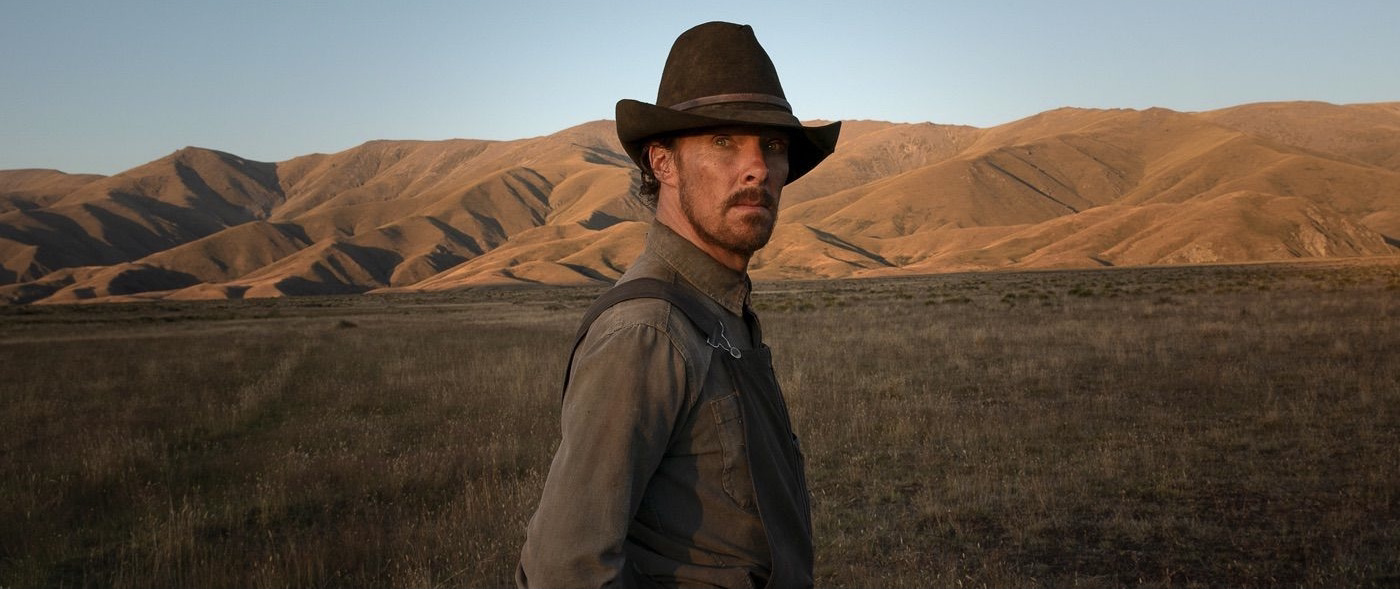
Psalm 22:20 pleads for protection from pack animals that attack the vulnerable. And in the first film in 12 years from writer/director Jane Campion, the leader of the pack is Phil Burbank (Benedict Cumberbatch).

Phil and his brother George (Jesse Plemons) are wealthy ranchers in 1925 Montana. George is soft spoken, well-dressed, polite and empathetic. Phil is none of those things.

So Phil is nothing but resentful when their family dynamic is upended by George bringing home Rose (Kirsten Dunst) and introducing her as his new wife. Though Phil doesn’t hide his suspicions of the new Mrs. Burbank, it is Rose’s son Peter (Kodi Smit-McPhee), that becomes his new favorite target.

Peter is quiet, gentle, and artsy, the perfect foil for Phil to belittle in front of his ranch hands. A master at exposing vulnerabilities, Phil doesn’t hesitate to loudly question Peter’s masculinity and his worth at the ranch – if not in the world.

So it surprises everyone – most notably the resilient, cautious Rose – when Phil seems to reverse course and take the young man under his wing. Peter needs new skills to be accepted into the ranch life, and Phil begins taking extra time to personally mentor him, passing on lessons that Phil himself learned at the feet of local legend Bronco Henry.

Even if you haven’t read the celebrated source novel by Thomas Savage, Campion’s adaptation unfolds with enough subtle poetry to convince you that it must be a wonderful read. Onscreen, the Oscar-winning Campion (The Piano) contrasts the vast majesty of the American West (kudos to cinematographer Ari Wegner) with delicate details that shift the nature of love, trust and strength within a family.

Campion gives Plemons, Dunst and Smit-McPhee the room to craft indelible characters, and they each respond with tenderly restrained excellence. But Cumberbatch is also the leader of this pack, delivering a magnificent, completely immersive performance sure to get awards season attention. Phil is unclean, both physically and spiritually, and Cumberbatch makes him a darkly compelling character, a feeling that directly feeds the unease that comes when Phil reasses his relationship with Peter.

What made Phil such an unforgiving brute? Are his new intentions truly kind, or is Peter in danger? And maybe Peter is seeing Phil more clearly than we realize.

The Power of the Dog finds its own power in what it shows but never truly tells. It’s a film that is hauntingly lyrical and masterfully assembled, with a beauty that lingers like an echo in the Montana wilderness.

Screening Room: Ghostbusters Afterlife, King Richard, Tick Tick Boom, Zeroes and Ones and More

Remember 1984? Be a Lot Zuuler If You Did

Ghostbusters: Afterlife

by George Wolf

Have you tried to branch out, only to end up with a revolt on your hands? Perhaps fan service is right for you! In other words, if 2016’s Ghostbusters was The Last Jedi, Afterlife is The Rise of Skywalker. With a side of Goonies.

That doesn’t mean it’s not a fun trip down memory lane.

Director/co-writer Jason Reitman picks up the 1984 baton from dad Ivan, crafting a new adventure that casually ignores the 1989 sequel.

Egon Spengler’s long-estranged daughter Callie (Carrie Coon) is being evicted from her Chicago apartment, so she takes daughter Phoebe (Mckenna Grace – just terrific in a completely heroic arc) and son Trevor (Finn Wolfhard) to the only thing Dad left her when he died: a dilapidated farmhouse in small-town Oklahoma.

Ah, but this farm holds secrets, and it isn’t long before science whiz Phoebe is getting familiar with proton packs and Trevor is checking to see if the ECTO-1’s engine might actually turn over.

Good timing, too, because Phoebe’s teacher Mr. Grooberson (Paul Rudd) has been noticing some serious seismic activity in town that he cannot explain. Turns out the Sexiest Teacher Alive is also a big fan of the original Ghostbusters, and he clues in Phoebe and her conspiracy-happy friend “Podcast” (a charming Logan Kim) about Grandpa’s heroics back in the day.

Once Trevor’s crush Lucky (Celeste O’Connor from Freaky) makes it a quartet, it’s up to the kids to figure out the real reason Egon abandoned the GB’s all those years ago, what’s brewing under the farmhouse, and just how to wrangle a stage 5 apparition.

This is a film so steeped in the nostalgia for its source material that you cannot imagine it existing on its own. Is that a direct result of the savagery that greeted the female (and for what it’s worth, underrated) reboot or a natural reaction by a son following in his father’s footsteps?

Either way, the benchmark callbacks come early and often, with Reitman frequently holding the shot an extra beat just to make sure you pick up what he left for you. And while the Bill Murray zany-ness is replaced by Paul Rudd sarcasm and wisecracking from a cast of wonderful young actors, there is humor here, enough to justify the “comedy” label (which honestly, the original trailer had me questioning).

But is it fun? Oh yeah, with some slick CGI and high points that are zuuler than the other side of the pillow.

You’ll want to stay through the credits for two extra scenes, but there’s a good chance you’ll still be thinking about all that Reitman has in store during that finale. It’s plenty – maybe even enough for your eyes to stay as pufty as a certain marshmallow man.

Louder Than Words

tick, tick…BOOM!

by George Wolf

What’s an aspiring writer to do when his first major work is bypassed for the eager anticipation about what he’ll do next?

He takes his agent’s advice to “move on to the next one. And write what you know.”

Broadway trailblazer Jonathan Larson – Tony and Pulitzer Prize-winning writer and composer of Rent – agonized for 8 years over Superbia, a futuristic musical that never earned a full production. When Larson did move on to the next one, it became tick, tick…BOOM!, his autobiographical story of a composer named Jon whose final days as a twentysomething bring feelings of rejection and inadequacy.

ttBOOM! made it to off-Broadway in 1990, with revivals beginning in 2001,15 years after both the phenomenal success of Rent and Larson’s tragic death from an aortic aneurysm at the age of 35.

Now, director Lin-Manuel Miranda brings Larson’s story of struggling artistry to the screen with an infectious exuberance and undying respect for those committed to the roar of the greasepaint and the smell of the crowd.

Andrew Garfield stars as Jon, who waits tables in a New York diner, works on his musical and worries about how much other people have accomplished before turning 30 (“Sondheim wrote West Side Story at 27!”)

While Jon struggles to find enough money to keep the lights on, his longtime girlfriend Susan (Alexandra Shipp) mulls a tempting job offer in the Berkshires, and his best friend Michael (Robin de Jesus) decides it’s finally time to give up the Broadway dream and get a real 9 to 5 gig.

While everyone – including Sondheim himself! (a terrific Bradley Whitford) – tells him Superbia needs one more big song in the second act, Jon rebuffs any need for a life “backup plan,” even as his tenuous relationship status and a co-worker’s HIV diagnosis remind him of each precious tick of the clock.

Miranda and screenwriter Steven Levenson (Dear Evan Hanson, Fosse/Verdon) effectively layer the musical segments with real-life inspirations and one-man show beginnings that build to workshop performances and Broadway fantasies. From the birthday defiance of “30/90” to the pleading interplay between Garfield, Shipp and Vanessa Hudgens (as Susan’s stage persona) on “Come to Your Senses,” Miranda’s staging is lively and stylish, peppered by plenty of Easter eggs and cameos saluting years of musical greats (including Chita Rivera, Bernadette Peters, Bebe Neuwirth and two of Hamiton‘s Schuyler sisters in the show-stopping “Sunday” alone).

Garfield delivers an electric, committed performance, singing well and absolutely selling the manic, no-sleep-til-curtain-time tunnel vision that Larson clings to instead of admitting that there might be any other way to live.

And as a tribute to this life, the creative process and one man who personified both, tick, tick…BOOM! is a runaway hit. But in the process, it forgoes a sense of intimacy that might have brought us closer to Larson himself. That’s a trade-off the film ultimately seems comfortable with. Miranda, Garfield and company are going big here, and end up reaching the balcony with crowd-pleasing panache.

A Pair of Aces

King Richard

by George Wolf

You know how many parents are convinced their kid is destined for athletic greatness? Quite a few, and that’s just in your neighborhood.

So how – and why – did Richard Williams’s predictions for daughters Venus and Serena come so incredulously true?

That’s a compelling story, one that King Richard tells with enough restraint and humanity to sidestep most sports movie cliches and find layers of true inspiration.

The Williams family – Richard (Will Smith), wife Brandy (Aunjanue Ellis), Venus (Saniyya Sidney), Serena (Demi Singleton), and three additional daughters from Brandi’s previous relationship – weren’t exactly welcomed into the L.A. tennis community when Richard put his master plan in motion.

Tennis was a sport for the rich and the pale. They were a Black family from Compton, often dodging gang activity for a chance to practice on run down community courts. Richard was dogged in his search for a coach, first landing Paul Cohen (Tony Goldwyn) before Venus earned the entire family an invite to Rick Macci’s (Jon Bernthal, playing delightfully against type) exclusive training center in Florida.

In his debut screenplay, writer Zach Baylin follows a fairly standard biopic formula, but manages to weave in necessary layers of nuance. While we see that the doubt Richard encounters about his daughters’ future greatness is understandable, the added barrier of racism is understood without an overplaying the hand. In fact, Baylin’s script (or the editing bay) occasionally downplays obstacles that the Williams’s surely encountered all too often, seemingly mindful of the film’s 138 minute running time.

But director Reinaldo Marcus Green (Monsters and Men) has a good feel for pacing, with well-placed bits of tension, humor and impressively-staged tennis sequences that never let the film feel sluggish.

And while you can hardly be blamed for detecting the whiff of “Will Smith Oscar bait” in the air, don’t be surprised if he lands his third nomination. The film is an inspirational crowd pleaser that steers refreshingly clear of pandering, and Smith responds with a performance that leans into the colorful personality of Richard Williams while checking his penchant for heavy-handed mugging.

It helps that Smith is constantly elevated by Sidney and Singleton, the two wonderful young actresses playing Venus and Serena, and the always amazing Ellis (Lovecraft Country, Ray, The Help). Though Brandi’s character is often strong and silent, there are fine moments that prove just how vital she is to the Williams plan. And by the time Brandi is dressing down Richard as just another man that won’t admit he’s scared, it’s clear how vital Ellis is to the film’s resonance.

Though Venus and Serena get Executive Producer credits, the film doesn’t ignore some problematic areas in Richard’s personality, and Smith makes the mix of crazy-like-a-fox determination, gentle humor and hidden scars one that -like Smith himself – is hard to dislike.

As the older sister and the first to find success on the tour, it is Venus that gets much of the film’s focus. But Richard’s prediction for Serena (“the best ever”) serves as a natural pivot to send us home with a reminder about how lucky we’ve been to witness their greatness.

And as the best sports movies always do, King Richard scores often enough to land its message past the fault lines. The Williams plan may have been heavy on tennis, but it’s anchored by life lessons that not only benefitted all of Richard and Brandi’s children, but would undoubtedly be an asset in any arena.

So what made Richard’s vision so much clearer than every other parent in the stands?

Just some unending determination and confident stubbornness. Plus two daughters with once-in-a-generation gifts, the passionate drive to excel, and the desire to make the road a little smoother for the next young phenom that isn’t white or wealthy. That helps, too.