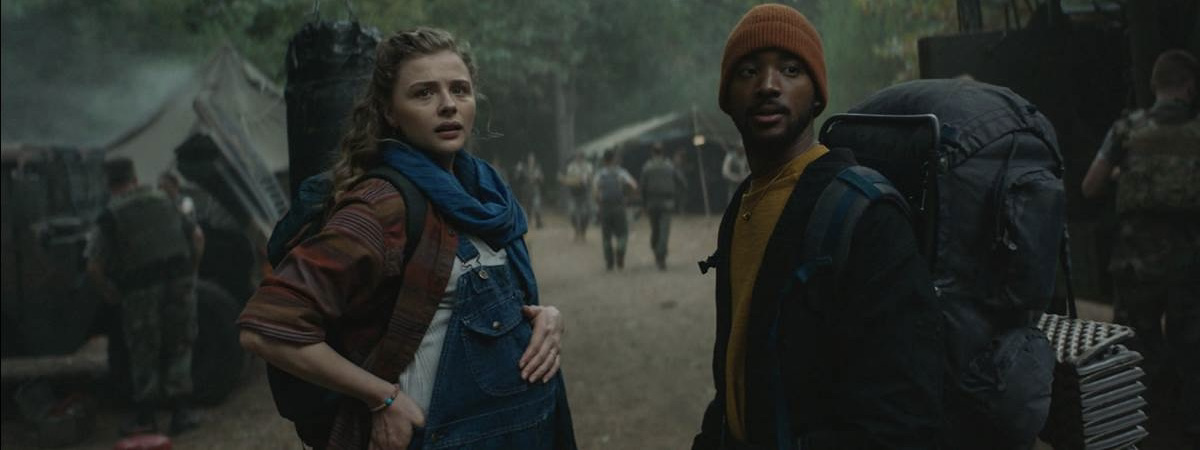
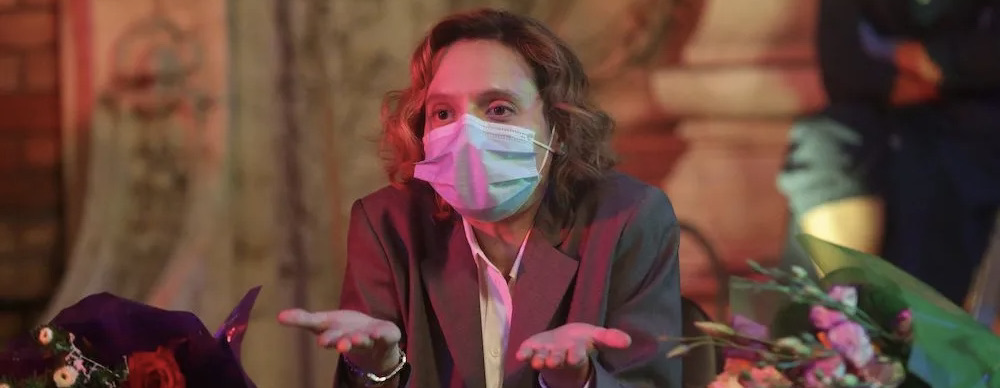
You think you’ve got a good handle on Hulu’s Mother/Android pretty quickly. Take some zombie basics that we’ve seen from Romero through The Walking Dead, replace the undead with some renegade robots, and away we go.
But while there is plenty here that’s familiar, give writer/director Mattson Tomlin credit for finding sly ways to surprise you, and ultimately subvert your expectations with an nifty metaphorical finale.
Chloë Grace Moretz stars as Georgia aka “G,” a young woman struggling to enjoy a party after the shock of finding out she’s pregnant. Her boyfriend Sam (Algee Smith) is saying all the right things, but she’s unsure about their future.
As A.I. servants dutifully attend to the party guests, G and a friend head to the bathroom for a private chat. But in an instant, a painful sonic blast drops the humans to their knees while rebooting the bots to a default “kill” setting.
Fast forward nine months, and Tomlin’s got a standard setup (survivors running toward a rumored safe haven while being pursued by a relentless menace) with the always convenient “savior” trump card (very pregnant woman).
Tomlin’s storytelling appears workmanlike but uninspired, often rehashing ideas and set pieces you’ll remember from Terminator, The Descent, A Quiet Place, and even The Empire Strikes Back. But when G and Sam get separated, and G meets up with a fellow survivor (Raúl Castillo) who once helped create the Android serving class, Tomlin finally gets around to rewarding all who stick it out for Act 3.
With foreshadowing that is effectively subtle and an affecting turn from Moretz that crafts G as both tortured and courageous, the film reveals its first twist in finely organic fashion while keeping you distracted from the true motive ahead. Once revealed, it arrives as a plea for global empathy that lands with some unexpected emotional pull.
The best science fiction tales succeed when their glimpses of the future help us reassess the present. Mother/Android gets there, eventually, with a measured pace that seems much more confident when the party’s over.
If you think the word “porn” in the title is just for effect, the first few minutes of Bad Luck Banging or Loony Porn will be a hardcore surprise.
We first meet Romanian married couple Emi (Katia Pascariu) and Eugen (Stefan Steel) as they’re ignoring knocks on the bedroom door to record their spirited relations on home video. They’re consenting adults, so fair enough.
Well, maybe not so fair enough. Emi is a teacher at a prestigious school in Bucharest and when her frisky business footage winds up online, some parents loudly cry foul. But Emi is defiant, and as she’s subjected to a public hearing about her “sins,” writer/director Radu Jude makes it the centerpiece of a wildly audacious, funny and free-flowing diatribe against hypocrisy and the rise of meanness.
Jude divides the narrative into chapters, and doesn’t waste much time in Part 1 worrying about how the tape became public in the first place. Emi’s plight is more a situation than a story and for Jude, the point is the aftermath.
But before Emi faces her critics, Jude breaks away for “a short dictionary of anecdotes,” filling his second act with a series of definitions, archival reels, and meme-worthy examples of everything from racism to explicit oral sex. Subtle, it isn’t, which Jude readily acknowledges by following the word “metaphor” with a child’s game that essentially grabs toy fish from a barrel.
And by the time Emi’s hearing plays out as an Act 3 “sitcom” with multiple endings going off various rails, you’ll be amazed by how much this Romanian import reminds you of any number of heated arguments here at home. Subjects such as FOX News and George Soros are thrown around while the matter at hand quickly devolves into wild conspiracy theories and whataboutism where “the more idiotic the opinion, the more important it is.”
Jude has some strong views of his own, about modern life and how cinema should best reflect it. He doesn’t hold much back in Bad Luck Bangingor Loony Porn, a film that leans into its absurdity for a boldly extreme and worthwhile declaration.
This season has inspired so much horror. You have classics like Black Christmas, foreign masterpieces like Inside, Calvaire and Sheitan, and tons upon tons of guilty pleasures. Today we narrow the focus to the best of the Santas – those fur coated, black booted terrors that can really ruin a festive noel. Here are our favorites.
5. Christmas Evil (1980)
Lewis Jackson’s yarn about a damaged boy growing up to be a murderous Santa may sound like every third holiday horror to come out in the 80s, but because it was one of the first to do it, it doesn’t fit the predictable pattern. More importantly, Brandon Maggart’s sympathetic performance elevates this film above schlock horror like Silent Night, Deadly Night (and its sequels) to something considerably better.
Yes, childhood memories of Dad and Mom getting cozy under the mistletoe while Dad’s dressed as Father Christmas have had an ill effect on Harry. His zealotry concerning the season, the ribbing he takes from people he knows, and the naughtiness he sees all around him finally push him over the edge. Predictable enough, and with a low budget that allows for very few jingle bells and whistles. Still, Jackson’s script goes unexpected places and Maggart delivers more than standard fare as the marauding Claus.
4. A Christmas Horror Stor ( 2015)
A trio of Canadian directors – Steve Hoban, Brett Sullivan, and Grant Harvey – pull together a series of holiday shorts with this one. Held together by Dangerous Dan (William Shatner), the small-town radio announcer who’s pulling a double shift this Christmas Eve, the tales vary wickedly from three teens trapped in their own wrong-headed Nativity, to a family who accidentally brought home a violent changeling with their pilfered Christmas tree, to a dysfunctional family stalked by Krampus, to Santa himself, besieged by zombie elves.
Yes, there is a second film out this holiday season with Krampus in it. You know what? This one’s better – in fact, it’s almost patterned after Krampus director John Dougherty’s cult favorite Trick r’ Treat and it offers more laughs and more scares.
Plus Shatner! He’s adorably jolly in the broadcast booth, particularly as the evening progresses and his nog to liquor ratio slowly changes. This is a cleverly written film, well-acted and sometimes creepy as hell. Merry f’ing Christmas!
3. Deadly Games (1989)
That mullet! That house! Rene Manzor’s 1989 holiday horror predates Home Alone by one year, but both films have the same idea in mind. What if an incredibly rich family leaves a kid to defend himself against home invaders on Christmas Eve?
Except in this case, rich doesn’t begin to cover it and the home invader isn’t a couple of suburban thugs, it’s a psychotic dressed as Santa. Patrick Floersheim brings layers of tragic man-chid mental instability to the role, and that gives the film a lot of depth. Alain Lalanne is adorable as the mulleted boy who believes in Santa, and Louis Decreux – as his go-along-with-anything grandpa – is equally precious.
The editing leaves a lot to be desired, so the action sequences and montages lack propulsion. But the set decoration is amazing. This is a fun one.
2. Saint (Sint) (2010)
What is every child’s immediate reaction upon first meeting Santa? Terror. Now imagine a mash-up between Santa, a pirate, and an old-school Catholic bishop. How scary is that?
Well, that’s basically what the Dutch have to live with, as their Sinterklaas, along with his helper Black Peter, sails in yearly to deliver toys and bag naughty children to kidnap to Spain. I’m not making this up. This truly is their Christmas fairy tale. So, really, how hard was it for writer/director Dick Maas to mine his native holiday traditions for a horror flick?
Allegorical of the generations-old abuse against children quieted by the Catholic Church, Saint manages to hit a few nerves without losing its focus on simple, gory storytelling.
https://www.youtube.com/watch?v=2Mih1tR5kTw
1.Rare Exports (2010)
It’s not just the Dutch with a sketchy relationship with Santa. That same year Saint was released, the Fins put out an even better Christmas treat, one that sees Santa as a bloodthirsty giant imprisoned in Korvatunturi mountains centuries ago.
Some quick-thinking reindeer farmers living in the land of the original Santa Claus are able to separate naughty from nice and make good use of Santa’s helpers. There are outstanding shots of wonderment, brilliantly subverted by director Jalmari Helander, with much aid from his chubby-cheeked lead, a wonderful Onni Tommila.
Rare Exports is an incredibly well-put-together film. Yes, the story is original and the acting truly is wonderful, but the cinematography, sound design, art direction and editing are top-notch.
Step right up, folks, and witness a master of the macabre! See Guillermo Del Toro twist the familiar tale of ambition run amuck! Gasp at the lurid, gorgeous, vulgar world of Nightmare Alley!
Bradley Cooper stars as Stan, good lookin’ kid on the skids taken in by Clem (Willem Dafoe, creepy as ever) to carny for a traveling show. Stan picks up some tricks from mentalist Zeena (Toni Collette) and her partner Pete (David Strathairn), then lures pretty Molly (Rooney Mara) to the big city to set up their own mind-reading racket.
Things are going swell, too, until Stan gets mixed up with psychiatrist Lillith (Cate Blanchett) whose patient list includes some high rollers with large bank accounts ripe for the picking.
That’s already one hell of an ensemble, but wait there’s more! Richard Jenkins, Ron Perlman, Mary Steenburgen and Tim Blake Nelson all add immeasurably to the sketchy world Stan orbits.
What Del Toro brings to the tale, besides a breathtaking cast and an elegantly gruesome aesthetic, is his gift for humanizing the unseemly. Edmund Goulding’s 1947 adaptation of William Lindsay Gresham’s novel (a solid slice of noir with Tyrone Power in the lead) dulled the edges of any seediness. Even Tod Browning’s Freaks – maligned as it was – found the unsettling carny life mainly wholesome.
Cinematographer Dan Lausten and composer Nathan Johnson create a delicious playground for Del Toro’s carnival to call home, one where even the most likable members of the family turn a blind eye to something genuinely sickening and cruel happening in their midst. The filmmaker plumbs that underlying horror, complicating Stan’s arc and allowing the film’s climax to leave a more lasting mark.
As usual, Del Toro wears his feelings proudly on his sleeve, with unmistakable but organic foreshadowing that ups the ante on the stakes involved. Anchored by another sterling performance from Cooper, Stan’s journey rises to biblical proportions. An actor whose gifts are often deceptively subtle, Cooper makes sure Stan’s pride always arrives with a layer of charming sympathy, even as it blinds him to the pitfalls ahead.
And Blanchett – shocker – is gloriously vampy. She swims elegantly through the sea of noir-ish light and framing that Del Toro bathes her in, as Lillith casts a spell that renders Stan’s helplessness a fait accompli.
Nearly every aspect of the screenplay (co-written by Del Toro and Kim Morgan) creates a richer level of storytelling than the ’47 original. The dialog is more sharply insightful, the finale more dangerously tense and the characters – especially Mara’s stronger-willed Molly – more fully developed. All contribute greatly toward the film rebounding from a slightly sluggish first act to render the two and a half hour running time unconcerning.
For Del Toro fans, the most surprising aspect of Nightmare Alley might be the lack of hopeful wonder that has driven most of his films. As the title suggests, this is a trip to the dark corners of the soul, where hope is in damn short supply.
So as much as this looks like a Del Toro film, it feels like a flex just from taking his vision to the sordid part of town. But what a vision it turns out to be – one of the year’s best and one of his best.
Don’t believe me? See it with your own eyes, step right up!
This week on Twitter, director Edgar Wright reminded anyone doubting Steven Spielberg’s way around a musical number to revisit “Anything Goes” from Indiana Jones and the Temple of Doom. Okay, point taken, but West Side Story? That’s a big step up.
It is, and he makes it in stride.
Right from the opening minutes, Spielberg’s camera seamlessly ebbs and flows along with the street-roaming Sharks and Jets. Their threats of violence are more palpable this time, as Riff (Mike Faist, an award-worthy standout) and his New York boys want to settle their turf war with Bernardo (David Alvarez) and the Puerto Ricans once and for all.
At the dance that night, the first meeting between tragic lovers Tony (Ansel Elgort) and Maria (Rachel Zegler, a newcomer with an amazing voice who beat out thousands in open auditions) now happens under the gym bleachers, the first in a series of subtle and not-so-subtle updates that Spielberg and screenwriter Tony Kushner (Lincoln, Munich, Angels in America) employ to deepen the narrative impact.
“Dear Officer Krupke” seems more organic in the station house, “America” (led by an irresistible Ariana DeBose as Anita) is given more room to move across the west side city streets, while a department store full of mannequins depicting white suburban dreams proves an ironically joyful setting for Maria and her co-workers’ buoyant reading of “I Feel Pretty.”
And from one musical set-piece to the next, Spielberg’s touch is smoothy precise, starting wide to capture the breadth of Justin Peck’s homage to Jerome Robbins’s iconic choreography, zooming in for intimacy, and then above the dancers and rumblers for gorgeous aerials set with pristine light and shadow. Stellar efforts from cinematographer Janusz Kaminski and production designer Adam Stockhausen turn the everyday drab of hanging laundry and fabric remnants into an elegant playground for Spielberg’s camera eye.
In short, it looks freaking fantastic.
It sounds pretty great, too, even beyond the genius of Bernstein’s melodies and Sondheim’s lyrics. Because Spielberg couples his appropriate and welcome diversity of cast with a complete lack of subtitles, rightly putting the opposing cultures on equal narrative footing, and bringing more depth to the cries of “speak English!”
And as the gang fight turns deadly, all of the stakes are embraced more tightly. The offhand bigotry of Lt. Schrank (Corey Stoll, terrific as always) is more casually cruel, the identity conflict of Anybodys (Iris Menas) feels more defined, while Anita’s fateful visit to Doc’s store – now run by Valentina (expect another Oscar nod for the incredible Rita Moreno) – plainly calls it like it always was.
Then, as his (almost) parting shot, Spielberg unveils his grandest revision, a move nearly as bold and risky as the one Richard Attenborough face-planted with in 1985’s A Chorus Line.
By altering the context of one of the most emotional songs, Attenborough showed he didn’t know, or didn’t care, about what the show was trying to say. Spielberg, though, gently adds a perspective that makes Tony and Maria’s quest soar with a renewed, more universal vitality.
Just like most everything else in this West Side Story.
“Do you have a story to tell? Do you have something to say? Then spit it out!”
That’s solid advice from a veteran director to an aspiring filmmaker named Fabietto (Filippo Scotti, completely charming). But in The Hand of God, it sounds more like writer/director Paolo Sorrentino reaching out to his teenaged self.
Fabi’s life in 1980s Naples is filled with a steady array of colorful family members, neighbors, friends and passersby. They laugh, they argue, pull pranks on each other and cheer fanatically for Diego Maradona in the 1986 “Hand of God” World Cup. Fabi soaks it all in happily, his headphones constantly draped around his neck while his wandering teen eyes fall often on his voluptuous Aunt Patrizia (Luisa Ranieri).
Though there’s much drama in and around the household (including a sister who never leaves the bathroom), there’s never a shortage of love or laughter, which makes the tragedy that comes in the film’s second act land that much harder.
This is clearly a very personal project for Sorrentino (Il Divo, The Great Beauty). And it often feels like a series of rather testosterone-heavy vignettes pulled from his memory, strung together with the majesty of architecture and landscapes that he continues to showcase so beautifully.
Though the overall tapestry flirts with self-indulgence before the young Fabi finds his calling, Sorrentino has crafted a warm and often wonderful homage to the people, places, and twists of fate that make us what we are.
Since Adam McKay shifted into “political” comedy with The Big Short and Vice, it’s become most convenient to label him a satirist. But Don’t Look Up, his latest as writer/director, is more proof that pure satire isn’t quite McKay’s forte.
Not that his work isn’t funny, or astute, or politically charged – it’s all of that. But what McKay does best is his own special blend of outrage, farce, skit-based comedy and yes, moments of satire. The best of the modern satirists – Armando Iannucci, for example – are almost always commenting on one thing by talking about something else. McKay, though, fires slings and arrows that are so often on-the-nose they toe the line between shedding light and making it.
Climate change and disinformation are in McKay’s sights this time, and it isn’t hard to imagine Don’t Look Up being inspired by some exasperated bit of conversation.
“What if some giant, cataclysmic comet were heading straight for Earth? Would that get somebody’s attention?”
Astronomy PhD candidate Kate Dibiasky (Jennifer Lawrence) discovers just such a comet, and along with her anxiety-prone professor Randall Mindy (Leonardo DiCaprio), calculates it will destroy the Earth in precisely 6 months and 14 days.
Sounding the alarm proves harder than they realize.
President Orlean (Meryl Streep, a bit too SNL) and her chief of staff son (Jonah Hill, in pitch perfect Don, Jr. mode) want to “sit tight and assess,” so Kate and Randall take their message to the people. But after an appearance on vapidly positive morning cable news chat, Kate is vilified for her severe bangs and shrill warnings while Randall gets tagged as a PILF and starts getting cozy with TV host Brie Evantee (Cate Blanchett, glorious).
Meanwhile, weird tech CEO Peter Isherwell (Mark Rylance) determines the comet could really be a good thing! It’s composition could be worth billions, so he pushes the administration toward a Star Wars-worthy plan to break it up in pieces small enough to harvest, as uber-angry broadcaster Dan Pawketty (Michael Chiklis) instead wants to focus on the real problem of topless senior caregivers.
What’s left for the little people to do except take sides?
With the clock ticking and the comet now visible overhead, the anti-science crowd preaches “don’t look up” while pop diva Riley Bina (Ariana Grande) belts out a soaring (and surprisingly tuneful) plea to “get your head out of year ass, just look up, turn off that shitbox news.”
The fertile ground of current pandemic disinformation makes McKay’s mash of Dr. Strangelove and Mars Attacks! seem a little extra urgent. And while Don’t Look Up never matches the satirical majesty of Kubrick, McKay is able to nicely cop the disinformation industry’s circular strategy of reframing evidence against it as evidence supporting it. He knows how his film’s worldview will be attacked, but also how some calculated ridiculousness can be a pre-emptive strike.
But is McKay’s film going to change anyone’s mind? Seriously? No, no it’s not, but he knows that, too.
Hey, if you think our current situation is too dire to have fun with, that’s understandable. But if you can relate to Grande singing, “Celebrate or cry or pray, whatever it takes,” then this is funny stuff. Just don’t mistake the laughs in Don’t Look Up – and there are plenty of them, including a priceless running gag about expensive snacks – for a lack of outrage or conviction. McKay and one of the year’s best ensembles find space for all three.
Sit tight for mid-credits and after-credits stingers, too. And trust me on the snacks thing.
After Agnes, some disgruntled horror fans may end up checking the credits for the stamp of A24. Don’t get me wrong, I consistently love A24’s brand of spooky, but I can’t deny that some of their trailers write a visceral check that the films themselves don’t always cash.
So don’t come to Agnes for some standard demonic possession fare, cause it ain’t here. But what director/co-writer Mickey Reece has in store ends up being bold and weird, funny and captivating, and in the end, even sweetly hopeful.
Opening with a convent birthday gathering that gets out of hand fast, Reece then introduces us to Father Frank Donaghue (Ben Hall), whose knowledge of the rite of exorcism earns him a meeting with the Bishop. Back at Santa Teresa, young sister Agnes (Hayley McFarland) seems to have the Devil in her. Church elders want Father Frank and his neophyte Benjamin (Jake Horowitz) to cast it out.
Things don’t go well, leading Father Frank to call in reinforcement from the renegade Father Black (Chris Browning), a cocky, chain-smoking padre who puts Agnes through a hilarious bit of exorcising straight out of Airplane!
If you saw Reece’s Climate of the Hunter, you won’t be surprised by the layer of dark humor running through his latest. But what might surprise you is realizing that what happens to Agnes isn’t really the point here. The point is what happens to Mary (Molly C. Quinn).
Sister Mary committed to the convent after a tragic loss in her life but abandons the order following those clumsy attempts at driving the Devil from her friend. From there, Reece also leaves the convent behind to focus on Mary’s attempts at re-adjusting to “normal” life.
The film’s tone takes a major shift, establishing a clear contrast between nunnery silliness and real-world struggles that reinforces an early observation made by Father Frank.
Belief in evil is on the rise, so where is the increased belief in Godly things?
Quinn (Mrs. Grady in Doctor Sleep) invites both curiosity and sympathy as Mary wanders wide-eyed and often expressionless, looking for a reason to believe. She proves a wonderful vessel for both Mary’s crisis of faith and Reece’s unconventional methods for raising worthwhile questions.
Follow its admittedly jarring path and Agnes just might make you find comfort in your next ham sandwich.