Tag Archives: Screen Wolf

Hooray for Hollywood

Babylon

by George Wolf

Well first, let’s talk about the elephant in the room.

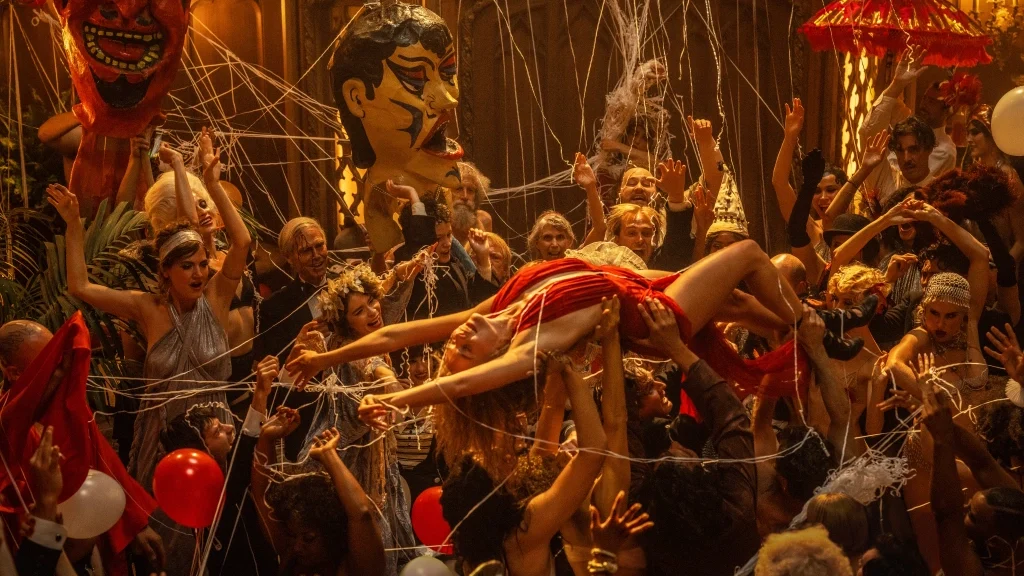
There’s an elephant in the room. A real one, delivered to a film exec’s insane party by the ambitious young Manuel (Diego Calva). Wannabe starlet Nellie LaRoy (Margot Robbie) has also found a way past security, and as writer/director Damien Chazelle’s extended take winds us through some impressively staged decadence, Babylon begins its frantically entertaining chronicle of intertwining fates in early Hollywood.

Manuel and Nellie meet that night, each launching a dream to break into the movie business, where Jack Conrad (Brad Pitt) reigns as the king of silent films. While Manual begins climbing the ladder on the production side and Nellie’s persona as the screen’s new “wild child” makes her an in-demand sensation, the jaded Jack pines for innovation and laments that “the most magical place in the world” has become stagnant.

And before anyone can warn Jack about being careful with his wishes, “motherfucking sound!” comes to the movies.

Chazelle’s vision here is more ambitious than ever. Babylon is always big and often wild, swinging in all directions as it proposes a drug-fueled toast to the movies, the people that make them, and to the often cruel way those people are used and abused.

It’s a mess of humor, spectacle and emotion, with all angles fighting the urge to run off on their own. There’s surprising humanity in the arc of Sidney (Jovan Adepo), an African American horn player whose success in musicals can’t protect his dignity, but curious excess revealed in the strange cameo from Tobey Maguire as a scary guy with an alligator in his dungeon, as well as a sudden montage of classic movie moments that pops up in act three.

All three leads are terrific. Pitt exudes charisma and hard-earned wisdom as a man forced to admit bitter truths, Calva provides the film’s sympathetic heart and Robbie is flat-out ferocious, delivering a constant challenge for you to just try and look somewhere else. The always welcome Jean Smart is also a treat, stealing scenes with an award-worthy supporting turn as an influential gossip columnist.

Babylon isn’t just big, it’s large, with a three-hour-plus running time that Chazelle packs with enough pizazz and amazing craftsmanship to keep it constantly compelling. This film may be many things, but boring is not one of them.

Like Jack, the silent film star struggling in talkies, Chazelle knows the movie business may be at an important crossroads. But both men still believe in the power of movie magic, and that despite shame from the past and uncertainty in the future, Hollywood deserves the big loud hooray that explodes from Babylon.

Carry That Weight

The Whale

by George Wolf

By now you’ve probably heard plenty of accolades about Brendan Fraser’s “comeback” performance in Darren Aronofsky’s The Whale. It’s all true.

And that emotional standing O at Cannes? He deserved it.

It’s a stupendous performance, in a movie that’s always struggling to keep up with him.

Fraser, under some pretty impressive prosthetics and makeup, is Charlie, who pretends his laptop camera is broken so his online writing students won’t glimpse his obesity.

Charlie spends almost every moment of the day in his Idaho apartment, resisting face-to-face contact with anyone except his caring nurse Liz (Hong Chau, Oscar-worthy herself). Liz and Charlie share a connection to the traumatic event that sent Charlie down the path of eating himself to death, and Liz’s frustrated admonishments about Charlie’s habits seem to have little effect.

What does stir Charlie from his destructive routine are two surprise visits. One is from Thomas (Ty Simpkins), a missionary from New Life Ministries. The other is from Ellie (Sadie Sink from Stranger Things and Fear Street), Charlie’s angry, spiteful and estranged teenage daughter.

Screenwriter Samuel D. Hunter adapts his own play, and while Aronofsky offsets the chamber piece roots with sufficient cinematic vision, not all of Hunter’s themes make an equally successful transition.

The Moby Dick metaphor is frequent and obvious, but woven as it is through the lens of a composition teacher, settles in as an organic and relatable device. Similarly, Hunter’s points about the often judgmental and unforgiving nature of religious groups aren’t exactly profound, but their character-driven delivery is welcome.

But the heavily dramatic relationship between Charlie and Ellie – and later, Ellie’s mother (Samantha Morton) – suffers from the stage-to-screen edit. Emotions often escalate from two to ten in an instant, straining authenticity and pushing the manipulative wave that threatens to consume the film.

It doesn’t help that Aronofsky’s camera flirts with fetishizing Charlie’s shame, though Fraser’s tenderness is always the film’s saving grace. His every expression is etched with a soul-deep pain that’s finally being pierced by a last hope for redemption. Far from the maudlin exercise this character could have been, Fraser’s is an endlessly compassionate performance that will not let you give up on Charlie, or the film.

And you may very well see the resolution coming by the second act, but regardless, don’t forget to have the tissues handy for the third. Every time The Whale needs saving, fear not, Fraser will keep it afloat.

Screening Room: Avatar: The Way of Water, If These Walls Could Sing, Utama, Onoda, High Heat

Come and Sea

Avatar: The Way of Water

by George Wolf

Week after week, really good films telling solid, compelling stories have been debuting in movie theaters and sinking like streaming-bound stones. What’s it gonna take for movies not named Top Gun to move people off the couch and back into the cinema?

James Cameron thinks the answer is to provide a sensory experience you just cannot get anywhere else. And on that front, Avatar: The Way of Water is a resounding success. See it on the IMAX screen, with the 3D glasses on your face, the thumping Dolby in your earholes and the high frame rate injected in your eyeballs and you’ll be transported to a theme park-like world of technical wonder.

The storytelling, on the other hand, is all wet.

Since we last left Jake Sully (Sam Worthington) over ten years ago, he and Neytiri (Zoe Saldana) have formed a happy family among the forest people of Pandora.

Their peace is shattered by a new invasion from the sky people, with a Na’vi clone of Colonel Quaritch (Stephen Lang) out to settle an old score. To keep the Na’vi from the fight, Jake and family flee to a village of the water people (including Kate Winslet and CCH Pounder) that’s led by Tonowari (Cliff Curtis).

But just as the forest family is bonding with their new water world, Quaritch and his troops come calling for a showdown.

You know who realized they shouldn’t run, that war would follow them and put others at risk? Neytiri did, the latest in a long line of smart women in James Cameron movies who no one listens to. That’s not the only throwback to Cameron films you may notice. Aliens, The Abyss, and Titanic are all over this film, and why not? Everybody else steals from them, why not Cameron?

The problem is not that he borrows from himself, but that he repeats himself. Scenes replay the same beats again and again. There’s so much wasted narrative space in this three-plus-hour film, and yet voiceover narration explains what that space could have been used to show.

And that’s the ironic weakness that consistently keeps Avatar 2 from resonating beyond surface-level amazement. Cameron (who also co-wrote the script) shows us so many wonderful delights, but precious few of them advance any investment in character, theme or narrative. It’s not that the ideals hitching a ride with the wizardry aren’t worthy, it’s just that they’re slapped together with so much obviousness and redundancy.

As the long-promised follow-up to the all-time box office champ, and carrying a budget in the hundreds of millions with several more sequels in the pipeline, there was already plenty riding on Cameron’s new vision. But a big return for TWOW could fast track a bittersweet bargain. The days of a rising tide at the multiplex lifting all boats seem to be fading fast, and one more huge wave might not leave room for anything on the big screen that’s less than pure spectacle.

Truth and Consequences

Bardo: False Chronicle of a Handful of Truths

by Hope Madden and George Wolf

The latest from Oscar-winning director Alejandro G. Iñárritu may be uneven and frustrating at times, but do not be tardy. The first three minutes of the film, while showcasing only light, shadow and landscape, unveil the most mesmerizing opening we’ve seen in a damn long time.

And good news, it’s just an appetizer for the two and a half hours of visual delights that follow.

Crafting self-indulgence into sometimes breathtaking art, Iñárritu turns his characteristic cinematic style inward for the sorta-semi-autobiographical Bardo: False Chronicle of a Handful of Truths.

“If you don’t know how to fool around, you don’t deserve to be taken seriously.” So says the Iñárritu stand-in, Silverio Game (Daniel Giménez-Cacho, terrific), a journalist-turned-documentarian who yearns to show emotion rather than fact.  

Silverio’s about to be presented with a big award in L.A., which only triggers a series of introspections that attempt to reconcile an imposter complex with a need for recognition, global fame with his Mexican identity, and a general distaste for the state of his profession.

Visually, Iñárritu pulls no punches, reminding us of the fluid wonder that characterized his films from Babel to Biutiful to Birdman and The Revenant. Here those tactics conjure a dreamlike reality, simultaneously playful and bitter, ideal to reflect the reminiscences and wallowing preoccupations of an artist brooding on his accomplishments and shortcomings.

The narrative is bloated and rambling, which Silverio freely acknowledges as Iñárritu (who also co-wrote the script with frequent collaborator Nicolás Giacobone) continues indulging his self-indulgence. Giménez-Cacho finds sympathy in Silverio’s identity crisis, and it’s fascinating to feel both the push and pull of Iñárritu‘s approach. We embrace it for the shot-making but resist it while the artist tries to tell us where his artistry takes root.

The metaphors, symbolism and contradictions pile on, along with enough jaw-dropping framing to make you realize this could be in an unknown language with zero subtitles and it would still be worth seeing.

“Life is a brief series of senseless events,” Silverio tells us. Maybe. And though Bardo may not be brief and its sense can be confounding, there’s no denying its beauty.

Indulge yourself. See it on the big screen.

Fry Hard

High Heat

by George Wolf

Ana (Olga Kurylenko) is a high-end chef with a particular set of skills leftover from her past, so High Heat also offers a slice of Taken. But honestly, Die Hard is just easier to have pun with.

Okay, I’m done.

And there is some shoot-’em-up fun to be had with this film, you just have to wait for Ana’s old KGB partner to join the party.

But first, it’s opening night at the restaurant Ana co-owns with her husband (not her Dad) Ray (Don Johnson). It’s a pretty successful debut, until some mafia goons show up to burn the place down and settle Ray’s massive debt with an insurance payoff.

And before you can 86 the sea bass, Ana’s dispatching the hitmen so quickly that big boss Dom (Dallas Page) has to call in some mercenary backup.

But Ana has a friend to call, too. It’s Mimi (Kaitlin Doubleday), who’s still mad about being ghosted when Ana (or is it “Anya?”) left the Russian spy game. Mimi might be more inclined to hurt Ana than help her, but she’s on her way, along with her getting-in-touch-with-his-feeling hubby Tom (Chris Diamantopoulos) and their teenage twins (Bianca and Chiara D’Ambrosio).

And it’s that nuttily contrasting family dynamic that delivers on the promise of director Zach Golden’s breezy, stylishly throwback opening. Doubleday and Diamantopoulos supply the chemistry here, and along with Jackie Long as a mob masseuse in way over his head, give the film the jolt it needs to avoid being completely forgettable.

Even so, James Pedersen’s debut screenplay feels slight. High Heat struggles to find enough padding for even an 84 minute running time, and will probably fade from the menu pretty quickly. But when it does, maybe Golden and Pedersen will recognize the potential in their side dishes.

Re-tool this project into some cable-ready episodes starring Mimi, Tom and the twins, and you might really get something cooking.

https://www.youtube.com/watch?v=vEEmIy77PYM

Fright Club: Best John Carpenter Horror Movies

Our Christmas gift to ourselves this year is a walk through the career of horror master John Carpenter. Yes, we did want to include Assault on Precinct 13 and Escape from New York. But we stayed strong, because we still had to sift through so many genre classics to determine which five would rise to the top.

5. The Fog (1980)

Stevie Wayne (director John Carpenter favorite, at least while they were married, Adrienne Barbeau) does an air shift from a studio in that old lighthouse out on Antonio Bay. But the fog rolling in off the bay is just too thick tonight. It’s as if she’s entirely alone in the world. Can anyone hear her? Will someone go check on her young son?

While a lot does not work in Carpenter’s pirate leper ghost story (leper pirates?!), his first theatrical release after Halloween does hit some of the right marks. The vulnerability of a radio DJ – totally isolated while simultaneously exposed – has never been more palpable than in this film.

Jamie Lee Curtis (another Carpenter favorite) joins her mom Janet Leigh and B-horror legend Tom Atkins to fill out the pool of leper pirate bait. While the film is hardly one of Carpenter’s best, his knack for framing, his voyeuristic camera, and his ability to generate scares with a meager budget are on full display.

4. They Live (1988)

More SciFi and action than horror, still John Carpenter’s vision of an elite class using tech to mollify and control the population of the US was eerily prescient. And horrifying.

At the time, though, it was just plain entertaining in a way that married Carpenter’s own iconic Escape from New York vibe with the SciFi horror miniseries of the day, V.

But mainly, it’s Rowdy Roddy Piper chewing bubble gum, and the 6 1/2 minute fight scene between Piper and undeniable badass Keith David that make this film as fun to watch today as it was when it was released.

3. In the Mouth of Madness (1994)

Sutter Cane may be awfully close to Stephen King, but John Carpenter’s cosmic horror is even more preoccupied by Lovecraft. The great Sam Neill leads a fun cast in a tale of madness as created by the written world.

What if those horror novels you read became reality? What if that sketchy writer with the maybe-too-vivid imagination was not just got to his own page, but god for real? This movie tackles that ripe premise while ladling love for both of the horror novelists who made New England the creepiest section of America.

2. Halloween (1978)

No film is more responsible for the explosion of teen slashers than John Carpenter’s babysitter butchering classic.

From the creepy opening piano notes to the disappearing body ending, this low budget surprise changed everything. Carpenter develops anxiety like nobody else, and plants it right in a wholesome Midwestern neighborhood. You don’t have to go camping or take a road trip or do anything at all – the boogeyman is right there at home.

Michael Myers – that hulking, unstoppable, blank menace – is scary. Pair that with the down-to-earth charm of lead Jamie Lee Curtis, who brought a little class and talent to the genre, and add the bellowing melodrama of horror veteran Donald Pleasance, and you’ve hit all the important notes. Just add John Carpenter’s spare score to ratchet up the anxiety. Perfect.

https://www.youtube.com/watch?v=rKvxAvkJkac

1.  The Thing (1982)

John Carpenter’s remake of the 1951 SciFi flick The Thing from Another World concocts a thoroughly spectacular tale of icy isolation, contamination, and mutation.

A beard-tastic cast portrays a team of scientists on expedition in the Arctic who take in a dog. The dog is not a dog, though. Not really. And soon, in an isolated wasteland with barely enough interior room to hold all the facial hair, folks are getting jumpy because there’s no knowing who’s not really himself anymore.

This is an amped up body snatcher movie benefitting from some of Carpenter’s most cinema-fluent and crafty direction: wide shots when we need to see the vastness of the unruly wilds; tight shots to remind us of the close quarters with parasitic death inside.

The story remains taut, beginning to end, and there’s rarely any telling just who is and who is not infected by the last reel. You’re as baffled and confined as the scientists.

On With the Show

Empire of Light

by Hope Madden and George Wolf

There are certain actors – you know the ones – who seem to put out a film every year right at awards season. The people who somehow never have a straight-to-VOD indie or a summer romp, just yearly Oscar vehicles.

For at least one of these people it is a welcome return visit, year after year.

Hello, Olivia Colman.

Seriously, is there anyone who does not love her? Any filmmaker, any actor, any moviegoer? Her performances are shamelessly, giddily human, authentic to a chilling degree. Her force of nature in Sam Mendes’s ode to the cinema, Empire of Light, is no different.

Mendes’s 2019 epic 1917 showed him a master of pacing, understated emotion and visceral thrill. Back in 2012, he made an almost Shakespearean Bond film, easily the strongest in the entire franchise with Skyfall. For Empire of Light, the filmmaker ­– who also wrote the script ­ – returns to the more sentimental content of his earlier career.

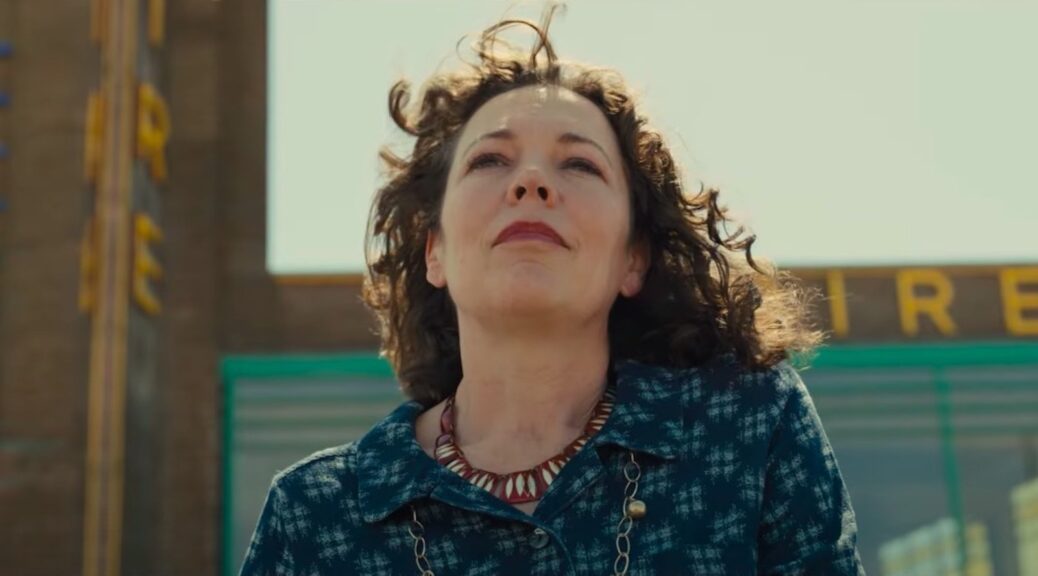
Colman is Hilary, the troubled, often melancholy manager of a coastal England cinema in the very early 1980s. A wonderful supporting cast – from the kindly Toby Jones to the prickly Colin Firth, the tender Michael Ward to surprising Tom Brooke ­– surrounds Colman with sparring partners up to the challenge.

Mendes’s tale, at its heart, revels not just in the magic of the movies, but of the movie house itself. Most of the patrons seem to come to the screenings alone, looking to escape the loneliness, the mundane, or the rising tide of extremism right outside those glass doors.

And though the crowds aren’t as large as they once were, the theater still has something to offer – as does Hilary. Her dutiful existence is shaken by the younger Stephen (Ward, outstanding) joining the crew, and together they start exploring some forgotten areas of the once majestic cinema.

The metaphor isn’t subtle, and the film’s tone is overtly nostalgic, but because Colman’s character is anything but typical, Mendes punctures his own sentimentality before it can become overbearing. Gorgeous framing from the great Roger Deakins doesn’t hurt, bathing it all in a grand beauty that reinforces what power can come from that certain beam of light.

The pandemic has drawn out no shortage of filmmakers who’ve been understandably inspired to assess their life’s work. With Empire of Light, Mendes is wearing his heart on his cupholder, imploring us to value what the theater has to offer.

This film can offer the exquisite Colman and a stellar ensemble, and that’s just enough. Through them, Mendes finds impact in his sweetness, rising above the moments that seem engineered for an ad that runs right before the one telling you not to talk or text.

Cruel Yule

Violent Night

by George Wolf

Maybe director Tommy Wirkola was kicking back with writers Pat Casey and John Miller one night, arguing about whether Die Hard was a Christmas movie. A few cold pops later, they’d swapped out John McClane for Santa Claus, added Die Hard 2 and Home Alone to the guest list, and Violent Night was born.

David Harbour is a hoot as a hard drinking Claus who’s not very jolly anymore. Kids are all greedy “little shits” these days, nobody believes, and maybe it’s time to hang up the sleigh.

But when he’s dropping off toys for bona fide nice list member Trudy Lightstone (Leah Brady, a cutie) on Christmas Eve, Santa becomes the monkey in the wrench.

Trudy’s grandmother Gertrude (Beverly D’Angelo, nice to see you) is obscenely wealthy, so the evil “Scrooge” (John Leguizamo) and his gang have invaded the festivities at the Lightstone compound. They want the millions hiding in the family vault, but they hadn’t planned on a red-suited party crasher and a little kid’s booby traps.

Santa’s not barefoot, but Wirkola (the Dead Snow films) and the Casey/Miller team (The Sonic the Hedgehog films) are not shy about re-creating sequences straight from the Die Hards and Home Alone. They do at least name check both films, and once the season’s beatings begin the film takes on a self-aware, R-rated vibe that’s plenty of ornery fun.

But what Trudy wants most this year is for her Mom (Alexis Louder, so good in Copshop) and Dad (Alex Hassell, The Tragedy of Macbeth) to get back together, and Violent Night can’t help undercutting its subversive streak with a nice, safe glass of milk and cookies.

The film backs away just when it could have been decking the halls with some raunchy hilarity, and that’s disappointing. This Santa likes his snacks with some “pre-War” brandy, and his hammers of the sledge variety. And when Violent Night is reaching into that brand new blood-soaked bag, it’s boughs of whiplash smiles.

Screening Room: Violent Night, Eternal Daughter, The Inspection, A Wounded Fawn, Salvatore & More