Tag Archives: movies

Tale of Two Mothers

The Wrath

by Hope Madden

This week, Shudder premieres a Korean ghost story, and there is always reason to be optimistic about a Korean ghost story.

Young-sun Yoo’s The Wrath revisits Hyeok-su Lee’s somewhat obscure 1986 period thriller, Woman’s Wail. A young woman of humble birth is brought to the ancient home of a high ranking Korean official, ostensibly to marry his youngest son. In truth, she’s been brought here to trick a vengeful spirit.

What unspools is a historically set spectral tale of family dysfunction, classism, sexism, and women who hate other women—or, in a single label, the horrors of patriarchy. All of which has been done before, and better. (Please see Jee-woon Kim’s masterpiece A Tale of two Sisters. Seriously, please see it.) But The Wrath is a very pretty film that delivers a fairy tale quality and solid performances.

The Wrath is more of a spook show than Two Sisters, with lots of wraiths and jump scares, lots of blood spitting and black ooze spitting and blood spatter and arterial spray, plus gorgeous costumes and a well-designed and well-used set.

The film drops us into a story in progress. A young girl (Na-eun Son) traveling to the secluded property is intercepted by a well to do son returning home. His step-mother (Young Hee Seo, wonderful), who appears to be head of the household, offers a chilly reception to both travelers.

Soon the girl is pregnant, the son is dead, and there’s something suspicious out in the storage shed.

Yoo’s film works best when he doesn’t try to explain too much. Heavy-handed flashbacks to the events that led to the family’s curse feel perfunctory and uninspired, while the hinted at spookiness generates more atmosphere.

For a period film, Yoo contains the environment to create something both believable and economical, the image of a very pretty yet desolate trap.

Na-eun Son, whose role offers the most layers, particularly impresses, but the whole cast embraces these somewhat slightly written characters. Each performer draws on period appropriate attitudes and, more importantly, finds a way to generate chemistry with the others trapped in the same confined quarters.

If you’ve seen much from Korea’s deep cinematic closetful of wronged-women-turned-vengeful-spirit options, there are few real surprises to be found in The Wrath. It’s a capably made film that wastes little time, boasts strong performances and offers familiar but creepy fun.


So Much Drama in the NYC

After the Wedding

by Brandon Thomas

The adult drama has all but vanished from American multiplexes. Sure, the occasional Oscar-baity title sneaks through around the holidays, but those mom-pleasing, bring your hanky dramas of yesteryear are pretty much a thing of the past. 

Despite the presence of A+ talent and an overall intriguing story, After the Wedding isn’t the shot in the arm the genre was looking for.

A retread of Susanne Bier’s 2006 Oscar nominee for foreign language film, After the Wedding follows Isabel (Michelle Williams), who is living a fulfilling, productive life running a small orphanage in Kolkata.

After an extremely generous donation offer is made to the orphanage, Isabel travels to New York to meet Theresa (Julianne Moore), the benefactor. Unexpectedly invited to the wedding of Theresa’s daughter, Isabel finds herself face-to-face with a man from her past (Billy Crudup), and a 20-year-old decision that will shake her to her core.

After the Wedding trips up right out of the gate by leaning so heavily into melodrama. Instead of an emotionally weighty dramatic piece anchored by an amazing cast, this film latches on to genre cliches and doesn’t let go.

Deep, dark family secrets? Check. Mystery illness? Check. Sneaky motivations? Double check. The movie is one evil twin away from being a bad episode of General Hospital.

Did I mention the amount of teary-eyed yelling? There is plenty.

The only real sense of urgency comes from the movie being in a rush to get to that next dramatic reveal. The characters, and likewise the audience, are never given the chance to dwell on what just happened. The experience feels cheap and anticlimactic.

Moore and Williams continue to show that they’re national treasures, but even they can only do so much with the material afforded them. The two actresses share multiple scenes together, but any emotional weight is often deflated by the scattershot script—co-written by director Bart Freundlich (Moore’s husband)— jumping from one unearned character beat to the next. These people feel like a blended mix of every character seen in indie dramas instead of being fully-formed individuals.

Despite reeling in a Who’s Who of a cast, After the Wedding never becomes anything more than a Who Cares.


Identity Theft

Luce

by Hope Madden

It’s appropriate that so much of the film Luce follows the titular character’s preparation for a debate. The film itself seems to beg for audience argument.

Luce is a bit of an American miracle. A boy soldier rescued from Eritrea at 7 by a wealthy white couple, he’s reinvented himself by the beginning of his senior year in high school, becoming the golden child: debate team captain, cross country captain, speech team captain and eventual valedictorian.

A sternly supportive history teacher (Octavia Spencer) raises questions, her goal to help ensure Luce understands that he “cannot fuck up.” It becomes the catalyst for a tense, borderline terrifying exploration of identity, preconceptions, race, refined society and who gets to take credit for what.

Kelvin Harrison Jr., so wounded and wonderful in It Comes at Night, holds all these puzzle pieces together as the enigma at the center of a mystery. His turn as the charismatic central figure in this highly polite and scholarly debate is fascinating, haunting and, in rare flashes, painfully vulnerable.

His manufactured persona, his carefully studied sincerity, emphasize an image that’s too good to be true. But Harrison Jr. brings so many additional layers—manifestations of survival techniques, an ability to read his environment and predict everyone’s behavior—that give his character needed complexity. Luce is not just a black student everyone can be proud of, or some wonderful example of how our system can work.

And that’s what makes him scary. So when he executes a history assignment too well—writing from the perspective of a historical figure who suggested violence as a moral response to colonialism—he freaks out a teacher (Spencer, wonderfully righteousness) who’d rather he embrace his favored status so she can bask in the glow.

Naomi Watts and Tim Roth play Luce’s socially conscious parents, and the pairing makes it tough to keep your mind from recalling Funny Games, Michael Haneke’s grim picture of affluent familial catastrophe. Whether intentional or not, the casting adds an underlying sense of urgent dread—as does Geoff Barrow and Ben Salisbury’s discordant score.

Watts is particularly strong, and the who-knows-what dance she does with Roth as their son plays one off the other adds a queasying rhythm to the mystery.

Julius Onah’s direction sometimes betrays the stagebound nature of the source material. (J.C. Lee adapts his own much lauded play.) Too much is revealed through lengthy monologues and there’s little smooth flow from scene to scene.

But his film teems with provocation and his cast more than meets that challenge. Harrison Jr. in particular is a revelation, an image of a thing that doesn’t exist but is so true you’ll never know if anything else is really there.

I Don’t Want to Go Out—Week of August 26

What do you want to watch this week? A musical biopic that finally manages to get past the standard “behind the music” approach is our pick because it’s a charming bit of fun. And because everything else that comes out this week kind of reeks.

Rocketman

Godzilla: King of the Monsters (DVD)

The Secret Life of Pets 2 (DVD)

I Do or Die

Ready or Not

by Hope Madden

Fucking rich people.

I don’t know about you, but this is a sentiment I can get behind.

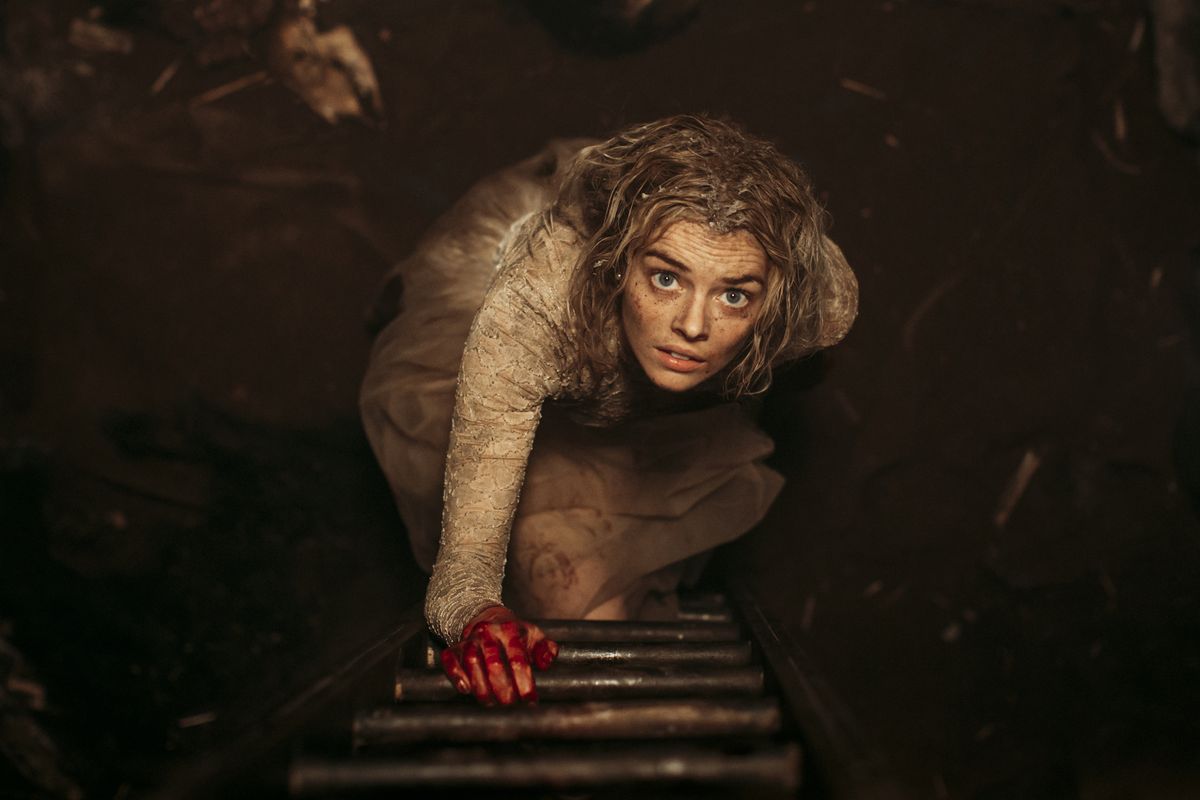
Grace (Samara Weaving, Mayhem) doesn’t know whether her soon-to-be in-laws are eccentric or they just plain hate her. Or maybe they are as evil as her groom Alex (Mark O’Brien) and his drunk-but-amiable brother Daniel (Adam Brody) say they are.

The brothers are just kidding, right?

Directors Matt Bettinelli-Olpin and Tyler Gillett (Devil’s Due—meh) invite you to join the happy couple as they plunge into a world where the wealthiest among us would rather commit murder than do without what none of them worked very hard to earn.

At midnight on Grace and Alex’s wedding night, everyone assembles in the Le Domas family game room: Mom and Dad (Andie MacDowell and Henry Czerny), Aunt Helene (Nicky Guardagni), other siblings and in-laws. It’s a ritual. Just one quick game of hide and seek. What could go wrong?

The inky black comedy plays like a game of Clue gone mad with arterial spray, the film’s comic moments coinciding most often with the accidental slaughter of servants.

The filmmakers take advantage of Weaving’s grit and comic timing, skipping from one bloody comic set up to the next. The plot and the chase move quickly enough to keep you from dwelling on the shorthand character development, the errant plot hole and the occasional convenience. It’s fun, it’s funny, and it’s a bloody mess.

And yet, the film feels safe, as if it is loath to truly represent the wealthy as people who’d leech the life from those beneath them (a la Get Out). Although, like Jordan Peele’s horror classic, Ready or Not introduces a deeply disturbing song almost as chilling as Get Out’s “Run Rabbit, Run.”

Weaving is proving herself to be reliably badass in the genre, her central performance elevated by the sometimes inspired work of the ensemble. MacDowell, in particular, seems to be enjoying herself immensely.

Even with the clever turns and cheeky performances, the film lacks substance. I mean, yes, I can indulge my secret belief that the rich are evil all day long. So, thank you Ready or Not for playing that card. In the end, though, the film’s just a slight and entertaining (and gory) way to waste your time.

Thump, Thump, Draaaag

Scary Stories to Tell in the Dark

by Hope Madden

Was there a story you heard as a kid that scared you sleepless? Mine was Bloody Fingers, the tale of a mangled man who dragged his carcass toward you. You could hear him coming: thump, thump, draaaaag. My neighbor used to sneak up behind me muttering those terrifying words.

Writer Alvin Schwartz knew how to work a kid’s nerves even better than my neighbor. Inspired by campfire tales and urban legends, he spun yarns for maximum kid fright, then paired them—and this is the important part—with the inspired line drawings by Stephen Gammell. The result, Scary Stories to Tell in the Dark, became the go-to for kids who like to be scared and schools who like to ban books.

Director André Øvredal (TrollHunter, The Autopsy of Jane Doe) and co-writer Guillermo del Toro both know something about tingling the spine. Together with a team of writers—some veterans of horror, some of family films—they’ve created an affectionate and scary ode to the old series of books.

Set in Mill Town, Pennsylvania around Halloween, 1968—trees are turning, Nixon is about to be elected, Night of the Living Dead is showing at the drive in—Scary Stories to Tell in the Dark follows three wholesome high school outcasts and a handsome out-of-towner. On the run from the Vietnam-bound, letter-jacket wearing bully, they hide in the old, abandoned Bellows place. The town says the house is haunted.

Sounds a little cliched, right? The kind of story you’ve heard over and over, but that’s exactly the point. To begin to tell Schwartz’s tales—all of them pulled from the collective unconscious, all of them drawing on those same old stories that were new to us as kids—Øvredal sets a familiar and appropriate stage.

His framing device works well enough for a while. Stella (Zoe Margaret Colletti), who hopes to be a writer herself, swipes creepy old child killer Sarah Bellows’s book of stories, but when she gets them home, new stories write themselves in the blank pages and, one by one, the kids in Mill Town go missing.

This is what PG-13 horror should look like. Yes, like most of the genre films engineered for youngsters, Scary Stories rehashes tropes familiar to adult viewers, but Øvredal’s clear fondness for the terrifying source material, especially the illustrations, gives the film the primal, almost grotesque innocence of a childhood nightmare.

The film’s tone is spot-on, performances solid and the set design and practical effects glorious. This is more than an anthology of shorts. It’s a cohesive whole that contains a handful of Schwartz’s nightmares, but the whole is not as great as the sum of its parts. Too heavy with clichés in the framing device, the film loses steam as it rolls into its third act.

An analogy of lost innocence, nostalgic without becoming too sentimental, this is old school scary, as unapologetically unoriginal as its source material and almost as effective.

https://www.youtube.com/watch?v=yf0JwXkXs0c