Tag Archives: movie reviews

Hollywood in the Closet

Scotty and the Secret History of Hollywood

by Brandon Thomas

Hollywood has always been about vanity, secrets and fiction. It’s an industry filled with people who make a living pretending to be someone else. Scotty and the Secret History of Hollywood tells a tale of men and women who led fictional personal lives too.

After his service in World War II, Midwest transplant Scotty Bowers lands a job at a busy gas station on Hollywood Blvd. It’s here where Scotty meets his first secretly gay Hollywood celebrity: Walter Pidgeon (Forbidden Planet). This meeting—and subsequent sexual encounter—opens Bowers’s eyes to a large community of closeted gay actors and actresses. He wants to give them a place to meet one another…and to make a buck in the process. Through his likability and ability to find sexy, young men and women, Bowers cements his place among the Hollywood elite.

During his tenure as “Pimp to the Stars,” Bowers finds himself setting up rendezvous for more than just famous actors and directors, as business tycoons also knew of his reputation. Bowers also attracts the attention of British royalty. Through it all, Scotty Bowers claims to only want one thing: to make people happy.

Scotty and the Secret History of Hollywood could’ve easily turned into one big tell-all (and there are some revelations that I didn’t know), but director Matt Tyrnauer wisely keeps the focus squarely on Bowers himself. Scotty Bowers isn’t the flamboyant center of attention you’d expect. Instead, we’re shown a 95-year-old hoarder who spends most of his free time cruising the streets looking for junk he can load into one of his many homes.

The film wisely doesn’t rely on talking heads to fill in the gaps of the story. There’s the occasional interview with a Hollywood player like Peter Bart (former editor of Variety) or one of Scotty’s “boys,” but the bulk of the movie is composed of Scotty’s interactions with these people. Tyrnauer strives to show how Bowers continues to make connections with people, even though gay culture in Hollywood has become mainstream.

Scotty and the Secret History of Hollywood is a celebration of sexual freedom. The feel-good nature of the film is a byproduct of who Bowers is as a person. He claims he only wanted to make people happy—and he meant it.

Survivorman

Alpha

by Christie Robb

Visually stunning, but emotionally monotonous, Alpha seems like a planetarium show scaled up to feature length, given a sketch of a plot to justify shots of a human staring up at the firmament and trudging through various majestic terrains.

Set 20,000 years ago in Europe, a hesitant young man, Keda (Kodi Smit-McPhee), sets out on his first hunt with the goal of making his dad proud. But when one of the beasts fights back, Keda takes a header off a cliff and is left for dead.

What follows is his somewhat preposterous journey to get back to his settlement.

It’s a little bit Cast Away, a little bit 127 Hours, with wide, sweeping shots of Keda’s journey that are very reminiscent of iconic scenes from the Lord of the Rings movies.

And there are glorious vistas to enjoy, any number of which would make a fantastic desktop picture for your work computer. But to properly enjoy it, you kind of have to turn the thinking part of your brain off. (At least a little bit. You still have to be able to read the subtitles to parse the Neanderthal language being spoken.)

For example, the hunting ground presumably is close enough to Keda’s settlement to allow the hunters to bring back the spoils before they, you know…spoil. And yet, on the way home, Keda climbs a few mountains, treks through a dessert, passes a swamp, skirts a volcano, and grows a delightfully thin adolescent mustache. For quite a time, he is doing this on a recently dislocated ankle and while carrying a full grown wolf.

Cause, oh yeah, he’s got a wolf buddy who he basically domesticates on the way home.

Billed as the heart of the story, Keda’s relationship with Alpha the wolf supposedly “shines a light on the origins of man’s best friend.” Given this, I was expecting the relationship to have a certain amount of complexity and emotional give and take. But this falls flat. The domestication happens so easily that it seems inevitable. I’ve adopted dogs that were harder to train. And despite the harsh environment and the occasional menacing hyenas, at no point do Keda and Alpha seem in any ultimate danger.

All, in all, Alpha would probably be best viewed if you’re jonesing for an easy visual escape or if you want inspiration for upgrading your winter wardrobe. Cause those suspiciously healthy-looking folks eking out their existence during an Ice Age have some beautifully made clothes. Now, I’m off to search for a pair of leather pants online.


Money Changes Everything

Crazy Rich Asians

by Rachel Willis

When Nick Young (Henry Golding) asks Rachel Chu (Constance Wu) to be his date to a wedding in Singapore, she expects a nice, but simple trip to her boyfriend’s home. She’ll meet his family, and they’ll take an important step forward in their relationship. It’s what Rachel doesn’t know – that Nick is a member of a family known as “Singapore royalty” – that sets up the comedy and drama of Crazy Rich Asians.

Director Jon M. Chu’s adaptation of Kevin Kwan’s novel is an entertaining look at the culture clash that happens when Rachel attempts to fit in with Nick’s family.

“Crazy rich” is an accurate descriptor for Nick’s family and their class of friends. Born and raised in New York by a single, working mother, Rachel isn’t prepared for the ostentatious wealth that surrounds Nick’s family. Though proud of her life and career – economics professor at NYU – she realizes that she’s seen as an unremarkable outsider in this world of wealth and power, especially by Nick’s mother, Eleanor (Michelle Yeoh – outstanding as always). Efforts to sabotage their relationship begin before Rachel even leaves New York.

There are a lot of characters in the movie. Too many, really, and the important side characters suffer a lack of necessary development. A second narrative thread involving Nick’s cousin, Astrid (Gemma Chan), and her husband, Michael (Pierre Png), never hits the stride it deserves.

But there’s a lot to like about the movie. Nick and Rachel rank among the best – and most realistic – rom-com couples. As Rachel’s friend Peik Lin, Awkwafina provides the film’s funniest moments. She’s also the dose of reality Rachel needs when dealing with the crazy rich. And despite being 120 minutes, long for a romantic comedy, the film never drags.

Crazy Rich Asians is the kind of fluffy, fun, romantic summer fare that will leave almost everyone satisfied.

God Save McQueen

McQueen

by Rachel Willis

The life of iconic fashion designer Alexander McQueen is the subject of director Ian Bonhôte’s documentary, McQueen. With writer and co-director Peter Ettedgui, Bonhôte creates a richly artistic dive into the controversial designer’s life and art.

Dividing his portrait into sections, Bonhôte uses home videos, archival footage, interviews with family and friends, and scenes from the catwalk to highlight McQueen’s unique—and oftentimes controversial—work.

As Bonhôte highlights with sensitivity and warmth throughout the film, fashion is an expression of McQueen’s experiences. It’s clear McQueen puts his feelings into his designs, and his collections become deeply personal. “I would go to the far reaches of my dark side and pull these horrors out of my soul and put them on the catwalk,” he says of his art.

The fondness with which people speak of McQueen in the documentary’s many interviews offers a picture of someone who made an impact beyond his creative output. His friends, many of whom were part of his design team, speak of the dedication and drive behind his designs. There is a love for McQueen that shines throughout the film.

However, the darkness in McQueen, at first kept to the catwalk, begins to come through in his personal life. As his success grows, the energy behind his work grows darker. Some of his long-time collaborators end their working relationship with him, something he takes personally. For McQueen, there was no such thing as a work-life balance.

It’s clear through the course of the film that the world of haute couture is a stressful one, and no one seemed to take on more than McQueen. In an interview, he mentions assembling 14 collections a year. It’s a staggering number given how much time, energy, and effort must go into each piece of clothing, not to mention the hair, makeup, and set design that made up McQueen’s unique and stunning exhibitions. What’s unclear is if McQueen’s inner turmoil drove him to work nonstop or if it was the work that fueled his inner chaos.

Bonhôte and Ettedgui produce a mesmerizing narrative. From McQueen’s early apprenticeships with tailors to his meteoric rise as one of the most sought-after designers, the filmmakers cultivate an interest in a subject that many may be unfamiliar with. They highlight the art in fashion design, utilizing footage from many of McQueen’s collections to show this artistry.

Coupling the fashion world and McQueen’s creativity with a captivating score, the documentary pulls the viewer in from the first moment and never lets go. It’s a fascinating, compassionate portrait of an imaginative genius.


I Don’t Want to Go Out—Week of August 13

A little something called Avengers: Infinity War finally comes home this week. Heard of it? Well, you should have. You can also pick up a fun misfire of a punk rock flick.

Click the film title to read the full review.

Avengers: Infinity War

How to Talk to Girls at Parties

He Deserves Better

Slender Man

by Hope Madden

It’s the end of the summer! Quick, what lackluster genre trash can we tidy up with a PG-13 rating to cash in on kids’ free time before they have to go back to school next week?!

That’s the theme for this week at the movies, a period in which a 70-foot prehistoric shark movie contains no blood-not one drop. Also, a super creepy, tall, faceless but nattily clad monster terrorizes teens.

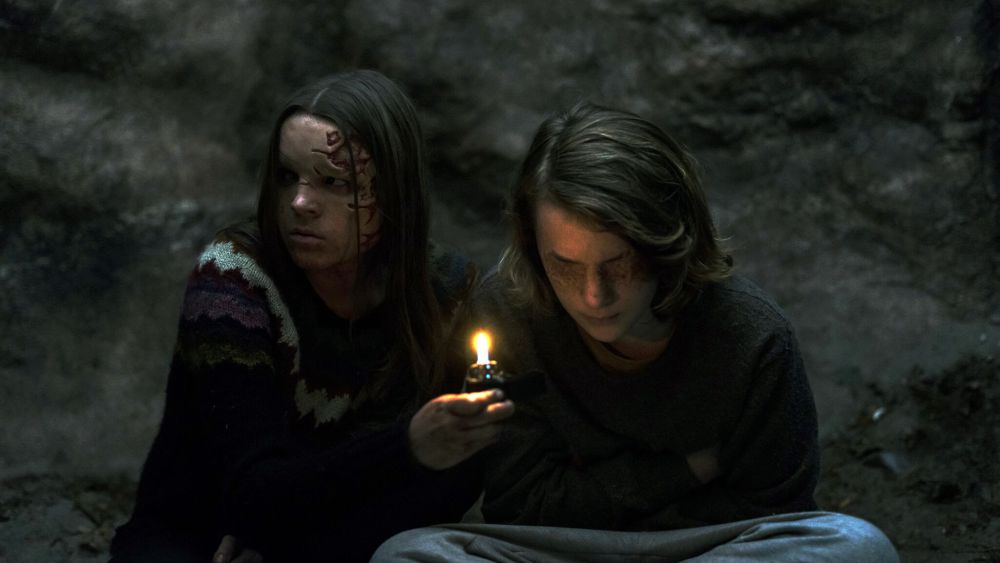
I love a good villain, and this film has an opportunity. Slender Man is a cool character. Born online in a meme contest in 2009, the elongated, pale, bald and faceless man in a black suit who beckons children was immediately embraced by a horror community who apparently has no idea what to do with him.

Sylvain White’s film positions him as an urban legend. Four girls watch a video to conjure the beastie. Bad things happen.

Do you know why bad things happen? Because kids today aren’t shown the classics, like The Ring. That movie knew how to maneuver a PG-13 rating.

So, the supernatural being haunts the woods. Or your phone. He’s electrical, you see. So, the woods. No, wait…

And therein lies the problem. We have a villain, born a meme. He has no real backstory, but he’s cool and he deserves a proper horror show. Screenwriter David Birke was absolutely not up to the task of creating that story. And even if he had done a proper job of it, White can’t manage to move scene to scene with any sense of dread or even narrative logic.

Boxes are checked with zero thought about why. Is there a scene in a library where one character stumbles upon some important background information? Why, yes, although it doesn’t make sense and leads nowhere.

Is there another scene of googling where a previous victim turns out to be in an asylum? Indeed! And again, this goes nowhere. Do they find her? Do they visit the asylum? Is she ever brought up again? Nope.

More than anything, Slender Man is just boring. And he shouldn’t be.

Ball of Confusion

BlacKkKlansman

by Hope Madden

Welcome back, Spike Lee!

It’s not like he’s really been gone. He’s made a dozen or more TV episodes, documentaries, short films and basement-budget indies since his unfortunate 2013 compromised vision Old Boy. But BlacKkKlansman is a return to form—to the envelope-pushing enjoyment that showcases his skills as storyteller, entertainer and activist.

Earmarks of his most indelible marks on cinema—Do the Right Thing, Jungle Fever, Malcolm X—these three elements have rarely joined forces since 1992. You might get one (Get on the Bus) or two (Inside Man, Chi-Raq), but not all three.

Why now? Lee isn’t the first filmmaker to realize how painfully relevant historical tales of systemic racism are at the moment. But it wasn’t until 2014 that Ron Stallworth published the book detailing how he, a black cop in Colorado Springs in 1979, infiltrated the KKK.

You see how it all comes together?

If you don’t, you really should. Lee balances unexpected shifts between humor and drama, camaraderie and horror, entertainment and history lesson, popcorn-muncher and experimental indie with a fluidity few other directors could muster.

The story itself is beyond insane—a zany, hair-raising misadventure destined for the big screen. Stallworth (John David Washington), a rookie in Colorado Springs’s intelligence office, stumbles upon an ad in the newspaper, makes a call, and joins the Klan.

Of course, he’ll need a second officer to actually show up. Enter Flip Zimmerman (Adam Driver—perfect), who sounds about as much like Stallworth as he looks, plus he’s Jewish, which could further complicate his face-to-face relationship with the hate group.

Much sit-com-esque absurdity and dramatic police procedural thrills follow, but it’s the way Lee subverts these standard formats that hits home. The insidious nature of the racism depicted in 1979 echoes in both directions—in the history that brought our country to this moment in time, and in the future Ron Stallworth undoubtedly hoped he could prevent.

Yes, there are laugh out loud moments in this film, but there are far more rallying cries.

A Not So Simple Plan

The Third Murder

by Matt Weiner

“He changes his story every time.”

This early warning might be the only straightforward point made in The Third Murder, a new film from Hirokazu Kore-eda that goes from courtroom procedural to riveting thriller to heady exploration of truth and objectivity in rapid succession.

Defense lawyer Shigemori (Masaharu Fukuyama) takes the lead in re-investigating a murder committed by Takashi Misumi (Kôji Yakusho), with an eye toward helping his client avoid the death penalty. A few small tugs at loose ends cause the official description of the case to unravel, presenting an entirely new take on the crime—and Misumi’s motivations in particular.

Kore-eda’s austere settings and still, unflinching direction for the legal proceedings suggest an air of impartiality at first. But the deeper Shigemori delves into what happened, and the more everyone’s stories start to come into conflict, it becomes clear that Kore-eda’s setup has been as misleading as the characters within it.

Balancing Shigemori’s dogged pursuit for the truth are his fellow lawyers, including his world-weary older boss and a bright-eyed new lawyer. The team reaches out to the family of Misumi’s victims, while also trying to learn more about their unhelpful client.

As with a typical legal thriller, the ideals of truth and justice are on trial along with the crime itself. Unlike lesser genre entries, however, Kore-eda’s characters are cursed with a hyperawareness that the parts they are playing are bigger than the justice system.

For all the lofty discussions of capital-T truth, the actors all keep their monologues from drifting into melodrama. As Misumi, Yakusho is especially compelling as a cipher for much of the movie (or “vessel,” as his lawyers might say). The inconsistent narratives only work if they’re believable, and frustration is rarely as delightful as watching everyone try to get a straight answer out of Misumi.

Learning that the legal system isn’t there to get people to tell the truth is punishing enough for even the most jaded lawyers in The Third Murder. Kore-eda’s methodical prodding offers a glimmer of hope that while easy resolutions might forever escape us, there’s a moral victory to be had in the examination, however pyrrhic.


I Don’t Want to Go Out—Week of August 6

What’s your pleasure? Loads and loads of new releases to peruse at home this week. There’s one powerful cowboy movie and a whole slew of badass women. Let us help you sort it out.

Click the film title for the full review.

The Rider

Revenge

On Chesil Beach

Life of the Party

Breaking In

Book Club