Tag Archives: movie reviews

A Star Is Spun

Maria by Callas

by Christie Robb

It’s an ambitious project to document the life of an international celebrity almost entirely in her own words. And that’s the task undertaken, not entirely successfully, by director Tom Volf in Maria by Callas.

The life of the mid-century opera singer is captured primarily through taped interviews, diary entries, letters to friends (read by the opera singer Joyce DiDonato), and, of course, recordings of Callas’s phenomenal performances.

We see the polished surface of a star born to humble beginnings in New York who rose to command stages across Europe and the Americas. It’s almost two hours of sweeping updos, elaborate costumes, chic evening wear, dripping jewels, swaddling furs, impeccable makeup, and pristine manicures.

Volf tracks Callas’s career from the 50s through the 70s, and lingers on close ups of Callas’s arias. She’s a waif—all bouffant hair, expressive eyes, and bird-like bones. You wonder how such a big voice can possibly come from such a tiny frame. She’s magnetic. Passionate. Commanding.

The singing is interspersed with autobiographical tidbits provided by Callas. But these are only sketches. Although she states again and again that she would give up her career to raise a family and it’s clear that at some point around her late 20s or early 30s she got married, the first time she utters her husband’s name in the documentary it’s to discuss their impending separation. We are left to wonder how genuine she is in saying that she’d give up her career for domestic life and how much she felt compelled to say that, given the prevailing gender norms of the years in which she was famous.

Much of the autobiography portion is consumed with Callas’s operatic 10 plus year affair with Greek shipping magnate Aristotle Onassis, which occurred both before and after his marriage to Jackie Kennedy. Through interviews and letters you can see Callas’s attempt to put a positive spin on what must have been quite a tumultuous relationship. Even while he is pulling away from her, Callas writes to a friend, asking for agreement on how he has changed for the better.

The final moments of the movie show Maria kicking back in Florida. Her hair is down for the first time. She’s wearing loose lounge wear instead of a corseted bodice. Her hair flows down her back, and she’s sporting thick glasses that magnify her myopic eyes. It’s clear how much effort has gone into the package of the public Callas persona.

The contrast between the woman and the artifice would have been more effective with a bit more exposition. It’s an admirable goal to have Callas in control of her own narrative, but to do so leaves out information that would be helpful to provide context to this life. For example, Maria’s rivalry with an older sister who was considered to be the pretty one in the family. The scandalous headlines. The qualities of her vocal talents. The year Maria decided to lose some weight mid-career and lost nearly 80 pounds. How the weight loss may have contributed to her vocal decline. How her changing voice impacted her attempted late-career comeback. Without the biographical backstory, the documentary seems too surface level.

If you don’t know a lot about Callas, do your research beforehand and come for the music and her arresting performances.

I Don’t Want to Go Out— Week of December 3

It’s a big-ass week in lounge around in your jammies movie watching. For some of these, you will want a very large TV.

Click the movie title for the full review.

McQueen

Mission: Impossible—Fallout

Operation Finale

The Happytime Murders

The Nun

Screening Room: Bodies and Souls

Wow! Hollywood unloaded last week for Thanksgiving, but the pickings are slim this weekend. We cover The House that Jack Built – director’s cut, The Possession of Hannah Grace, Burning, Mirai and Meow Wolf: Origin Story, plus we dig into what’s new in home entertainment.


Listen to the full podcast HERE.

Dead on Arrival

The Possession of Hannah Grace

by Hope Madden

Do you ever watch a movie and wonder how it got that elusive green light? I just did.

The Possession of Hannah Grace is not a terrible movie. It’s not a provocative movie, not a scary movie, not a gory movie, not an interesting movie. It’s just not a movie you’ll be able to keep straight a few weeks after you see it. You’ll be combining what few moments you recall with other movies.

You’ll be wondering, was that Hannah Grace, or was it The Last Exorcism? Did that happen in Hannah Grace or in The Corpse of Anna Fritz? Or maybe in The Autopsy of Jane Doe? And then you’ll just forget this movie entirely. It’s been 20 minutes for me and I’m already struggling to recall the bland details.

In a nutshell, Dutch filmmaker Diederik Van Rooijen’s first English language film follows troubled ex-cop Megan (Shay Mitchell) on her first days in her new routine: nighttime morgue attendant followed by an early morning AA meeting with sponsor, Lisa (Stana Katic).

But on Night #2, things go funny as the corpse of a mutilated, burned and inexplicably naked young woman is brought in. Hannah Grace (Kirby Johnson) is not your garden variety naked, contorted, burned corpse, though.

How do you cast this, exactly? “Hey, how would you like to play the title role in my new movie? You will be nude for 90 minutes and you have exactly no lines. You in?”

The jump scare morgue marathon amounts to a long and very tortured metaphor about addiction. Kudos to Van Rooijen and writer Brian Sieve for setting you up for one of two clichéd endings, and then sidestepping both. Too bad they sidestep clichéd endings in favor of nothing at all.

That’s about what you can expect from Hannah: 85 minutes of not too much—not much point, very little action, not a lot of scares and even fewer answers. But it is indeed a horror film that could be completed with three total locations and a cast of about 10, so, you know, why not go ahead and make it?

Wolf Pack Mentality

Meow Wolf: Origin Story

by Rachel Willis

If you’ve never heard of Meow Wolf, an 88-minute documentary about their beginnings may seem pointless, but I promise it’s worth it. By the time the credits roll, you’ll be looking into the price of plane tickets to Santa Fe.

Santa Fe, New Mexico is one of the world’s most vibrant arts centers. Home to hundreds of galleries and dozens of museums, it’s known worldwide for its art markets, events and performances.

And it’s also home to Meow Wolf, an art collective comprising a handful of anarchistic artists who saw too much bourgeois capitalism in the local art scene. Seeking to break away from the idea of art as commodity, these creative individuals banded together to create something new, unique and entirely collaborative.

Using animations, archival footage and interviews with founding members of the collective, directors Jilann Spitzmiller and Morgan Capps create a visually engaging documentary. It would have to be to capture the spirit and brilliance of the art and artists behind Meow Wolf.

The major theme of the film, which is the major dilemma for Meow Wolf, is maintaining artistic integrity while creating a marketable product. From the very beginning of Meow Wolf’s inception, most of the group’s members were opposed to anyone trying to impose too much order into the creation process.

Spitzmiller and Capps document the bitter fights, the fissions within the group, and ultimately, the success when they manage to work together to find common ground. With a collective, each member is involved in the creation process. Each member has a say, and each person contributes to the final product.

Documenting a few of Meow Wolf’s early successes, the film culminates with their most ambitious endeavor: the House of Eternal Return. A 20,000 square feet interactive, immersive art installation, it’s one of the most incomparable and wondrous projects you’ll have the pleasure of viewing from conception to completion onscreen.

That George R.R. Martin of Game of Thrones fame helped fund the project only adds to its charm.

Watching Meow Wolf create ambitious, quirky projects is like watching a great band write game-changing songs. There are tense moments, fights and losses, but when things come together you’ll come as close as one can to true magic.

Burning Questions

Burning

by Brandon Thomas

Films like M, Vertigo and Chinatown have spent decades taking audiences on twisty narrative rides. These classic mysteries raise thrilling questions, and payoff with satisfying answers. But what if a great mystery wasn’t at all concerned with answering the questions it raised? Chang-dong Lee’s Burning is more interested in the journey than it is the destination.

Jong-Su (Ah-In Yoo) spends his days doing odd jobs and taking care of his family’s dilapidated farm on the outskirts of town. A chance encounter brings Hae-mi (Jong-seo Jeon), a childhood neighbor, back into his life. Through Hae-mi, Jong-Su also meets Ben (Steven Yeun of The Walking Dead), a wealthy, good-looking and mysterious young man. While having drinks one evening, Ben confides to Jong-Su that he occasionally enjoys burning abandoned greenhouses. Jong-Su begins to think that burning greenhouses isn’t Ben’s only secret.

Burning unravels slowly. Two and a half hours seems daunting at first glance, but the twinge of unease hanging over the film keeps you involved the entire time. There’s a sense of dread that is hard to pinpoint, but is also intoxicating.

The film comes alive through the character work. Jong-Su is an open book. He’s miserable, lonely, disappointed and bored. And we get to see it all. He tells Hae-mi and Ben that he’s a writer, but he’s never actually shown writing. He spends hours working his monotonous jobs and pretending to be invested in taking care of the family farm. Jong-Su is a phony, and Ben sees that immediately.

Hae-mi and Ben, on the other hand, are complete enigmas to Jong-Su and the audience. Hae-mi tells Jong-Su stories from their childhood that he doesn’t remember, and eventually finds out aren’t true. Ben’s wealth, job and true motivation are complete mysteries. Knowing next to nothing about these two people that he so admires frustrates Jong-Su to the point of obsession.

For nearly 20 years, South Korean cinema has cemented itself as the industry to beat, creatively. Burning is absolutely no exception. The film owes more to Memories of Murder than it does Oldboy, slowly oozing into your psyche with its methodical and unconventional approach.

It’s easy to be frustrated by Burning as the credits start to role. It offers zero easy answers, and even refuses to acknowledge Jong-Su as an unreliable narrator. By defying genre conventions and expectations, Burning provides an alternative mystery that pops with just as much excitement.

Burning burns ever so bright.

Screening Room: Good Gravy, One Turkey

We talk through the first official week of the holiday movie onslaught: Creed 2, Ralph Breaks the Internet, Green Book, The Front Runner, Robin Hood and The Dark. We also give a look at what’s new in home entertainment.

Listen to the full podcast HERE.

Beauty in the Beast

The Dark

by Hope Madden

There are a lot of ways to approach a zombie film, few of them fresh. Zombie flick as YA (young adult) melodrama isn’t even a new idea anymore—2015 saw a surprisingly nuanced Arnold Schwarzenegger nurse his reanimated teen (Abigail Breslin) in Maggie, the best of the batch until now.

Still, writer/director Justin P. Lange has something on his mind with his debut feature The Dark, and he has found a compelling way to tell not-just-another zombie story.

We open on a twist to a familiar scene. A man in a rush, likely a fugitive of some kind, grabs some supplies at an out-of-the way gas station. He opens a map. The lone, wizened clerk points him toward an assumed destination: Devil’s Den.

As familiar as even the twist feels, the truth is that Lange gets more mileage from that old warhorse than you immediately realize. And he will continue to wield our assumptions and biases against us to better direct his story.

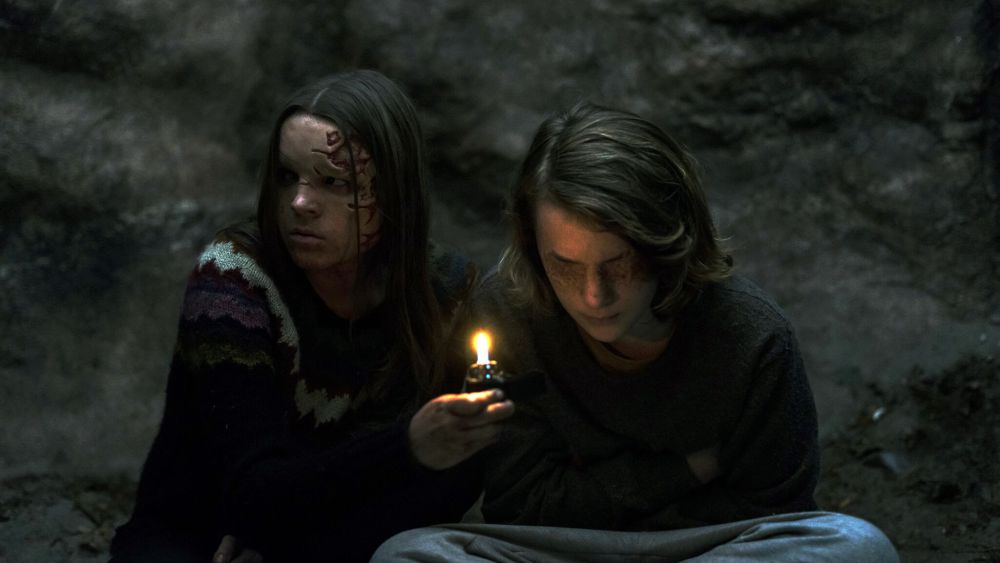
The blandly titled The Dark is, at its heart, a guide to overcoming trauma. Nadia Alexander is Mina, the creature that haunts Devil’s Den—a merciless, relentless, thoughtless killer. Until, that is, she comes across Alex, a blind young man (Toby Nichols) who reminds her of what she once was and what could have saved her.

Lange makes a series of clever narrative choices besides simply using our preconceived notions to surprise us. The Dark is, in part, a vengeance fable far less preoccupied by punishing those who do damage than those who should have been there for protection.

Alexander impresses as the beast unhappily and involuntarily rediscovering her humanity. Her silences, particularly in later scenes, are haunting.

As her mirror image and polar opposite, Nichols embodies vulnerability and resilience. There’s an optimism alongside a brokenness in his performance that is both necessary and heartbreaking.

The Dark occasionally skirts mawkishness, but what YA film doesn’t? In truth, Lange doesn’t run from the baggage associated with his chosen genres. He embraces it, forgives it, makes something powerful out of it.

Drive Safely

Green Book

by Hope Madden

What have the Farrelly brothers been up to?

Well, one of them (Peter) just updated Driving Miss Daisy. Nope, it is not a provocative but good natured spoof. It is Oscar bait.

The director and co-writer penned Green Book, a road picture telling the true tale of 1960s musician Dr. Don Shirley (Mahershala Ali) and Tony Vallelonga (Viggo Mortensen), the New York City nightclub bouncer Shirley hired to drive him throughout his tour of the deep South.

It’s a nice story, buoyantly directed. It’s another odd couple, two people with nothing in common who learn a lot from each other. And it’s hard to pick apart a true story for being so achingly convenient.

The film, co-written by Vallelonga’s son Nick, owes what artistic success it offers to two strong central performances.

Ali and Mortensen are veteran actors who just do not ever give an inferior performance. They are both excellent, always, and Green Book is no different. Their rapport and chemistry are the stuff of movie magic, and it is a joy to ride along with them.

Credit Mortensen for making more of Tony than a working class cliché, and to Ali for finding so many layers in what could have been a one-dimensional character. In his hands, Don Shirley is not simply the high class genius Tony first sees. Ali finds more in the character even than the lonely outsider Tony comes to understand. In Ali’s hands, there is a level of otherness, isolation and loneliness that borders on masochism, and it makes for a far more fascinating and far less knowable character.

Little else onscreen suggests layers.

Green Book is a film that tries very hard and wants so badly not to offend. Yes, the unlikely duo faces some challenges on their journey, but honestly, their struggle—indeed, everything about the movie—feels easy. Neutered.

Equally problematic is the point of view, which is, of course, the white male lead’s. It’s his lessons we’re really interested in, right? And he learns to have deep sympathy for Dr. Shirley.

But that is the primary problem with Green Book. It sympathizes greatly, but has absolutely no idea how to empathize.

Merry, Indeed

Robin Hood

by Hope Madden

Hey, do you guys remember Guy Ritchie’s King Arthur? I mean, of course you don’t. It made like $9.

Had it been anything other than a global box office disaster, a likeminded retooling of the British legend of Robin Hood might have made sense. And yet, here we have it: a poor man’s Guy Ritchie (Otto Bathurst) trying to anachronism his way through the old bandit’s tale.

Taron Egerton stars as the Hood, billed by imdb as “a war-hardened Crusader” but coming off more as a precocious 12-year-old. He’s joined by battlefield adversary and post-war comrade John (Jamie Foxx), who insists on calling him English regardless of the fact that they are in England and, you know, every single person is English. (Let’s not even talk about his accent.)

Eve Hewson and Tim Minchin round out the merry band as the politically liberal/inappropriately dressed Marian and the only actor who doesn’t embarrass himself, respectively.

Ben Mendelsohn shoulders the evil Sheriff of Nottingham duties this go-round. If you only know Mendelsohn from Ready Player One, Rogue One or Dark Knight Rises, please believe me when I say that he needs to stop playing scenery-chewing baddies. He is one of the most versatile and talented character actors in film today. Please go watch literally anything else he’s ever made. (Give yourself the gift of the Aussie film Animal Kingdom.)

Writers Ben Chandler and David James Kelly blandly reimagine Robin of Loxley’s origin story, casting aside any historical authenticity in favor of hip fun. Tragically, the result is never hip and rarely fun.

The film details some ludicrously debauched ties with the church and a global plot to bilk a few hundred peasants of more money than the whole of England would possess. Where do all those golden bowls and goblets come from? How many peasants are dining so flamboyantly?

They also reach to give the sheriff some Trumpian moments, though that backfires as well. As fine an actor as Mendelsohn is, it is tough for him to come off as a dumb ass.

The score feels cribbed, the action is video-game superficial and the costuming came directly from Forever 21.

Why did they make this movie again?