Tag Archives: movie reviews

Pretty, Poor

Shepherdess and the Seven Songs

by Cat McAlpine

“Beauty is a curse when you’re born into a poor family,” muses Laila’s new husband. This is her curse. Laila (a fantastic Navjot Randhawa) is beautiful and poor, and there’s nothing she can do about either ailment.

When Tanvir sets eyes on Laila and decides to marry her, all he has to do to win her hand is complete a feat of strength and gain her brother’s approval. Laila has no say in the matter, and soon she is migrating to a new county. In the disputed territory of Jammu and Kashmir, Laila is targeted by the men of local law enforcement for her beauty and minority status.

Writer/Director Pushpendra Singh paints his fable beautifully, with long atmospheric shots in moody forests. Paired with a gorgeous score The Shepherdess and the Seven Songs is a cinematic triumph in style. As Laila goes out into the world to fight her own battles against the men that dog every step, the traditional songs of her culture, the bleating of goats, and even sometimes the thunderous silence of the forest all become a haunting soundtrack to her own introspection.

Singh doesn’t shy away from dissonance though. One of the chief conflicts of his tale is that “Times have changed.” The Bakarwal herders can no longer freely migrate without proper paperwork, and they are constantly under the eye of government officials. We watch Laila herd her flock along a paved road with cars in the distance. Rich campfire scenes are brightly punctuated with flashlights. Contemplative moments are underscored with quiet radio broadcasts that remind you this is a land of tension and conflict.

Laila’s true trial doesn’t begin until she catches the eyes of local officer Mustaq (Shahnawaz Bhat, effortlessly charming and suspicious). The power struggle between the tribe and the local police becomes hyperfocused on who will possess Laila. Local officers ceaselessly pursue her, even though she is already married, a testament to how little the Bakarwal are respected or given autonomy.

Singh empowers Laila with her repeated manipulations of the men in her life, desperately trying to show them her boundaries and needs. But the story begins to lose steam as Laila’s circumstances fail to improve. Finally, she asks herself “Perhaps it is my skin that is the problem” while admiring a shed snakeskin.

It is the circumstances she was born into that she cannot escape. She is a woman, she is poor, she is a minority. What was a story of a fiery woman in difficult circumstances becomes an exhausted lament. And while women’s stories don’t need to be fierce or triumphant to hold value, The Shepherdess and the Seven Songs disappoints some with its meandering end and lack of resolution.

Tied Down

Tethered

by Tori Hanes

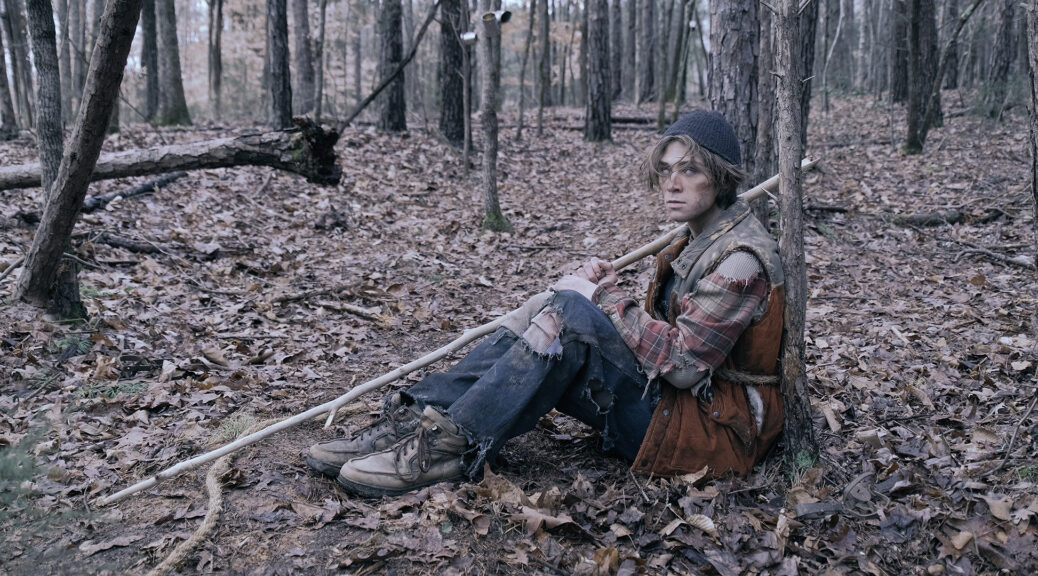
Another “beware the beast in the woods” tale, Tethered (the first feature film for director/co-writer Daniel Robinette, expanding his short from 2017) attempts to make its mark on the genre utilizing a unique leading man- a blind, recluse teenager.

Abandoned by his mother (Alexandra Paul) at an early age, Solomon (Jared Laufree) makes due in his secluded wooded home before befriending a lost hunter (Kareem Ferguson). Solomon lives by the rules his mother left before her unceremonious departure, the most important of which being: always keep a hold of the rope. 

Connected to the home, Solomon ties the titular rope to his waist any time he ventures outside of its walls- partially for guidance due to his blindness, and primarily to keep away from the monster lurking in the forest.

The directing is competent and the film well shot, creating an aesthetically pleasing piece. The dull gray scale that has become all too common with modern horror is present but not suffocating, playing well into the earthy tone. The visual aesthetic created through production design and costuming is perhaps the strongest aspect of the film- the ever-present feeling of unease is visually palpable.

From top to bottom, the piece is plagued by uneven acting performances. The characters feel awkward and confusing, lacking in any interesting development.  Whether these character issues are caused by stilted performances or an unbalanced script is hard to say, but can most likely be chalked up to a bit of column A, a bit of column B. 

A blind teenager tethered to his home is an inherently interesting idea, but not interesting enough to carry the entirety of a film. Tethered seems to rely on novelty instead of investing in uniqueness. The themes it leans into- generational trauma, loneliness, parental abuse- are lightly grazed. The opportunities director Daniel Robinette had to explore these themes and transform this piece to a level similar to The VVitch or Hereditary seem visualized, but unfulfilled. 

Much of the film is spent indulging in the visuals- which, again, is the strongest aspect. But paired with the slow, staggered pacing and the lack of character development, one can’t help but wonder if the film’s 88 minutes could have been used more wisely.

In the case of Tethered, sometimes the beast in the woods can become your own unfulfilled ambition. 

A Different Looking Glass

Alice

by Hope Madden

Long after slavery was abolished, Black families were still held against their will in the rural American south, and through lies and isolation were convinced that they belonged — like slaves — to the white families whose land they worked for free.

It was incredibly uncommon, but it was Mae Louise Wall Miller’s life until 1960.

1960!

Miller’s story inspired first-time writer/director Krystin Ver Linden to make Alice, a testament to knowledge, representation, and the power of Pam Grier.

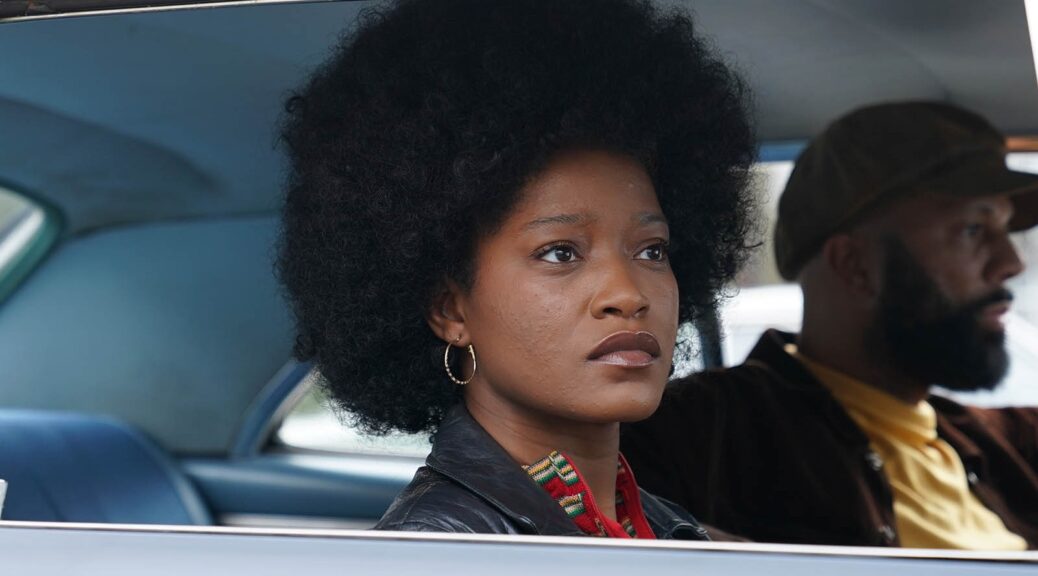
Alice (Keke Palmer, who also produces) has lived her entire life on an isolated Georgia plantation as a “domestic” (code for slave) to Paul Bennett (Johnny Lee Miller). Cruelty, rage and fear finally spur her to run, and she winds up on a highway with no context for the world of 1973.

1973 has very little context to understand Alice, either.

There’s no avoiding comparisons to Gerard Bush and Christopher Renz’s 2020 film Antebellum. Where that uneven Janelle Monáe-led vehicle raged with modern horror, Ver Linden’s film takes a decidedly blaxploitation direction.

Bennet had taught Alice to read, but only so she could read to him for his enjoyment. This one gift is enough to fuel a passion for knowledge. Pair that with the inspiration of Pam Grier in Coffy, plus the encouragement of truck driver and one-time activist Frank (Common) – who nearly ran her down as she escaped to the highway – and Alice is ready to return for her family and some tasty revenge.

Palmer finds a true north for her character, and she never leaves that course. Alice’s grief, pain, confusion, fear, and finally righteous rage are never showy, always authentic. Frank’s arc is a little more superficially drawn, but Common gives the character tenderness that brightens the film.

No psychotic plantation owner will ever live up to the unfathomable evil of Michael Fassbender’s Edwin Epps in 12 Years a Slave. Still, Miller’s brand of cowardly, narcissistic villainy is chilling.

Period detail and visual storytelling are both strengths for Ver Linden and her cinematographer, Alex Disenhof. But the film — this year’s Sundance winner for dramatic feature — has some pacing problems it can’t entirely overcome.

Alice falls into three very distinct acts, none of which move. The story itself is very deliberately built, but the way scenes are stacked offers no sense of momentum or urgency. This meandering quality robs the film’s climax of some of its power. But Alice mainly overcomes this weakness by telling the truth about the power in knowing who you are.

Lacks a Punch

Panama

by Brandon Thomas

There’s been a lot of talk lately about the “Geezer Teaser” subgenre. What’s a Geezer Teaser you might ask? Well, it’s typically a cheaply made action movie or thriller that has a semi-recognizable young lead (usually Scott Eastwood or Devon Sawa), and a much more famous older actor that shows up for a solid 10 to 15 minutes tops. A lot of action movie heavy-hitters have done these. Bruce Willis, Sylvester Stallone, John Travola, and Mel Gibson have all done their fair share.

I guess the big question is “Are these movies any good?”

The answer? 

No, not really, and Panama, Gibson’s latest in this subgenre, is particularly sleep-inducing. 

Ex-marine James Becker (Cole Hauser of 2 Fast 2 Furious) is recruited by Stark (Mel Gibson) to negotiate an arms deal in the country of Panama. As the American invasion of Panama looms over the country, Becker becomes more embroiled with the corrupt government and a shadowy local (Kiara Liz).

From the get-go, Panama is a chore to sit through. Director Mark Neveldine (Game Over, Ghost Rider: Spirit of Vengeance) tries hard to craft a sexy, tropics-based thriller, but nearly every beat is a re-heated moment from infinitely better movies. It’s not a matter of budget, as Daniel Adams’s and William Barber’s script fails on even an entertainment level. The twists lack surprise and a coherent story or character motivation seems to have been an afterthought.

That Panama is so inert is a shame as Neveldine and former directing partner Brian Taylor made two of the wildest action movies with their Crank series. Panama – while not trying to be anything that zany – lacks even a tenth of Crank’s macabre sense of humor or electric visual style.

Cast wise, the bulk of the heavy lifting is put on the shoulders of Hauser. Hauser has rarely been a leading man, and his work in Panama does nothing to show that this should change. Supporting turns in Dazed & Confused, Good Will Hunting and Pitch Black allowed the actor to play second, third or even eighth banana in some really good films. For a character that’s supposed to be charismatic and suave, Hauser brings nothing to the role. His constant stoic and dry delivery conveys the opposite every single time.

At this point, Gibson is just doing his traditional thing. He shows up, kicks a little ass, delivers a few cool lines and heads off into the sunset. It’s the kind of role Gibson could do in his sleep, but doesn’t offer anything we will remember even five minutes after the credits begin to roll.
As far as Geezer Teasers go, Panama is hardly the worst. Still, with weak action, a “been there, done that” story, and a phoned-in cast, it’s still one to skip.

https://www.youtube.com/watch?v=O_FWx79_GNs

Freshman Blues

Master

by Hope Madden

Filmmaker Mariama Diallo’s episodic and short film work has explored — in comedic and dramatic form — the impact of living within a culture of micro- and not-so-micro-aggression. Her feature debut Master dives deeper, taking themes in more horrific directions.

Regina Hall plays Gail Bishop, the first Black residence hall “master” in the long and storied history of New England’s Ancaster College. In her first year on campus, she’ll meet another newcomer, freshman Jasmine (Zoe Renee), the only Black student in her dorm.

Jasmine has the bad luck of being assigned to the dorm’s spookiest room, where a student haunted by campus’s legendary witch once killed herself. As freshman year progresses, both Jasmine and Gail begin seeing menace around every corner.

Diallo sets up shop at the intersection of racism and misogyny. While her story tells of a history of racism that’s clearly alive and well, the filmmaker’s comment on institutional and historical contempt for women is more sly but ever-present.

The result for this particular position in the crosshairs is a palpable, inescapable sense of loneliness. If there’s one thing Master communicates it’s the isolation and aloneness both Gail and Jasmine face at this institution and, more broadly, in this world. The effect is poignant and sincerely scary.

It’s always great to see Hall at the center of a film. The veteran has provided reliable support, both comedic and dramatic, in films for ages. Her frustrating but sympathetic lead offers the perfect balance to Renee’s vulnerability.

Amber Grey’s turn as confidant Liv Beckman is superbly brittle and narcissistic. Likewise, a sea of white faces (Talia Balsam, Will Hochman, Bruce Altman, D.C. Anderson) hit varying degrees of condescension and hostility to create a drowning pool with little chance of escape.

Diallo struggles at times balancing allegory and horror story. On occasion, genre tropes become too obvious. At other times, the obviousness of political points overtakes cinematic narrative. But the underlying horror of reality ably depicted by Hall and a game cast make sure these minor issues remain minor.

Move Over Batman, There’s a New Vengeance in Town

Measure of Revenge

by Christie Robb

Life imitates art when famous Broadway tragedian, Lillian Cooper’s rock star son and his pregnant girlfriend die of an apparent drug overdose. Or is it murder?

Inspired by intrusive thoughts of revenge that manifest as visions of famous characters Lillian has portrayed on stage, the heartbroken mother stalks the streets of New York searching for those responsible and hatching a plot to make them pay for their misdeeds.

Along the way, Lillian (Melissa Leo) joins forces with young photographer/drug dealer, Taz (Bella Thorne) whose motivations may not be entirely transparent.

Like a stage performance, first-time director Peyfa’s Measure of Revenge can lean a bit toward the histrionic—sudden, jarring discordant tones of the score; dialogue that runs backward when Lillian is having a tough time emotionally; characters literally rending their clothes in grief.

But it’s a clever film, a mystery that isn’t entirely linear with an ending that doesn’t tie itself up in a neat little bow. You gotta work for the resolution and there’s room for debate (and some discussion about how forensic evidence could probably play a greater role in the fate of at least one character).

However, the film may spend too much time on its theatrical gimmick to the detriment of character development. This is especially true of the dead son and those who may have been motivated to do him wrong. 

Academy Award-winner Leo (The Fighter) is magnetic, showing an incredible range—from bubbly anticipatory delight at seeing her son return from a successful rehab stint through to wrathful avenging angel. And along the way, we are treated to snippets of some of the greatest tragic characters of all time—Hester Prynne, Hedda Gabler, Lady Macbeth, and Hamlet’s Ghost among them.

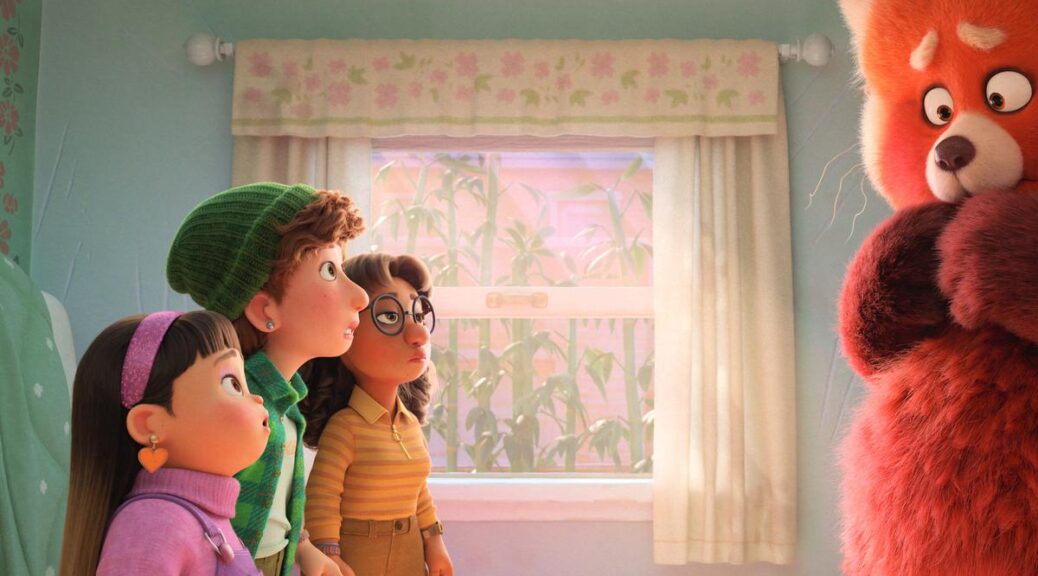
Screening Room: Turning Red, The Adam Project, Fear, The Seed & More

Is This Thing On?

Heckle

by Brandon Thomas

You’ve only had to pay half attention to the entertainment world during the past few years to know that a lot of high-profile comedians have been outed as scumbags. It’s probably the worst kept secret in the industry. From Louis C.K. to Bill Cosby, a lot of comedy titans came under fire for their bad – or even criminal – behavior. 

This landscape seems ripe for a darkly comedic horror flick. Unfortunately, Heckle lacks the laughs or the scares to do this topic justice. 

Stand-up comedian Joe Johnson (Guy Combes) is riding a wave of success. His tours are popular and he’s about to star in a major film playing tragically murdered comedy icon, Ray Kelly (a supremely foul-mouthed Steve Guttenberg of Police Academy and Cocoon fame). All of that starts to crash as a particularly nasty heckler worms his way into Joe’s psyche. As his mental state begins deteriorating, Joe starts to believe that his physical well-being is also in danger from the obsessive heckler. 

Heckle spends a lot of time easing the audience into Joe’s world and his inner circle. Joe’s supposed to be this “big deal” comedian, yet the character is never really shown to be funny. The same process is used for Guttenberg’s character. The abrasiveness of the characters becomes the focal point to the detriment of everything else. It’s hard to buy this grand world of comedy legends if none of them are actually that funny.

The horror aspect suffers in the same regard. Nothing much happens for the first two-thirds of the film. There are some weak attempts to show Joe’s psychological decline, but none of it is particularly scary or thrilling. Mostly, these scenes come across as wheel-spinning to pad out an already short running time. By the time the actual carnage begins in the last act, it’s too little, too late. 

Heckle is full of starts and stops. The movie never quite knows if it wants to be a full-on horror film, a biting satire of the stand-up world or a comedy. Unfortunately for the audience, Heckle never truly succeeds at doing any of the three. 

A Slow Slack through China

Striding into the Wind

by Christie Robb

Director Shujun Wei starts this film with a shot of identical white sedans slowly completing a set driving course. The cars follow each other down the established path until one jerks to a stop for a moment before peeling away, erratically weaving in and out of the course until the driver jumps out and runs away.

It’s a metaphor for the protagonist Kun’s (You Zhou) approach to life. A film school student studying to be a sound engineer, Kun takes his dad’s money and invests in a ’97 Jeep despite failing to obtain a license. The film, co-written by Shujun Wei and Gao Linyang, follows Kun as he and the Jeep erratically weave in and out of the life path others attempt to set.

As is the case in other slacker films, it’s clear here what Kun doesn’t want. But it’s unclear if he has anything in the way of a vision for himself and his future. Like a toddler having a tantrum, Kun wants to break what he doesn’t like, but he lacks the ability to envision what would make him happy. So all his flailing around results in quite a bit of self-harm.

Eventually, Kun, his mullet, and his Jeep make their way out of Beijing and out into the countryside of Inner Mongolia for a film shoot, suffering an escalating series of misadventures and indignities along the way.

Very slow in its pacing, the film’s best moments are Shujun Wei’s wry presentation of the Chinese film industry. It serves up amusing caricatures of crew members—the video guys who can’t be quiet enough to capture ambient sound, the needy director requesting reassurance that his aesthetic sensibilities are up to snuff, and the lead actress trying to make sense of vague instructions while rebuffing the advances of her co-workers.

In the end, it’s a solid enough entry in the manchild coming-of-age genre, even if the ending tends toward the bleaker edge of the spectrum.

Jacking and Jilling

Adventures in Success

by Rachel Willis

Fair warning – this film may be the most unpleasant experience you’ll ever have with the female orgasm.

Writer/director Jay Buim, along with co-writers Susan Juvet and Rachel Webster, has crafted one of the most uncomfortable, meandering and sometimes funny mockumentaries with the film Adventures in Success.

Focusing on the group Jilling Off, we follow “energy transformationist” Peggy (Pegasus) Appleyard (Lexi Mountain) as she leads a group of men and women to the Catskills to harness the energy of the female orgasm in “the womb room.”

Joining this group is newbie Erica (Yaz Perea-Beltran). At first, Erica’s seeming skepticism makes her feel like our straight woman among these guys and gals who use terms like “economic ejaculate.” A hilariously uncomfortable scene involving the extreme invasion of Erica’s personal space by another member is one of the film’s highlights.

There are several scenes that are so uncomfortable you can’t help but laugh. Otherwise, you might spend most of the film squirming in your seat.

As Peggy, Mountain embraces the role of sex goddess guru, and the film is better for it. A personal highlight was Peggy’s cover of Bruce Springsteen’s I’m On Fire, but it’s mostly a moment that doesn’t fit well into the overarching story. The movie is full of these, as if the writers didn’t know how to fill 90 minutes about a group whose sole purpose is ‘jilling off.’

Another downfall is the fairly large cast of characters – not just the Jilling Off members, but townspeople who pop up from time to time (many more than once), usually to give their two cents on the group who’s descended on their town. It’s hard to keep track of everyone.

The film tries to make you care about the members of the cult, but so much time is spent making fun of them it’s hard to feel sympathy for their struggles. Some films can strike a good balance, but Success never manages to do so.

The film sometimes offers a strangely empowering message about women’s sexuality and female pleasure. It’s too bad the filmmakers’ mocking tone buries it beneath a lot of silliness.