Gigi & Nate follows the story of an unlikely bond between recent quadriplegic Nate (Charlie Rowe) and his service monkey.
Director Nick Hamm’s film tracks the pair’s difficulties due to Nate’s disability and society’s stigmas around their pairing. Running at a generous 1 hour and 54 minutes, the bond between man and primate is thoroughly, though not particularly well, examined.
Gigi and Nate seems to miss the backbone of what makes this unique story interesting. Threaded by a plot riddled with holes, a strong emotional ethos has no channel through which to flow. Instead, Hamm and writer David Hudgins string together uneven attempts to create a compelling narrative. These attempts hit the beats of any PG, feel-good, family-friendly story, while remaining seemingly uninterested in exploring any nuance.
The story initially paces along logically. It takes a devastating blow, however, when concentration on the human-animal connection is severed and focus turns to a bizarre examination of society’s skepticism toward the human/primate pairing. With this, whatever fuel burning the emotional fire behind the story runs dry.
Performances, including Rowe’s, struggle to rise above surface level. Nate’s lack of metamorphosis is staggering. We see the glimmer of change directly following his accident, but are ultimately disappointed in Nate’s quick return to a sunny-despite-the-circumstances disposition. The filmmakers never allow the audience inside the full depths of Nate’s psyche, so no catharsis can be earned.
This lack of depth creates real problems. Narrative solutions feel unearned. Outlandish antagonists are clumsily formed, their stories undeservingly resolved. A potentially intriguing tale from an underrepresented perspective is lost to a cop-out of a resolution.
Gigi & Nate is especially disappointing because the film —though it takes significant creative freedom— is inspired by the true story of quadriplegic Ned Sullivan. While the filmmakers’ hearts were undoubtedly in the right place, their sincerity doesn’t justify a film that does little work to amplify the voices of the people it’s portraying.
If you’re just looking for your cuteness dosage, Gigi (played by Capuchin, Allie) certainly has her moments, but you’re better off skipping this film and picking up Marley and Me.
Honk. It’s such an inelegant word. Not that beep or toot are much more graceful, but honk?
That’s what makes it such a perfect choice for writer/director Adamma Ebo’s look at commercial spirituality, Honk for Jesus. Save Your Soul.
First Lady Trinitie Childs (Regina Hall, amazing as always) is launching a comeback. Her husband, Pastor Lee-Curtis Childs (the incomparable Sterling K. Brown), had a little run in with morality and scandal five years ago. Since then, their mega church, Wander to Greater Paths—which once boasted more than 10,000 congregants—has been shuttered.
Well, no more! That scandal is almost behind them (there’s the issue of one hold out in the settlement…) and this dynamic duo is ready. And they want people to know, which is why Lee-Curtis agreed to let a documentary crew follow them as they prepare for their upcoming Easter Sunday resurrection.
What follows is a mockumentary of sorts, although Ebo’s point of view is not exclusively that of the documentarian (that elusive Anita). And while the world seems most interested in the pastor and his past transgressions, that sly Anita seems more drawn to the first lady.
To call this a satire, or really even a mockumentary, is to be a bit off the mark. Though it’s often funny, it’s not exactly a comedy, either. Brown’s damaged, shamed pastor is so pathologically single-minded as to be villainous outright. But Brown seems incapable of creating a character whose flaws don’t make him all the more human, and therefore tender, however irredeemable.
Likewise, Hall, whose performance is more decidedly comedic, mines Trinitie for deep conflict between submission to spirituality or to patriarchal bullshit. Her profound unhappiness partnered with her pride make the character a preaching contradiction in a church hat.
Solid support work bolsters the comedy (Nicole Beharie, in particular) and the tragedy (the late introduction of Austin Crute’s Khalil is powerful).
What starts off as a bit of fun at commodified religion’s expense turns into a surprisingly layered and cynical investigation into the damage organized religion of any kind can have, especially on those who believe.
Loosely based on a video game from 2016, writer David Ebeltoft’s Root Letter offers a unique take on the idea of a pen pal seeking out a friend in trouble. Though director Sonja O’Hara does her best to flesh out the surprisingly bare-bones story, there doesn’t seem to be much for her to work with.
Sarah (Keana Marie) is given a school assignment at school to write four letters to a pen pal. She goes above and beyond the requirements, exchanging dozens of letters with Carlos (Danny Ramirez), who was hospitalized after his girlfriend’s dad discovered Carlos in his daughter’s bed.
When Carlos receives a distressing letter one year after the end of his communication with Sarah, he sets out to discover what happened to her.
It takes surprisingly little for Carlos to find Sarah despite only knowing her first name and the name of her high school. Carlos is able to elicit help from an English teacher who offers him a not-so-subtle nudge in the right direction.
There isn’t a lot of meat to Carlos’s character. He doesn’t serve as a guide to the past, since Sarah’s story isn’t told through interviews with her friends, but rather through flashbacks from the previous year. The present story doesn’t raise new questions or offer surprising twists to the story. We’re mostly biding time waiting to get back to the heart of Sarah’s story.
And yet, Sarah’s tale isn’t very compelling either. It’s weightier than Carlos’s forays into Sarah’s past life, but not by much. For a mystery, there are zero surprises as you can predict each measure beat by beat.
There are also too many characters even though the number was greatly reduced compared to the video game. Aside from Sarah, few of the characters come to life in meaningful ways. Sarah’s best friend is the kind of woman who’ll do anything to keep hold of a tenuous relationship. Sarah’s mom is a stereotypical single mom drug addict with a bad back.
Sarah’s friend Caleb (Breon Pugh) is our most interesting character, but his brief moments on screen do little to make him stand out.
There is a certain quaintness to the story, particularly in the beginning – who knew letter writing could be so endearing? – but any originality is dropped in favor of a paint-by-numbers mystery. If only the actors had something more compelling to work with, perhaps their earnestness would have been rewarded with a more watchable story.
Perhaps the most terrifying horror born of neighborly manners is Michael Haneke’s unnerving Funny Games (either his 1997 German-language original or his 2007 English-language remake). Writer/director Duncan Birmingham doesn’t go that far. What he does is walk a tightrope that’s a little goofier, a little less horrifying, but effective nonetheless.
Margo (Melissa Tang) and Adam (Ryan Hansen) throw a housewarming party. Well, Adam throws it. Margo endures it. She doesn’t honestly know what was wrong with their old neighborhood. It doesn’t help that their 5-year-old has had nightmares every night since they arrived.
Adam invites all his colleagues and bosses, hoping to impress without coming off as douchey. He’s upwardly mobile, although the house —which he got at a steal because of that nasty double homicide—might make them look a little higher up than they really are.
Not that Margo and Adam are the only partiers who aren’t what they seem. That really good-looking couple—the two who look like they just came from a really hip funeral—does anyone know who they are?
Maybe Sasha (Perry Mattfeld) and Tom (Timothy Granaderos) are the neighbors, as they say.
But probably not.
What we can say for sure is that they do not want to leave.
What transpires after all the other guests have gone would be a comedy of manners except that it feels pretty clear that something awful lurks underneath the handsome couple’s evasion and gaslighting.
Birmingham’s film is a mystery of sorts, although you’ll have most of that intrigue figured out pretty early. There is also a subplot about Margo’s friends who are babysitting. This goes essentially nowhere. Worse still, Birmingham rushes Act 3 and leaves you feeling short-changed.
However, that 30 minutes or so that Margo and Adam and Sasha and Tom have on their own gets pretty uncomfortable.
Hansen unveils surprising warmth within the needy, insecure Adam. He and Tang take the married couple in surprising and welcome directions. Mattfeld and Granaderos are drolly perfect as the home invaders masquerading as partygoers who just can’t tell it’s time to go.
A tight script wastes little time and manages to surprise even if you figure out the main mysteries early. Who Invited Them isn’t flawless, but it is an anxious bit of fun.
Exciting all MaddWolf Pack episode! Daniel Baldwin, aka The Schlocketeer, and Brandon Thomas join us to talk about a topic we stole from their Twitter conversation: which directors not known for horror made the best horror movies?
Be sure to listen because Daniel and Brandon both bring much knowledge (plus extra movie titles!) to the conversation. But here’s our Top 5:
5. Nosferatu, the Vampire (1979, Werner Herzog)
Sure, it’s another Dracula, but because it’s another Dracula by way of Murnau’s masterpiece Nosferatu, and it’s written and directed by the great Werner Herzog, it’s weird and wonderful.
Herzog uses the imagery Murnau created – in particular, the naked mole rat of a vampire – to turn vampirism into a pestilence to evoke the Black Plague of Europe. Klaus Kinski is that naked mole rat, and he is glorious.
Isabelle Adjani is the pure of heart maiden who is his undoing, but the way Herzog reimagines Jonathan Harker gives the film a cynical twist that feels like a surprise within this dreamlike adaptation. Gorgeous location shooting and an astonishing score help Herzog create a suffocating but captivating atmosphere.
4. The Haunting (1963, Robert Wise)
Coming off the big epics of The Sound of Music and West Side Story, no one would have expected the intimate psychological horror of Robert Wise’s The Haunting.
Shirley Jackson fans have to appreciate the way the film remains true to her vision of horror. Fans of horror have to appreciate Wise’s unbelievable knack for generating terror with sound design and imagination.
Yes, the performances are magnificent – especially Julie Harris, whose bitter Eleanor is picture perfect. But Wise’s mastery of form is what makes this G-rated film a lasting terror.
3. Hour of the Wolf (1968, Ingmar Bergman)
Like all Bergman films, this hypnotic, surreal effort straddles lines of reality and unreality and aches with existential dread. But Bergman and his star, Max von Sydow, cross over into territory of the hallucinatory and grotesque, calling to mind ideas of vampires, insanity and bloodlust as one man confronts repressed desires as he awaits the birth of his child.
As wonderful as von Sydow is as the central figure, a man spiraling toward insanity, it’s the heartbreaking Liv Ullman who owns this movie. Heartbreaking, solid, and the most unusual combination of strength and weakness, her Alma grounds the surreal elements of the movie.
The result is gorgeous, spooky, and so very sad. It’s one of the most underappreciated films of Bergman’s career.
2. The Shining (1980, Stanley Kubrick)
You know who you probably shouldn’t hire to look after your hotel? Jack Nicholson.
A study in atmospheric tension, Kubrick’s vision of the Torrance family collapse at the Overlook Hotel is both visually and aurally meticulous. It opens with that stunning helicopter shot, following Jack Torrance’s little yellow Beetle up the mountainside, the ominous score announcing a foreboding that the film never shakes.
The hypnotic, innocent sound of Danny Torrance’s Big Wheel against the weirdly phallic patterns of the hotel carpet tells so much – about the size of the place, about the monotony of the existence, about hidden perversity. The sound is so lulling that its abrupt ceasing becomes a signal of spookiness afoot.
Nicholson outdoes himself. His early, veiled contempt blossoms into pure homicidal mania, and there’s something so wonderful about watching Nicholson slowly lose his mind. Between writer’s block, isolation, ghosts, alcohol withdrawal, midlife crisis, and “a momentary loss of muscular coordination,” the playfully sadistic creature lurking inside this husband and father emerges.
He’s not the caretaker management expected, but really, was Grady? Like Grady and Lloyd the bartender, Jack Torrance is a fixture here at the Overlook.
1. Silence of the lambs (1991, Jonathan Demme)
It’s to director Jonathan Demme’s credit that Silence made that leap from lurid exploitation to art. His masterful composition of muted colors and tense but understated score, his visual focus on the characters rather than their actions, and his subtle but powerful use of camera elevate this story above its exploitative trappings. Of course, the performances didn’t hurt.
Hannibal Lecter ranks as one of cinema’s scariest villains, and that accomplishment owes everything to Anthony Hopkins’s performance. It’s his eerie calm, his measured speaking, his superior grin that give Lecter power. Everything about his performance reminds the viewer that this man is smarter than you and he’ll use that for dangerous ends.
Demme makes sure it’s Lecter that gets under our skin in the way he creates a parallel between Lecter and FBI investigator Clarice Starling (Jodie Foster). It’s Clarice we’re all meant to identify with, and yet Demme suggests that she and Lecter share some similarities, which means that maybe we share some, too.
After an hour of holding it in, I began to scream at the screen. “You’re stupid. You’re stupid.”
The poor decision-making of the characters in Kate Cox’s thriller Into the Deep, written by David Beton, had finally taken its toll on me.
Into the Deep, starring Ella-Rae Smith, Jessica Alexander, and Matthew Daddario, follows the budding romance of two strangers that become shipwrecked when a mysterious third party joins their affair.
The premise of this slow-burn thriller has so much potential: an isolated location, strangers harboring potentially criminal secrets, and twisted motives. But the film as a whole fails to bring these delicious ingredients together to create a cohesive, entertaining work.
Problems begin with the character development of the lead, Jess (Smith). Her amazingly promising backstory ties perfectly into the setting and action of the film. However, this backstory is never effectively delved into or utilized.
Not every mystery in a narrative needs to be spelled out. Based on the way certain mysteries were presented here, it seems as though the filmmakers did not know how to use them as devices in the film.
While there were no major plot holes, except perhaps in the very last moment, many of the decisions each lead character makes are truly nonsensical. Additionally, the characters will inexplicably overlook or ignore things directly in their faces.
For example, if you pour a gallon of gasoline around someone who has a reasonable sense of smell, you are not going to need to point out to them that they are surrounded by gasoline. That might be fine once or twice, especially in a thriller like this, but not every 15 minutes.
Into the Deep’s runtime hovers roughly around 90 minutes, which I was excited to see at first. However, this film could have been shortened easily by 20 minutes.
Not only was there far too much pointless exposition, the action did not commence until about an hour into the runtime. No real action, mystery, or discovery in a mystery-thriller for almost two-thirds of its runtime.
The saddest part in all of this is that it is more than evident that the cast of this movie is uber talented. I cannot wait to see what each player does next, even Nikkita Chadha, who had a supporting role.
Unfortunately, the wasted talent could not overcome the shallow characters and muddy vision of Into the Deep.
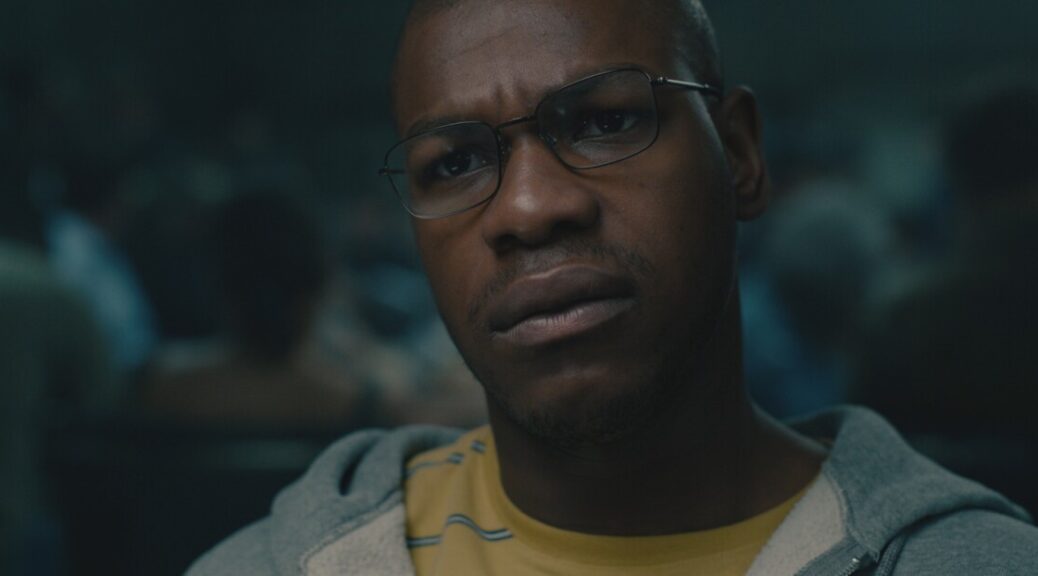
John Boyega is here to remind us that he is more than Finn.
He has been, of course. He burned right through the screen in the raucous Attack the Block. He simmered with contempt and resignation in Detroit. And he charmed as the well-meaning hero in some light galactic fluff.
He explores something entirely different in Abi Demaris Corbin’s heartbreaking true story, Breaking. The filmmaker delivers a bleak look at bureaucracy and the plight of the Black American veteran without fanfare or sentimentality. Instead, her film aches with compassion.
Boyega is Brian Brown-Easley, a retired Marine on the verge of homelessness due to a clerical error made by the VA. He is about to do something very rash.
The set-up is pure high drama, a tension-fueled action flick waiting to happen. And it can wait, because Demaris Corbin and her cast take a profoundly dramatic situation, one exploited for its tension for as long as we’ve made films, and drain it of hyperbole, finding something not mundane but intimate.
Films like this are loud, but Breaking is quiet. Demaris Corbin builds relentless tension with very little volume, the silences only emphasizing the fear felt by a small group of characters inside an uncomfortably intimate situation.
Boyega disarms and devastates with clarity, tenderness, and touches of paranoia. You never know exactly what to make of Brown-Easley, but any tendency to underestimate him is met with rejection.
Nicole Beharie (Miss Juneteenth) meets that performance with fierce but terrified honesty. Her fiery performance demands that the film never resign itself to Brown-Easley’s fate, and reminds us clearly that the plight of the Black veteran looks different than that of a white one.
Michael Kenneth Williams, in one of his final performances, joins mid-film, playing against-type as a thoughtful hostage negotiator. He carries a sense of optimism with him that only deepens the tragedy the film tells.
Please prepare to be heartbroken, particularly when Brown-Easley’s daughter Kiah (London Covington – oh, that little face!) reminds her panicking father to breathe, imitating the proper way to do it as if it’s a ritual the two have. Covington is wonderful, heartbreakingly natural, and the scene offers a gorgeous piece of realistic tragedy, or day-to-day struggle and resilience.
Demaris Corbin uses visuals to move seamlessly from present tense to flashback, and one particular image of a blood trail across worn bank carpet is particularly effective. For a film trapped primarily in a single space, Breaking creates something tragically universal, but it never betrays its hard-won intimacy.
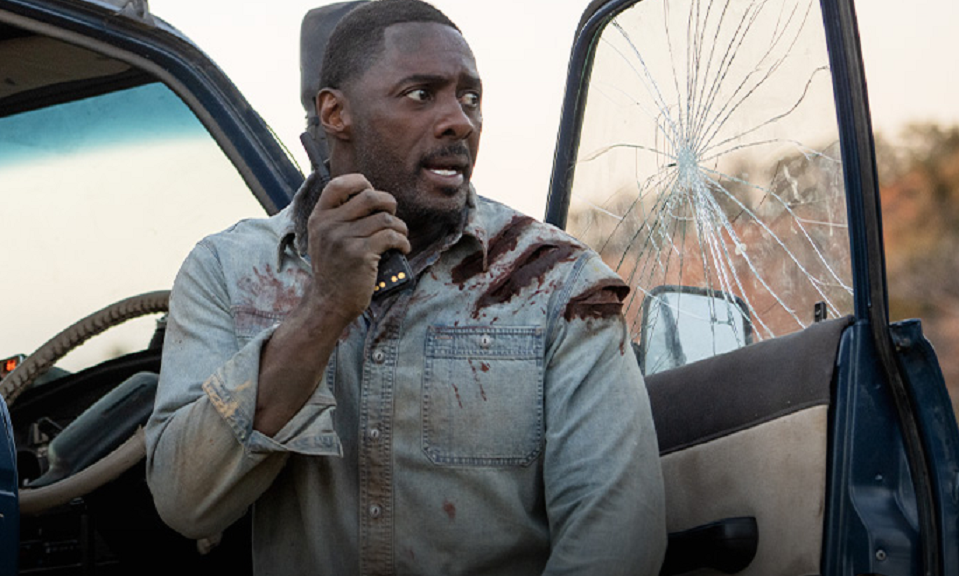
Idris Elba fights a lion. I don’t know what more you want from a movie.
Elba plays Dr. Nate Samuels, on a trip with his daughters to visit his late wife’s stomping grounds, the bush in South Africa. He and the girls (Leah Jeffries and Iyana Halley) had become somewhat estranged during their mother’s illness, and he hopes that staying with family friend Martin (Sharlto Copley) and touring the animal reserve he manages will help them all heal.
It’s more likely to kill them, as it turns out, because poachers have pissed off a really big lion and he’s gone all Jaws IV on the lot of them.
How is Mr. Elba? He’s very handsome. Dreamy, even. He’s also weirdly believable as a vulnerable widower, protective dad, capable doctor and badass who kicks lions in the face.
And he’s not the only one kicking lions, either. Halley gets some badassery in as well, as does Copley. Copley also takes a lot of abuse. Jeffries gets to be the smart one in a film unafraid to deliver teenage girls with agency.
This is not to say Beast is a great film. It borrows a great deal from a great many films: Jaws and Cujo most notably.
Director Baltasar Kormákur is an interesting filmmaker, able to produce smart, visceral thrillers like The Oath. Even his more flawed films —Contraband, 2 Guns, Everest, Adrift — make a valiant attempt at more than action for the sake of action. It helps when he writes. He doesn’t write this one.
Ryan Engle writes this one, and he’s not especially good, as a rule. He’s not terrible. His previous efforts — Non-Stop, The Commuter, Rampage, Breaking In — range from mediocre to poor. But Kormákur pulls a few tricks to elevate this material.
Firstly, he turns genre tropes on end by bringing a Black family to Africa and having their white guide be their wise mentor. Beyond that, there are not a lot of surprises, just a competent if uninspired adventure thriller in which Idris Elba fights a lion.